AI chatbots and human-led customer support each offer unique advantages, but they serve different purposes. Chatbots excel in speed, cost-efficiency, and scalability, handling routine inquiries instantly and 24/7. Human agents, however, are irreplaceable for complex, emotional, or high-stakes issues requiring empathy and judgment. Many businesses today combine both models for a balanced approach - AI for quick resolutions and humans for personalized care.
Key Takeaways:
- AI Chatbots: Handle routine tasks like order tracking and FAQs with response times as fast as 1.8 seconds and costs as low as $0.0006 per interaction.
- Human Support: Best for billing disputes, sensitive complaints, and complex troubleshooting, offering emotional understanding and decision-making.
- Hybrid Model: Combines both for efficiency and customer satisfaction, resolving up to 95% of issues effectively.
Quick Comparison:
| Feature | AI Chatbots | Human Support |
|---|---|---|
| Cost per Interaction | $0.0006–$0.99 | $3–$12+ |
| Availability | 24/7, no downtime | Limited to business hours |
| Response Time | 1.8 seconds | 2–5+ minutes |
| Complex Issue Handling | Limited | Strong |
| Scalability | Instant, low cost | Requires hiring/training |
The choice depends on your business needs: use AI for speed and scale, human agents for empathy, or a mix for the best of both worlds.
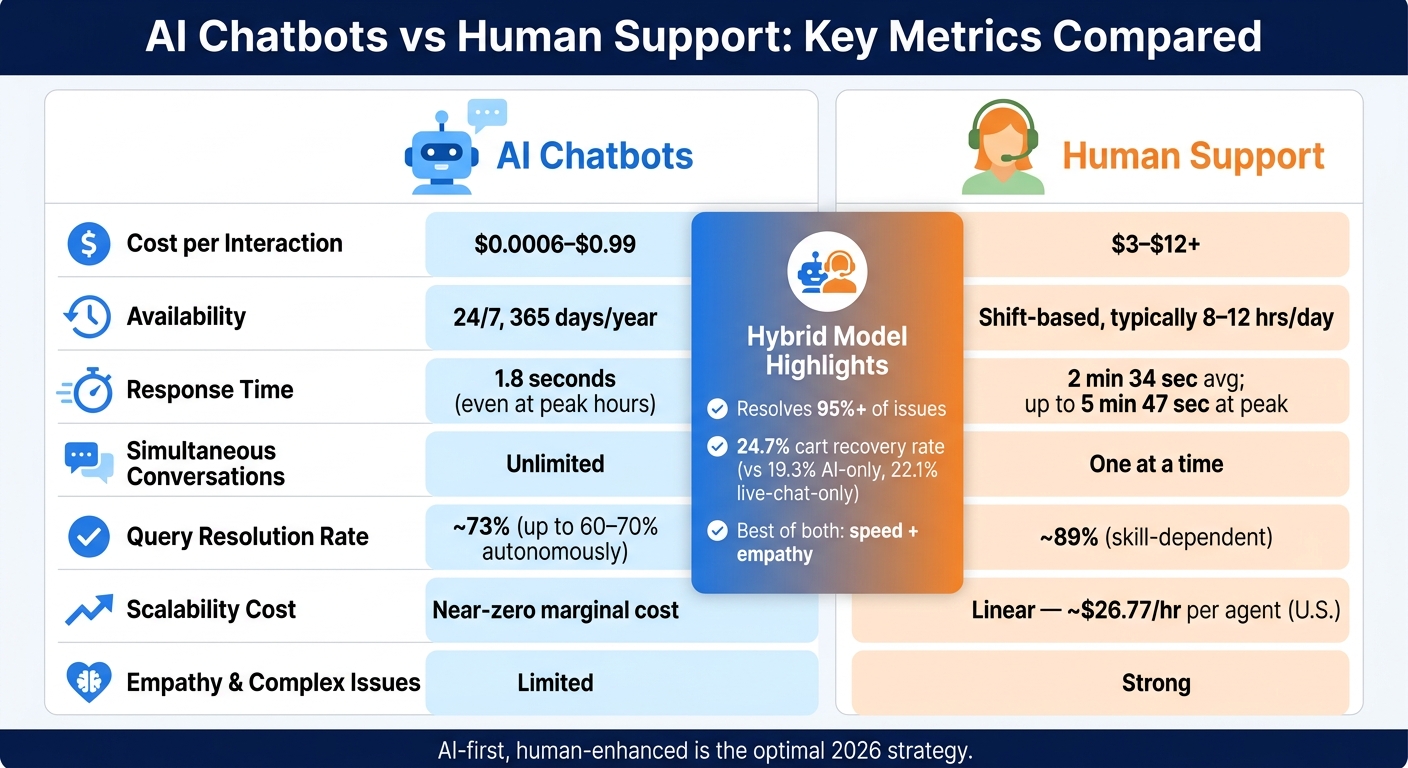
AI Chatbots vs Human Support: Key Metrics Compared
How Each Support Model Works
Understanding how each support model functions helps highlight their strengths and weaknesses. This clarity lays the groundwork for comparing their effects on cost, scalability, and customer satisfaction.
AI Chatbots: Automated and Always On
AI chatbots rely on natural language processing (NLP) to interpret customer questions and connect them with pre-set responses or workflows as part of a broader AI customer support implementation. When a customer types in a query, the system analyzes the intent through its knowledge base or decision tree, delivering an answer - usually in under two seconds.
What sets modern AI chatbots apart is their ability to handle a massive volume of routine queries at the same time without compromising response quality. They work 24/7 without breaks, fatigue, or the need for shift rotations. A great example of this is Telefónica's 2024 implementation of AI for managing routine inquiries. This move cut their cost per interaction by 90%, dropping from about $3.80 to just $0.38, while enabling them to handle over 900,000 additional voice calls each year [1]. This constant availability makes chatbots a benchmark for efficiency and cost-effectiveness.
Traditional Customer Support: Human-Led and Reactive
Human agents bring a personal touch to customer interactions. They listen, ask follow-up questions, and adapt based on the customer's tone and emotions. This makes them indispensable when the root cause of a problem isn't obvious, or when a frustrated customer needs empathetic support.
However, traditional support tends to be reactive. Agents manage one conversation at a time, work within fixed schedules, and require ongoing training to stay effective. Scaling this model means hiring and onboarding new staff - a process that takes both time and money. While AI chatbots shine in speed and consistency, human agents excel in empathy, judgment, and problem-solving - qualities that automation can't fully match.
The most effective systems today combine both approaches. AI chatbots handle initial interactions, resolving straightforward issues and identifying customer intent. For more complex or sensitive situations, human agents take over, armed with the conversation history so customers don't have to repeat themselves [2]. This hybrid model balances efficiency with the human touch, setting the stage for further discussion on operational costs and scalability.
Cost and Efficiency: A Direct Comparison
As explored earlier, speed and scalability are critical factors in support models. Now, let's take a closer look at how cost and efficiency play a role in differentiating AI chatbots vs traditional human support.
Upfront and Ongoing Costs
The financial gap between AI chatbots and human agents is striking. Employing human agents involves salaries, benefits, training, and management expenses. Daniel O'Connell, an industry expert, highlights this challenge:
"Many organizations are challenged by agent staff shortages and the need to curtail labor expenses, which can represent up to 95% of contact center costs. Conversational AI makes agents more efficient and effective."
AI chatbots, on the other hand, are typically billed on a subscription or usage basis. For example, ChatSpark offers an entry-level plan at $19/month for solo users, while its Pro plan costs $129/month and supports up to 2,000 messages. This plan also includes advanced features like integrations and unbranded widgets. Compared to hiring a full-time support agent, these costs are minimal. Some models even use outcome-based pricing, charging only for successfully resolved interactions - bringing costs down to as little as $0.0006 per ticket at scale.
And it doesn't stop at initial costs. Day-to-day operational efficiency has an equally significant impact on overall performance.
Operational Efficiency
When it comes to efficiency, the differences are equally stark. Human agents can only manage one conversation at a time, need regular breaks, and require retraining as policies or systems evolve. AI chatbots, however, work around the clock, handling thousands of conversations simultaneously without compromising response quality.
In well-developed setups, AI systems now resolve 60–70% of customer queries independently [4][2], ensuring the majority of support issues never reach a human agent. By 2026, it's forecasted that 80% of routine interactions will be managed by AI [3].
Here’s a quick breakdown of how these models compare:
| Metric | AI Chatbot | Traditional Human Support |
|---|---|---|
| Cost per interaction | $0.0006–$0.99 (usage-based) | Typically $3–$12+ (labor-inclusive) |
| Availability | 24/7, no downtime | Shift-based, limited hours |
| Simultaneous conversations | Unlimited | One at a time |
| Query resolution rate | 60–70% autonomous [4][2] | Varies; depends on agent skill |
| Scaling cost | Minimal additional cost | Increases with headcount |
To maximize an AI chatbot's efficiency, ensure your knowledge base is well-organized. A well-structured documentation system directly enhances chatbot performance and resolution rates.
Response Time and Availability
When it comes to customer satisfaction, speed is everything. Quick responses not only resolve issues faster but also leave a lasting positive impression.
24/7 Support Coverage
Traditional support teams often work in shifts, typically covering 8 to 12 hours a day. This means customers might be left waiting during nights, weekends, or holidays. AI chatbots, however, are always on - 24/7, every day of the year - offering consistent and reliable responses no matter the time [5]. This continuous availability has reshaped customer expectations. In fact, 74% of consumers now expect round-the-clock service, largely because they know AI-powered solutions make it possible [2]. As Crisp Blog aptly states:
"Real 24/7 is benchmarked by response time. The wait time is the product." [5]
This constant accessibility ensures not only uninterrupted service but also faster response times.
Speed and Handling Multiple Inquiries
AI chatbots don’t just work anytime - they work fast. While human agents take an average of 2 minutes and 34 seconds to respond, AI chatbots reply in just 1.8 seconds. And during peak hours, when human response times can stretch to 5 minutes and 47 seconds, AI still maintains its lightning-fast 1.8-second average [1]. This speed matters: faster response times have a strong correlation (0.72) with improved customer satisfaction [1].
Another key difference? Human agents can only handle one conversation at a time, while AI chatbots can juggle thousands simultaneously. This scalability is a game-changer, especially for businesses dealing with high volumes of inquiries efficiently.
| Metric | AI Chatbot | Traditional Human Support |
|---|---|---|
| Availability | 24/7/365 [1] | Business hours (typically 8–12h) [1] |
| Median first response time | 1.8 seconds [1] | 2 minutes 34 seconds [1] |
| Peak-hour response time | 1.8 seconds [1] | Up to 5 minutes 47 seconds [1] |
| Simultaneous conversations | Unlimited | One at a time |
These numbers highlight how AI chatbots outperform traditional support models, especially when it comes to meeting growing customer demands.
Scalability and Workload Management
Scalability is where the real test lies: can your support system handle a sudden flood of inquiries without breaking a sweat?
Scaling with AI Chatbots
AI chatbots are built for instant scalability with almost no extra expense. Whether it’s ten conversations or ten thousand, chatbots handle the load seamlessly. This ability to scale without significant cost makes them perfect for unpredictable surges - like product launches, holiday shopping frenzies, or viral social media moments.
Unlike human agents, chatbots don’t need overtime, never feel overwhelmed, and maintain the same performance no matter how high the demand climbs. They’re always ready to deliver consistent service, no matter the volume.
Now, let’s see how traditional support measures up.
Hiring and Training for Traditional Support
Traditional support operates on a very different model. Scaling here is a linear process - more inquiries mean hiring more agents, which brings additional costs, onboarding, and scheduling challenges. In the U.S., the fully loaded hourly cost for a support agent is about $26.77 [2].
Hiring takes time, too. New agents often require weeks to get up to speed, especially for complex issues. During this onboarding period, service quality can take a hit, particularly if the team is already stretched thin.
Here’s a quick breakdown of the scalability differences:
| Scaling Metric | AI Chatbot Support | Traditional Human Support |
|---|---|---|
| Cost to scale | Near-zero marginal cost [3] | Linear - more staff, more spend [3] |
| Time to scale | Instant | Weeks (hiring + training) |
| Loaded cost per agent (U.S.) | N/A | ~$26.77/hour [2] |
| Performance during spikes | Consistent | Degrades under pressure |
These contrasts highlight how scalability impacts both cost and efficiency, especially during peak demand. This naturally leads into the broader conversation about how each model shapes personalization and the overall customer experience.
Personalization and Customer Experience
When it comes to defining the customer experience, personalization plays a key role. AI chatbots and traditional support models tackle this in very distinct ways.
AI Chatbots: Data-Driven Personalization
AI chatbots rely on data like CRM records, purchase histories, and browsing behavior to tailor interactions. They can maintain continuity across different channels, ensuring that customer history stays intact even when switching from, say, WhatsApp to email. This is an area where traditional support often falters, especially during agent transfers.
AI also employs tools like natural language understanding (NLU) and sentiment analysis to pick up on cues like frustration or urgency. It can adjust its tone accordingly or escalate the conversation to a human agent when needed. For example, in January 2026, Liberty London used AI to analyze customer intent and sentiment in real time. This gave their support teams immediate insight into whether an issue was positive or negative, enabling them to respond more effectively and with greater empathy [5].
While AI provides streamlined, data-backed personalization, it lacks the nuanced understanding that human agents bring to the table.
Traditional Support: Empathy and Human Judgment
Unlike AI, human agents excel at picking up on emotional subtleties and tone - essential skills in sensitive situations like billing disputes or complaints, where customers often just want to feel understood. In fact, human agents outperform AI by 15 to 25 percentage points in customer satisfaction (CSAT) scores for emotional complaints and escalated disputes [4]. As one comparison puts it:
"AI can detect frustration. Humans can resolve it." - Certainly CX Intelligence Editorial Team [4]
Interestingly, 61% of consumers say they prefer AI - or have no preference - when sharing sensitive information, like health or financial issues. AI’s non-judgmental nature often makes it easier for customers to discuss such topics [6].
Here’s a quick breakdown of how the two models differ in terms of personalization:
| Dimension | AI Chatbots | Traditional Support |
|---|---|---|
| Personalization Basis | CRM data, purchase history, browsing behavior | Emotional cues, situational awareness |
| Empathy Level | Low to moderate (simulated) | High (genuine) |
| Context Across Channels | Consistent (shared memory) | Variable (often lost in transfers) |
| Best For | Routine, data-rich, privacy-sensitive cases | Complex, emotional, high-stakes situations |
Ultimately, neither approach is universally better. AI shines in routine, data-heavy interactions, while human agents are invaluable in handling emotionally charged or complex scenarios. Each has its place, depending on the situation.
When to Use AI Chatbots vs. Traditional Support
Deciding between AI chatbots and traditional support comes down to aligning the tool with the task. By weighing factors like cost, speed, and scalability, you can determine which model is the best fit for specific scenarios.
When AI Chatbots Are the Right Fit
AI-powered customer service shines in situations where speed, consistency, and the ability to handle large volumes are key. Tasks such as order tracking, password resets, answering FAQs, and lead qualification are perfect for chatbots. These are repetitive, rules-based jobs that don't require judgment, making them ideal for automation. Plus, these tasks are often the least efficient - and most costly - when handled by human agents.
Real-world examples highlight how AI can drastically cut resolution times and scale effortlessly to handle high volumes of inquiries [1][2]. With response times measured in seconds and the ability to manage countless interactions simultaneously, chatbots are a natural choice for routine, high-demand tasks.
However, when a situation calls for a deeper understanding or emotional intelligence, human agents are indispensable.
When Traditional Support Is the Right Fit
Human agents excel in scenarios requiring empathy, discretion, or complex decision-making - areas where chatbots struggle. Situations like billing disputes, policy exceptions, escalations, and emotionally sensitive complaints demand a human touch. These interactions often depend on the customer feeling understood rather than just receiving a quick response.
"AI should own speed, consistency, and repetition. Humans should own judgment, exception handling, and trust repair." - MessengerBot.app [2]
Here’s a quick comparison of tasks and their ideal support models:
| Task | Best Fit | Why |
|---|---|---|
| Order tracking | AI Chatbot | Fast and straightforward data retrieval |
| Password resets | AI Chatbot | High-volume, rules-based, repetitive |
| Lead qualification | AI Chatbot | Efficient data collection at scale |
| Billing disputes | Traditional Support | Requires empathy and negotiation |
| Policy exceptions | Traditional Support | Needs judgment and discretionary action |
| Complex troubleshooting | Traditional Support | Demands advanced problem-solving skills |
For many businesses in 2026, the optimal strategy is an "AI-first, human-enhanced" model. This approach lets AI handle routine inquiries while seamlessly transferring complex cases to human agents, complete with all the necessary conversation history [1][7]. It’s a setup that blends the efficiency of automation with the personalized care customers expect when challenges arise.
Conclusion: Picking the Right Customer Support Model
Choosing the right customer support model comes down to understanding your business's specific needs. There's no one-size-fits-all solution. AI shines when it comes to speed, availability, and handling large volumes of inquiries. On the other hand, human agents bring empathy, critical thinking, and adaptability to more complex or sensitive situations. Data shows that AI resolves about 73% of queries, while human agents handle around 89%. Interestingly, a hybrid model - combining both - can push resolution rates above 95% by leveraging the strengths of each [1].
The hybrid approach often delivers the best results. AI can take care of straightforward, repetitive questions, freeing up human agents to focus on the tricky or emotionally nuanced cases. This blend not only improves efficiency but also protects revenue. For example, businesses using hybrid setups achieve a 24.7% cart recovery rate, outperforming AI-only models at 19.3% and live-chat-only models at 22.1% [1].
That said, a hybrid model isn’t the best fit for every organization. If your business handles fewer than 80 tickets a month or operates in an industry requiring human oversight for every response due to legal regulations, sticking with a fully human support team might make more sense [8].
Start by evaluating your customer support needs. Look at your ticket volume and the nature of your inquiries. If the majority are routine, automation can help reduce costs without sacrificing quality. But if your inquiries tend to be complex or emotionally charged, prioritize building a strong human team and introduce automation only where it adds real value. Whatever model you choose, make sure the conversation context follows the customer throughout their interaction to avoid frustrating handoffs [9] [8].
FAQs
How do I know if my support tickets are “routine” enough for a chatbot?
Take a close look at your support data to identify recurring themes. Common topics often include order tracking, password resets, return policies, or billing questions. These high-volume, repetitive inquiries are perfect candidates for automation since they tend to follow clear patterns.
To confirm which tasks are routine enough for AI, dive into metrics like response times and resolution rates. These numbers can reveal which inquiries are straightforward and can be efficiently managed by automated systems. By automating these tasks, your team can dedicate more time to handling complex, nuanced issues that require a human touch.
What’s the best way to hand off from a chatbot to a human without customers repeating themselves?
When transferring a customer interaction to a human agent, it’s crucial to ensure the process is seamless and supportive. Here's how to achieve that:
- Provide a complete transcript: Share the full conversation history, including every detail of the interaction so far. This ensures the human agent has all the necessary context.
- Include customer history: Attach relevant account details, previous interactions, and any pertinent background information to give the agent a complete picture.
- Incorporate sentiment analysis: Highlight the customer's tone and emotions during the conversation to help the agent approach the situation appropriately.
- Detail the AI's resolution path: Clearly outline the steps the AI has already taken to address the issue. This prevents redundancy and saves time.
-
Add a concise summary: Break down the core of the issue, actions already performed, and the next steps. Use headers like:
- Main Issue: A brief description of the customer's concern.
- Steps Taken: What actions the AI has implemented so far.
- Next Steps: What the human agent should focus on to resolve the matter.
Finally, use warm, reassuring language to inform the customer. For example: “We’re connecting you to a specialist who already has all your details, so you won’t need to explain everything again.” This not only saves the customer from frustration but also creates a sense of care and efficiency.
How can I measure if a hybrid support model is improving customer satisfaction and costs?
To assess the effectiveness of a hybrid support model, focus on tracking metrics that reflect both cost efficiency and customer experience.
For costs, calculate Cost Per Interaction by dividing total support expenses by the number of resolved tickets. Hybrid models often help reduce costs by automating repetitive tasks, freeing up resources for more complex issues.
For customer satisfaction, pay close attention to CSAT scores (Customer Satisfaction Scores). Additionally, use sentiment analysis to pinpoint areas where customers express frustration. Operational efficiency can be gauged by monitoring metrics such as First Response Time, Average Handle Time, and First Contact Resolution. These indicators provide a clear picture of how well the support team is performing overall.