AI customer service software automates customer interactions using natural language processing (NLP) and machine learning. It handles tasks like answering questions, processing refunds, and tracking orders without human involvement. Businesses use it to meet rising customer expectations, reduce costs, and improve efficiency. Here's why it matters:
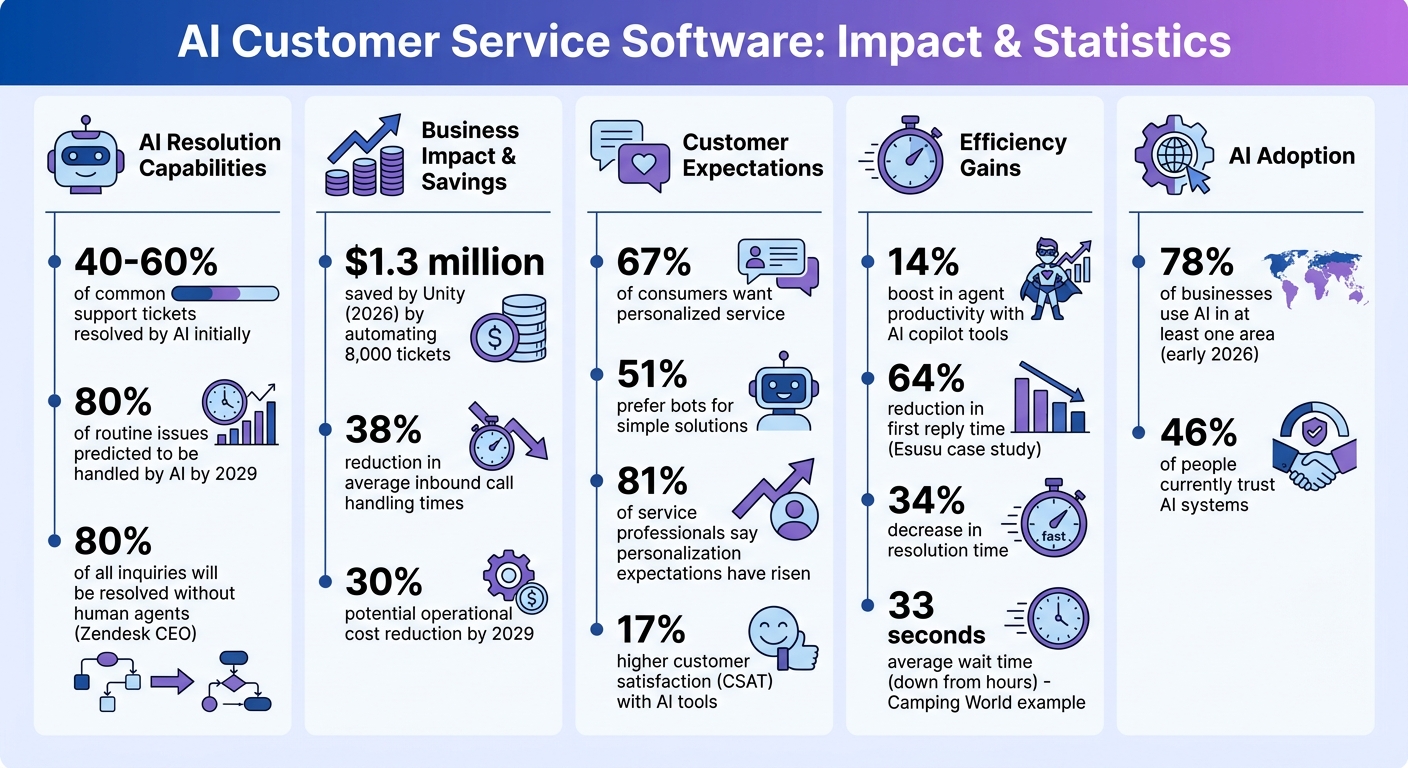
- Efficiency: AI resolves 40-60% of common support tickets initially and is predicted to handle 80% of routine issues by 2029.
- Cost Savings: Companies report significant savings, such as $1.3 million saved by Unity in 2026 by automating 8,000 tickets.
- Customer Expectations: 67% of consumers want personalized service, and 51% prefer bots for simple solutions.
- 24/7 Support: AI provides constant availability, reducing wait times and improving satisfaction.
AI systems like ChatSpark integrate advanced technologies, including large language models (LLMs), sentiment analysis, and Retrieval-Augmented Generation (RAG). These tools ensure fast, accurate responses tailored to business-specific data. For example, ChatSpark has reduced agent workloads by over 80% for some businesses while maintaining high customer satisfaction.
AI customer service software is transforming support operations by automating repetitive tasks, allowing human agents to focus on complex issues, and delivering faster, more personalized service. It’s a powerful solution for businesses looking to scale and meet modern customer demands.
AI Customer Service Software Impact: Key Statistics and Benefits
How AI Customer Service Software Works
AI customer service software uses natural language processing (NLP), machine learning, and analytics to provide predictive and automated support. These technologies work together to interpret customer inquiries, identify intent, and deliver accurate responses. Let’s break down the key technologies that make this possible.
Core Technologies Behind AI Customer Support
Natural language processing is at the heart of AI customer service. It consists of two main components: Natural Language Understanding (NLU) and Natural Language Generation (NLG). NLU translates human language into a format computers can process, while NLG converts computer-generated responses back into conversational language that feels natural to the user.
The process involves several steps. First, the system standardizes the input by converting text to lowercase, tokenizing sentences, and removing punctuation. Machine learning then kicks in to classify the intent behind the message - whether it's about tracking an order, requesting a refund, or resolving a technical issue. Using entity recognition, the AI extracts critical details like order numbers or email addresses. Finally, it generates a response tailored to the identified intent and context. These steps form the backbone of the system's ability to provide proactive support.
Modern AI systems rely on Large Language Models (LLMs), which excel at understanding context and nuance far better than older keyword-based systems. They also incorporate sentiment analysis to pick up on emotional cues like frustration or urgency, ensuring that conversations are escalated to human agents when necessary. Unlike traditional rule-based chatbots, these systems can maintain context throughout multi-turn interactions, making them much more effective at handling complex queries.
Customer Interaction Workflow
Here’s how the workflow typically unfolds when a customer submits a query. The AI system first analyzes the message to determine its intent and urgency. Based on this analysis, it directs the query to the most suitable resource - whether that’s an automated response, an AI agent, or a human team member.
For simple questions, the AI retrieves information from the company’s knowledge base and provides an instant response. For more complicated issues, it can execute backend tasks like processing refunds, updating accounts, or modifying orders. A great example of this is Camping World’s virtual assistant, "Arvee", launched in November 2025. Arvee boosted customer engagement by 40% and reduced average wait times from hours to just 33 seconds [2][6].
When the system detects certain keywords - like "frustrated", "cancel", or "urgent" - it escalates the issue to a human agent, providing them with full context from previous interactions. This ensures customers don’t have to repeat themselves. Over time, the AI learns from these interactions, improving its ability to handle new types of queries. This seamless workflow combines chatbots, virtual assistants, and analytics to create a comprehensive customer support system.
Key Components: Chatbots, Virtual Assistants, and Analytics
AI customer service platforms rely on three main components:
- Chatbots: These handle quick FAQ responses and basic self-service tasks using NLP and rule-based systems.
- AI Agents: Equipped with generative AI and LLMs, these agents manage more complex tasks, such as troubleshooting or processing returns.
- Analytics Platforms: These tools track performance metrics and identify trends through machine learning and data mining. They enable predictive support by flagging potential issues - like service disruptions - before customers even report them.
For instance, in January 2026, Unity integrated AI agents with their knowledge base, automating responses for 8,000 tickets and saving $1.3 million [7]. Similarly, Grove Collaborative used AI agents to handle 68,000 monthly tickets with just 25 human agents, all while maintaining a 95% customer satisfaction (CSAT) score [7].
According to Tom Eggemeier, CEO of Zendesk, "80% of all inquiries will be resolved without the help of a human agent" [5].
How ChatSpark Delivers AI Customer Service
ChatSpark takes customer interactions to the next level by building on advanced AI support technology. Its four-step AI engine ensures on-brand, accurate responses. Here's how it works: the system identifies the customer's intent, retrieves relevant business data through multiple searches, ranks the results using over 10 signals, and delivers a response in your brand's voice [8]. This process is powered by Retrieval‑Augmented Generation (RAG), which ensures every response is based on your business-specific data, such as product pages, FAQs, and help documents, minimizing errors and maximizing reliability [8].
The platform promises a 99.9% uptime and delivers responses in under two seconds for routine queries [10]. This speed allows human agents to focus on more complex tasks. On average, ChatSpark resolves over 80% of inquiries, with some enterprise clients achieving up to 98% resolution rates [9][10]. For example, in late 2025, a global construction products company deployed ChatSpark for a flagship brand. Over four months, the system handled 10,754 messages, achieved a 98% AI resolution rate, saved more than 66 days of agent time, and slashed costs by $47,880 on a modest $4,000 investment [10][11].
Omnichannel Support and 24/7 Availability
ChatSpark supports six channels - your website, WhatsApp Business, Instagram DMs, Facebook Messenger, Telegram, and Slack [9][12]. No matter the channel, the system ensures consistent answers by maintaining a unified knowledge base and brand voice. Beyond answering questions, its AI Actions feature can perform tasks like checking order statuses, booking appointments via Calendly, and updating CRM records. It supports over 140 actions across more than 40 platforms [9][10].
Businesses using ChatSpark often see an 80%+ reduction in routine inquiries, enabling teams to scale without hiring additional staff [10]. Lorri G., a Customer Service & Technical Support Manager, shared her experience:
"ChatSpark has been managing two of our largest product lines over the past year. It currently handles an average of 1,831 chats per month without any human intervention. Since implementing it on our website, we've realized measurable savings of $119,225" [10][11].
Customizable Responses in 85+ Languages
ChatSpark automatically detects and supports communication in 85+ languages [10]. It adjusts to regional nuances, including local expressions, date formats, and currency symbols, to make interactions feel natural. Businesses can customize the AI's personality by specifying roles (e.g., "friendly sales rep"), tone, and boundaries to align with their brand’s voice.
While the AI translates English training data in real time, businesses can also upload native-language content for technical or legal-specific needs. The platform allows for custom responses when queries fall outside its training data and offers canned responses for critical moments, such as legal disclaimers or promotions. Additionally, up to five clickable prompts can guide users toward common topics, streamlining interactions [13].
Features for Business Growth
ChatSpark also supports growth through built-in lead capture, gathering customer details during conversations and syncing them with CRMs via Zapier [13]. Its analytics tools track performance metrics and integrate with Google Analytics 4 (available on Plus and Enterprise plans) to measure ROI [13]. The ChatSpark CoPilot browser extension extends the AI's knowledge to internal tools like Gmail, Salesforce, and Zendesk, assisting human agents with real-time insights [10].
The platform integrates seamlessly with major tools like Shopify, WooCommerce, Zendesk, HubSpot, and Calendly [10]. Security is also a priority, with AES‑256 encryption, GDPR compliance, and a SOC 2 roadmap ensuring data protection [8][9]. Eric T., a verified G2 user, highlighted:
"ChatSpark supports business growth and scalability, handling increased chat volumes with ease. It enables real‑time engagement and customer support, improving satisfaction and loyalty" [10].
These capabilities position ChatSpark as a powerful resource for modern customer service.
Why Businesses Use AI Customer Service Software
ChatSpark's AI customer service software helps businesses streamline operations, create more personalized customer experiences, and support their teams more effectively. By automating repetitive tasks and improving interactions, companies can tackle key challenges like reducing costs, scaling support, and enhancing both customer and agent satisfaction.
Improved Efficiency and Lower Costs
One of ChatSpark's standout features is its ability to handle routine tasks like password resets, order tracking, account updates, and basic troubleshooting. By automating these tasks, companies can scale their support operations without needing to expand their teams. Businesses that have adopted AI solutions report a 38% reduction in average inbound call handling times[6], with AI handling up to 80% of common customer inquiries[3].
For example, in February 2026, Unity, a 3D content platform, integrated ChatSpark with its knowledge base to manage ticket volumes. This move deflected 8,000 tickets and saved $1.3 million in operational costs[3]. Another success story comes from a global camping company that implemented ChatSpark in 2024. They saw agent efficiency improve by 33%, customer engagement rise by 40%, and average wait times drop to just 33 seconds[6].
ChatSpark also ensures round-the-clock availability, removing the need for night-shift staffing for basic queries. Its intelligent routing system automatically assigns tickets to the most qualified agents based on the nature and urgency of the issue.
"ChatSpark resolves more issues through automation, enhances agent productivity, and delivers more accurate, personalized service."
Better Customer Satisfaction and Personalization
Modern customers expect a personal touch in their interactions. In fact, 81% of service professionals say customer expectations for personalization have risen, and 67% of consumers now expect AI-driven services to provide tailored interactions[1][3]. ChatSpark meets these expectations by analyzing data like browsing history, purchase patterns, and past interactions to craft precise, personalized responses.
Using sentiment analysis, ChatSpark can detect frustration or urgency, enabling it to prioritize and escalate issues quickly. It can also anticipate customer needs by sending troubleshooting guides or renewal reminders proactively. In 2024, a German media company partnered with IBM to launch a generative AI-powered assistant for product recommendations. This system delivered personalized suggestions 10 times faster than before, leading to a 15% boost in customer satisfaction[6].
Companies using AI tools like ChatSpark report a 17% higher customer satisfaction (CSAT) rate compared to traditional methods. Mika Yamamoto, Chief Customer and Marketing Officer at Freshworks, highlights the transformative potential of AI:
"The future of AI agents is about anticipating needs, not just responding. It's smarter, faster, and lets teams act before problems grow"[4].
Higher Agent Productivity
Personalized AI tools not only improve customer satisfaction but also empower agents to handle more complex tasks. ChatSpark doesn't replace agents - it enhances their capabilities. Its real-time copilot tools provide case summaries, suggested replies, and direct access to knowledge bases, boosting agent productivity by an average of 14%[6].
A great example comes from Esusu, a fintech startup, which implemented ChatSpark's advanced features in January 2026. By leveraging automated macro suggestions and summarization tools, Esusu streamlined support for 10,000 monthly tickets. The results? A 64% reduction in first reply time, a 34% decrease in resolution time, and an impressive 80% one-touch response rate[14][3].
"ChatSpark's automated triage delivers time savings of 220 hours per month by eliminating manual ticket sorting, benefiting businesses of any size."
ChatSpark Pricing Plans
ChatSpark provides four pricing options tailored to fit businesses at different stages of growth. These plans are designed to align with your customer support requirements as they evolve. Every plan includes access to the ChatSpark AI Engine, which leverages Retrieval-Augmented Generation (RAG) to deliver responses grounded in your own business data. Rest assured, your training data remains private and is never shared or used to train models for other clients.
Pricing and Features Comparison
| Plan | Monthly Cost | Message Limit | Agent and Training Capacity | Key Features | Limitations |
|---|---|---|---|---|---|
| Basic | $19 | 100 | 1 Agent / 25 Training Pages | 24/7 support, 85+ languages, basic analytics, 14-day trial, multiple data sources | Supports 1 website only; no advanced integrations |
| Plus | $59 | 250 | 1 Agent / 50 Training Pages | 5 AI Actions, CoPilot extension, REST API, 24/7 support, 85+ languages | Supports 1 website only; no advanced integrations |
| Pro | $129 | 2,000 | 1 Agent / 500 Training Pages | 40 AI Actions, omnichannel deployment, Zapier & Freshchat integrations, GA4 tracking, unbranded widgets | Limited to 1 agent per channel |
| Enterprise | $499+ | Custom | Unlimited Agents / Custom Pages | Unlimited AI Actions, dedicated account manager, custom SLAs, audit logs, role-based access control (RBAC), priority support | Requires consultation for pricing |
When deciding on the right plan, consider how your business interacts with AI and customer support. For instance, a recent study shows that 78% of businesses already use AI in at least one area as of early 2026 [16]. While AI excels at managing routine inquiries, complex or sensitive issues still require human involvement. To maintain customer trust, clearly label AI interactions - especially since only 46% of people currently trust AI systems [15].
Conclusion
AI customer service software is reshaping how businesses manage support operations, offering a blend of efficiency and personalization. Tools like ChatSpark, powered by natural language processing, machine learning, and intelligent automation, provide round-the-clock, tailored support in over 85 languages. By handling routine inquiries effectively, these technologies allow human agents to focus on more complex tasks that demand empathy and critical thinking.
The impact is clear: organizations utilizing AI in customer service report a 17% increase in customer satisfaction [6]. For mature AI adopters, average inbound call handling time drops by 38% [6]. Companies adopting AI-powered solutions also see substantial cost savings without compromising service quality. As Tom Eggemeier, CEO of Zendesk, puts it:
"AI resolves more issues through automation, enhances agent productivity, and delivers more accurate, personalized service" [3].
ChatSpark offers scalable pricing to suit businesses of all sizes, from startups to large enterprises. Every plan includes the ChatSpark AI Engine, ensuring responses are tailored to your business data while prioritizing privacy.
Looking ahead, Agentic AI is expected to autonomously resolve 80% of common customer service issues by 2029, potentially cutting operational costs by 30% [2]. Beyond efficiency, AI is driving a shift from reactive to proactive support, identifying patterns and addressing issues before customers even raise them. This data-driven approach is key to delivering scalable, modern customer service that meets growing expectations. For businesses aiming to enhance customer experiences while streamlining operations, AI is quickly becoming an indispensable tool.
FAQs
What data does the AI need to answer accurately?
AI customer service software relies on customer-related data to provide accurate responses. This data includes chat logs, emails, voice recordings, and knowledge resources such as FAQs and internal documentation. To avoid irrelevant responses or mistakes, the data must be high-quality and free from bias. Regular updates and audits are also crucial, ensuring the AI can deliver precise, personalized support that aligns with customer intent and context.
When should a customer be routed to a human agent?
When the AI system hits a wall and can't resolve an issue, it's time to connect the customer with a human agent. This typically happens when the inquiry is too complex, needs a personal touch, or goes beyond what the AI is designed to handle. Routing customers to a human ensures they get the right support tailored to their situation.
How do you measure ROI from AI support?
To assess the return on investment (ROI) from AI support, focus on a few critical metrics. Start with cost savings per interaction - AI typically costs between $0.99 and $2.00 per ticket, compared to $6–$12 for human support. Next, monitor ticket deflection rates, which often begin at 20–40% and can climb to over 60% as the system matures.
Another key area is agent productivity improvements. For instance, AI can enable agents to handle 14% more tickets per hour. Lastly, keep an eye on the Resolved on Automation Rate (ROAR). This metric usually starts at 20–40% and can grow to exceed 60% within 6–12 months. Together, these metrics provide a clear picture of how AI support impacts efficiency and cost-effectiveness.