AI-driven customer support works nonstop, helping businesses save costs, improve response times, and meet customer expectations for instant assistance. Here's what you need to know:
- E-commerce: Handles routine questions, reduces cart abandonment, and boosts sales.
- Healthcare: Provides after-hours support, answers patient queries, and schedules appointments.
- SaaS: Resolves technical issues, automates tasks like password resets, and ensures 24/7 availability.
- Omnichannel Lead Capture: Maintains conversation context across platforms, increasing conversions.
- After-Hours Service: Offers round-the-clock help, improving customer satisfaction and retention.
- Multilingual Support: Breaks language barriers, delivering real-time assistance in over 85 languages.
AI tools like ChatSpark make this possible by integrating across platforms like WhatsApp, Instagram, and Slack, helping businesses operate efficiently while enhancing customer experience.
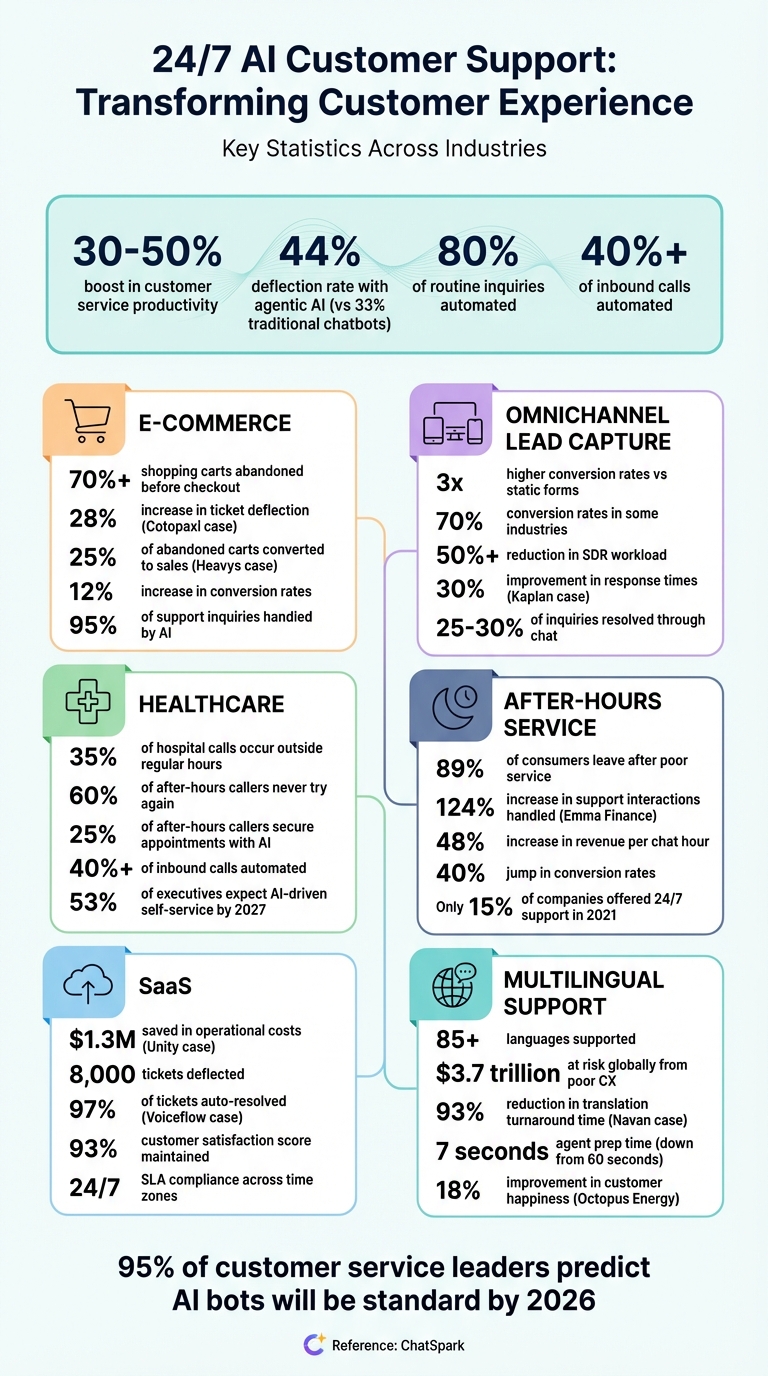
24/7 AI Customer Support: Key Statistics and Impact Across Industries
1. E-commerce Support
For online retailers, customer questions can pile up at every stage of the buying process. And with over 70% of shopping carts abandoned before checkout, even a minor unresolved issue - like uncertainty about sizing, shipping costs, or return policies - can drive shoppers straight to a competitor [7][9].
AI-powered support systems are stepping in to handle these routine inquiries, covering everything from product compatibility to promo codes and order tracking. These systems integrate seamlessly with platforms like Shopify and fulfillment tools, providing real-time data access to process returns, track orders, or even reroute shipments [2][3]. A great example? Outdoor gear retailer Cotopaxi. In early 2024, they implemented Forethought’s AI, integrated with Kustomer and Shopify. The result? A 28% increase in ticket deflection while maintaining a solid 4.5 customer satisfaction score [2].
But AI isn’t just about answering questions - it’s also about driving sales. Take Heavys, a premium headphones brand. In 2024, they launched an AI concierge to tackle pre-purchase concerns and provide setup guidance. The impact was huge: nearly 25% of abandoned carts were converted into sales, and their overall conversion rates jumped by 12%. Today, AI handles 95% of their support inquiries [6].
Platforms like ChatSpark make this level of support accessible across multiple channels - websites, Instagram, Facebook, WhatsApp, and Telegram - offering responses in over 85 languages. Whether it’s a shopper browsing at 2:00 AM or an international customer needing help in their native language, AI ensures immediate, accurate assistance.
And the results speak for themselves. Companies using agentic AI report a 44% deflection rate, significantly outperforming the 33% achieved by traditional chatbots [2]. By providing real-time updates on inventory, applying discounts, and addressing shipping delays, AI removes the roadblocks between browsing and buying.
2. Healthcare Assistance
Healthcare providers, like those in retail, face unique challenges when it comes to after-hours support. Did you know that 35% of hospital calls happen outside regular hours, and 60% of those callers never try again? [10]. This isn't just a missed opportunity for providers - it directly impacts patient care.
AI systems are stepping in to bridge this gap. By handling routine inquiries - like operating hours, parking details, insurance coverage, and visitor policies - AI ensures patients get quick answers. These systems even secure appointment intents from 25% of after-hours callers, ensuring fewer missed opportunities [10].
AI isn't just limited to administrative tasks. It plays a role in clinical triage as well. For example, it can help determine whether post-surgical bleeding requires an immediate ER visit or if fasting-related questions can wait until morning. This reduces unnecessary cancellations and rescheduling, keeping operations smoother for both patients and staff.
Currently, AI chatbots are automating over 40% of inbound healthcare calls, mirroring the efficiency seen in other industries [5]. This allows healthcare staff to focus on more complex, high-priority patient needs. Looking ahead, industry leaders predict a major shift toward fully autonomous systems by 2027. In fact, 53% of healthcare executives expect a rise in AI-driven, personalized customer interactions for patients [11].
To meet patients where they are, hospitals are rolling out AI systems across platforms like WhatsApp, web chat, and SMS. Tools like ChatSpark make this possible, offering omnichannel support in over 85 languages, ensuring 24/7 accessibility for diverse patient populations.
3. SaaS Support
Quick Solutions Anytime, Anywhere
SaaS companies face a tough reality: their customers expect uninterrupted access to the tools they rely on, no matter the time or day. A login issue at 2:00 AM or a broken API integration on a Sunday can’t wait until Monday morning. That’s where AI support systems step in. These systems handle common tasks like password resets, billing updates, and account management instantly - eliminating the need for human agents to work overnight shifts. This kind of immediate problem-solving is essential for businesses running 24/7.
The numbers speak for themselves. In early 2024, Unity implemented an AI-driven support system connected to its knowledge base. The result? It deflected 8,000 tickets and saved an estimated $1.3 million in operational costs [12]. Voiceflow’s AI bot, "Tico", achieved similar success, automatically resolving 97% of support tickets while maintaining a 93% Customer Satisfaction score [1].
AI doesn’t just stop at answering questions - it actively resolves issues. These systems integrate seamlessly with backend platforms like Stripe and Shopify, handling tasks such as processing refunds, updating subscription plans, or checking order statuses. For SaaS companies, this means they can keep technical operations running smoothly while easing the workload on their human support teams.
Thanks to these capabilities, SaaS companies can meet Service Level Agreements (SLAs) across time zones without hiring additional night-shift agents. Tools like ChatSpark make this possible by integrating with platforms like Slack, WhatsApp, and web chat. They even provide support in more than 85 languages, ensuring customers get help wherever they are.
"Now we are proactive in answering customer questions before they even need to reach out to our team." - Ashley Monganaro, Director of CX, Everlane [5]
4. Omnichannel Lead Capture
Meeting Customers Where They Are
Today's customers interact with brands across multiple platforms. They might stumble upon your Instagram post, send a query via WhatsApp, and then browse your website - all within a short span of time. If your lead capture system can't keep up with these transitions, you risk losing potential leads. AI-powered tools solve this by maintaining conversation context as customers move between platforms, ensuring they never have to repeat themselves. This smooth experience across channels can drastically boost conversions.
The results speak for themselves. Businesses using AI chatbots report 3x higher conversion rates compared to traditional static web forms, with some industries achieving conversion rates of up to 70% [14]. Take Kaplan Early Learning, for example. By centralizing its support system in 2025 with AI agents across multiple platforms, the company resolved 25–30% of inquiries through chat and improved average response times by 30% - all without adding staff [17].
AI also takes a proactive approach to customer engagement. Features like exit-intent triggers and on-site behavior tracking allow businesses to start conversations before visitors leave [15]. On social media, tools like "Comment-to-DM" workflows transform public Instagram comments into private, qualified lead discussions [14]. By applying frameworks such as BANT (Budget, Authority, Need, Timeline), AI systems qualify prospects instantly, filtering out low-intent inquiries and cutting the workload for Sales Development Representatives by 50% or more [14].
The demand for speed and availability is clear: 64% of consumers say 24/7 availability is the top benefit of chatbots, while 59% expect a response within 5 seconds [14]. Platforms like ChatSpark seamlessly capture leads from websites, WhatsApp, Instagram, Facebook, Telegram, and Slack, all while retaining context and quickly routing high-intent prospects to the right team.
"AI allows companies to scale personalization and speed simultaneously. It's not about replacing humans - it's about augmenting them to deliver a better experience." – Blake Morgan, Customer Experience Expert [16]
5. After-Hours Service
Never Miss a Midnight Moment
Customer issues don’t follow a 9-to-5 schedule. A billing error at 3:00 AM, a forgotten password at midnight, or a "Where’s my order?" question at 2:00 AM can determine whether you gain - or lose - a customer. Here’s a telling statistic: 89% of consumers stop doing business with a company after a poor service experience, often because support was too slow or unavailable [18]. Yet, in 2021, only 15% of companies provided true round-the-clock support, making 24/7 availability a game-changer [18].
AI can fill this gap and turn after-hours challenges into opportunities. Take Emma Finance, for example. From February to October 2025, they doubled their customer base and saw a 124% increase in monthly support interactions - all with just one human agent. Their secret? An AI chatbot that handled Tier 1 tasks like password resets and order status updates during the night. By the time the team started their day, there were no backlogs, just clear priorities [18].
AI also slashes resolution times during off-hours, which is crucial for businesses with a global reach. While your London team sleeps, your Tokyo customers might need immediate help. For them, quick and reliable support isn’t just nice to have - it’s essential.
The financial benefits are just as striking. Businesses offering 24/7 live chat support see a 48% increase in revenue per chat hour and a 40% jump in conversion rates [19]. AI doesn’t just respond - it pulls live shipping data, resolves basic queries, and escalates urgent issues to on-call specialists when needed.
"When people know you're there for them anytime, they're more likely to reach out, more likely to stick around, and more likely to trust you." – Akshay Adheesh, Support Manager, Hiver [19]
6. Multilingual Support
Break Down Language Barriers Without Breaking the Bank
Your customers may speak a variety of languages, but hiring native-speaking agents for every language can quickly become expensive. That’s where AI chatbots step in, translating queries in real-time to facilitate smooth communication across languages [20]. ChatSpark, for instance, supports over 85 languages, ensuring customers receive consistent assistance in their native tongue, no matter where they are.
The financial impact of poor customer experiences is staggering - global organizations risk an estimated $3.7 trillion annually [13]. Language barriers play a significant role in these losses. In 2025, FINOM partnered with CloudTalk to handle 9,300 calls and 17,300 minutes of communication per quarter, slashing agent call preparation time from 60 seconds to just 7 seconds [13]. This kind of efficiency highlights how AI-driven tools can transform localization efforts.
"AI chatbots can automatically translate customer queries and responses in real-time. This allows for seamless interactions across different languages without a wait time for translations." – Auralis.ai [20]
Today’s AI tools go beyond basic translation - they offer true localization. This means adapting responses to account for cultural nuances, regional preferences, and even the quirks of modern communication, like mixed languages, sentence fragments, or emojis [20][8]. For example, Navan (formerly TripActions) automated their translation workflows, cutting translation turnaround times by 93% and achieving full product localization across nine languages [5].
Conclusion
Around-the-clock AI customer support is delivering noticeable results across various industries. By implementing generative AI at scale, businesses can boost customer service productivity by 30% to 50% [3]. This allows human agents to dedicate their time to handling more complex issues that require empathy and critical thinking. Companies that have embraced this technology early on report shorter resolution times and higher customer satisfaction rates [1]. For example, Octopus Energy saw an 18% improvement in customer happiness scores when using AI-drafted emails compared to responses crafted solely by humans [4].
Agentic AI is now capable of automating up to 80% of routine customer inquiries. It manages tasks like processing refunds, updating orders, and filing support tickets [21]. This level of efficiency not only reduces operational costs but also enables businesses to scale across different time zones and languages - offering a distinct competitive advantage.
"The era of 'office hours' is over. Customers expect help the moment they need it, across every time zone, on every channel." - Crisp [8]
For businesses looking to adopt AI-driven support, ChatSpark offers a simple, omnichannel solution. You can follow a customer service automation checklist to ensure a smooth setup. It integrates seamlessly across platforms like websites, WhatsApp, Instagram, Facebook, Telegram, and Slack. From lead capture to analytics, ChatSpark handles it all while allowing for custom branding to ensure responses align with your business tone. Starting at just $19 per month for solo entrepreneurs and scaling up to enterprise-level solutions, it caters to businesses at any stage of their growth.
With 95% of global customer service leaders predicting that AI bots will be a standard part of service by 2026 [4], the time to act is now. Implementing AI-powered customer support today could be the key to staying ahead in an increasingly competitive market.
FAQs
How does AI enhance customer support in e-commerce?
AI is changing the way e-commerce businesses handle customer support, making it faster, more efficient, and available around the clock. With AI-driven tools like chatbots, companies can instantly manage thousands of inquiries - whether it’s about tracking an order, understanding return policies, or learning more about a product. This 24/7 availability cuts down on wait times and keeps customers happier.
Beyond just answering questions, AI simplifies operations by taking care of repetitive tasks like tagging tickets or directing more complex issues to human agents. It can even analyze customer sentiment to provide responses that feel more empathetic and personal. Tools like ChatSpark allow businesses to deliver consistent, multilingual support, helping them connect with customers across the globe.
By integrating AI into their customer service, e-commerce companies can offer quicker, more tailored assistance, strengthening customer loyalty in the process.
How does AI improve customer support in healthcare?
AI plays a key role in transforming healthcare customer support by offering round-the-clock assistance. Patients can access medical information, book appointments, and get answers to common questions at any time, making healthcare services more accessible and convenient. At the same time, this reduces the workload for healthcare staff, allowing them to focus on critical tasks.
With the help of natural language processing (NLP) and machine learning (ML), AI tools create interactions that feel personal and conversational, helping patients feel heard and understood. These tools can handle high volumes of inquiries efficiently, freeing up healthcare professionals to concentrate on more complex cases. This combination of speed, reliability, and patient-focused care makes AI an essential tool in modern healthcare support.
How does AI provide support for customers in different languages?
AI relies on natural language processing (NLP) and advanced localization methods to provide seamless communication in various languages. This allows businesses to offer precise and tailored support to customers, regardless of their language preference.
With these capabilities, AI can process, understand, and respond to questions in more than 85 languages. This makes it an invaluable resource for companies catering to diverse, international audiences. The result? Improved accessibility and happier customers, thanks to consistent, timely, and brand-aligned responses available 24/7.