
AI is transforming how businesses engage with customers. Here's what you need to know:
- 71% of U.S. consumers expect tailored interactions, and 76% feel frustrated when this isn't met.
- AI personalization boosts revenue by 5-8% and reduces service costs by 20-30%.
- Companies like a U.S. airline (October 2025) saw an 800% rise in satisfaction by using AI for flight delay compensation.
- AI tools predict needs, tailor messaging, and even detect emotions, enabling real-time, relevant responses.
- Despite its potential, only 49% of consumers think brands use their data effectively.
Key takeaways: Map customer journeys, identify friction points, and use AI to deliver timely, personalized experiences. Unified data, ethical practices, and a consistent brand voice are critical for success.
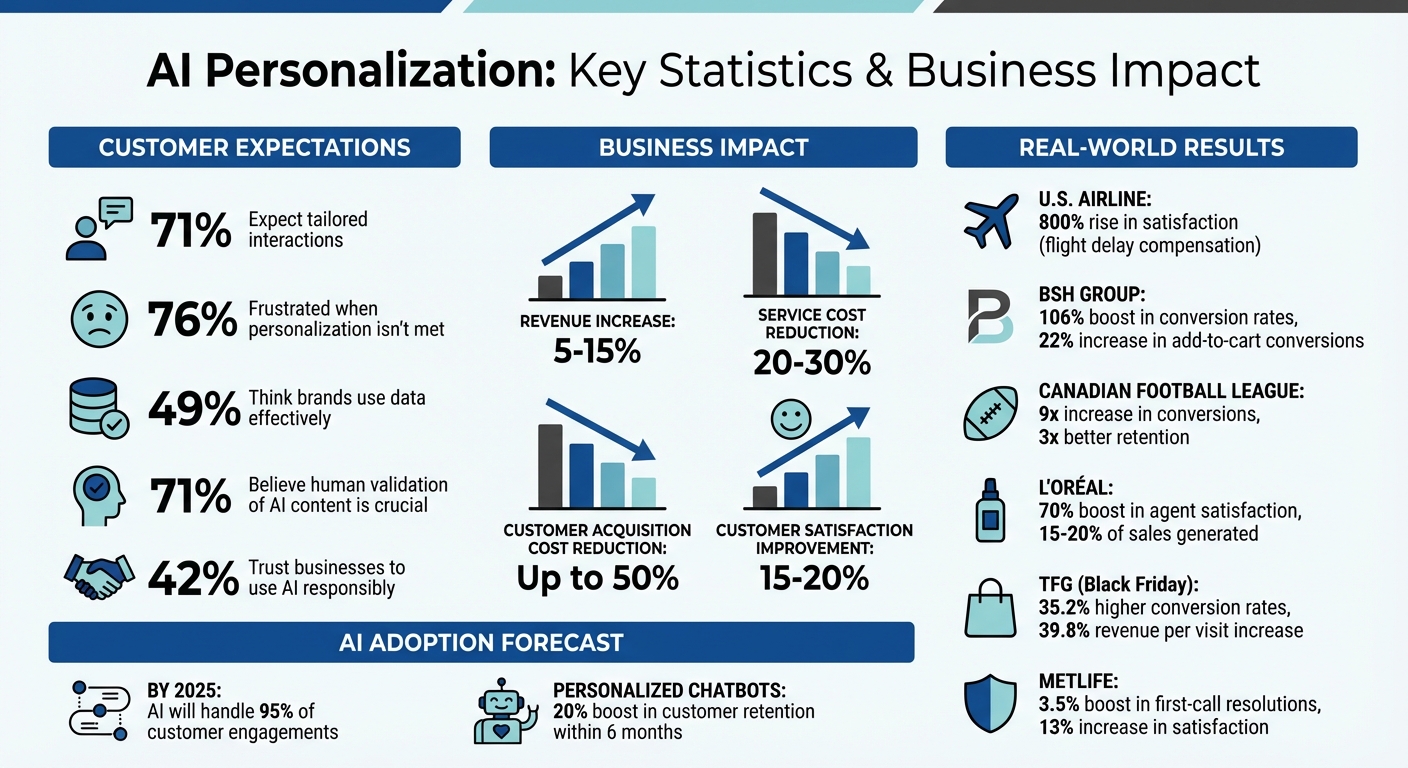
AI Personalization Impact: Key Statistics and Business Outcomes
Finding AI Opportunities in Your Customer Journey
Review Your Current Customer Journey
Start by mapping out every point where customers interact with your brand. This could include your website chat, email campaigns, social media messages, phone support, mobile app, or even the checkout process. Once you've mapped these touchpoints, look closely for areas where customers seem to hit a wall - whether that's repeating the same questions, abandoning their cart, or dropping off entirely.
Take the BSH Group as an example. In 2025, they tracked customer interactions across 40 multichannel touchpoints using experience orchestration. By pinpointing the moments where customers disengaged and calculating real-time engagement scores, they achieved some impressive results: a 106% boost in overall conversion rates and a 22% increase in add-to-cart conversions [8]. Their success came from identifying exactly where the friction was and addressing it effectively.
The big takeaway? Spotting these friction points allows you to focus on the moments where AI can make the biggest difference through personalization.
Spot High-Value Personalization Moments
Once you've analyzed the customer journey, zero in on the touchpoints where personalization can have the most impact. For instance, cart abandonment is a classic example. Predictive analytics can step in here, sending a perfectly timed discount or reminder to nudge the customer back. Another great opportunity is onboarding - AI can tailor the experience based on how quickly a customer is picking up your product.
Other high-impact moments include pricing inquiries, where AI can explain complex billing before frustration sets in, or support requests, where sentiment analysis can detect when a customer is getting upset. Even customer reactivation can benefit: predictive models can identify who’s likely to churn in the next week and intervene. For example, an Asia-Pacific telecommunications company used generative AI to send personalized messages about billing changes and tailored plan alternatives, cutting churn by 5% [3].
Use Customer Data for Personalization
AI personalization thrives on a mix of behavioral, transactional, and demographic data - think browsing history, purchase records, and location. When these data types come together, the personalization opportunities are endless. Picture this: AI notices a customer in Alaska browsed winter coats, abandoned a $150 cart, and usually shops on weekdays around 7:00 PM EST. A timely, targeted message could bring them back.
For U.S. businesses, location data can be especially powerful. AI can tweak messaging based on regional weather (promoting umbrellas during a rainy week in Seattle), time zones (sending emails when customers are most likely to open them), and even local preferences (emphasizing "free shipping", since 65% of U.S. customers say targeted promotions influence their purchases [7]). A great example is L'Oréal, which in March 2025 used AI to automate metadata tagging for 200,000 titles across 36 brands. This saved 120,000 hours of manual work while enabling more discoverable, personalized content [11].
The secret to making this work? Build a single source of truth - a unified customer profile that pulls information from your website, CRM, e-commerce platform, and support tickets. Breaking down data silos ensures your communications are consistent and on point.
Preparing Your Business for AI Personalization
Create a Single Customer Data Source
To make AI personalization truly effective, all customer data - CRM, support tickets, analytics, billing - should be consolidated into one platform. In fact, 78% of organizations have already implemented or plan to adopt a Customer Data Platform (CDP) to achieve this [13].
The process involves advancing through the C360 Maturity Model. First, move from siloed data spread across multiple tools to a structured view of customer actions (what they did). The final step is achieving an intelligent view by incorporating unstructured data like email conversations and call transcripts, which reveal the why behind customer behavior [12]. This deeper understanding unlocks AI's full potential by uncovering customer intent and sentiment.
Take the Canadian Football League as an example. In 2025, they unified 120 data points per fan, leading to a 9x increase in conversions and 3x better retention of marketable fans [12]. Similarly, L'Oréal used Salesforce Service Cloud to unify data from over 200 direct-to-consumer websites. This effort boosted agent satisfaction by 70% and helped generate 15% to 20% of sales for a major B2C brand [5].
To achieve this, consolidate data into a data lake, clean it, transform it into standardized formats, and store it in a modern data warehouse. For example, Autodesk revamped its analytics platform with Snowflake, resulting in a 10x increase in data ingestion speed and requiring 3x fewer staff to manage the system [12].
"The old model of copying data between dozens of tools is broken. It creates a costly, high-latency and ungoverned ecosystem that is difficult (if not impossible) to trust."
- Florian Delval, Snowflake [12]
Prioritize real-time data over historical data. For instance, recent browsing activity is far more useful than outdated information when crafting relevant offers. Also, ensure your data is clean - messy data can lead to biased algorithms and inaccurate personalization [1][4].
Once your data is unified, the next step is to define a consistent AI brand voice.
Set Up Your AI Brand Voice Guidelines
With unified data in place, it’s time to establish your AI brand voice. This means creating a style guide that specifies tone, formality, and language rules to ensure AI-generated content aligns with your brand identity [7].
Start by building "prompt stores" and vector databases to maintain consistency across AI implementations [7]. Then, implement automated guardrails and templates to keep the AI on track. For example, a European telecommunications company in 2024 used generative AI to create messages for 2,000 different actions. By setting strict rules for message length and tone, they successfully blended general branding with campaign-specific nuances, leading to a 10% boost in customer engagement [7].
Human oversight is still essential. Even as AI improves, 71% of customers believe human validation of AI-generated content is crucial [5]. By involving marketing or compliance teams in reviewing AI outputs, businesses can refine their brand voice and catch errors before they escalate [3].
"It is critical that they [organizations] build models to validate and govern gen AI–created content in order to establish guardrails against bias, toxicity, and hallucinations, and to ensure that content is in accordance with enterprise standards and design systems."
- McKinsey & Company [7]
Your guidelines should also allow flexibility. For example, AI can adapt its tone for different audiences - using formal language for enterprise clients and a casual tone for younger consumers - while staying true to your brand [3][7].
With your brand voice defined, it’s critical to safeguard this personalization strategy with robust data privacy measures.
Handle Data Privacy and Compliance
Protecting customer data starts with encryption, multi-factor authentication, and strict access controls. Transparency is equally important - clearly communicate what data you collect, how it’s used, and how AI factors into your marketing and service strategies [1][5][14]. With 71% of customers becoming more protective of their data and only 42% trusting businesses to use AI responsibly, offering clear opt-in and opt-out options is essential [5].
Data governance plays a key role here. Track data lineage to ensure every data element’s origin and transformation are documented for regulatory compliance [3]. Use grounding techniques to secure customer context and prevent AI from generating false information, a phenomenon known as "hallucinations" [14]. This is vital, as 79% of IT leaders believe generative AI introduces new security risks to both company and customer data [14].
Automated quality checks can catch anomalies like missing data or sudden drops in record volume, which could affect AI accuracy [3]. Regularly retraining your AI models ensures they stay relevant as customer behavior evolves [5].
"AI ethics and trust aren't just about avoiding reputational damage. They can actively be a competitive advantage."
Building Personalized AI Conversations
Design Adaptive Conversation Flows
AI-powered conversations need to adapt on the fly, responding to real-time customer behavior like clicks, browsing habits, and even sentiment shifts across different touchpoints [9][15]. For instance, using Next Best Experience (NBE) orchestration, you can sequence interactions that align with a customer's immediate needs. Say a customer has an unresolved support ticket - your AI can pause promotional messaging and focus on addressing their concern first [3].
AI systems can also calculate scores, such as a customer’s likelihood to respond to a promo or their risk of churning. These insights help decide whether to offer a discount, share a useful tip, or schedule a proactive service call [7][3]. A great example comes from November 2025, when specialty retailer TFG introduced an AI chatbot during Black Friday. The bot engaged customers at crucial moments, boosting online conversion rates by 35.2%, revenue per visit by 39.8%, and reducing exit rates by 28.1% [15]. Advanced AI tools even fine-tune their messaging dynamically, adjusting tone and content based on predicted outcomes, while retaining conversation history for a seamless transition from AI to human agents when needed [15][3][16].
The next step? Use real-time data to segment your audience and craft highly targeted AI responses.
Group Customers and Set Response Triggers
By leveraging predictive analytics, you can divide your audience into microsegments based on lifecycle stages - like new buyers, loyal customers, or those at risk of leaving - and specific behaviors such as their sensitivity to discounts or product preferences [5][7]. Real-time data, like current browsing activity or location, can then trigger personalized responses. For instance, if a customer abandons their cart, AI can immediately send a tailored incentive to encourage checkout [9][3].
It’s also vital to coordinate these triggers across departments to avoid overwhelming customers. If someone has an open service issue, your system should automatically suppress promotional emails until the problem is resolved [3]. A European telecom company demonstrated this in early 2025, testing 2,000 AI-generated messages tailored by factors like age, gender, and data usage. The result? Customers engaging with personalized content 10% more often than with generic mass promotions [7].
Program Tone and Empathy into AI Responses
Once you’ve nailed down adaptive flows and precise triggers, it’s time to focus on tone and empathy to make interactions feel genuinely human. AI can analyze text, tone, and conversational cues to detect emotions like frustration, excitement, or hesitation [17]. Machine learning models trained on thousands of interactions help the AI respond appropriately, adjusting its tone to match the customer’s emotional state [2]. Research even shows that 5.2% of customers value empathy more than low wait times, which only 2.7% prioritize [2].
Branching logic is key here. For example, a customer looking for a quick fix will need a different response than someone venting their frustrations [17]. Between 2020 and 2024, MetLife implemented AI tools in its call centers that detected emotional cues like a rising voice pitch or overlapping speech. The system guided agents in real time, leading to a 3.5% boost in first-call resolutions and a 13% increase in customer satisfaction [17]. Tailor the AI’s tone to the communication channel - keep SMS responses short and direct, while email can be more detailed and formal [3]. By integrating CRM data, the AI can reference past interactions, making its empathy feel natural rather than robotic [18].
"Generative AI will allow platforms to detect frustration, excitement, or hesitation in real time and respond with genuine, not mechanical, empathy."
Personalized: Customer Strategy in the Age of AI with David C. Edelman
Deploying and Improving AI Personalization with ChatSpark
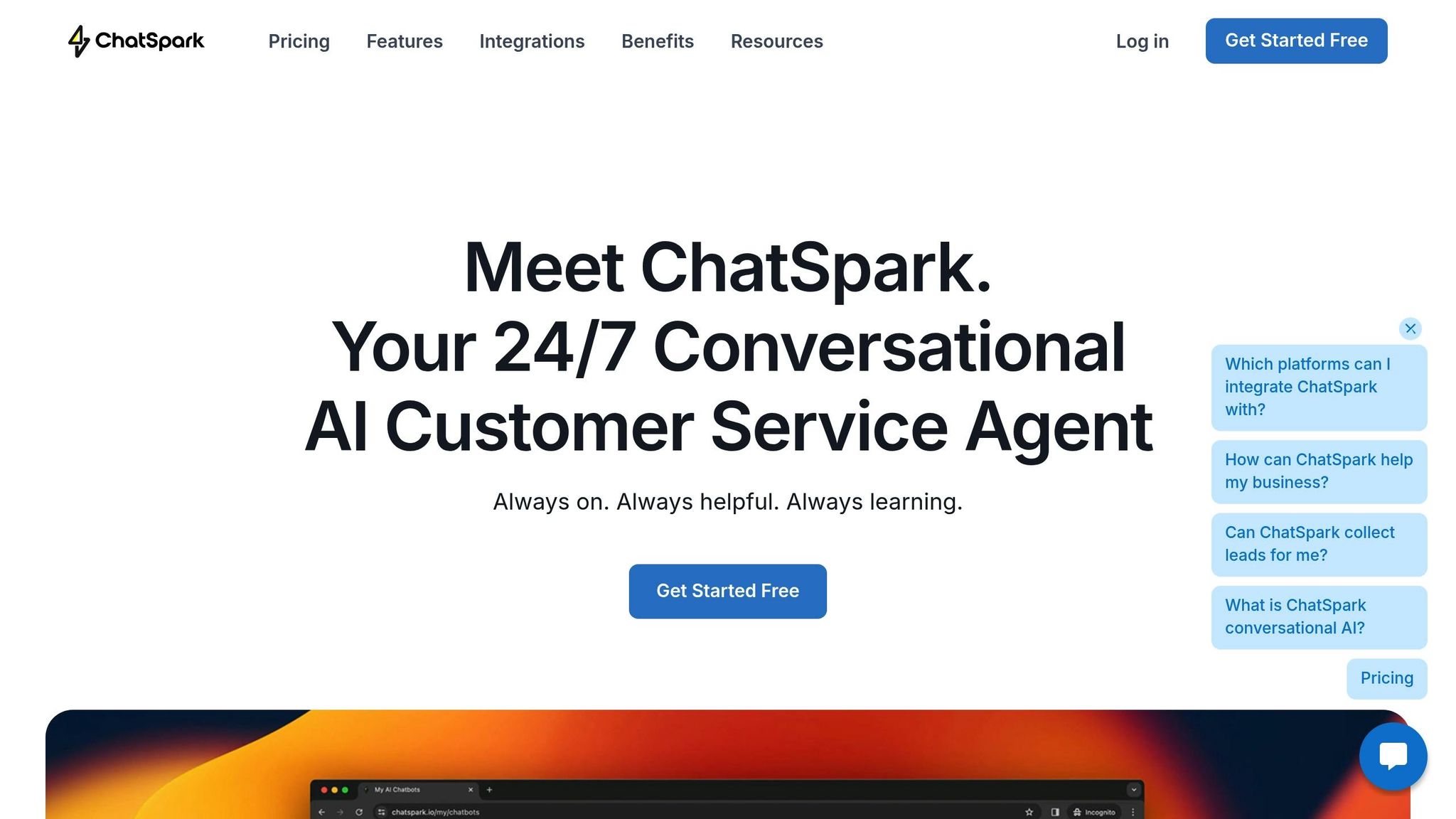
Building on unified customer data and smart conversation design, ChatSpark makes it easy to personalize customer interactions across multiple platforms quickly and effectively.
Connect ChatSpark to Your Channels
You can set up ChatSpark in less than 10 minutes - no coding required [19]. Start by syncing your knowledge sources. This includes uploading website URLs for automatic crawling, as well as importing PDFs, Word documents, PowerPoints, CSV files, YouTube transcripts, or Google Docs containing customer information. This step centralizes all your content, ensuring consistent AI-generated responses.
Once your content is loaded, deploy your AI agent across platforms like your website, Instagram, Facebook, WhatsApp, Telegram, and Slack. Integration is as simple as copying and pasting a code snippet. You can also customize the agent to match your brand’s tone and personality. For users on the Pro plan ($129/month) or Enterprise tier, integrating with Freshchat allows for seamless transitions from AI to human agents when complex issues arise, with the full chat history intact.
With your channels connected, you can activate ChatSpark’s real-time personalization tools to deliver engaging, tailored customer experiences.
Activate Real-Time Personalization Features
Once integrated, ChatSpark’s real-time personalization kicks in immediately. The AI identifies customer intent, searches your knowledge base, selects the best responses, and delivers them in your brand’s style. It also supports over 85 languages, responding in the customer’s preferred language regardless of your original content’s language.
You can enable automated or keyword-triggered lead capture to collect valuable customer information. Additionally, connecting ChatSpark to Zapier allows you to send captured leads directly to your CRM, such as HubSpot or Salesforce. You can also integrate with platforms like Square and Calendly for instant bookings and purchases. For example, between July and October 2025, a global construction products company used ChatSpark for one of its major brands. During that time, the AI managed 10,754 messages, captured 153 new leads, and achieved a 98% resolution rate. This saved the company over 66 days of agent time and $47,880, all from an investment of around $4,000 [19].
To ensure ongoing accuracy, regularly review metrics like "Top Unanswered Questions" and "Knowledge Coverage" on your dashboard. Use these insights to update your content and improve performance.
Manual vs. AI Personalization: A Comparison
| Feature | Manual Customer Service | ChatSpark AI Personalization |
|---|---|---|
| Availability | Limited to business hours/shifts | 24/7/365 instant availability |
| Consistency | Varies by agent mood/training | 100% consistent brand voice |
| Cost | High (approx. $30/hour per agent) | Low (plans starting at $19/month) |
| Scalability | Requires hiring/training more staff | Scales instantly to handle any volume |
| Language Support | Limited to staff capabilities | Supports over 85 languages |
| Response Time | Minutes to hours | Milliseconds |
ChatSpark consistently achieves an AI resolution rate of over 80% [19], meaning most customer interactions are resolved without human assistance. By 2025, it’s expected that AI will handle 95% of customer engagements [20], and personalized chatbots could boost customer retention by 20% within six months [20].
Measuring Results and Expanding AI Personalization
Monitor Key Performance Metrics
To understand the impact of personalization, keep an eye on metrics like NPS (Net Promoter Score) and CSAT (Customer Satisfaction Score). These indicators reveal how well your AI is connecting with customers. At the same time, track operational metrics like First Contact Resolution (FCR) and First Response Time (FRT) to measure how efficiently your AI handles issues. Research shows that AI-powered personalization can boost customer satisfaction by 15% to 20% [3].
Financial outcomes are just as important. Metrics such as Customer Lifetime Value (CLTV), conversion rates, and average order value (AOV) help you tie personalization directly to revenue. For instance, AI-driven "next best experience" models have been shown to increase revenue by 5% to 8% while cutting service costs by 20% to 30% [3]. Engagement metrics are another critical area - emails with personalized subject lines, for example, are 26% more likely to be opened [2].
To keep your AI strategy sharp, regular testing is essential.
Test and Refine Your AI Approach
A/B testing is a powerful way to fine-tune your AI's performance. Experiment with different triggers, customer segments, and conversational tones to see what resonates most with your audience. This process helps you identify the personalization strategies that drive the best engagement and conversion rates, allowing you to make data-driven improvements.
To measure the true impact of your AI initiatives, set up universal control groups - customers who don’t receive AI-driven personalization. Also, use tools like the ChatSpark dashboard to review areas like "Top Unanswered Questions" and "Knowledge Coverage." These insights can help you pinpoint content gaps and make updates that improve your system's overall effectiveness.
Once your AI strategy is performing well, it’s time to expand its reach.
Expand to More Channels and Markets
When you've proven success on one channel, take a strategic approach to scaling your efforts. ChatSpark supports over 85 language platforms, including websites, Instagram, Facebook, WhatsApp, Telegram, and Slack, enabling you to deliver consistent personalization across multiple touchpoints.
For example, an Italian telecommunications company used a phased rollout with an AI-driven contextual marketing platform over five years. In one campaign, the system initiated a three-day sequence: a Gen AI email on Day 1, an in-app push notification on Day 2, and a proactive call from a human advisor on Day 3. This approach led to a 5% increase in incremental revenue and click rates 2-3 times higher than traditional campaigns [3]. The lesson? Consistency is key, but adapting to local preferences is just as important. ChatSpark’s customizable brand voice guidelines help ensure your messaging stays on-brand while aligning with regional nuances.
Conclusion
AI-driven personalization has become a cornerstone of modern customer expectations. It represents a shift from broad, generic marketing strategies to a more refined approach - delivering the right message at the right time. This shift not only enhances customer experiences but also transforms occasional buyers into loyal, repeat customers [3].
The numbers speak for themselves: businesses that embrace AI personalization see revenue increases of 5%–15%, reduce customer acquisition costs by up to 50%, and improve satisfaction by 15%–20%, all while cutting service costs by 20%–30% [3][6][10]. Platforms like ChatSpark are designed to bring this level of precision to businesses at scale.
ChatSpark offers 24/7 automated support across multiple platforms, including websites, Instagram, Facebook, WhatsApp, Telegram, and Slack. With support in over 85 languages, it ensures your brand voice remains consistent through customizable guidelines. Real-time analytics further enable you to track performance and fine-tune your strategy. Whether you're a solo entrepreneur opting for the Basic plan at $19/month or a large enterprise seeking tailored solutions, ChatSpark turns customer data into meaningful, personalized interactions - making every conversation count.
FAQs
How does AI-driven personalization enhance customer satisfaction while reducing costs?
AI-driven personalization is reshaping how businesses interact with their customers. By analyzing real-time data, it predicts customer needs and delivers tailored messages exactly when they’re most impactful. Research shows that companies using AI can see a 15–20% boost in customer satisfaction while slashing service costs by 20–30%. Even more impressively, personalization can cut customer acquisition costs by up to 50% and increase revenue by 5–15%. The financial and customer experience advantages are hard to ignore.
In the U.S., 81% of consumers now expect brands to provide personalized experiences. This isn’t just a nice-to-have anymore - it’s a baseline expectation. AI achieves this by analyzing customer behaviors like browsing history, purchasing habits, and real-time feedback. With these insights, it can recommend the most relevant products, offers, or solutions, strengthening customer loyalty and driving higher engagement.
ChatSpark exemplifies this approach with its conversational AI platform. Available 24/7, it offers automated support, lead capture, and analytics across channels like websites, Instagram, and WhatsApp. Its AI engine delivers instant, personalized responses in over 85 languages, resolving issues quickly while escalating complex ones only when necessary. The result? Lower operational costs and happier customers - a clear win for businesses and their audiences alike.
What are the essential steps to successfully implement AI for personalized customer interactions?
To make AI work effectively for personalized customer interactions, start by pinpointing the areas where it can make the biggest difference. This might include boosting efficiency or creating a better overall experience for your customers. The next step is to pull together customer data from all touchpoints - think purchase history, browsing behavior, and other interactions - to build a comprehensive dataset that AI can use.
Once you've consolidated your data, focus on creating and refining AI models. Techniques like machine learning and natural language processing can help you predict what your customers need and deliver experiences tailored just for them. Deploy these models to offer proactive support and personalized communication across various channels. Don’t stop there - keep an eye on the results. Look at metrics like customer satisfaction, revenue growth, or cost savings, and adjust your approach to keep improving.
A tool like ChatSpark can make this process much smoother. ChatSpark provides 24/7 automated support, captures leads, and offers analytics across platforms like websites, Instagram, Facebook, WhatsApp, Telegram, and Slack. It can respond instantly in over 85 languages while staying consistent with your brand, making it easier than ever to scale personalized interactions.
How does AI protect data privacy and ensure compliance in personalized customer experiences?
AI plays a critical role in safeguarding data privacy and ensuring compliance by embedding rigorous protections and transparent practices into its framework. One key strategy is data minimization - collecting only the information absolutely necessary for a specific purpose. This approach reduces the chances of gathering excess data, which could lead to misuse. Additionally, clear, consent-based policies are provided to customers, ensuring they fully understand how their data is handled. These practices align with major regulations like the CCPA and GDPR.
To keep data secure, AI employs advanced measures such as encryption and anonymization, safeguarding information whether it's being stored or transmitted. Systems also use audit logs and risk-detection tools to monitor for unusual activity, helping to prevent potential breaches. By focusing on first-party data, businesses can create personalized customer experiences without relying heavily on third-party sources, which minimizes exposure to cross-border data challenges.
ChatSpark integrates these principles to offer secure, personalized interactions across platforms like websites, Instagram, Facebook, WhatsApp, Telegram, and Slack. With features like customizable privacy settings and real-time compliance monitoring, ChatSpark empowers U.S. businesses to meet regulatory requirements while delivering AI-driven customer support that fosters trust and drives engagement.