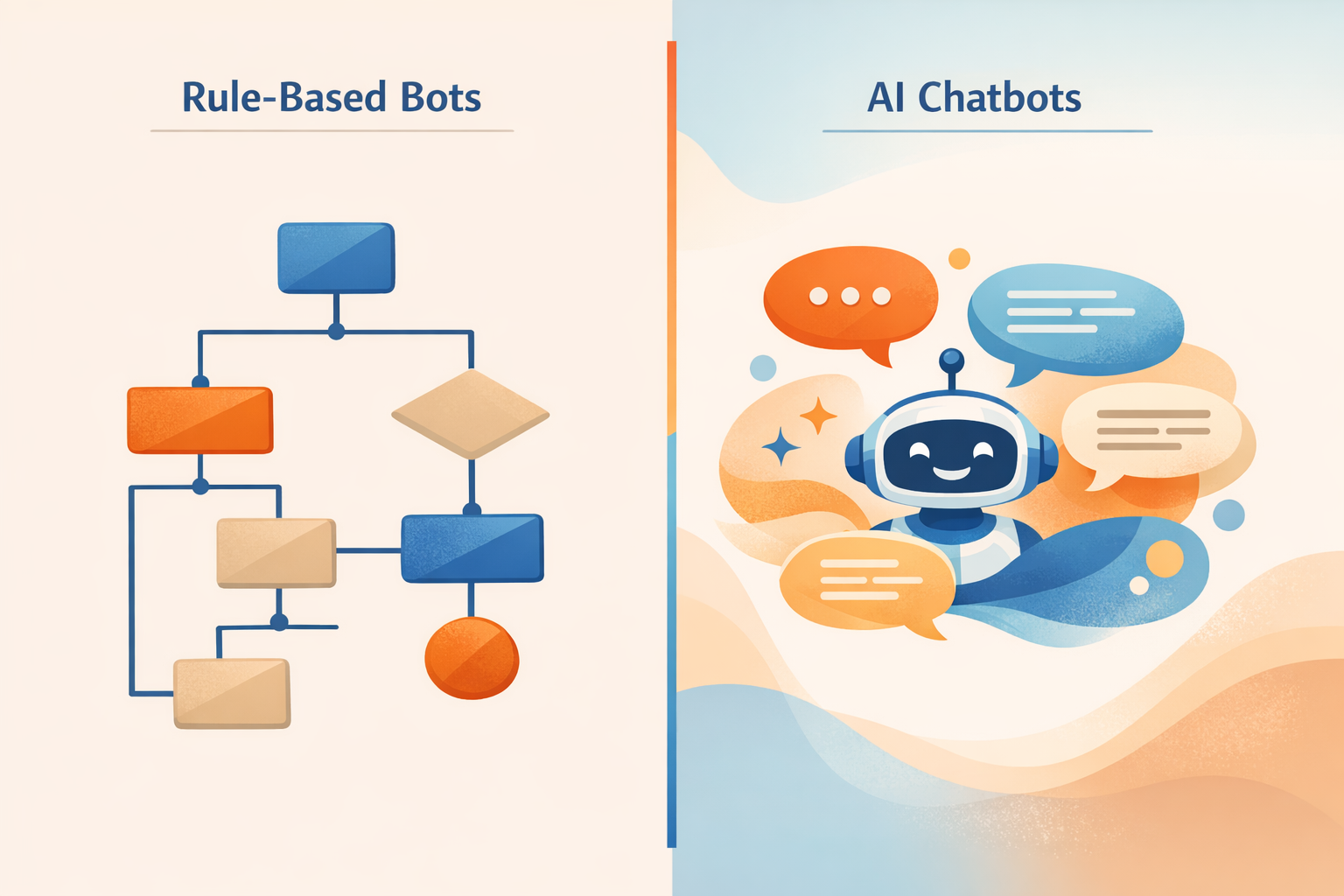

Conversational AI enables computers to communicate in human language, offering natural, context-aware interactions. Unlike basic chatbots, it uses advanced technologies like Natural Language Processing (NLP), Machine Learning (ML), and Dialogue Management to understand intent and respond intelligently. Businesses benefit from 24/7 support, cost savings, and improved customer experiences, with examples like Unity saving $1.3M by automating support. However, challenges include handling complex queries, data quality, and integration with existing systems. With the market projected to reach $41.39 billion by 2030, early adoption positions businesses for success.
Key Features:
- Core Components: NLP (NLU for understanding, NLG for responses), ML, and Dialogue Management.
- Use Cases: Customer support, lead generation, multi-channel communication.
- Benefits: Reduced costs, faster response times, and data-driven insights.
- Challenges: Complex queries, training data quality, and technical integration.
Quick Tip: Start small - identify repetitive tasks, train an AI system, and gradually expand its capabilities.
What is Conversational AI? - EXPLAINED in 3 minutes!
How Conversational AI Works
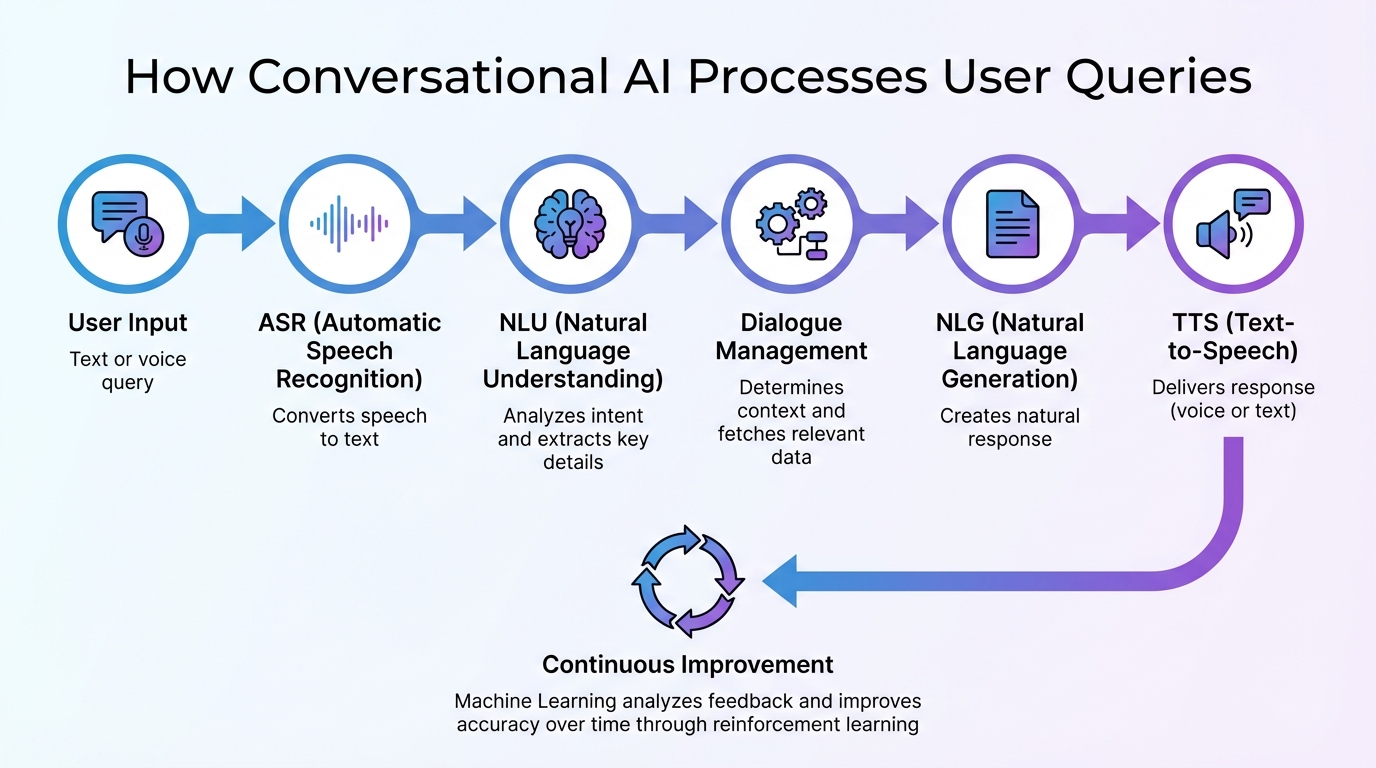
How Conversational AI Processes and Responds to User Queries
Core Components of Conversational AI
Conversational AI relies on a mix of advanced technologies working together to create smooth, human-like interactions. At the heart of this system is Natural Language Processing (NLP), which converts human language into a format computers can understand. Within NLP, there are two key processes: Natural Language Understanding (NLU), which deciphers user intent and picks out important details, and Natural Language Generation (NLG), which takes structured data and turns it into natural, conversational responses.
Machine Learning (ML) plays a crucial role by allowing the system to improve over time through feedback. It helps the AI adapt and become more accurate with every interaction. Dialogue Management ensures the conversation flows naturally by keeping track of context and deciding the next logical step in the exchange. For voice-based interactions, Automatic Speech Recognition (ASR) converts spoken language into text, while Text-to-Speech (TTS) transforms text back into spoken words, completing the loop.
Processing and Responding to User Queries
When a user interacts with the system, whether through text or voice, the input follows a structured path. For voice interactions, ASR first converts spoken words into text. Then, NLU steps in to analyze the text, figure out the user's intent, and pull out any necessary details. Dialogue Management uses this information to determine the context and fetch relevant data from connected databases or knowledge bases. Afterward, NLG creates a natural, easy-to-understand response. If it’s a voice interaction, TTS delivers the reply in spoken form. This entire process is fine-tuned using reinforcement learning, which evaluates the interaction and helps the system improve for future conversations.
How Machine Learning Improves Performance Over Time
Machine learning is what makes Conversational AI smarter with each interaction. By continuously analyzing feedback, the system learns to handle a variety of challenges, like different ways of phrasing questions, slang, or even typos. Over time, it becomes better at recognizing patterns and understanding user inputs more accurately. Reinforcement learning plays a key role here, as it allows the AI to learn from both successful interactions and mistakes. This constant refinement not only improves the quality of responses but also contributes to better user experiences and operational efficiency.
Benefits of Conversational AI for Businesses
Conversational AI is changing the game for businesses by automating customer interactions, improving efficiency, and enhancing the overall customer experience.
24/7 Customer Support
One of the standout advantages of Conversational AI is its ability to provide round-the-clock support without the added expense of staffing overnight or holiday shifts. Unlike human teams, which require breaks and time off, AI systems are always "on", ready to handle customer inquiries instantly. This is particularly important, given that 51% of consumers prefer interacting with bots for immediate assistance[2]. Plus, these systems maintain consistent, on-brand responses no matter the time of day or the volume of queries.
Repetitive tasks like password resets, order tracking, and answering FAQs are handled seamlessly by AI, freeing up human agents to focus on more complex issues. Yves Normandin, VP of AI Technologies and Products at Waterfield Tech, highlights this efficiency:
"We're actually addressing a very serious staffing issue with these automated agents. And once you've trained an automated agent, you can replicate them as many times as you want"[4].
Not only does this ensure constant service, but it also significantly cuts costs.
Lower Costs and Easy Scaling
By automating routine tasks, businesses save on operational costs that would otherwise require a team of full-time employees. In fact, 93% of service professionals report saving significant time on repetitive tasks thanks to AI automation[1]. These savings extend beyond salaries to include reductions in office space requirements, recruitment efforts, management overhead, and training expenses.
Scaling operations is also much simpler with AI. Expanding AI capabilities costs far less than hiring and onboarding new staff. During busy periods like seasonal sales or product launches, AI effortlessly handles increased query volumes without the need for temporary workers or overtime pay.
But the benefits don’t stop at cost savings and scalability - AI also delivers actionable insights that help businesses improve.
Data-Driven Insights Through Analytics
Every interaction with Conversational AI generates data that businesses can use to better understand their customers. By analyzing chat transcripts, companies can uncover common questions, identify recurring issues, and even learn how customers phrase their requests. This helps refine processes, improve customer service strategies, and make smarter business decisions. Sentiment analysis, for example, can detect frustration or negative emotions, allowing businesses to adjust responses or escalate issues to human agents when needed.
A great example of this is Bank of America's virtual assistant, Erica. With over 42 million users, Erica analyzes financial behavior to provide proactive alerts, such as warnings about missed recurring payments or unusual spending patterns[3]. These insights go beyond customer support, influencing product development, marketing strategies, and overall customer experience. By leveraging this data, businesses can fill knowledge gaps, improve automated responses, and create a smoother, more personalized customer journey - all based on real-world behavior, not assumptions.
Common Uses of Conversational AI
Conversational AI has grown far beyond basic chatbots, evolving into sophisticated systems that handle tasks, engage customers across multiple channels, and drive measurable business outcomes.
Chatbots and Virtual Assistants
One of the most visible applications of conversational AI is in chatbots and virtual assistants. These tools handle repetitive tasks like resetting passwords, scheduling appointments, or providing order updates. By automating these everyday interactions, businesses can free up human agents to tackle more nuanced and complex issues.
For instance, TaskRabbit used AI to manage a 60% surge in inquiries, deflecting 28% of tickets through automated initial responses. Similarly, Upwork’s AI system resolved 58% of customer queries without requiring human involvement [2]. Platforms like ChatSpark take it a step further by supporting over 85 languages, ensuring consistent and brand-aligned communication worldwide.
But the power of conversational AI isn’t limited to individual tasks - it also enhances customer support across multiple platforms.
Multi-Channel Customer Support
These days, customers expect seamless support whether they’re on a website, Instagram, WhatsApp, Facebook, or email. Conversational AI enables businesses to meet customers wherever they are, maintaining the context and history of conversations even as users switch between platforms. ChatSpark, for example, integrates effortlessly with tools like Telegram, Slack, and social media channels, creating a unified and consistent support experience.
"If a chatbot is answering publicly there's a lot more scrutiny. It's a higher bar to be in the social media space" [4].
- Christine Dupuis, Senior Director of Product and AI at Heyday
This ability to unify communication across platforms doesn’t just improve support - it also opens doors for proactive engagement with potential leads.
Lead Capture and Qualification
Another game-changer is how conversational AI enhances lead generation. By engaging visitors instantly, AI tools can collect key information - like names, emails, and company details - while also gauging lead quality based on behaviors, such as repeated visits to pricing pages. Businesses using AI for lead capture have reported a 50% jump in qualified leads and a 33% drop in cost per lead [7].
Integrations with scheduling tools like Calendly further streamline the process, allowing companies to book demos directly within a chat session. This not only shortens the sales cycle but also improves conversion rates. In fact, businesses have seen a 30% boost in lead conversions and a 50% cut in response times after implementing AI-powered voice bots [6]. Engaging prospects when their interest is at its peak proves to be a crucial advantage.
Challenges and Limitations of Conversational AI
While conversational AI has made significant strides, it does come with its own set of challenges. Being aware of these limitations allows businesses to manage expectations and plan for smoother execution.
Handling Complex or Specialized Queries
One of the biggest hurdles conversational AI faces is understanding subtleties like sarcasm, irony, regional slang, or industry-specific terminology. For instance, when users rely on local dialects or niche jargon, the system's ability to provide accurate responses can drop - especially in less commonly spoken languages.
When it comes to highly specialized queries, like resolving obscure technical issues or navigating complex compliance scenarios, conversational AI often struggles. A practical approach is to use hybrid systems that blend traditional rule-based logic for structured tasks with advanced language models for open-ended conversations. For ambiguous situations, structured human handoffs are essential. These limitations emphasize the need for high-quality training data and consistent human oversight to ensure the system performs effectively.
Data and Training Requirements
The success of conversational AI heavily depends on the quality of the data it's trained on. If data from systems like CRMs, knowledge bases, or ticketing platforms is outdated or inconsistent, the AI may produce incomplete or incorrect responses. This issue, combined with a lack of skilled professionals in the field, can increase both the cost and complexity of implementing and maintaining these systems.
Regular updates are crucial to keep up with changes in language and business needs. Organizations that prioritize strong data management practices and continuous training often report success rates as high as 90% and ROI ranging between 300% and 500% [8]. However, these challenges highlight the intricate process of integrating and tailoring AI systems to specific business environments.
Integration and Customization Needs
Technical integration presents another significant challenge. Many businesses rely on older systems that require custom API development to connect with AI tools. Real-time data aggregation from multiple sources only adds to the complexity.
Security and compliance are also critical concerns. AI systems handling sensitive customer data must meet strict regulations like GDPR, HIPAA, or the EU AI Act. Additionally, user trust can be fragile, especially given past negative experiences or fears of job displacement. Despite these obstacles, 97% of executives acknowledge the urgent need to adopt AI tools, while 93% of service professionals say AI saves them considerable time on routine tasks [1].
Conclusion
Key Takeaways for Businesses
Conversational AI has evolved to offer smarter, context-aware assistance that adapts to a wide range of customer needs. By utilizing tools like Natural Language Processing, Machine Learning, and Dialogue Management, businesses can now provide round-the-clock support while reaping significant benefits. These include cutting costs by up to 30%, maintaining a 95% customer satisfaction rate, reducing contact volumes by as much as 70%, and boosting high-quality lead generation by 55% [5].
With the global conversational AI market expected to hit $41.39 billion by 2030 [5], companies that adopt this technology early will gain a strong edge over their competitors. However, success depends on a few key factors: clearly defining user intents, ensuring smooth transitions to human agents for more complex issues, and consistently monitoring the system for accuracy. These steps are essential to building a solid foundation for your AI initiatives.
Getting Started with Conversational AI
To begin, identify repetitive tasks in your customer support by reviewing transcripts and support tickets to pinpoint recurring questions. Use this data to create a focused set of FAQs as a starting point. This allows you to test and refine your AI system gradually, building confidence as you go.
For an easy way to dive in, consider platforms like ChatSpark. Evaluate how well it integrates with your existing systems and data sources to handle routine inquiries effectively. While conversational AI can serve as an excellent first line of support, it’s not meant to replace human agents. Instead, it works alongside your team, taking care of straightforward tasks so your staff can focus on more complex, high-value customer interactions.
FAQs
What makes Conversational AI different from traditional chatbots?
Traditional chatbots operate on rule-based systems, sticking to pre-programmed scripts. They depend on specific keywords or rigid conversation flows, which limits them to handling simple, predictable questions. If a user phrases something in an unexpected way or strays from the script, these chatbots often fall short, unable to provide a meaningful response.
Conversational AI takes a completely different approach. By leveraging natural language processing (NLP) and machine learning, it can understand user intent, keep track of context, and craft dynamic, context-aware replies. This allows it to tackle complex or unclear questions, switch between languages, and even get better over time by learning from past interactions. The result? Conversational AI delivers a more natural, human-like experience, offering personalized and adaptable support that surpasses the rigid limitations of traditional chatbots.
What challenges do businesses face when implementing Conversational AI?
Implementing Conversational AI comes with its fair share of challenges, and businesses often need to navigate these hurdles to fully realize its benefits.
One major issue is data quality. AI systems thrive on large, accurate, and unbiased datasets. If the data is incomplete or flawed, the AI may generate responses that feel off-target or irrelevant, which can frustrate users and erode their trust in the system.
Another critical concern is security and privacy. Handling sensitive personal or financial information requires businesses to follow strict regulations, such as GDPR or CCPA. Beyond compliance, they must also ensure that user data is protected against breaches and misuse, which can be a daunting task.
Then there’s the challenge of technical integration. Connecting Conversational AI to existing tools like CRMs or ticketing platforms often involves creating custom APIs and managing ongoing maintenance. Without proper integration, the system may struggle to operate efficiently or scale effectively.
Tackling these challenges requires thoughtful planning, strong security protocols, and constant monitoring. With the right approach, businesses can harness Conversational AI to improve efficiency and elevate customer experiences.
How can businesses start using Conversational AI to improve their operations?
To get started with Conversational AI, businesses need to pinpoint the specific challenges they aim to solve. This might include automating repetitive customer service tasks, simplifying how sales leads are qualified, or improving internal employee support systems. By clearly outlining these objectives, you can decide what type of virtual assistant fits best - whether that’s a chatbot, a voice assistant, or a mix of both.
The next step is selecting a Conversational AI platform that’s easy to use and integrates seamlessly with your current tools, like your CRM or help desk software. Begin with a small-scale pilot project, training the AI using company-specific data, such as FAQs, product information, or past customer interactions. Keep an eye on key performance indicators like response times, resolution rates, and customer satisfaction to measure the AI’s effectiveness.
If the pilot delivers the results you’re looking for, you can roll out the solution across more channels - your website, mobile app, or even social media - and explore its potential in other areas of your business. Regularly updating and fine-tuning the AI will ensure it stays aligned with your evolving needs.