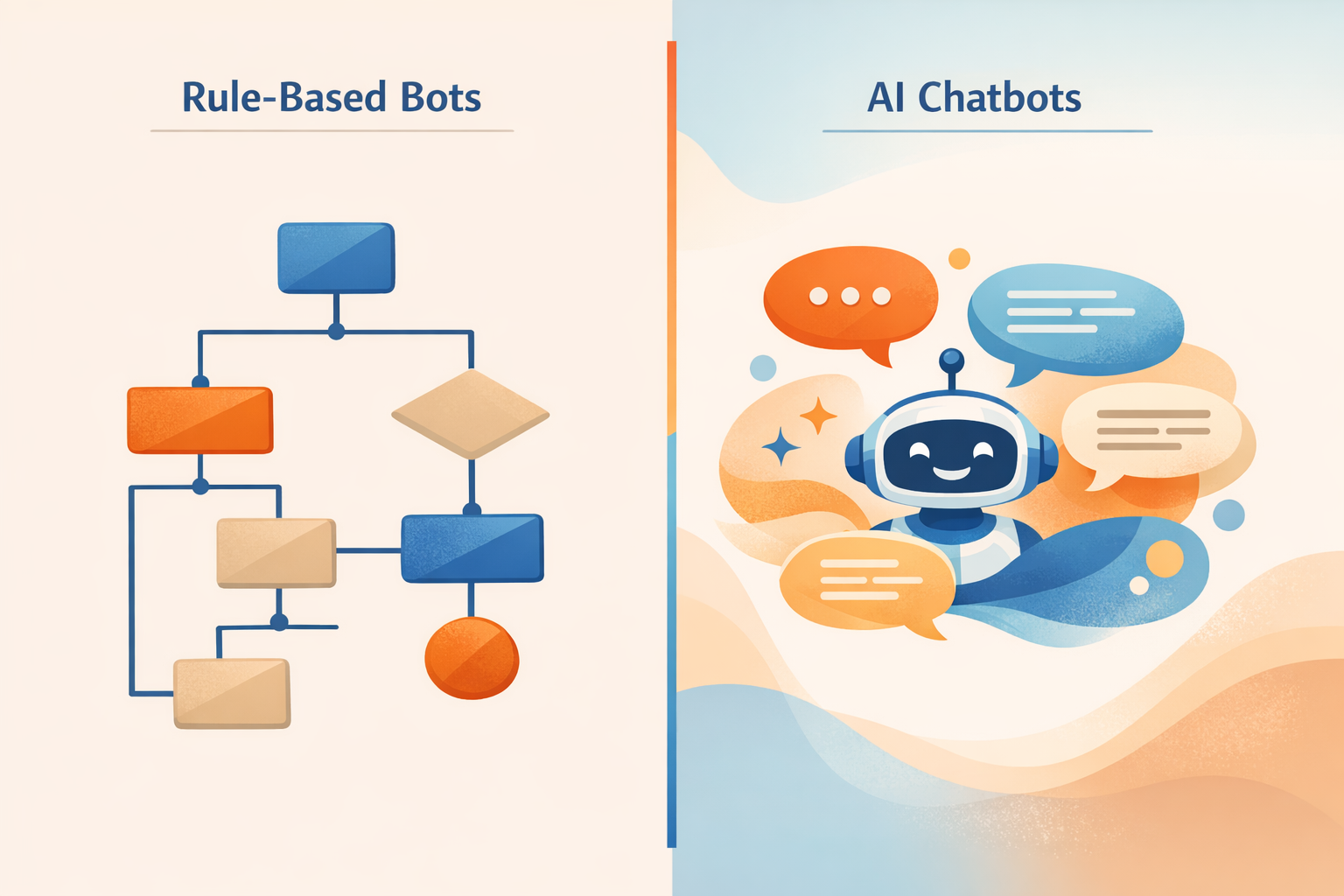
Choosing between rule-based bots and AI chatbots depends on your business needs. Rule-based bots are simple, cost-effective, and ideal for handling repetitive tasks like FAQs or order tracking. AI chatbots, however, offer more advanced capabilities, using natural language processing (NLP) and machine learning (ML) to understand context, intent, and tone. They excel at managing complex queries, providing personalized responses, and learning from interactions.
Key Points:
- Rule-based bots follow pre-set rules and decision trees, offering predictable responses but limited flexibility.
- AI chatbots analyze user input, adapt to varied phrasing, and improve over time, but they require higher upfront investment and technical expertise.
- Businesses can save up to 30% on support costs with either type of chatbot, depending on their use case.
Quick Overview:
- Rule-Based Bots: Best for simple, structured tasks (e.g., order tracking, FAQs). Low cost, fast setup, but limited adaptability.
- AI Chatbots: Ideal for nuanced, dynamic interactions (e.g., troubleshooting, multilingual support). Higher cost, longer setup, but scalable and self-improving.
| Feature | Rule-Based Bots | AI Chatbots |
|---|---|---|
| Technology | Decision trees, keywords | NLP, ML, deep learning |
| Setup Time | Days to weeks | Months |
| Cost | Low | High |
| Learning | No self-learning | Continuous improvement |
| Handling Complexity | Limited | Excels |
| Scalability | Limited | High |
Conclusion: For straightforward tasks, rule-based bots are sufficient. For complex, context-driven interactions, AI chatbots are the better choice. Select the right solution based on your budget, query complexity, and long-term goals.
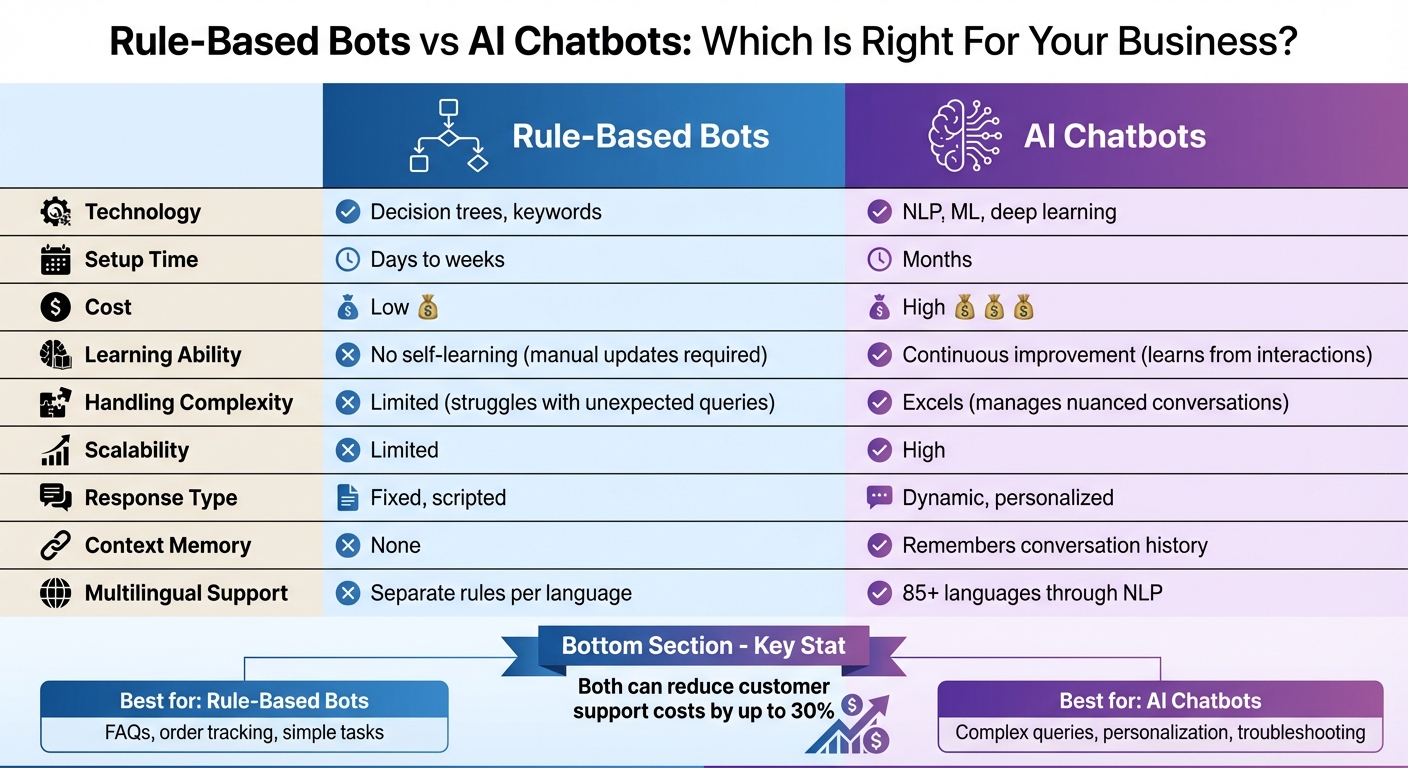
Rule-Based Bots vs AI Chatbots: Feature Comparison Chart
Rule-Based VS AI-Driven Chatbots: The Technology Behind
What Are Rule-Based Bots?
Rule-based bots are automated conversational tools that follow a set of predefined rules and "if-then" logic. Think of them as interactive FAQs - they respond to specific keywords with preset answers but lack the ability to understand context.
These bots rely on decision trees and flowcharts to guide conversations. For instance, if a user types "pricing", the bot might display a menu of available service tiers. Selecting "basic plan" would prompt the bot to share the associated pricing details. Every interaction sticks to a fixed, menu-driven path. Since rule-based bots don’t use natural language processing, they work best with button-based menus that keep users within their programmed boundaries.
This structured approach has its strengths and weaknesses. On the plus side, rule-based bots are great for handling repetitive tasks like order tracking, appointment scheduling, or answering simple questions about business hours or locations. In fact, they’ve been shown to manage over 70% of customer inquiries in retail without needing human assistance [2]. Additionally, businesses can cut up to 30% of customer service costs by automating routine queries [4].
However, their limitations become clear when interactions go off-script. These bots can’t learn from past conversations or adapt to unexpected questions. They struggle with typos, subtle language, or anything outside their pre-programmed responses. When faced with an unfamiliar query, the bot often hits a dead end. To prevent user frustration, it’s important to have a system in place for escalating complex issues to a human agent. Another challenge is the ongoing maintenance - every new customer scenario requires manual programming, which can quickly become a time-consuming task.
How Rule-Based Bots Work
Rule-based bots operate using a decision tree structure. Each branch represents a specific user choice or keyword trigger, leading to a predetermined response. The bot matches user input to its database of predefined answers using simple keyword recognition, without any natural language processing.
Their behavior is entirely predictable, thanks to their reliance on "if-then" statements. For example, if a user asks about "business hours", the bot will always provide the same response. This ensures consistent answers for straightforward questions but leaves no room for flexibility. Additionally, these bots don’t remember past interactions or adapt their responses based on user history, making personalization impossible.
This rigid design explains why rule-based bots excel at repetitive, predictable tasks but falter when faced with more complex or nuanced queries.
Pros and Cons of Rule-Based Bots
Rule-based bots come with several advantages for businesses that deal with predictable customer service needs. They are cost-effective, quick to implement, and highly reliable for routine tasks. By delivering consistent, pre-written responses, these bots help maintain a uniform brand voice and ensure compliance with industry regulations - particularly in fields like banking or healthcare.
On the flip side, their inability to learn or adapt limits their usefulness. While they perform well for simple, repetitive tasks, they struggle with complex or unexpected queries. Since they rely on basic keyword detection, they can’t handle questions that haven’t been pre-programmed by the conversation designer. This can lead to frustration when users stray from the expected interaction path. Additionally, as customer expectations evolve, maintaining and updating the bot’s decision tree becomes increasingly labor-intensive, making it harder for fast-growing businesses to scale efficiently.
What Are AI Chatbots?
Unlike rule-based bots that stick to pre-set scripts, AI chatbots use machine learning and natural language processing (NLP) to understand user intent by analyzing context, tone, and sentiment. This ability allows them to deliver natural, tailored responses, setting them apart from their more rigid predecessors.
One of their key strengths is intent recognition, which enables them to interpret different ways users might phrase the same request. For instance, whether someone says, "I need help with my order", "Where's my package?" or "Track my shipment", the bot understands the underlying intent is the same. They also maintain contextual awareness, meaning they can recall earlier parts of a conversation to provide coherent and relevant replies across multiple messages.
Another standout feature is their capacity to learn and improve over time. By analyzing user interactions, AI chatbots refine their responses continuously. Some even use reinforcement learning, where user feedback - like marking a response as "helpful" or "not helpful" - guides future performance. This self-improvement happens automatically, without requiring manual updates, making them more effective with each interaction.
The financial benefits are striking too. Businesses implementing chatbots have reported an average return on investment of 1,275%, primarily through reduced support costs [3].
Modern AI chatbots go far beyond simple question-and-answer tasks. With generative AI and large language models, they can craft creative responses and manage complex, multi-layered conversations. They also offer features like real-time translation, integration with CRM systems to analyze customer history, and even the ability to predict user needs based on behavioral data [2].
How AI Chatbots Work
When a user sends a message, an AI chatbot processes it using NLP to understand the text. This involves identifying the user's intent, analyzing the context, and recognizing key details like dates, names, or product numbers. Instead of relying on pre-written responses, the bot generates replies dynamically using machine learning models. Advanced systems, powered by deep learning and neural networks, produce responses that sound natural and human-like, enhancing the overall user experience.
AI chatbots also adapt their tone based on sentiment analysis. For example, they can detect if a user is frustrated or confused and adjust their responses accordingly. Their contextual memory allows them to connect related queries - for instance, linking an order status inquiry to a follow-up request for a change.
Every interaction provides valuable data that feeds back into the system, helping the chatbot refine its language understanding and improve over time. Some platforms have achieved intent recognition accuracy rates as high as 94%, thanks to continuous training [5]. However, the quality of training data plays a critical role. Poor or biased data can lead to errors or unexpected responses, highlighting the importance of well-curated input [2].
Pros and Cons of AI Chatbots
AI chatbots shine when it comes to delivering personalized, context-aware interactions. They excel at handling complex, multi-step queries, making them ideal for industries like healthcare or finance, where precision and nuance are crucial. Their ability to learn continuously means they can improve performance without manual updates, and they scale effortlessly to meet growing business demands. Additionally, their support for multiple languages eliminates the need to create separate scripts for different regions.
However, these advantages come with challenges. Setting up an AI chatbot typically involves higher upfront costs and greater complexity. Businesses need to invest in high-quality training data, robust model development, and ongoing optimization. The process takes more time compared to deploying simpler rule-based bots and often requires technical expertise. Furthermore, if the training data is limited or biased, the chatbot might deliver inaccurate or unexpected responses. For companies with straightforward support needs, these complexities might outweigh the benefits.
Technology Differences Between Rule-Based Bots and AI Chatbots
The main distinction between rule-based bots and AI chatbots lies in how they process and respond to user inputs. Rule-based bots operate on predefined decision trees and rely heavily on keyword matching. When a user types a specific keyword, the bot retrieves a corresponding scripted response from its database. This rigid structure directly impacts how effectively these bots handle customer interactions.
AI chatbots, on the other hand, take a more advanced approach. Using natural language processing (NLP) and machine learning (ML), they analyze user intent. Instead of simply matching keywords, they interpret the meaning behind a user's input, even when phrasing varies significantly.
"AI chatbots use machine learning (ML) algorithms and natural language processing (NLP) to break down and interpret the input."
– Pankaj Gupta, CEO and Founder, EnableX
This quote highlights the fundamental operational difference between the two systems.
When it comes to generating responses, the contrast becomes even clearer. Rule-based bots rely on pulling fixed replies from a preset library, while AI chatbots craft context-aware, personalized responses. Thanks to machine learning, AI chatbots continuously improve over time, eliminating the need for manual updates that rule-based bots require.
Conversational Capabilities Compared
The conversational experience offered by these technologies is vastly different. Rule-based bots deliver structured, linear interactions that strictly follow predefined paths. If a user asks a question outside the bot's script, the conversation often hits a dead end, frustrating users whose phrasing doesn't align with the bot's programming.
"Conversations with AI chatbots feel more natural and fluid, whereas rule-based chatbots may come across as robotic or even unintelligent."
– Born Digital
AI chatbots, however, provide a more dynamic and human-like experience. They use entity recognition to maintain context across a conversation. For example, if a user asks about an order status and later says, "Can I change the delivery address?", the AI chatbot understands the connection between the two queries without requiring additional clarification. Rule-based bots, lacking contextual memory, treat each question as a separate interaction.
Moreover, AI chatbots excel at managing unexpected questions. While rule-based bots falter when faced with input outside their programmed scripts, AI chatbots can handle complex, layered queries. They even adjust their tone based on the user's detected emotions, such as frustration or confusion, making interactions feel more empathetic and tailored.
Technology Features Comparison Table
Here’s a breakdown of the key differences:
| Feature | Rule-Based Bots | AI Chatbots (ChatSpark) |
|---|---|---|
| Underlying Technology | Decision trees, if-then logic, keyword matching | NLP, ML, Deep Learning, Large Language Models |
| Conversational Flow | Structured, predefined, and rigid | Natural, fluid, and context-aware |
| Handling Complexity | Struggles with unexpected or multifaceted queries | Excels at nuanced and complex problem-solving |
| Response Flexibility | Fixed, scripted replies | Dynamic, generative, and personalized |
| Learning Ability | No self-learning; manual updates required | Continuously improves through machine learning |
| Scalability | Limited; adding rules becomes cumbersome | Highly scalable; handles high volumes seamlessly |
| Context Memory | Lacks ability to track conversation history | Remembers previous interactions within a session |
These differences play a critical role in determining which type of bot is best suited for specific customer support scenarios.
Pros and Cons Compared
To decide between rule-based bots and AI chatbots, businesses need to weigh their unique strengths and limitations. These two technologies cater to different priorities, such as cost, user experience, and scalability, making them suitable for various operational needs.
Rule-based bots shine in their simplicity and predictability. They offer consistent responses, require no training data, and can be up and running within days or weeks. This makes them a practical choice for businesses with tight budgets and straightforward customer service needs. However, their rigidity can be a drawback. When customers phrase questions in unexpected ways, these bots often fail to adapt, leading to frustration and dead-end interactions.
On the other hand, AI chatbots bring a more dynamic and personalized experience to the table. Using natural language processing (NLP), they can understand context and intent, creating interactions that feel more natural and human-like. But this sophistication comes at a cost - both financial and technical. AI chatbots require a significant investment in development, high-quality training data, and expertise in NLP to function effectively.
As of 2025, about 60% of B2B companies and 42% of B2C companies still rely on rule-based bots. However, 34% of businesses are expected to increase their use of AI chatbots by the same year [2].
Here’s a quick comparison to help visualize these trade-offs:
Pros and Cons Comparison Table
| Aspect | Rule-Based Bots | AI Chatbots |
|---|---|---|
| Initial Cost | Low; budget-friendly for small businesses | High; requires significant investment |
| Setup Time | Quick (days to weeks); no training needed | Longer (months); requires extensive training |
| Response Consistency | Fully predictable and consistent | May occasionally produce unexpected replies |
| User Experience | Robotic and scripted | Natural and conversational |
| Handling Complex Queries | Limited; struggles with nuanced questions | Excels at managing complex queries |
| Maintenance Effort | High; manual updates for new scenarios | Self-improves with machine learning |
| Scalability | Limited; becomes cumbersome as rules grow | Highly scalable |
| Multilingual Support | Separate rules needed for each language | Supports multiple languages through NLP |
| Cost Savings Potential | Up to 30% via basic task automation | Up to 30% cost savings |
| Technical Expertise | Minimal; no AI/ML knowledge required | High; needs NLP and machine learning experts |
This comparison highlights the key differences, helping businesses align their choice with their goals and resources. Whether prioritizing cost-efficiency or aiming for a more human-like customer experience, the right solution depends on the specific needs of the organization.
When to Use Each Type of Chatbot
The type of chatbot you choose should align with your business needs, factoring in the complexity of queries, budget constraints, and the level of personalization required.
Rule-based bots are ideal for handling straightforward, predictable interactions. If your business deals with routine questions, these bots can efficiently manage tasks without requiring complex AI. They’re especially handy when you need a quick deployment - often ready within days or weeks - and when operating within a tight budget.
AI chatbots, on the other hand, shine in situations where customer conversations are more nuanced and less predictable. They can grasp context, detect sentiment, and adapt their responses dynamically. If your business handles a wide variety of inquiries, operates in multiple languages, or aims to deliver tailored product recommendations, the advanced capabilities of an AI chatbot can justify the higher investment.
Let’s dive into specific scenarios where each type of chatbot can deliver real value.
Best Use Cases for Rule-Based Bots
Rule-based bots thrive in environments where tasks follow clear and predictable patterns. They’re great for addressing frequently asked questions like “What are your business hours?” or “Where is your office located?” These bots can also handle order tracking seamlessly - customers simply provide an order number, and the bot retrieves the status from your database.
They’re also effective for straightforward tasks like menu navigation or basic appointment scheduling. Whether it’s helping customers select a department, book a time slot, or access specific resources, rule-based logic ensures smooth interactions. Additionally, these bots can assist with lead generation by collecting contact details, asking pre-set qualifying questions, and routing leads to the right sales team.
Best Use Cases for AI Chatbots
AI chatbots are built for more dynamic and complex scenarios, making them indispensable for certain business needs. They excel in providing support for intricate issues that require an understanding of context and intent. For example, they can handle technical troubleshooting by identifying the root cause of a problem, asking follow-up questions, and guiding users through step-by-step solutions - all while adjusting their tone based on the customer’s sentiment.
These bots are also perfect for multilingual, omnichannel support. They can seamlessly assist customers across platforms like websites, WhatsApp, Facebook, and Instagram in over 85 languages, without needing separate scripts for each. This makes them a powerful tool for businesses with a diverse, global audience.
AI chatbots are particularly effective for lead nurturing and offering personalized recommendations. By analyzing user behavior and past interactions, they can suggest products based on browsing patterns, answer detailed questions about features, and tailor their responses depending on whether the customer is exploring options or ready to make a purchase. They can even detect frustration or dissatisfaction, adjusting their tone or escalating the conversation to a human agent when necessary.
How to Choose Between Rule-Based Bots and AI Chatbots
Selecting the right chatbot for your business boils down to understanding your specific needs and how each type of bot aligns with them. The choice is influenced by practical factors that directly shape your operations and customer interactions.
Query Complexity
If your business primarily handles straightforward queries - like store hours or order tracking - a rule-based bot will get the job done. But for situations where customers ask open-ended questions, need troubleshooting through multiple steps, or expect tailored recommendations, an AI chatbot is the better option. Rule-based bots thrive in predictable scenarios, while AI chatbots excel in handling nuance and complexity.
Budget and Timeline
Rule-based bots are more budget-friendly upfront and can be deployed quickly using visual flow builders. On the other hand, AI chatbots come with higher initial costs. However, for businesses managing a high volume of complex interactions, the investment in AI chatbots can be worthwhile in the long run.
Scalability
Rule-based bots require manual updates for new scenarios - whether it’s adding new product lines, updating policies, or expanding services. In contrast, AI chatbots continuously learn from interactions, adapting on their own, which makes them a scalable option for growing businesses.
Decision Factors for Businesses
When deciding between the two, consider the following factors to match the solution to your operational needs:
Query Type: If the majority of your queries follow a predictable pattern, a rule-based bot can handle the workload efficiently. However, if your customer interactions involve context, emotional cues, or require understanding previous exchanges, the advanced natural language processing of an AI chatbot is indispensable.
Technical Resources: Rule-based bots are easier to manage and can be maintained by teams with basic technical skills. AI chatbots, however, require collaboration between IT, DevOps, and machine learning experts, along with ongoing monitoring and retraining.
Customer Expectations: In industries like healthcare or finance, where empathy and nuanced communication are crucial, AI chatbots stand out. They can recognize emotional context and adjust their tone, making them ideal for sensitive situations like addressing denied claims or resolving security issues. Rule-based bots, while consistent, may fall short in these scenarios with their scripted responses.
Integration Needs: AI chatbots integrate more deeply with CRM systems, pulling real-time customer data to deliver personalized support. They can also be hosted on internal servers to meet the data protection demands of regulated sectors like banking and healthcare.
Long-Term Costs: While rule-based bots are cheaper to implement initially, the ongoing manual updates required as your business grows can add up. Over time, this could make an AI chatbot a more cost-effective solution.
Ultimately, the decision should align with your support model and business goals. Whichever option you choose, ensure there’s always a seamless way to transfer customers to a live agent for situations that exceed the bot’s capabilities.
Conclusion
Deciding between rule-based bots and AI chatbots comes down to aligning the technology with your business needs. Rule-based bots excel at handling straightforward tasks like FAQs or order tracking, offering consistency and simplicity. On the other hand, AI chatbots - powered by Natural Language Processing and Machine Learning - are designed for more complex interactions, adapting to customer queries and delivering tailored experiences that evolve as your business grows.
Businesses that implement chatbot solutions effectively can experience up to a 30% boost in customer satisfaction while simultaneously cutting support costs by as much as 30% [1][4].
Your choice should reflect how your customers engage with your business. If you deal with a high volume of detailed, context-heavy conversations, AI chatbots provide the advanced capabilities you need. Meanwhile, for simpler, predictable workflows, rule-based bots offer reliable automation without added complexity. This distinction explains why many businesses opt for platforms that can handle both straightforward and intricate needs with ease.
For those seeking a dynamic solution, ChatSpark’s AI chatbot platform delivers 24/7 automated support across multiple channels, supports over 85 languages, and integrates effortlessly with your existing tools. It adapts to your message volume and continuously learns, improving accuracy and enhancing customer satisfaction over time.
Ultimately, the right chatbot isn’t just about automating tasks - it’s about creating a support experience that meets your customers where they are and evolves alongside your business goals. It’s a smarter, more responsive approach to customer support.
FAQs
How do I decide between a rule-based bot and an AI chatbot for my business?
Choosing between a rule-based bot and an AI chatbot comes down to the complexity of your customer interactions and what your business needs most.
Rule-based bots work using predefined scripts, making them perfect for straightforward and repetitive tasks. They’re affordable, quick to set up, and ideal for things like sharing your business hours, providing static product details, or handling compliance-sensitive data where consistency is critical. If your customer interactions don’t require much variation, this might be the right choice.
AI chatbots, on the other hand, take it up a notch with natural language processing (NLP) and machine learning. These bots can understand a wide range of customer inputs, improve over time, and offer tailored responses. They’re great for tackling complex or nuanced questions, suggesting products, or managing high volumes of customer interactions. While they require more upfront investment and ongoing maintenance, they offer a more conversational, human-like experience and can adapt to changing customer demands.
To decide which is right for you, think about your budget, how complex your customer queries are, how quickly you need to implement a solution, how well it integrates with your current systems, and any regulatory requirements you need to meet. Each option has its strengths - choose the one that fits your goals best.
How do AI chatbots manage unexpected or complex questions compared to rule-based bots?
AI chatbots leverage natural language processing (NLP) and machine learning to grasp user intent, assess conversational context, and craft dynamic, adaptable responses. This capability allows them to tackle ambiguous, multi-layered, or completely novel questions by interpreting their meaning and using their training data to deliver relevant answers. Plus, they get smarter with time - learning from interactions to better handle complex or unpredictable inquiries.
On the other hand, rule-based bots stick to predefined scripts and rigid "if-then" logic. They’re designed to respond only to specific inputs they’ve been programmed for. When users stray from these scripts, the bot typically falls back on generic error messages or transfers the conversation to a human agent. While these bots work well for straightforward, repetitive tasks like answering FAQs, they lack the flexibility to manage nuanced or unexpected situations.
What are the costs and technical requirements for setting up AI chatbots?
Implementing an AI chatbot usually involves a larger upfront investment compared to rule-based bots, but the long-term savings and efficiencies often make it worthwhile. Businesses can cut operational costs by as much as 30%, thanks to the chatbot's ability to handle repetitive tasks, freeing up human agents to tackle more complicated issues. The initial expenses typically cover licensing fees for the AI platform, cloud hosting or on-premise servers, and preparing or training the data. For a medium-scale deployment, these costs can range from $5,000 to $20,000. On top of that, there are ongoing expenses like model maintenance, retraining, and monitoring tools to keep the chatbot accurate as customer needs evolve.
From a technical standpoint, AI chatbots use natural language processing (NLP) and machine learning to interpret user intent, maintain conversations, and provide tailored responses. Key elements include:
- Training data: A database of user queries paired with accurate responses to help the AI learn.
- Compute resources: Cloud-based GPUs or servers to manage processing and updates.
- System integration: APIs that link the chatbot to CRM systems, ticketing platforms, or e-commerce tools.
Careful planning around these technical needs ensures your AI chatbot will deliver dependable, scalable, and efficient service, all while improving over time.