Choosing between live chat and AI chatbots depends on your business needs. Here’s the bottom line:
- Live chat: Best for handling complex or sensitive issues that need human judgment. Offers empathy and personalized support but comes with higher costs and limited scalability.
- AI chatbots: Ideal for managing high volumes of repetitive queries 24/7. They’re cost-effective, fast, and scalable but struggle with nuanced or emotional concerns.
Quick Comparison
| Feature | Live Chat | AI Chatbot |
|---|---|---|
| Availability | Business hours | 24/7 |
| Response Time | ~45 seconds | Instant (<5 seconds) |
| Cost per Interaction | $10–$25 | $0.50–$5.00 |
| Scalability | Limited | Unlimited |
| Best For | Complex, emotional issues | Simple, repetitive queries |
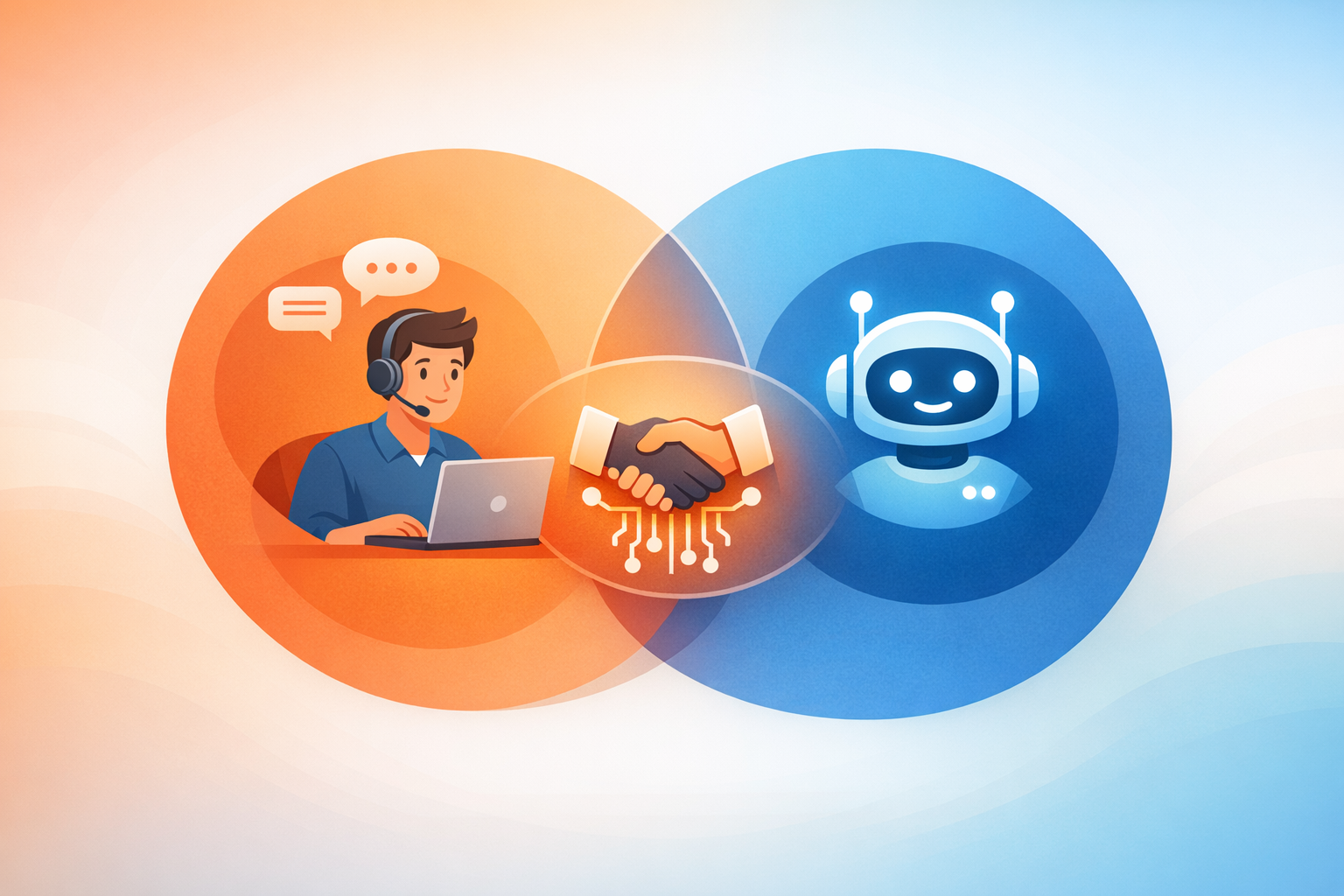
For most businesses, a hybrid approach works best: use chatbots for routine tasks and live agents for complex problems. This strategy balances efficiency with the human touch, ensuring your customers get the right support when they need it.
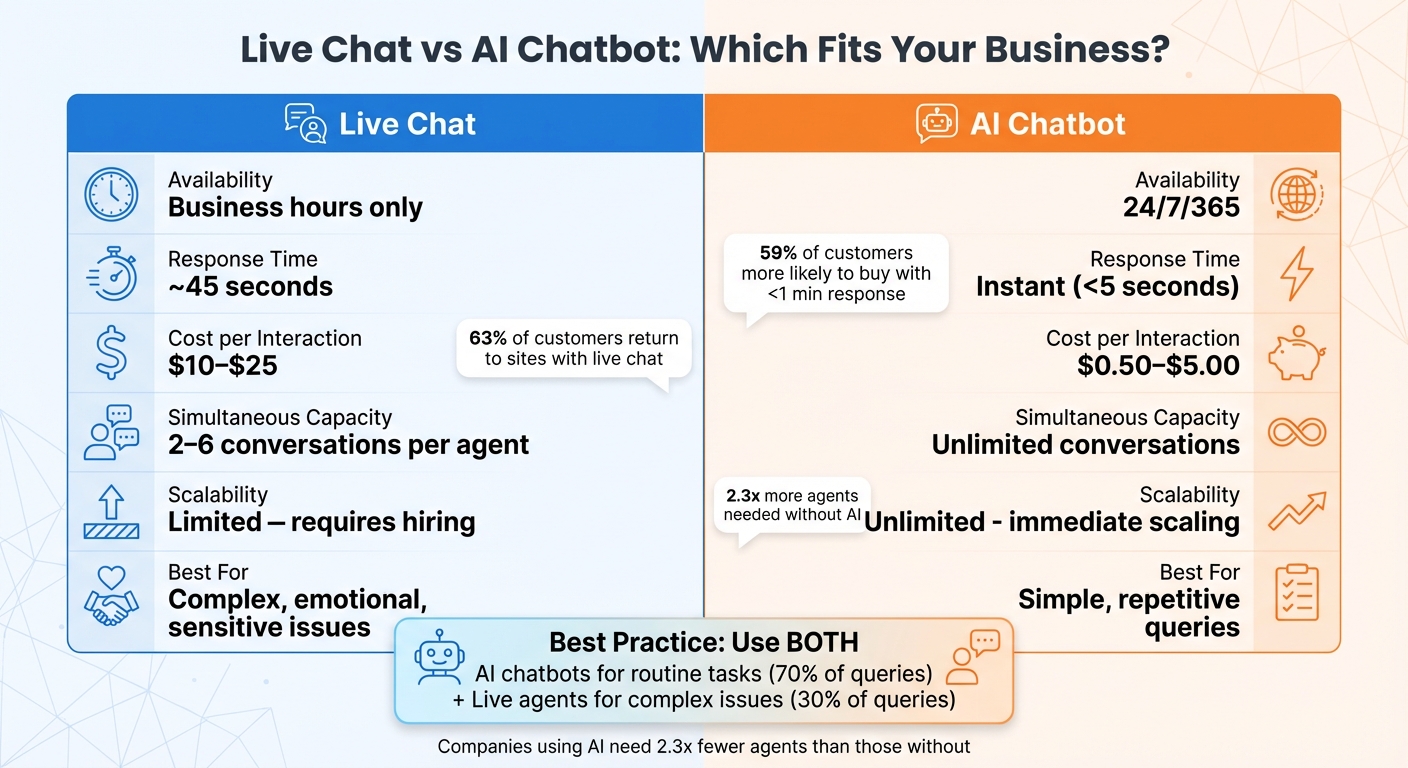
Live Chat vs AI Chatbot Comparison: Cost, Speed, and Scalability
How Live Chat Works
Features and How It Functions
Live chat operates through a chat widget that connects customers directly with human agents in real time. When a visitor clicks the chat icon, they’re instantly paired with an available agent who can respond immediately. Unlike phone support, where agents handle one call at a time, live chat agents can juggle between 2 to 6 conversations at once, making it a more efficient way to manage multiple customer inquiries simultaneously [3][4].
Modern live chat tools come equipped with features like typing indicators, message previews, and integrated searchable knowledge bases. Many systems also sync with CRM platforms, giving agents access to valuable customer data - like purchase history, previous support tickets, and account details - during the chat. This integration allows agents to deliver more tailored and effective support [7][2].
Benefits of Live Chat
One of live chat’s biggest advantages is its ability to handle complex customer issues quickly. Instead of days of back-and-forth emails, a single chat session can resolve even sensitive or intricate problems. This efficiency is enhanced by the human touch - agents can use their judgment, empathy, and adaptability to address customer needs in ways automated systems simply can’t match [3].
Live chat is particularly useful in scenarios like high-value purchases, where customers often need reassurance before buying, or technical troubleshooting, which benefits from real-time, two-way communication. It’s also a go-to for resolving sensitive issues, such as billing disputes or account security concerns. For instance, 63% of customers are more likely to revisit a website that offers live chat, and 21% of consumers aged 25–39 prefer web chat over other support options [7][3]. These statistics highlight live chat’s role in building trust and stronger customer relationships.
Limitations of Live Chat
Despite its advantages, live chat does come with some challenges. One major drawback is the cost of operation. Running a live chat team involves significant expenses, including salaries, benefits, and continuous training for agents [1][4]. On top of that, live chat software typically costs between $15–$50 per agent each month, though staffing costs are the primary expense [7][2].
Another limitation is availability. Unless you have a global team working in shifts, live chat is usually restricted to business hours. Even during those hours, each agent can only manage a limited number of conversations at once. This can lead to wait times during busy periods, particularly for businesses experiencing rapid growth or seasonal traffic spikes. Scaling up often requires hiring and training additional staff, which isn’t as simple as flipping a switch to activate more features. These limitations are important to keep in mind when comparing live chat to AI chatbots.
How AI Chatbots Work
Features and Automation Capabilities
AI chatbots rely on Natural Language Processing (NLP) to understand customer messages and Natural Language Understanding (NLU) to interpret intent and context. This allows them to provide automated responses without requiring human intervention [8]. When a customer sends a query, the chatbot analyzes the text to determine what the user needs and responds accordingly.
With Machine Learning (ML), chatbots continuously improve by identifying patterns in conversations. Many also include sentiment analysis to detect emotions like frustration or confusion. This enables them to adjust their tone or escalate the interaction to a human agent when necessary.
Unlike live chat solutions, AI chatbots are available 24/7 and can operate across multiple platforms, including websites, Facebook Messenger, WhatsApp, and SMS. They also support multiple languages, translating conversations in real time to meet diverse customer needs.
Benefits of AI Chatbots
The advanced capabilities of AI chatbots translate into substantial operational and financial benefits.
One of their biggest advantages is scalability. While human agents can typically manage 2–6 chats simultaneously, a single AI chatbot handles thousands of interactions without compromising performance [3]. For context, contact centers without AI often require 2.3 times more staff to handle the same workload [3].
This scalability significantly reduces costs. For example, teams managing 20,000 monthly requests can save over 240 hours. Amtrak's AI assistant demonstrated these benefits by delivering an impressive 8× return on investment, cutting costs by $1 million, increasing bookings by 25%, and boosting revenue by 30% [8][9].
AI chatbots also excel at automating repetitive tasks. They handle common queries about shipping times, return policies, order tracking, password resets, appointment bookings, and lead qualification with ease [8]. For instance, Edwardian Hotels uses an SMS chatbot named "Edward" to assist guests with over 1,200 topics, leading to a 50% increase in room service sales [9]. Similarly, Town Gas employed chatbots to let customers independently schedule or cancel maintenance appointments, resulting in a 50% jump in self-service interactions [8].
Speed is another major advantage. AI chatbots respond instantly, which is crucial given that two-thirds of millennials expect real-time customer service [8], and 61% of customers prefer self-service for simple issues [10]. A great example is HelloFresh's Facebook Messenger bot "Freddy", which reduced response times by 76% while handling a 47% increase in total message volume [9].
Unlike live chat, where costs and agent availability can limit scalability, chatbots consistently manage high volumes of requests without breaking a sweat.
Limitations of AI Chatbots
Despite their many strengths, AI chatbots have their limitations. They often struggle with complex or nuanced queries that require human judgment, empathy, or creative problem-solving. While they excel at addressing straightforward, repetitive questions, they can frustrate customers when faced with unexpected issues or sensitive topics like billing disputes or account security [3].
Another challenge is the extensive training required to deploy a chatbot effectively. Unlike live agents, who can be onboarded in days, chatbots need to be trained with company policies, product details, and historical data. This upfront effort can be time-consuming [3].
Customer trust is another hurdle. A single negative experience can deter users - 72% of customers say they won’t reuse a company’s chatbot after a poor interaction [10]. Errors like providing incorrect information or failing to escalate to a human agent can erode trust, highlighting the need for continuous monitoring and updates.
"Gartner predicted that agentic AI, combined with conversational AI chatbots, would autonomously resolve 80% of common customer service issues without human intervention by 2029." – Gartner
While the future of AI chatbots looks promising, they still require careful oversight to ensure they enhance customer experiences rather than create new frustrations. Balancing automation with human support is key to maximizing their potential in customer service.
Chatbot vs Live Chat: Which is Better for Customer Service? 📣
Live Chat vs AI Chatbots: Side-by-Side Comparison
Choosing between live chat and AI chatbots comes down to understanding their core differences and how they align with your business needs. While both are designed to handle customer interactions, they vary significantly in terms of cost, speed, and capability.
One of the biggest distinctions is scalability and availability. Live chat agents are typically limited to managing 2–6 conversations at a time during business hours. In contrast, AI chatbots can handle an unlimited number of conversations around the clock, without adding to staffing expenses[3]. This scalability makes a huge difference as your business grows. For example, businesses without AI are expected to need 2.3 times more agents than those that integrate AI into their operations[3].
Cost is another major factor. AI chatbots are far more budget-friendly, with interaction costs ranging from $0.50 to $5.00. On the other hand, live chat interactions cost between $10 and $25, primarily due to labor expenses[6]. Beyond individual interactions, the cost of maintaining live chat agents includes annual salaries of $30,000–$60,000, plus $7,000–$11,000 for training[6]. For businesses handling over 15,000 monthly conversations, this cost gap becomes even more apparent[6].
When it comes to response speed, AI chatbots have a clear advantage. They provide instant replies in under 5 seconds, while live chat responses typically take 45 seconds or longer, depending on agent availability[6]. This difference matters because 59% of customers are more likely to make a purchase if they receive a response in less than a minute[2].
Feature Comparison Table
| Feature | AI Chatbots | Live Chat |
|---|---|---|
| Availability | 24/7/365 | Typically business hours |
| Response Time | Instant (under 5 seconds) | Moderate (45+ seconds) |
| Simultaneous Capacity | Unlimited conversations | 2–6 conversations per agent |
| Cost per Interaction | $0.50–$5.00 | $10.00–$25.00 |
| Monthly Software Cost | Starting at $20/month | $15–$24 per agent/month |
| Issue Complexity | Simple, repetitive queries | Complex, nuanced problems |
| Scalability | Immediate and unlimited | Requires hiring and training |
| Personalization | Data-driven, scripted | High empathy, human judgment |
| Setup Time | Approximately 14 days | Approximately 7 days |
| Accuracy Rate | 98% for routine queries | 89% across all query types |
That said, it’s not always about choosing one over the other. Many businesses find a hybrid approach works best - leveraging AI chatbots for routine questions and lead qualification, while reserving live agents for complex, nuanced issues. This way, you get the efficiency of AI while still offering the human touch where it matters most.
How to Choose Between Live Chat and AI Chatbots
Picking the right support tool for your business hinges on understanding your customers, your operational capacity, and whether a mix of both live chat and AI chatbots might be the best solution. Let's break it down into three main considerations: customer needs, your operational setup, and the potential for a hybrid approach.
Assessing Your Customer Needs
Start by analyzing the types of inquiries you typically receive. For straightforward questions - like order tracking or password resets - AI chatbots are a great fit since they can provide instant replies.
That said, not every situation is straightforward. Complex issues, like billing disputes or emotional customer concerns, require empathy and human judgment. Chatbots just aren’t equipped to handle sensitive or nuanced scenarios. In fact, 49% of customers prefer speaking with a human for support, while 25% say their choice depends on how complicated the issue is [1].
Response speed is another key factor. With 59% of customers more likely to make a purchase if they get a reply in under a minute [2], chatbots can directly influence your sales. However, if your business relies on detailed explanations or building customer relationships, live chat may be worth the slightly longer wait time.
Once you’ve nailed down what your customers want, it’s time to think about your operational needs and budget.
Evaluating Your Operations
Your support volume plays a big role in deciding between live chat and chatbots. If you’re handling fewer than 15,000 conversations monthly, the cost difference between the two might not be significant. But as your volume scales - say, to 50,000 conversations per month - chatbots become far more cost-effective. Live chat, on the other hand, would require hiring more agents to keep up [6].
Budget constraints and team size are also crucial. Smaller businesses may find 24/7 live chat support financially out of reach. As Mia Naumoska, CMO of Internxt, explains:
"While [chatbots] may not have that special 'human touch,' they are an amazing opportunity for smaller companies who may not have the budget or who’d rather invest the time, money, and people back into their product or service" [2].
Chatbots, starting at around $20 per month, eliminate costs like salaries, benefits, and the $7,000–$11,000 annual training expenses required for live agents [6].
Availability is another consideration. If your business serves customers across different time zones or needs 24/7 support, live chat would require hiring multiple shifts. Chatbots, however, provide round-the-clock service without increasing your headcount. In fact, companies without AI are expected to need 2.3 times more agents than those using AI solutions [3].
Once you’ve accounted for these factors, you might find that combining both options offers the best of both worlds.
Using Both: A Hybrid Approach
A hybrid strategy merges the efficiency of chatbots with the empathy of live agents, addressing both customer preferences and operational challenges. Often, the smartest move isn’t choosing one over the other - it’s using them together. As Sayeh Afshar from Amio puts it:
"Chatbots do the heavy lifting (that no one really wants to do), and chat agents bring the human touch, giving you the best of both worlds" [1].
In this setup, chatbots handle the initial interaction, managing FAQs, qualifying leads, and answering routine questions. For more complex cases - or when a customer requests it - the chatbot can seamlessly transfer the conversation to a live agent, complete with all the context.
Take ChatSpark, for example. It allows businesses to deploy AI agents across multiple platforms - like websites, WhatsApp, Facebook, Instagram, Telegram, and Slack - while integrating with live chat tools. This lets the chatbot handle repetitive inquiries 24/7, freeing your human team to focus on more intricate or high-value conversations. A great example of this approach is travel company 10xtravel, which in 2025 cut inbound email support tickets by 70% by using AI agents for routine questions. This shift allowed their team to dedicate more time to complex travel planning requests [6].
To make this approach work, clearly disclose when a chatbot is being used and ensure customers can easily escalate to a human agent when needed [5]. This transparency builds trust and minimizes frustration for customers who need more than an automated response.
Conclusion
Deciding between live chat and AI chatbots comes down to aligning the solution with your business needs. If you’re managing a high volume of repetitive inquiries, need round-the-clock availability, or aim to scale without increasing labor costs, AI chatbots are a practical choice. They can handle countless conversations at once, delivering quick responses while offering notable cost savings [2]. However, for situations that demand empathy, intricate problem-solving, or tailored guidance during critical decisions, live chat with human agents remains indispensable.
While 81% of customers prefer to try solving issues on their own first [2], human agents become critical when challenges escalate or emotions are involved. As Reuben Yonatan, Founder of GetVoIP, aptly states:
"Chatbots are an addition to, not a replacement for, live agent skills and conversation" [2].
For most businesses, the best approach is a hybrid model - using AI to manage repetitive tasks while reserving human agents for conversations that require a personal touch. This strategy has already delivered results, as evidenced by Footshop's success [1].
ChatSpark simplifies the implementation of this hybrid model. Its AI agents can operate across platforms like your website, WhatsApp, Facebook, Instagram, Telegram, and Slack, handling routine inquiries 24/7 in over 85 languages. When a conversation requires human input, ChatSpark ensures a smooth handoff to live chat agents, keeping the full context intact. Whether you’re a solo entrepreneur starting with the Basic plan at $19/month or a large enterprise seeking custom solutions, ChatSpark adjusts to fit your needs.
To make the right choice, evaluate your support tickets, identify recurring questions, and assess your team’s capacity. The best solution isn’t about keeping up with trends - it’s about meeting your customers’ expectations while staying aligned with your operational goals.
FAQs
What are the benefits of combining live chat with an AI chatbot for my business?
A hybrid approach blends the capabilities of AI chatbots with the human touch of live chat, creating a well-rounded customer support experience. Chatbots handle routine inquiries, qualify leads, and provide instant, around-the-clock responses. Meanwhile, live agents step in to tackle complex problems or emotionally sensitive situations. This balance ensures quick, efficient service while preserving the personal connection that customers appreciate.
By assigning high-volume, straightforward tasks to chatbots, businesses can lower support costs and manage increased demand during busy times. When a situation calls for it, the chatbot can seamlessly transfer the conversation to a human agent, ensuring customers receive the appropriate care. This setup not only boosts customer satisfaction but also speeds up issue resolution and preps leads before they reach your team.
The hybrid model allows businesses to scale during peak periods, offer tailored support for critical moments, and gain insights from both chatbot and live agent interactions. It’s an efficient way to meet the expectations of U.S. customers, who value fast responses and human assistance when it truly matters.
How do I choose between live chat and an AI chatbot for my business?
Choosing between live chat and an AI chatbot comes down to what your business needs most. If your focus is on addressing complex, emotional, or nuanced customer issues, live chat is the way to go. It offers a personal touch, making it ideal for real-time problem-solving and even upselling, thanks to human judgment and interaction. On the flip side, AI chatbots are perfect for handling large volumes of routine queries, like answering FAQs, checking order statuses, or providing basic troubleshooting - anytime, day or night.
When weighing your options, think about scalability and cost. AI chatbots can handle thousands of conversations at once, which makes them a budget-friendly choice for businesses with high traffic or limited resources. However, live chat agents can only juggle a few conversations at a time. Scaling a live chat operation means hiring more staff, which increases costs but can significantly boost customer satisfaction by offering a more tailored experience.
A lot of businesses are finding success with a hybrid approach. By combining AI chatbots for quick, automated responses with live chat for more complex issues, they strike a balance between efficiency and a personalized touch.
How do AI chatbots handle customer emotions and complex questions?
AI chatbots rely on natural language processing (NLP) and sentiment analysis to gauge customer emotions and tailor their responses accordingly. They’re designed to pick up on tones like frustration, confusion, or satisfaction, allowing them to respond with empathy or escalate the issue to a human agent when necessary.
Another strength of these bots is their ability to maintain context throughout a conversation. This means they can handle multi-step inquiries or more nuanced requests without forcing customers to repeat themselves. For situations that are particularly complex or emotionally delicate, chatbots can seamlessly transfer the conversation to a live agent. What’s more, they ensure a smooth transition by preserving the entire chat history for the human agent to review.
That said, while AI chatbots excel at spotting patterns and delivering quick responses, they might miss subtle emotional cues. This is why many businesses strike a balance, pairing AI tools with human support to handle more intricate or sensitive interactions effectively.