
Struggling with customer support overload? Conversational AI can help. It automates repetitive tasks, prioritizes tickets, and scales instantly during busy periods - reducing costs and improving efficiency. Here’s how:
- Automates routine inquiries like order tracking and password resets, cutting response times.
- Prioritizes and routes tickets using sentiment analysis and intent recognition.
- Scales instantly during traffic spikes without adding staff.
- Integrates across channels (websites, WhatsApp, Instagram) for consistent support.
- Provides real-time analytics to track performance and optimize responses.
Businesses using tools like ChatSpark report up to 30% cost savings, 20-30% lower call volumes, and improved customer satisfaction. Whether you're managing 100 or 10,000 messages, conversational AI ensures reliable, 24/7 support.
1. Automating Routine Questions with Natural Language Processing
Natural Language Processing (NLP) powers conversational AI to understand customer questions, even when they’re phrased in different ways. Unlike older chatbots that relied on matching exact keywords, NLP focuses on intent (what the customer needs) and entities (specific details like order numbers or product names). For example, it can interpret "Where's my package?", "Track my order", and "When will my stuff arrive?" as the same request - handling slang, typos, and abbreviations with ease.
NLP relies on two main components: Natural Language Understanding (NLU), which figures out the meaning and context of a message, and Natural Language Generation (NLG), which converts structured data into clear, human-like responses. These systems also track conversation context, so customers don’t have to repeat themselves.
This technology delivers real results. TaskRabbit managed a 60% increase in ticket volume - handling 158,000 tickets monthly - with 100% automation of first contacts and a 28% deflection rate. Similarly, AbhiBus deflected 96% of queries, improving productivity by 33%. Unity saved $1.3 million while cutting first response times by 83% [1][3].
The trick lies in deciding which questions to automate. Start by analyzing support data to identify high-volume, repetitive queries like password resets, order tracking, or basic troubleshooting. Then, connect your AI to tools like your knowledge base and CRM to provide accurate, real-time answers. And don’t forget to set up smooth handoffs to human agents for more complex issues.
Platforms like ChatSpark make this process seamless. Their NLP-driven system supports over 85 languages and integrates with tools like Zapier, Freshchat, and Calendly. This allows ChatSpark to access real-time data and deliver accurate, personalized responses at scale. By automating up to 80% of routine inquiries [3], it frees up human agents to focus on the more nuanced problems that require empathy and critical thinking.
2. Smart Prioritization and Routing of Customer Tickets
Not all customer inquiries are created equal. Some, like cancellation threats, need immediate action, while others, such as questions about store hours, can wait. This is where conversational AI steps in, leveraging tools like intent classification, sentiment analysis, and entity extraction to sort and prioritize tickets in real time. It determines which issues can be automated, which need escalation, and who is best equipped to handle them.
By analyzing emotional cues (like words such as "furious" or repeated exclamation marks), extracting structured data (e.g., order numbers, error codes), and reviewing metadata (like VIP status or SLA deadlines), conversational AI ensures that the most pressing issues get attention first. And when the AI isn’t confident enough to resolve the issue, it promptly escalates the ticket to a human agent [9].
"Training AI to understand language, determine intent, and triage problems through well-defined workflows helps offload the grunt work from the agents, allowing them to focus on problem-solving, creative solutions, and empathy for the customer."
This system doesn’t just sound efficient - it delivers real results. Companies using AI-powered ticket routing have seen an 80% reduction in ticket transfers [9]. Those with more advanced AI setups report a 38% decrease in average inbound call handling time [8]. Conversational AI can also automatically resolve 80% of routine questions [3], freeing up human agents to handle the remaining 20% - the cases that require empathy, judgment, or specialized expertise.
ChatSpark takes this a step further with skills-based routing that integrates seamlessly with your existing support tools. When a complex technical issue arises, ChatSpark ensures the ticket goes to the right agent with the necessary expertise, bypassing the inefficiency of general queues. Plus, all relevant information - like conversation transcripts and extracted data (e.g., order IDs, product details) - is transferred with the ticket, so customers don’t have to repeat themselves. During peak periods, this approach helps reduce wait times and prevents customers from being stuck in the wrong queue.
| Priority Level | Criteria for AI Prioritization | Recommended Action |
|---|---|---|
| High | VIP customers, live chat/SMS, pre-sale questions, negative sentiment | Immediate routing to specialized human agent |
| Medium | Account updates, recent order issues, email inquiries | Human agent review within standard SLA |
| Low | FAQs, general feedback, "Where is my order?" (WISMO) | Automated response or self-service deflection |
3. Instant Scaling During High-Traffic Periods
When Black Friday rolls around or a product launch catches fire, traditional support teams often struggle to keep up. But conversational AI? It stays calm and collected, effortlessly managing thousands of conversations at once. It ramps up capacity instantly as demand spikes - no need for frantic hiring, overtime wages, or stressed-out agents. The system simply scales as needed.
The stats back this up. Sixty-one percent of call center managers have reported rising call volumes since 2021, and 58% expect this trend to continue [3]. Conversational AI shines in these moments, handling surges without sacrificing service quality. For instance, AbhiBus implemented conversational AI that deflected 96% of customer queries while increasing support team productivity by 33% [3]. Nykaa achieved a 99.7% engagement rate within one minute during peak times, doubling customer engagement by over 2.2× [3]. Even in the demanding healthcare sector, MediBuddy maintained a CSAT score above 90% while tackling complex queries during high-traffic periods [3]. These results are driven by a scalable, cloud-based infrastructure designed for reliability.
This type of infrastructure is powered by the cloud, allowing instant scaling of processing capacity. Combined with advanced natural language processing, it ensures accurate responses no matter how high the volume gets. Unlike human agents who can get overwhelmed, AI delivers consistent quality under pressure.
ChatSpark takes this scalability to the next level with its cloud-native architecture. Whether managing 100 messages or 10,000, ChatSpark adjusts seamlessly, maintaining performance across all channels. Even during peak periods, the platform prevents bottlenecks by processing inquiries in parallel. A surge in one channel won’t slow down responses elsewhere, ensuring customers never face delays or busy signals.
The cost savings are equally impressive. Automating customer interactions without losing quality can reduce support costs by up to 30% [6] and lower call volumes by 20–30% through proactive updates [4]. This approach not only keeps operations efficient but also eliminates the need for hiring and training temporary staff, making it a smart solution for businesses facing seasonal or event-driven spikes in demand.
4. Multi-Channel Integration for Consistent Support
In today’s fast-paced digital world, customers often jump between platforms - like a website, Instagram, or WhatsApp - all in the same day. Conversational AI ensures they don’t have to start over every time they switch. By preserving the entire conversation history, the AI recognizes previous interactions and maintains a smooth flow across all touchpoints, so customers never have to repeat themselves [10]. This creates a personalized customer experience that forms the backbone of accurate and consistent support.
The secret to this consistency lies in a centralized data system. Whether a customer reaches out through Facebook Messenger or a website chat widget, the AI pulls from the same source to deliver precise, on-brand responses. This system also ensures the AI maintains a consistent tone and personality, regardless of the platform [10].
Real-world examples show just how impactful this approach can be. In October 2025, Accor Plus, a hospitality network, saw a 20% boost in customer satisfaction and a 352% improvement in response times after rolling out AI agents for round-the-clock, multi-channel support [1]. Similarly, TaskRabbit automated all initial customer interactions and deflected 28% of total tickets while handling a 60% surge in demand during its international expansion [1]. Meanwhile, Nissan's Saudi Arabian operations reported a 138% jump in lead generation in August 2024 after deploying a conversational AI chatbot to assist customers outside dealership hours [11].
ChatSpark takes this concept even further by integrating with a wide range of platforms, including websites, Instagram, Facebook, WhatsApp, Telegram, and Slack. Supporting over 85 languages, it maintains context across channels and ensures smooth escalation to human agents when needed. When a complex issue arises, ChatSpark transfers all relevant information to a human agent, sparing customers the hassle of repeating their concerns [2].
This unified strategy doesn’t just enhance customer satisfaction - it also improves efficiency. With 51% of consumers favoring bots for immediate service [1], conversational AI can handle up to 87% of routine interactions automatically [12]. By meeting customers where they are and maintaining a single, reliable data source, businesses can avoid fragmented experiences and deliver effective support, even during peak demand.
5. Real-Time Analytics for Performance Tracking
Real-time analytics take the concept of scalable, multi-channel support to the next level by enabling businesses to fine-tune their AI systems on the go. Conversational AI doesn’t just respond to queries - it learns from every interaction. These analytics turn each customer exchange into actionable insights, helping teams identify patterns, measure performance, and quickly address areas that need improvement. Instead of waiting days or weeks, issues can now be resolved within hours.
Modern platforms go beyond basic tracking. They measure key metrics like containment rates, sentiment trends, and intent recognition accuracy to ensure the AI truly understands and meets customer expectations. Companies that adopt structured measurement systems report a 35% increase in user satisfaction and a 28% boost in operational efficiency [15]. For example, a well-optimized chatbot can achieve a containment rate of around 65% [13], while advanced systems can deflect up to 80% of routine inquiries in contact centers [14]. This level of precision in tracking helps businesses continuously improve their AI systems.
The impact of data-driven optimization is clear in real-world applications. Take Upwork, for instance: using Zendesk AI agents, they managed over 600,000 tickets annually and achieved a 58% resolution rate by consistently monitoring performance and enhancing their self-service options [1].
ChatSpark takes this approach a step further. Its analytics dashboard provides a comprehensive view of key metrics across all communication channels, including websites, Instagram, Facebook, WhatsApp, Telegram, and Slack. This multi-channel visibility allows businesses to keep their AI’s knowledge base up to date, ensuring the system evolves alongside customer needs.
Acting on data in real time is crucial. Weekly audits and custom event tracking help identify potential issues before they impact customer satisfaction. Sarah Chudleigh, Researcher & AI Content Lead at Botpress, emphasizes the importance of this approach:
"Proper monitoring is essential to a successful chatbot deployment - tracking analytics allows you to know which areas your bot has room for improvement and where it's delivering the most ROI" [13].
Comparison Table
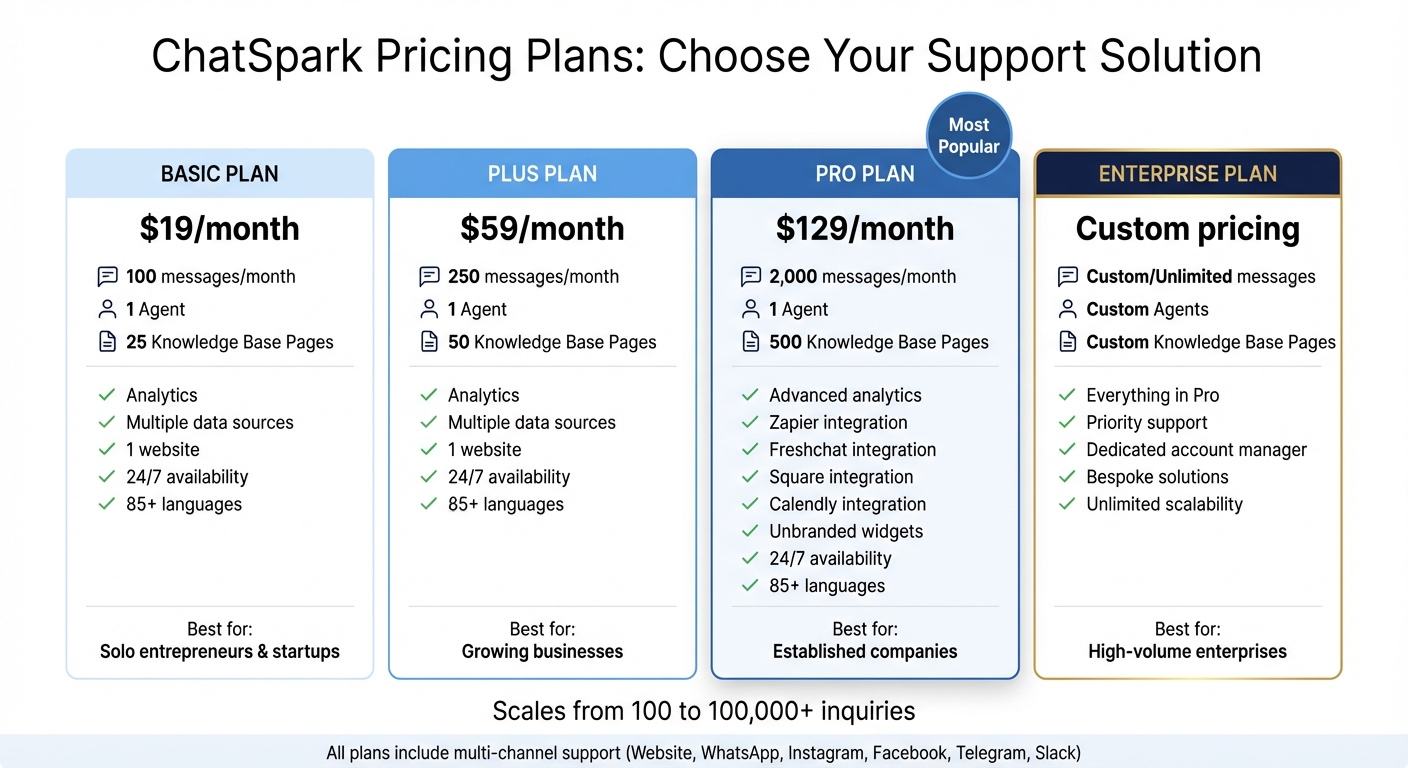
ChatSpark Pricing Plans Comparison: Features and Costs
ChatSpark offers four pricing tiers designed to grow alongside your business needs. Whether you're just starting out or managing high volumes of customer inquiries, there's a plan to suit your requirements.
The Basic plan, priced at $19/month, is perfect for solo entrepreneurs and startups. It includes 100 messages and 25 knowledge base pages per month, offering an affordable way to explore conversational AI. Stepping up, the Plus plan at $59/month accommodates 250 messages and 50 knowledge base pages monthly, making it a great option for businesses with moderate inquiry volumes.
For companies managing larger customer interactions, the Pro plan costs $129/month and supports 2,000 messages and 500 knowledge base pages each month. This tier also provides integrations with Zapier, Freshchat, Square, and Calendly, removes ChatSpark branding from widgets, and includes advanced analytics. Meanwhile, the Enterprise plan offers custom pricing tailored to businesses with high or fluctuating inquiry volumes. It features unlimited scalability, priority support, and dedicated account management.
No matter the plan, ChatSpark delivers essential features such as 24/7 availability, support for over 85 languages, and seamless integration across major channels. Performance remains consistent regardless of whether you're managing 100 or 100,000 inquiries, with analytics dashboards providing valuable insights across all channels.
Here’s a quick overview of the plans and their key features:
| Plan | Monthly Price | Messages/Month | Agents | Knowledge Base Pages | Key Features for High-Volume Support |
|---|---|---|---|---|---|
| Basic | $19 | 100 | 1 | 25 | Analytics, multiple data sources, 1 website |
| Plus | $59 | 250 | 1 | 50 | Analytics, multiple data sources, 1 website |
| Pro | $129 | 2,000 | 1 | 500 | Zapier/Freshchat/Square/Calendly integrations, unbranded widgets, advanced analytics |
| Enterprise | Custom | Custom | Custom | Custom | Priority support, dedicated account manager, bespoke solutions |
Conclusion
Conversational AI streamlines routine tasks, allowing businesses to handle customer inquiries more efficiently while reducing costs. By automating these repetitive interactions, companies can cut expenses by up to 30% and significantly lower the volume of calls, chats, and emails they need to manage.[6]
Operating around the clock without adding extra shift costs ensures customers get instant responses at any time. Companies like Klarna and Unity illustrate how this approach not only saves money but also improves response times.[1][7] This combination of efficiency and scalability makes it easier to meet customer demands, no matter how large or complex.
One standout advantage is the ability to scale operations instantly during traffic spikes - whether it’s a product launch, a holiday rush, or an unexpected surge in demand - without scrambling to hire temporary staff. Add to that the power of real-time analytics, which offer continuous insights into customer behavior and support performance, and businesses can make smarter, data-driven decisions to refine their services over time.
For businesses navigating these challenges, tools like ChatSpark deliver a complete solution. Offering automation, seamless integration, and advanced analytics, ChatSpark helps maintain high-quality support while keeping costs low. With pricing starting at $19/month and options for enterprise-level customization, companies of all sizes can tap into conversational AI to boost customer satisfaction and improve agent efficiency.
FAQs
How does conversational AI manage and prioritize customer inquiries?
Conversational AI leverages natural language processing (NLP) and machine learning to break down each message, evaluating its urgency and importance. It pinpoints key elements like customer intent (e.g., a billing inquiry or a technical problem), sentiment, and any service-level agreement (SLA) obligations. Urgent matters, such as complaints requiring immediate resolution or time-sensitive requests, are flagged for prompt action, while simpler questions are either resolved automatically or assigned a lower priority.
Once priorities are set, the AI directs inquiries to the best-suited destination. Straightforward queries are handled instantly using a knowledge base or AI-generated replies. For more complicated or sensitive issues, the system routes the inquiry to the right human agent or team, considering factors like expertise, workload, and the preferred communication channel (e.g., WhatsApp, website chat). This approach ensures customers receive prompt, consistent support, while human agents can concentrate on the most critical tasks.
ChatSpark seamlessly integrates these capabilities, providing round-the-clock automated support across various platforms. It efficiently manages routine questions and escalates urgent cases to the appropriate agents - all while maintaining consistent service quality in over 85 languages.
How does conversational AI help reduce customer support costs?
Conversational AI plays a key role in reducing customer support costs by taking over routine tasks like password resets, order tracking, and billing inquiries. By managing these straightforward issues around the clock, it eases the burden on human agents, cuts down on labor costs, and keeps operating expenses in check.
On top of that, its ability to deliver quick responses and resolve issues efficiently helps streamline operations. This not only reduces the need for escalations but also enables businesses to handle a larger volume of inquiries without expanding their team. In short, conversational AI offers a smart way to maintain excellent customer support while keeping costs under control.
How does integrating conversational AI across multiple channels improve the customer experience?
Integrating conversational AI across various platforms allows customers to engage with your brand wherever they feel most comfortable - be it your website, WhatsApp, Instagram, Facebook Messenger, or an in-app chat. This approach ensures a smooth experience where conversations flow effortlessly between channels, sparing customers from having to repeat their concerns.
By bringing these touchpoints together, conversational AI delivers consistent, brand-aligned responses while resolving issues more quickly. Operating around the clock, it provides instant support on the customer’s platform of choice. Additionally, it leverages data from all channels to personalize interactions and address pressing matters first. The outcome? A hassle-free, dependable experience that boosts customer satisfaction and loyalty.