AI is reshaping customer service, saving time, cutting costs, and improving response times.
Here’s what you need to know:
- Efficiency Gains: AI reduces first response times by 37% and saves over two hours daily for support teams by automating routine tasks like intent analysis, ticket routing, and drafting replies.
- Cost Savings: AI interactions cost $0.50–$2.00 compared to $8–$15 for human agents, saving the global contact center industry $80 billion by 2026.
- 24/7 Availability: AI handles 80% of inquiries autonomously, operates around the clock, and resolves common issues in 30–90 seconds.
- Personalization: AI uses sentiment analysis and supports 85+ languages, offering tailored responses and serving global audiences without additional staffing.
Platforms like ChatSpark make AI accessible with features like multi-channel support, customizable agents, and real-time analytics, starting at $19/month. Businesses using AI report higher customer satisfaction, faster resolutions, and significant cost reductions.
AI isn’t replacing humans - it’s freeing them to solve complex problems while improving customer experiences.
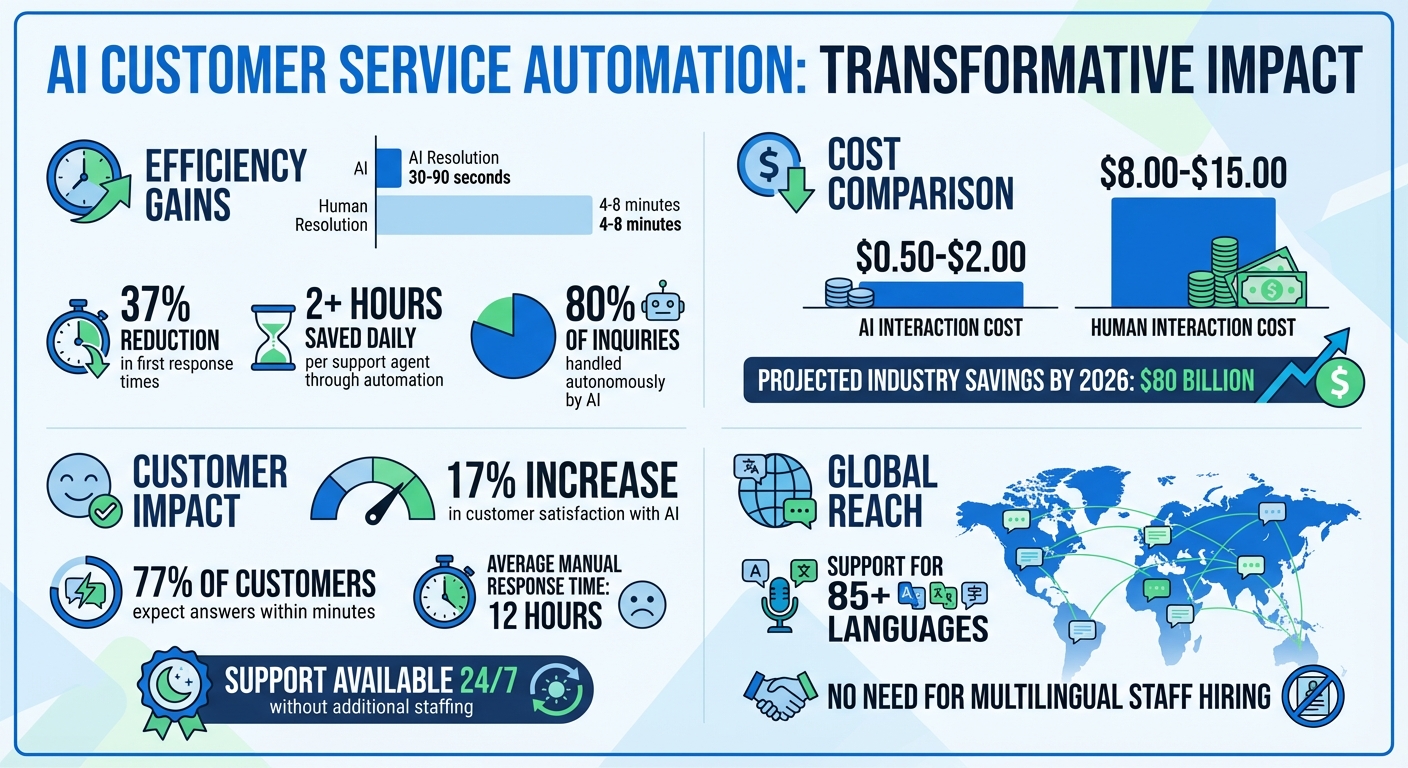
AI Customer Service Automation Impact: Key Statistics and Cost Savings
How AI Automation Benefits Support Teams
AI automation is transforming the way support teams operate by tackling repetitive tasks, giving human agents the freedom to focus on more complex and meaningful work. This shift isn’t about replacing people - it’s about cutting through the clutter that slows teams down and leads to burnout.
Improved Workflows and Team Productivity
AI takes over time-intensive tasks like analyzing customer intent, sorting tickets, and automatically routing them to the right agent [3][5]. When agents open a ticket, the system provides customer history and even drafts contextual responses based on past cases and help articles. This eliminates the need to start from scratch and saves valuable time [3][5].
The impact is clear: service professionals using generative AI save over two hours of manual work each day [3]. AI also creates structured summaries of resolved issues, summarizing the problem and its solution. Zendesk saw these benefits firsthand. After launching their AI system in March 2025, they automated over 60,000 service requests per quarter by July 2025 and achieved a 120% boost in high-quality generative responses [4].
"Even if the AI Agent isn't resolving queries, it frees up agent time to work on the more complex issues. It will collect order IDs, ask for a picture upload if something is faulty, and it'll do all of that legwork upfront." – Suzanne Duffy, Head of Customer Service, Papier [6]
Round-the-Clock Support and Volume Handling
AI also ensures continuous support and improves how teams handle high volumes of inquiries through AI customer support implementation. Operating 24/7, AI eliminates the need for extra staffing to cover nights or weekends [8][9]. Routine inquiries are resolved in just 30–90 seconds, compared to the 4–8 minutes it typically takes for human agents [9]. This speed is crucial when 77% of customers expect answers within minutes, yet manual response times average 12 hours [7].
Well-trained AI systems can autonomously handle around 80% of support tickets, including tasks like order lookups, password resets, and FAQs [8]. Unity, the 3D development platform, adopted AI workflows in January 2026 and saved over $1.3 million in service costs [6].
Lower Costs and Faster Response Times
The cost difference between AI and human interactions is striking. AI interactions range from $0.50–$2.00, while human-handled interactions cost $8–$15 [9]. Across all channels, the savings add up: AI-automated phone calls cost $1–$3 compared to $8–$15 for humans, and AI emails cost $0.50–$2.00 versus $5–$12 for human responses [10].
By 2026, the global contact center industry is expected to save $80 billion in labor costs thanks to AI automation. This is largely due to AI taking over routine tasks, allowing human agents to focus on complex, high-value cases [1][9]. These savings make it possible to invest in more personalized customer interactions.
Tailored Customer Interactions
AI’s ability to process language and analyze sentiment enables it to personalize responses. With support for over 85 languages, AI agents help teams serve a global audience without needing to hire native speakers for every region [5]. Beyond simple translations, AI understands context, keeps conversations natural, and adjusts its tone based on customer sentiment.
For example, Siemens Financial Services collaborated with Zendesk to introduce AI workflows for proactive financial support and autonomous responses. This improved global productivity and boosted customer satisfaction (CSAT) scores to 86% [6]. Companies using AI have seen a 17% increase in customer satisfaction, showing that thoughtful automation can enhance the quality of service [5].
ChatSpark: AI-Powered Customer Support Platform
ChatSpark transforms customer support by using conversational AI to deliver efficient, scalable solutions without increasing staff. It integrates automated responses, lead capture, and analytics into a single platform that operates seamlessly across multiple channels. Impressively, it resolves over 80% of customer inquiries automatically while keeping a consistent brand voice, even in over 85 languages [11]. These features make ChatSpark a go-to option for tackling modern customer support challenges.
Multi-Channel Support Available 24/7
ChatSpark's AI agents are designed to operate across six major channels: websites, WhatsApp, Instagram, Facebook Messenger, Telegram, and Slack. Using the same training data and brand voice for all platforms, it ensures a uniform customer experience [11]. The system works around the clock, handling inquiries in under 2 seconds, which eliminates the need for staffing during nights or weekends [11].
Routine tasks are handled with precision. The platform analyzes questions, searches the knowledge base, executes actions via over 140 integrations - like checking Shopify orders or creating Zendesk tickets - and provides responses almost instantly [11]. One enterprise user reported saving $119,225 monthly by automating 1,831 chats without requiring human intervention [11][12].
Customizable AI Agents with 85+ Language Support
ChatSpark allows support teams to fully customize AI agents. Teams can adjust natural language settings, tone, and response templates to align with their brand. Through the dashboard, users can define the agent's role, upload custom avatars, set brand colors using hex codes, and create up to five suggested prompts to guide customer interactions [13]. Pre-set "Canned Responses" can also be configured to trigger specific replies based on keywords like "discount" or "human", ensuring accuracy in responses.
The platform’s ability to support over 85 languages is a game-changer for businesses aiming to expand globally. It automatically detects and adapts to language and cultural nuances, allowing U.S.-based companies to serve international customers without hiring multilingual staff [11]. For example, a mid-sized U.S. e-commerce company managing over 10,000 interactions per month saw a 50% improvement in query resolution speed and a 30% reduction in costs after deploying agents in English and Spanish [14][15].
Analytics and Lead Capture Tools
ChatSpark’s real-time dashboards provide detailed insights into performance metrics like response times, resolution rates, sentiment trends, and query volumes. Heatmaps highlight the busiest channels, helping teams optimize their strategies [14][16]. The platform also identifies sales opportunities - such as inquiries about pricing or features - and routes them to CRM systems, leading to a 25% boost in conversions [14][16]. One SaaS company even used sentiment analysis on unresolved tickets to increase qualified leads by 40% [14][15].
The lead capture feature seamlessly collects customer information, including names, emails, phone numbers, and company details, either through natural conversations or triggered prompts [11]. Teams can review the "Unanswered Questions" dashboard to pinpoint knowledge gaps and refine the AI based on real customer interactions, ensuring continuous improvement in accuracy.
ChatSpark Pricing Plans
ChatSpark provides four subscription options: Basic ($19/month), Plus ($59/month), Pro ($129/month), and Enterprise (custom pricing). Each plan includes a 14-day free trial - no credit card required. Setting up the Basic plan takes about 5 minutes, while Enterprise setups take 1–2 weeks [17].
The pricing structure shows a clear cost advantage compared to traditional human support. While human agents typically cost $8.00–$15.00 per resolution, AI automation costs range from $0.15 to $2.00 [18]. For instance, in 2025, a global construction products company used ChatSpark for four months. During this time, the AI handled 10,754 messages with a 98% resolution rate, captured 153 leads, and saved over 66 days of agent time. This resulted in $47,880 in savings on an investment of approximately $4,000 [12].
Opting for annual billing provides a 14% discount, equivalent to nearly two months free. Users can also combine plans to increase limits for messages, pages, AI actions, and team members [19]. Below is a detailed breakdown of each plan.
Plan Comparison Table
| Plan | Monthly Cost | Messages/Month | AI Agents | Pages/Agent | Key Features | Best For |
|---|---|---|---|---|---|---|
| Basic | $19 | 100 | 1 | 25 | Website embed, FAQ handling, basic analytics, multiple data sources | Solo entrepreneurs |
| Plus | $59 | 250 | 1 | 50 | Advanced analytics, REST API, 5 AI Actions | Small businesses |
| Pro | $129 | 2,000 | 1 | 500 | Omnichannel (WhatsApp, Instagram, Slack), 40 AI Actions, 2 team members, unbranded widget | Mature operations |
| Enterprise | Custom | Custom | Custom | Custom | Unlimited actions/members, SOC 2 compliance, 90-day audit logs, priority support, dedicated account management | Large organizations |
Key limitations to note:
- Most replies cost 1 message credit, but advanced AI models on Pro or Enterprise plans use 20 credits per reply.
- Message limits reset on the first day of each calendar month, regardless of when the subscription begins.
- Each AI agent is tied to a single communication channel. For example, supporting both a website and WhatsApp requires two agents (and two slots).
- Omnichannel support (Instagram, WhatsApp, Slack) is only available on Pro and Enterprise plans.
- Refunds are not offered due to the upfront costs of training AI agents and setting up infrastructure [19].
Setting Up ChatSpark for Your Support Team
Setup and Customization Process
Getting started with ChatSpark is straightforward. First, sign up using your business email, verify your account, and activate ChatSpark instantly - no coding required [23][24].
Customization happens in two key steps: branding and personality. In the "Branding" tab, you can upload your logo, choose brand colors and fonts, and set up personalized greetings. This process typically takes about 10–15 minutes [23][24]. Next, shape your AI agent's behavior by defining personality traits like formal, friendly, or empathetic. You can also create response templates and design conversation flows using a drag-and-drop builder. These flows cover common scenarios like refund requests or troubleshooting [15][24].
For more advanced setups, you can configure escalation rules. For example, after three failed attempts to address a query, conversations can automatically transfer to a human agent, ensuring customers always have a resolution path [15][24]. A mid-sized e-commerce team shared how they customized ChatSpark in just one day, integrating it with Shopify and Slack. This approach cut their setup time by 70% compared to traditional support tools [15][24].
Once you've tailored the branding and personality, the next step is integrating ChatSpark with your existing tools.
Integration with Business Tools
After personalizing your AI, connect it to your essential business tools to optimize workflows. ChatSpark offers native integrations designed to fit seamlessly into your operations. Navigate to the "Integrations" section, authenticate your chosen tool, and map the necessary data fields. Most integrations are up and running in under 5 minutes [23][24].
Take Slack, for example. When ChatSpark detects a high-priority query through its sentiment analysis, it sends an instant Slack notification, complete with the chat transcript and customer details. This allows agents to jump into conversations seamlessly. Teams using this feature report 40% faster resolution times since agents can monitor multiple channels without needing to constantly check the dashboard [15][24]. Additionally, ChatSpark's AI Actions let your agent perform tasks like checking order statuses in Shopify, creating tickets in Zendesk, or scheduling appointments via Calendly - all directly within the chat interface [11][22].
Training AI on Your Knowledge Base
With the platform customized and integrated, the next step is training your AI on your knowledge base. Upload your files - whether PDF, CSV, URLs, or Google Drive - through the "Train AI" dashboard. The AI uses natural language understanding to process and index the content, with initial training typically taking 30–60 minutes [23][24]. ChatSpark employs retrieval-augmented generation (RAG) to deliver accurate responses, maintaining 95% accuracy on trained topics [15][23].
Start by focusing on your FAQ page or the most common support queries. This ensures the AI can handle a majority of inquiries right away [20][21]. For instance, a SaaS company trained ChatSpark on 500 FAQs and reached 85% auto-resolution for queries within a week [15][24]. Performance metrics like intent match rate, fallback rate (usually under 5%), and user satisfaction scores are all available through the platform's analytics dashboard [15][23]. Regularly reviewing and updating your knowledge base helps maintain response accuracy and relevance [24].
Impact and Future of AI Customer Support
ChatSpark Success Stories
ChatSpark has shown how AI-powered customer support can revolutionize the way businesses operate. By handling routine inquiries with ease, it not only improves operational efficiency but also reduces costs significantly. This means small and medium businesses can offer better customer experiences while saving resources - it's a win-win.
One of the standout features of ChatSpark is its ability to provide around-the-clock availability. Whether it's a holiday or the middle of the night, ChatSpark ensures instant responses. Plus, it can scale effortlessly to handle any volume of customer inquiries, something that traditional manual systems would struggle to achieve. These benefits highlight the transformative potential of AI in customer support.
What's Next for AI in Customer Support
With ChatSpark leading the way, the future of AI in customer support looks even more promising. A key trend on the horizon is sovereign AI, where companies run AI systems within their own environments. This approach ensures compliance with regulations like GDPR and strengthens data privacy protections [26].
Another exciting development is the rise of the agent-to-agent economy. Imagine this: consumer-side AI assistants, like Siri, directly interacting with business-side AI agents to handle service requests without human involvement. This shift could redefine how support systems operate. Nenshad Bardoliwalla, Group VP for AI Products at ServiceNow, explains the importance of trust in this evolution:
"A system that says 'I can resolve 70% of this autonomously and here's exactly why I'm escalating the other 30%' is more trustworthy than one that hallucinates an answer" [25].
The gap between traditional chatbots and advanced AI systems is also becoming more apparent. While basic chatbots often stumble with multi-step queries, agentic AI takes things further. It can perform backend actions like extending trials or activating features - all without needing human intervention [4]. ChatSpark's use of Retrieval-Augmented Generation (RAG) ensures that its AI agents rely solely on your company's documentation and policies [27]. This approach guarantees accuracy and builds the trust that modern support teams depend on.
Conclusion
AI customer service automation is transforming how support teams function. Businesses leveraging AI are seeing impressive results: a 37% reduction in first response times, over two hours saved daily, and projections indicating that 80% of routine interactions will be managed by AI by 2026 [3][1]. The transition from traditional support models to AI-driven solutions is no longer a future concept - it's happening now.
ChatSpark addresses key support challenges by offering 24/7 automated service across multiple channels, personalized to the customer, and available in over 85 languages. Starting at just $19 per month, this solution not only reduces costs but also allows human agents to focus on solving more complex issues.
Modern AI doesn't just deflect inquiries - it resolves them. As Tom Eggemeier, CEO of Zendesk, notes:
"80% of all inquiries will be resolved without the help of a human agent" [2].
This shift frees teams from repetitive tasks, enabling them to concentrate on challenges that require a human touch. By optimizing support operations and improving customer experiences, ChatSpark meets current needs while preparing businesses for the future.
With ChatSpark, you can scale your operations, cut expenses, and enhance customer satisfaction all at once. Whether managing high volume customer inquiries, the platform adapts seamlessly to your requirements, ensuring consistent and reliable service that meets customer expectations.
FAQs
What should we automate first with AI?
Automate tasks that are repetitive and straightforward, such as answering FAQs, providing order status updates, or handling basic account-related questions. These types of inquiries often come in high volumes, making them ideal for AI-powered tools to tackle efficiently. By doing so, you can significantly reduce response times and lower operational costs.
You can also use AI to optimize ticket routing and draft replies, which helps streamline workflows. This frees up human agents to dedicate their time and expertise to more complex issues, creating a smoother integration of AI tools while paving the way for more advanced capabilities in the future.
How do we keep AI replies accurate and on-brand?
To keep AI responses accurate and aligned with your brand, it's crucial to use well-trained, context-sensitive models. Regularly reviewing interactions helps ensure replies match your company's tone and guidelines. Ongoing monitoring and adjustments play a vital role in maintaining both quality and brand consistency.
When should AI hand off to a human agent?
When dealing with complex problems, multi-step processes, or emotionally sensitive issues, it's essential for AI to hand over the interaction to a human agent. Escalation becomes even more crucial when specific triggers signal the need for human intervention. This approach helps ensure effective resolutions while keeping customer satisfaction a top priority.