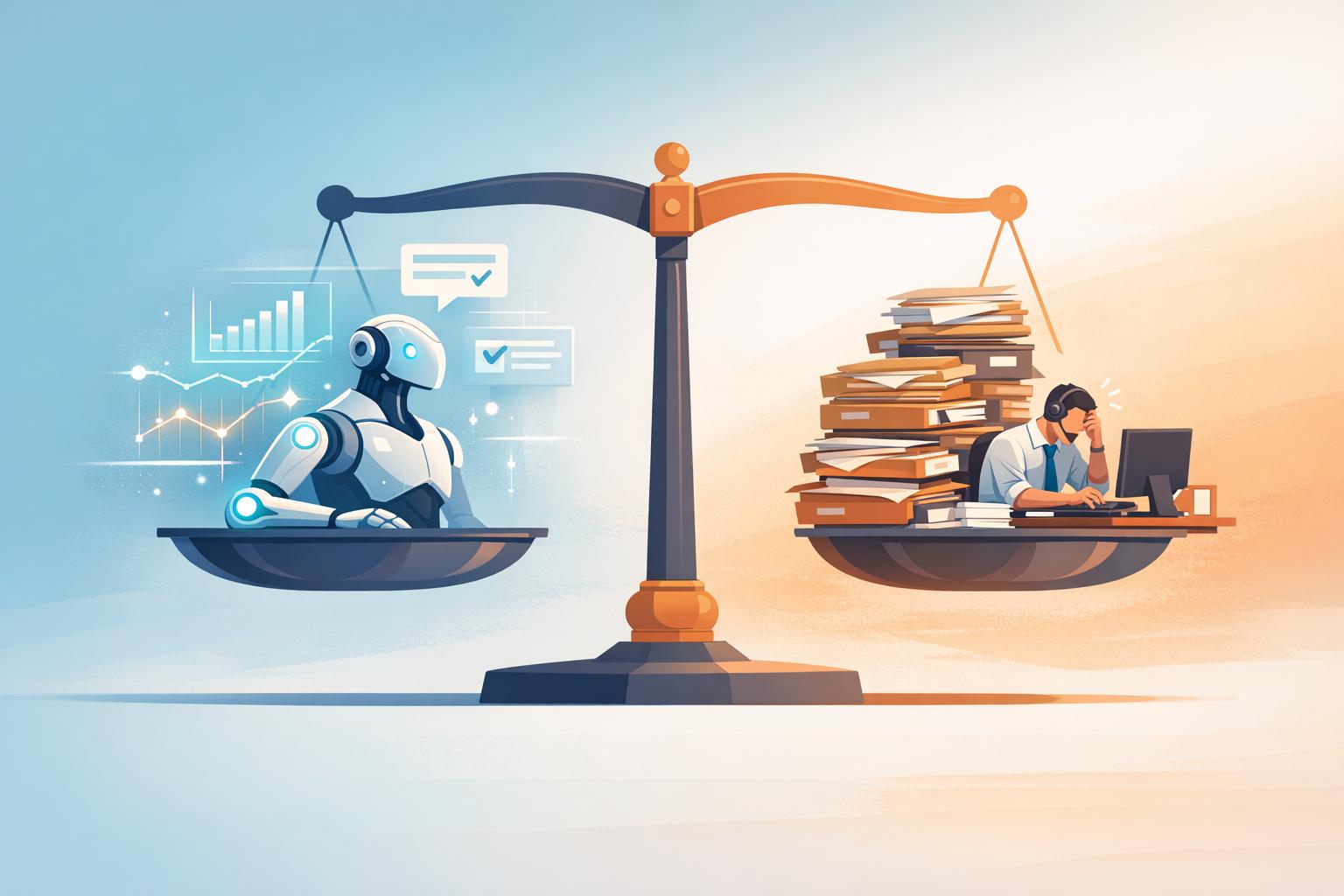
AI-powered customer support is drastically cheaper and more efficient than relying solely on human agents. Here's why:
- Cost per interaction: AI costs $0.25–$0.50 per interaction, compared to $3.00–$6.00 for human agents, cutting expenses by up to 90%.
- Annual costs: A single U.S.-based human agent costs $50,000–$80,000 annually (including benefits and taxes), while AI platforms like ChatSpark’s Pro plan cost $1,548 per year.
- Scalability: AI handles thousands of interactions simultaneously without extra costs, while human support requires hiring and training more staff.
- 24/7 availability: AI operates round-the-clock without overtime or shift premiums - something human teams struggle to achieve cost-effectively.
- Return on investment: Most AI systems pay off within 4–6 months and deliver ongoing savings as interaction volumes grow.
For example, companies like HelloFresh and Telefónica saved millions annually by replacing hundreds of agents with AI, maintaining service quality while drastically reducing expenses. AI support is not just a cost-cutting measure - it's a smarter way to meet growing customer demands efficiently.
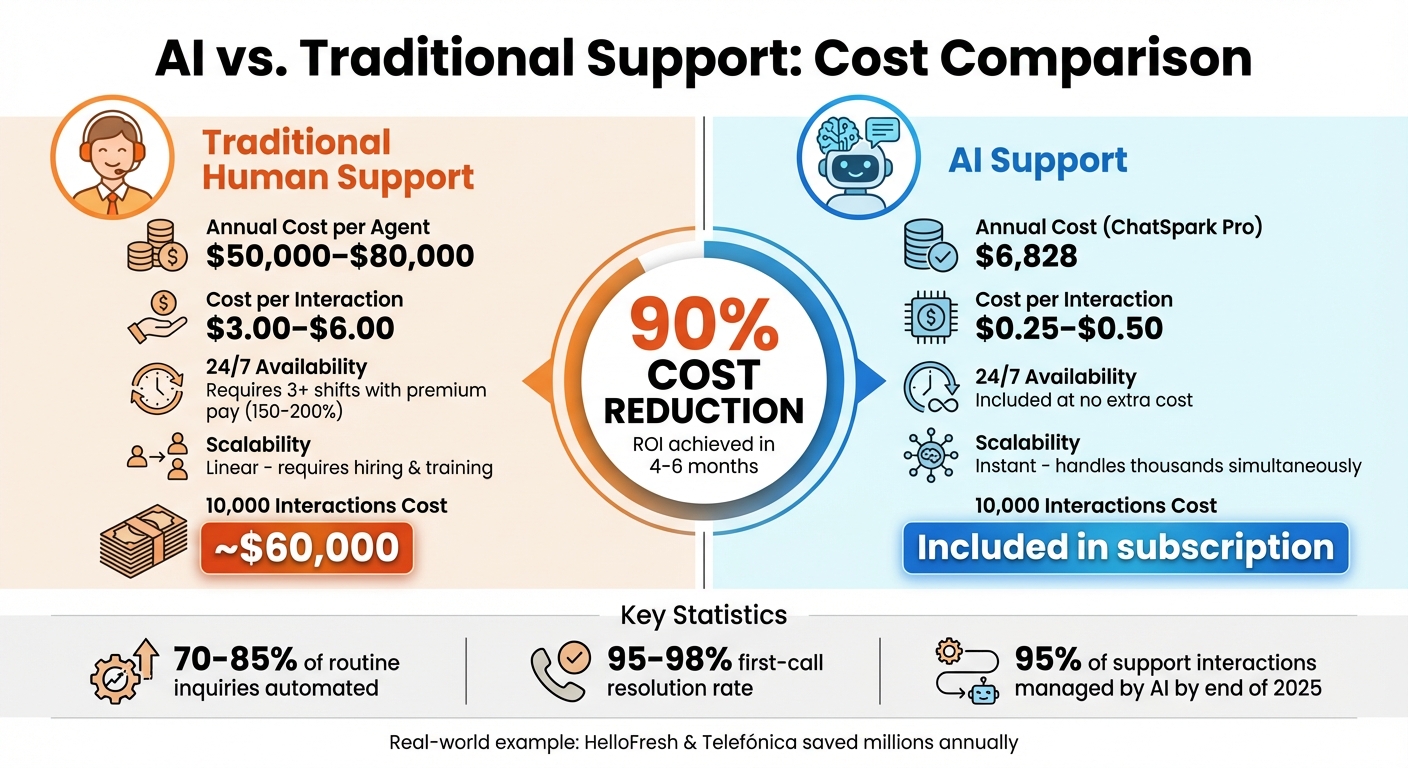
AI vs Traditional Customer Support Cost Comparison
AI Customer Service: Slash Costs & Boost Satisfaction Now! #shorts
Traditional Support Costs Breakdown
When examining traditional support costs, it's clear that expenses go far beyond just paying agent salaries. Each support representative's total cost includes their base salary, benefits (adding an extra 25–35%), payroll taxes (10–15%), and performance bonuses (10–20%)[1]. For example, a U.S.-based agent earning between $42,000 and $48,000 annually ends up costing a company approximately $77,000 when these additional expenses are factored in[4].
Main Expense Categories
Labor costs dominate the support budget, making up 60–70% of total expenses[3]. These costs include not only salaries but also benefits like health insurance, retirement plans, and paid time off. On top of that, training new hires - often a 2–6 week period of non-productive, paid instruction - further drives up costs[1].
Beyond labor, software and infrastructure costs add another layer of expense. Helpdesk and CRM tools typically cost between $1,200 and $2,400 per agent each year[1]. Then there are facilities-related costs, including office space, utilities, equipment, and IT support, which together account for about 15% of the total budget. For companies offering 24/7 customer support, costs rise even higher. Weekend shifts often require premium pay of 150–200% of base salaries, while overtime during peak times or night shifts can balloon labor expenses. Additionally, managing round-the-clock operations often necessitates extra supervisory staff, adding another 5% to the overall budget[5].
Here's a quick breakdown of these costs:
Traditional Support Cost Table
| Number of Agents | Salaries & Benefits (70%) | Software & Tools (15%) | Facilities & Overhead (15%) | Total Annual Cost |
|---|---|---|---|---|
| 1 Agent | $53,900 | $11,550 | $11,550 | $77,000 |
| 2 Agents | $107,800 | $23,100 | $23,100 | $154,000 |
| 3 Agents | $161,700 | $34,650 | $34,650 | $231,000 |
| 5 Agents | $269,500 | $57,750 | $57,750 | $385,000 |
| 10 Agents | $539,000 | $115,500 | $115,500 | $770,000 |
Estimates are based on U.S. benchmarks, with an average cost of $77,000 per agent annually[1].
For instance, before adopting AI in 2025, a global healthcare technology company employed 200 human agents to ensure 24/7 availability and meet HIPAA compliance standards, resulting in an annual operational cost of around $18 million[1]. Similarly, Telefónica faced traditional costs of €3.50 per contact, meaning a surge of 900,000 calls would require hiring an additional 150–200 agents[1]. These examples highlight just how expensive traditional support models can be.
Indirect costs also play a significant role, often going unnoticed but still driving up the price per ticket. For traditional voice support, the average cost per ticket is around $16, with complex or after-hours interactions exceeding $15.00 per ticket[3][5]. These mounting expenses contribute to U.S. businesses losing an estimated $75 billion annually due to poor customer service[4]. This breakdown sets the stage for exploring how AI-driven solutions can offer a more cost-efficient alternative.
AI Support Pricing Models
AI support pricing typically relies on fixed, subscription-based models, offering businesses predictable monthly costs. Unlike traditional expenses tied to staffing, benefits, and overtime, this approach ensures a steady fee regardless of ticket volume. Transparent pricing is crucial - 65% of IT leaders have encountered unexpected charges from usage-based AI platforms [6]. A prime example of this model is ChatSpark, which offers four scalable pricing tiers to suit different business needs.
ChatSpark Pricing Tiers
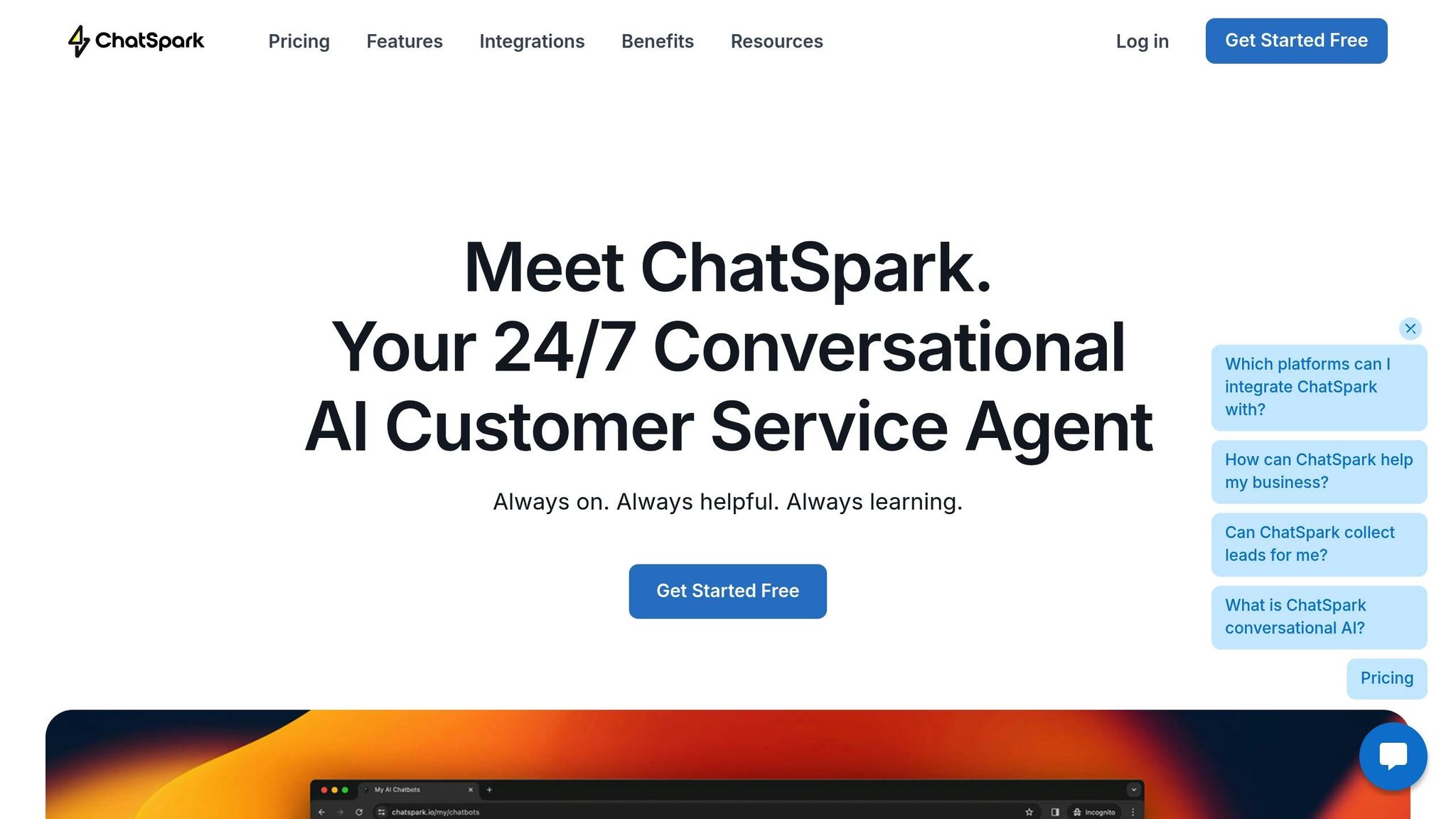
ChatSpark’s pricing is structured across four tiers, each designed to align with varying operational demands:
- Basic Plan: Priced at $19 per month, this entry-level option includes 100 messages. It's a great fit for solo entrepreneurs experimenting with AI support.
- Plus Plan: At $59 per month, this tier supports 250 messages and includes additional features, making it ideal for small business customer service automation.
- Pro Plan: For $129 per month, businesses gain access to 2,000 messages, full integrations (like Zapier, Freshchat, Square, and Calendly), and unbranded widgets - perfect for larger operations managing higher ticket volumes.
- Enterprise Plan: Tailored for large-scale organizations, this custom plan offers flexible message limits, dedicated account management, and priority support.
To put things in perspective, the Pro plan’s effective cost per interaction is approximately $0.065. Compare that to the $6.00–$7.00 average cost per ticket for traditional support, and the savings become undeniable [2]. Even when factoring in AI customer support implementation costs, AI-driven support proves to be a cost-effective solution [7].
AI Support Pricing Table
| Plan | Monthly Cost | Messages Included | Features | Best For |
|---|---|---|---|---|
| Basic | $19 | 100 | 1 agent, 25 pages/agent, analytics, multiple data sources | Solo entrepreneurs, startups |
| Plus | $59 | 250 | 1 agent, 50 pages/agent, analytics, multiple data sources | Growing small businesses |
| Pro | $129 | 2,000 | 1 agent, 500 pages/agent, integrations (Zapier, Freshchat, Square, Calendly), unbranded widgets | Mature operations with high volume |
| Enterprise | Custom | Custom | Custom agents, pages, priority support, dedicated account management | Large-scale organizations |
The scalability of AI support becomes especially evident when compared to traditional models. For instance, handling 2,000 monthly tickets with a traditional support team at an average cost of $6.50 per ticket would amount to around $13,000 in direct expenses. With ChatSpark’s Pro plan, the same workload costs just $129 - a staggering 99% reduction in direct costs.
Side-by-Side Cost Comparison
When you compare AI support to traditional customer service models, the cost gap is hard to ignore. Take ChatSpark's Pro plan, for example – it costs $1,548 per year, which is roughly 2–3% of the fully loaded annual cost of a single U.S.-based customer support agent. A human agent's base salary typically falls between $35,000 and $50,000 annually. But when you factor in benefits (an additional 25–35%), payroll taxes (10–15%), and infrastructure expenses, the total yearly cost balloons to $50,000–$80,000 [1]. This stark contrast highlights the potential for significant operational and long-term savings with AI-powered support.
Breaking it down further, traditional support interactions cost $3.00–$6.00 each, while AI support averages just $0.25–$0.50 per interaction. For instance, handling 10,000 interactions with human agents could cost as much as $60,000. In comparison, ChatSpark's Pro plan keeps the annual cost capped at $1,548, assuming usage stays within plan limits.
Here’s a quick look at the numbers:
Cost Metrics Comparison Table
| Cost Metric | Traditional Human Support | AI Support (ChatSpark Pro) |
|---|---|---|
| Annual Base Cost | $40,000+ (1 Agent) | $1,548/year |
| Total Annual Investment | $56,450–$98,400+ (with benefits/taxes) | $1,548/year |
| Cost per Interaction | $3.00–$6.00 | $0.25–$0.50 |
| Cost for 1,000 Interactions | ~$6,000 | Included in subscription |
| Cost for 10,000 Interactions | ~$60,000 | Included in subscription |
| 24/7 Availability | Requires 3+ shifts with premiums | Included at no extra cost |
| Scalability | Linear (requires hiring/training) | Instant (cloud-based) |
Main Cost Benefits of AI Support
Beyond the clear cost savings, AI support offers unmatched scalability and efficiency, allowing you to automate customer support without losing quality. Unlike human teams, which often rack up overtime costs - weekend and holiday shifts can add a 50–100% wage premium - AI delivers consistent, 24/7 coverage without extra charges.
Traditional support models scale linearly, meaning increased demand requires more hiring and training. AI, on the other hand, scales exponentially. It can handle thousands of simultaneous interactions without any need for additional staff [9]. Most organizations see a break-even point at around 40,000–60,000 interactions annually. Beyond that, the savings grow exponentially. By the end of 2025, it's estimated that AI will manage about 95% of all support interactions [8].
Long-Term ROI and Cost Savings
AI systems don't just cut costs upfront - they deliver long-term returns that grow over time. While most AI setups pay for themselves within 4 to 6 months [9], their real value emerges as they scale and handle more tasks without driving up costs. Over time, these systems become even more efficient, amplifying the savings.
What Drives ROI for AI Solutions
AI can automate 70–85% of routine inquiries [1][2], which means fewer resources are spent on repetitive tasks. By taking over jobs like password resets, order tracking, and FAQs, AI allows human agents to focus on issues that require empathy and critical thinking. This dual benefit - cost reduction and improved job satisfaction - creates a ripple effect of efficiency.
Take Telefónica as an example. In 2024, they implemented AI to manage routine inquiries. The results? A staggering 90% reduction in cost per interaction, dropping from about $3.80 to just $0.38 per interaction. The system handled over 900,000 additional voice calls, saving the company approximately $6.5–$8.6 million annually and eliminating the need to hire 150–200 new agents. [1].
AI also excels in first-call resolution rates. While human agents typically resolve 70–85% of routine queries on the first try, AI systems achieve rates as high as 95–98% [1]. Vodafone saw this in action with its AI assistant, TOBi. Operating in 14 languages, TOBi resolved 70% of customer inquiries and cut cost-per-chat by 70% [10].
"Many organizations are challenged by agent staff shortages and the need to curtail labor expenses, which can represent up to 95% of contact center costs. Conversational AI makes agents more efficient and effective, while also improving the customer experience."
These efficiency gains highlight how AI's ability to scale unlocks even greater savings over time.
Scalability and Performance Over Time
Traditional support models often require hiring more staff as demand grows, leading to proportional cost increases, whereas comparing live chat vs AI chatbots reveals how automation breaks this cycle. AI flips this script. Platforms like ChatSpark can scale effortlessly, handling higher volumes without significant cost jumps. For example, a company managing 500,000 annual interactions might spend $1.5–$3.0 million on human agents. With AI, that cost could drop to just $125,000, delivering annual savings of $1.375–$2.875 million.
This scalability is a game-changer. AI systems not only handle growing workloads but also improve with each interaction, thanks to machine learning. Over time, they become faster and more accurate, driving even greater performance gains while keeping costs steady.
Conclusion
The numbers speak for themselves: AI slashes support costs from $3.00–$6.00 per interaction to an incredible $0.25–$0.50 range, according to industry data[1]. Beyond the financial savings, businesses are also seeing happier customers and smoother operations.
What makes AI even more appealing is its ability to grow with your business. Unlike traditional methods that require hiring more staff as demand increases, AI scales effortlessly. Many businesses find that their AI investment pays off in just 4 to 6 months[1].
In today’s world, where customers expect 24/7 service, relying solely on human support is no longer practical - or affordable. AI offers instant, round-the-clock assistance without the added costs of overtime, shift differentials, or staffing challenges.
"The question isn't whether to implement AI - it's how quickly you can start realizing these benefits."
- Marie Angselius-Schönbeck, CMO, Teneo.AI[1]
ChatSpark makes these benefits accessible with its flexible pricing plans. Starting at just $19 per month for solo entrepreneurs, ChatSpark scales to meet the needs of larger businesses with custom enterprise solutions, tailored messaging limits, and dedicated support. The result? A proven return on investment and a smarter way to manage customer service.
FAQs
How long does it take to see a return on investment (ROI) with AI-powered customer support?
Many businesses see a noticeable return on investment (ROI) within just 2 to 4 months after adopting AI-driven customer support tools. Over six months, ROI gains often range between 240% and 380%, thanks to lower operational costs, quicker response times, and better customer satisfaction.
Tools like ChatSpark streamline operations by automating repetitive tasks and offering round-the-clock support. This not only saves time and resources but also elevates the customer experience, making AI support an efficient and budget-friendly way to scale operations.
What are the main costs involved in traditional customer support?
Traditional customer support comes with three main cost categories:
- Labor costs: This covers salaries, benefits, and the expenses tied to hiring, training, and managing employee turnover.
- Software and tools: Includes the expenses for ticketing systems, CRM platforms, and other essential support software.
- Overhead expenses: Think office space, utilities, compliance requirements, quality assurance, and continuous training programs.
These costs can escalate rapidly as a business grows, making it crucial to explore more budget-friendly options, such as AI-powered solutions.
How does AI manage more customer interactions without increasing costs?
AI platforms, such as ChatSpark, are transforming how businesses manage customer interactions by automating responses at a consistent, low cost per interaction. Unlike traditional support systems that require hiring more staff to handle increased demand, AI solutions scale effortlessly without driving up operational expenses.
This approach allows businesses to handle a higher volume of customer inquiries without adding to their workforce. The result? Reliable, around-the-clock support that keeps costs steady and under control.