Maintaining a consistent brand voice is essential for building trust and standing out in a crowded market. When AI reflects your brand's tone and style, it strengthens customer loyalty, drives engagement, and even boosts revenue - by up to 33%. But without proper training, AI risks sounding generic or off-brand, leading to lost customer interest and diluted identity.
Here’s how you can ensure you automate customer support while staying on-brand:
- Define Your Brand Voice: Identify 3–5 key traits (e.g., professional, approachable) and set specific tone rules (e.g., formal or casual, concise or detailed).
- Create Guidelines: Build a "must-use" and "never-use" list for words, phrases, and tone preferences. Include structural rules like sentence length and readability goals.
- Provide Examples: Use 10–20 top-performing content samples to teach the AI how your brand sounds in practice.
- Train AI Effectively: Upload brand documents, set tone parameters, and create templates for common customer scenarios. This helps personalize customer interactions while maintaining a unified voice.
- Quality Control: Monitor AI responses regularly using metrics like Brand Voice Consistency Score (target: 85%+) and Human Edit Rate (target: <10%).
- Update Regularly: Refresh training materials and guidelines quarterly to keep up with market trends and evolving customer needs.
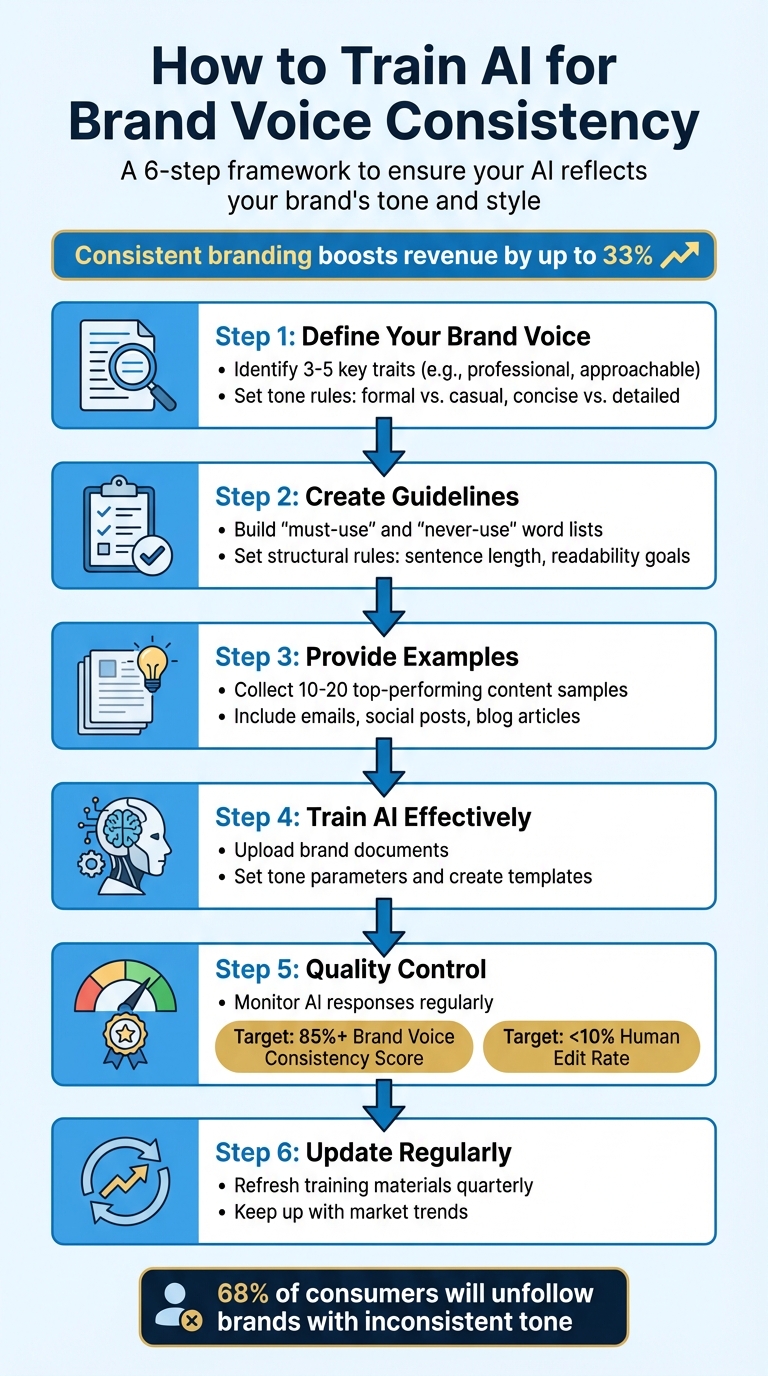
6-Step Process for Training AI to Match Your Brand Voice
Building Your Brand Voice Foundation
Before you train your AI, you need to define your brand voice. This involves documenting the specific words, tone, and style that make your communication stand out.
"A Large Language Model (LLM) can't create your unique brand voice from scratch if you haven't clearly defined it first. The model won't know what to emulate." – Ryan Tepper, Digital Marketing and Design Coordinator, Fishtank [2]
Think of this as creating a blueprint for your AI. Without clear guidelines, the AI will default to bland, generic responses. But with a well-defined voice, every interaction becomes an opportunity to reinforce your brand's identity.
Identifying Your Core Brand Voice Traits
Start by choosing 3–5 descriptive words that reflect your brand's personality. These should be practical and actionable, not vague buzzwords. For instance, an accounting firm might focus on being "professional, clear, approachable", while a B2B SaaS company might prioritize "thoughtful, clear, professional."
Next, decide on your tone. Is it formal or casual? Concise or detailed? Playful or serious? Setting these parameters ensures your AI receives clear instructions, avoiding vague directives like "be friendly."
Different industries naturally lean toward different traits. Education brands often aim for a tone that feels helpful, patient, and empathetic, while luxury brands tend to favor elegance, sophistication, and professionalism. Aviation companies, on the other hand, prioritize a tone that combines expertise, safety, and warmth.
Once these traits are defined, refine your brand voice further by establishing specific tone and word rules.
Setting Guidelines for Tone and Word Choice
Develop a brand dictionary that includes two key lists: a "must-use" list and a "never-use" list. The "must-use" list should include official product names, preferred industry terms, and signature phrases that align with your brand. The "never-use" list helps avoid overused buzzwords, competitor names, or jargon that feels out of place.
For example, a B2B SaaS company might include terms like "alignment, automation, operational clarity" on its "must-use" list while avoiding words like "growth-hack" or "disruptive." An accounting firm might emphasize terms like "compliance, clarity, trusted partner" while steering clear of phrases like "hustle" or "game-changing."
You should also establish structural rules for your writing. Short sentences (under 12 words) can convey energy and clarity, while longer sentences (15–25 words) are better for expressing authority. Define your grammar preferences too - whether you want to use contractions, Oxford commas, exclamation points, or even emojis, depending on your brand's personality.
Finally, set readability goals. Tools like the Flesch-Kincaid grade level can help. For example, many B2B brands aim for a 10th-grade reading level, while consumer-facing apps might target a 6th-grade level. This ensures your AI consistently matches the reading complexity your audience expects.
Gathering Brand Content Examples
Once your guidelines are in place, collect 10–20 examples of your best-performing content. These could include emails, social media posts, product descriptions, blog articles, or automated lead capture messages that perfectly capture your brand voice.
Use the Mirror Exercise to refine your voice further: input 3–5 top examples into an LLM to analyze and extract your brand's characteristics. This method can help identify gaps between how you currently sound and how you want to sound.
Include "before and after" examples to highlight subtle differences between off-brand and on-brand messaging. This is especially helpful for clarifying preferences that aren't easy to capture with descriptive words alone. Just be sure to remove any personal information from customer communications before using them as training material.
Lastly, tag your content with metadata like audience type, communication channel, and customer journey stage. This helps your AI adapt your voice to different contexts while keeping the core identity consistent.
Training AI to Match Your Brand Voice
Once you've defined your brand voice, the next step is setting up your AI to reflect it. This involves providing clear guidelines, establishing tone parameters, and creating templates for specific customer scenarios. Essentially, you're teaching the AI not just what to say but how to say it, ensuring every interaction aligns with your brand identity.
Adding Brand Guidelines and Content Samples
Start by uploading your brand voice documentation to your AI platform. This might include PDFs, documents, or even URLs from your website. Using Retrieval-Augmented Generation (RAG), the system can pull directly from these materials when responding to customer queries. This ensures the AI's answers are rooted in your actual content rather than relying on generic language.
To make the AI even more precise, provide 5–15 examples of your best-performing content - things like emails, social media posts, blog introductions, or customer support messages. These samples act as a blueprint, helping the AI understand your brand's tone, rhythm, and choice of words.
Additionally, set up system instructions that outline the basics: your brand's identity, target audience, and core offerings. These instructions serve as a constant reference for the AI in every interaction. And don't forget to scrub any personally identifiable information (PII) from customer communications before using them for training - this step is crucial for both compliance and privacy protection.
Configuring Tone and Style Settings
Fine-tuning the AI's tone and style is where your brand's personality really comes to life. Use tone sliders to adjust how the AI communicates - do you want it to sound formal or casual? Should it be brief and to the point, or provide detailed explanations? Decide on specifics like whether to use contractions, Oxford commas, exclamation points, or even emojis. These preferences prevent the AI from defaulting to bland, generic responses.
"Act As" prompts are another powerful tool. You can assign the AI specific roles, such as acting as a customer support specialist or a product expert, to ensure responses are tailored to the situation.
To maintain consistency, create a "Never Use" list to ban words or phrases that don’t align with your brand (e.g., overused buzzwords like "synergy"). Pair this with a list of preferred terms and signature phrases. For example, you might specify: "ALWAYS use 'Acme Labs™' instead of 'Acme'."
"Fine-tuning solves this by teaching a model to think in your voice, not just parrot your style guide when explicitly prompted." – Hillock Studio [8]
Creating Custom AI Responses for Different Situations
To handle different customer scenarios effectively, set up role cards. For instance, a "Greeter" card could focus on welcoming customers and identifying their needs, while a "Troubleshooter" card could guide them through resolving technical issues. This helps the AI adjust its responses while staying true to your brand voice.
Craft precise answers for frequently asked questions, especially high-priority topics like pricing, return policies, or product details. This ensures critical information is delivered clearly and consistently.
It's also wise to set up escalation triggers. For complex issues - like billing disputes or sensitive topics - the AI should know when to pass the conversation to a human agent. This ensures both accuracy and a personal touch where needed.
Here’s a real-world example: Between October 2025 and January 2026, a global construction products company used ChatSpark to manage customer interactions for one of its flagship brands. Over four months, the AI handled 10,754 messages, captured 153 new leads, and achieved a 98% resolution rate. This saved the company over 66 days of agent time and $47,880, all on an initial investment of about $4,000 [10].
Before launching your AI, test it with at least 25 realistic scenarios across various content types. Evaluate its responses for tone and accuracy, using a detailed rubric to identify any gaps in training. This final step ensures your AI is ready to represent your brand effectively.
Quality Control: Checking AI Response Consistency
Once you've tailored your AI agents to align with your brand voice, the work doesn’t stop there. Ensuring consistent performance requires ongoing quality control. Without regular monitoring, your AI might drift into generic or off-brand responses, undermining the hard work you’ve put into its initial configuration.
Setting Up Review and Feedback Systems
A solid review system combines automated checks, human oversight, and live-user testing to maintain quality [3]. Reinforcement Learning from Human Feedback (RLHF) plays a key role here, as it ranks multiple AI-generated responses to ensure they align with your brand [3]. Additionally, maintaining a "Golden Set" of 10–20 standard prompts acts as a regression test, helping you confirm that updates or retraining don’t compromise the system’s established quality [8].
Deviations should be categorized by risk level. For minor tone shifts, soft warnings can suffice, but critical issues - like missing legal disclaimers or unintentional mentions of competitors - demand hard blocks [4]. High-risk content, such as legal or compliance-sensitive material, should always involve human review. On the other hand, low-risk tasks like summarizing blog posts can often run autonomously [11].
Tracking AI Performance Metrics
Metrics provide a clear picture of how well your AI maintains brand consistency. For instance, your Brand Voice Consistency Score should ideally stay above 85% across all interactions [3]. Another key metric is the Human Edit Rate, which measures how often manual corrections are needed. A rate below 5–10% is a strong indicator that your AI is effectively following your guidelines [8]. This matters because businesses with consistent branding see, on average, 33% higher revenue and 23% stronger customer retention [4].
Here’s a breakdown of some key metrics:
| Metric | Target | Insights Provided |
|---|---|---|
| Brand Voice Consistency Score | 85%+ | Tracks adherence to voice guidelines [3] |
| Human Edit Rate | <5–10% | Measures how often manual tweaks are needed [8] |
| AI Resolution Rate | 80%+ | Percentage of inquiries resolved without human help [10] |
| Time to Compliance | Decreasing | Tracks the number of editorial rounds needed for approval [4] |
By monitoring these metrics and reviewing decision logs, you can quickly identify and address areas where training might be falling short [12].
Assigning Monitoring Responsibilities
Clear accountability is essential for maintaining consistency. While automated tools can handle routine checks, human reviewers are vital for ensuring strategic alignment and handling nuanced, high-stakes content [4]. Subject Matter Experts (SMEs) should review technical details and product claims, while a governance committee can oversee updates to brand guidelines and track trends in violations [4].
"Brand voice is a system, not a prompt." – The Pedowitz Group [11]
A risk-based framework helps streamline decision-making. For example, blog summaries might operate autonomously, but product pages should go through SME review, and legal content must always include human oversight [11]. Tracking how often interventions are needed will show when adjustments to prompts or guidelines are required [5].
Updating Your AI Brand Voice Settings
Your brand voice changes over time - it adapts to market trends, new products, and evolving customer needs. If you don’t keep it updated, your AI could lose alignment with your messaging goals [13][4]. To avoid this, regularly refresh your guidelines, training materials, and model parameters to ensure consistency.
Running Regular Brand Voice Audits
Set up monthly or quarterly reviews of your AI’s output. During these audits, randomly pick 25 AI-generated responses and evaluate them against your brand guidelines. Look for specific issues: Are banned phrases slipping back in? Is the tone too formal or the reading level too advanced? Are emojis being used incorrectly? These checks help you catch and fix problems early, preventing larger issues down the line.
If your Human Edit Rate spikes from 5% to 40%, it’s a sign your training materials need an update [8]. Use your Golden Set - high-quality examples of ideal responses - to validate these updates and detect performance dips before they affect your customers [8].
Updating Training Materials
After completing your audits, replace outdated examples with newer, high-performing content every quarter. If your team tweaks an AI response and it works flawlessly, save that version as a "gold standard" for future training [8]. This ensures that what works best today informs tomorrow’s AI.
Revise your "Must-Use" and "Never-Use" term lists monthly to stay current with new product names, industry shifts, and competitive changes [4]. Also, make sure to remove any personally identifiable information from customer interactions before adding them to your training library - a crucial step for maintaining data privacy [8][7].
Retraining AI Models Over Time
Once your guidelines and training materials are updated, adjust your AI model accordingly. Most businesses don’t require full model retraining. Instead, opt for prompt conditioning, which involves updating your custom instructions and persona prompts. This method is faster and less disruptive than full-scale fine-tuning [9]. Regularly update your Retrieval-Augmented Generation (RAG) library - the database of FAQs, product documents, and style guides your AI references. This keeps your AI’s responses fresh without causing downtime [11][7].
For more substantial changes, consider Parameter-Efficient Fine-Tuning (PEFT), such as using LoRA adapters. These lightweight updates allow you to refine your AI’s performance without the expense of full retraining [4][8]. Plan these updates on a quarterly basis to minimize drift, and always version your prompts so you can revert if needed [11][7].
"Fine-tuning isn't a one-time project; it's a continuous optimization loop, just like your product development process." – Hillock Studio [8]
Before rolling out any updates, conduct a calibration test. Use 10 prompts that cover various scenarios - emails, social media posts, and support tickets - and score each response on a 1–5 scale. This step helps you catch any potential issues before they reach your customers [7][6].
Maintaining Brand Voice Across Multiple Channels
Platforms like Instagram, WhatsApp, and Slack each have their own style, yet your brand's core identity must stay intact. Consumers are quick to notice inconsistencies - 68% of them will unfollow or stop engaging with a brand if its tone suddenly changes [4]. Here's how to ensure your voice adapts appropriately without losing its essence.
Adjusting Brand Voice for Different Platforms
While your brand values remain steady, how you communicate them should align with the audience and expectations of each platform. For example:
- Instagram thrives on a casual, emotional tone. Short sentences, emojis, and clear calls to action work best here.
- LinkedIn, on the other hand, demands a professional, authoritative voice. Thought leadership and data-driven content resonate most, with minimal use of emojis [6][14].
- Email communications should feel personal and direct, focusing on what comes next with a single clear call to action.
- Web chat needs to be concise and helpful, using short bullets and quick steps to resolve issues efficiently [1][6].
To manage this, create a "Tone by Channel" map. This tool outlines audience expectations for each platform and highlights specific "yes/no" phrases. You can also use persona-driven prompts for your AI, such as instructing it to "Act as a Community Manager" for social media or "Act as a Technical Support Specialist" for web chat. These tailored adjustments ensure your brand voice stays consistent, even as it shifts to match different contexts.
| Platform | Tone & Style | Key Characteristics |
|---|---|---|
| Emotional & Casual | Short sentences, emojis, clear CTA [6][14] | |
| Professional & Authoritative | Thought leadership, data, fewer emojis [6][14] | |
| Personal & Clear | Direct address, focus on "what's next" [6] | |
| Web Chat | Helpful & Concise | Short bullets, compact formatting, quick steps [1] |
Using ChatSpark for Multi-Channel Brand Consistency
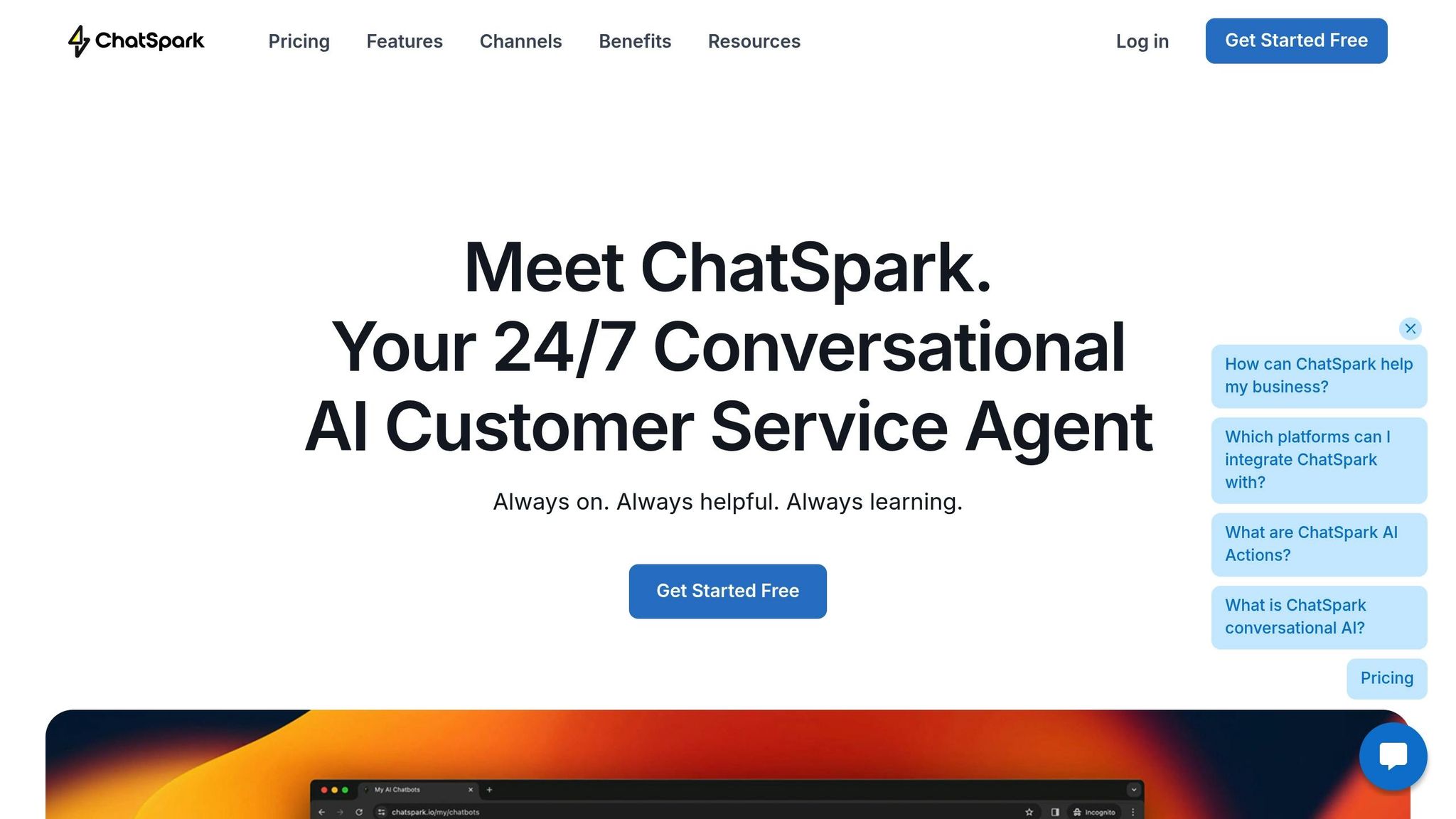
ChatSpark takes these strategies a step further by providing a platform to unify your brand voice across all channels. With ChatSpark, you train your AI once and deploy it seamlessly on platforms like Instagram, Facebook Messenger, WhatsApp, Telegram, and Slack. This ensures your brand persona remains consistent, no matter where your customers interact with you [10].
To maintain accuracy, you can upload brand resources like URLs, PDFs, documents, or YouTube transcripts, creating a centralized knowledge base. ChatSpark uses this "single source of truth" to keep responses aligned across platforms.
The platform also allows you to customize your AI's persona with features like name, avatar, color scheme, and personality traits. Whether your tone is professional, friendly, or sales-driven, ChatSpark ensures it translates effectively - even across 85+ languages. This way, a witty English tone doesn’t lose its charm when adapted for other languages [10][4].
Combining Automation with Human Review
Even with sophisticated AI tools, human oversight is essential to maintain authenticity. Certain situations - like legal concerns, safety issues, or repeated customer frustration - require human judgment [10]. To address this, set up escalation triggers that automatically pass complex conversations to live agents. ChatSpark integrates with tools like Freshchat, enabling smooth handoffs while preserving the full conversation history [10][1].
Designate "Brand Guardians" to monitor AI-generated responses for nuance, alignment with your strategy, and sensitivity to context. A strong workflow involves the AI scoring its drafts for consistency, followed by automated compliance checks, with human editors refining the final output. This blend of automation and human input ensures your brand voice remains authentic and effective [4].
Conclusion
Shaping AI to reflect your brand's voice is a continuous effort that requires clear guidelines, periodic updates, and a solid quality control system [4]. Begin by outlining your core brand values and offering 10–20 examples of content that aligns with your brand identity. To ensure consistency, adopt a three-tier quality control approach: AI voice classifiers to identify tone inconsistencies, rule-based validators to enforce essential standards, and human editors to add strategic nuance [4].
The benefits are clear: consistent branding not only strengthens customer loyalty but also boosts revenue. For instance, one ChatSpark client, a global leader, achieved a 98% resolution rate while saving 66 days of agent time and $47,880 [4][10].
To maintain this alignment, conduct quarterly audits of your brand voice. These audits help prevent tone drift and ensure your AI's knowledge base stays relevant - especially since outdated content is three times more likely to lose visibility in AI-driven search results [5]. Regularly update training materials to reflect shifts in your market.
ChatSpark makes it easier to deliver consistent, on-brand communication across websites and social platforms. By centralizing and maintaining an up-to-date knowledge base, it automates routine inquiries at 85–92% lower costs [10]. With support for over 85 languages and integrations like Freshchat and Zapier, updates are synchronized across all channels, eliminating inconsistencies [10].
Still, even with advanced automation, human oversight is crucial. Combining AI's efficiency with human judgment ensures authenticity and respects cultural nuances. Set clear escalation triggers and monitoring protocols to strike the right balance [4].
FAQs
How can I evaluate if my AI maintains a consistent brand voice?
To ensure your AI aligns with your brand's voice, start by comparing its responses to your established tone and style guidelines. Focus on tone, vocabulary, and messaging to confirm the AI mirrors your brand's personality effectively.
Regular audits can help identify any inconsistencies in its responses. These reviews can be done manually or with specialized tools that assess AI outputs across various platforms. Pay attention to recurring deviations, and adjust the training data or prompts to address gaps. Collecting user feedback is another valuable way to pinpoint areas where the AI might fall short in capturing your brand's voice.
Using a mix of these approaches helps you deliver a cohesive and reliable brand experience in every AI-driven interaction.
What should I do if my AI starts giving responses that don’t match my brand’s tone?
If your AI starts generating responses that don’t align with your brand, the first thing to do is revisit the training process. Make sure it’s equipped with clear brand guidelines, examples of the tone you’re aiming for, and any specific communication rules. Testing its outputs regularly is key - this allows you to tweak input data or prompts to keep the AI's responses on point with your brand’s style.
Another helpful step is to introduce validation processes, like periodic human reviews, to quickly identify and correct inconsistencies. You could also explore tools designed to maintain a consistent brand voice. These strategies can help refine your AI, ensuring it consistently reflects your brand's identity in every interaction.
How often should I refresh my brand voice guidelines for AI training?
To ensure your AI stays aligned with your brand and meets customer expectations, it's smart to revisit and refresh your brand voice guidelines on a regular basis. This can happen during routine content audits or whenever you notice changes in your brand identity or shifts in what your audience prefers.
Keeping these guidelines current helps guarantee that your AI consistently delivers messaging that feels on-brand and connects with your audience effectively.