
Your brand voice is how your business communicates its personality to customers. Keeping it consistent across platforms builds trust and loyalty, leading to higher revenue and customer retention. However, 81% of companies struggle with off-brand content, and 68% of consumers will disengage if a brand's tone changes unexpectedly.
AI tools can help maintain consistency by ensuring automated responses match your brand’s style. They serve as a safeguard - not a replacement for creativity - by validating content and catching inconsistencies. This guide outlines seven practical steps to define, implement, and sustain a unified brand voice with AI:
- Define Your Brand Voice: Identify your brand’s personality traits and create a clear voice chart.
- Audit Existing Content: Evaluate your current messaging for alignment and gaps.
- Create a Brand Voice Guide: Develop a playbook with specific rules, examples, and tone guidelines.
- Train AI agents: Use high-quality content and guidelines to teach AI your brand’s style.
- Set Clear Prompts: Craft precise instructions for AI to handle different scenarios.
- Combine AI with Human Oversight: Pair automation with human review for quality control.
- Monitor and Update Regularly: Continuously track performance and refresh guidelines.
These steps ensure consistent communication, stronger customer relationships, and measurable growth.
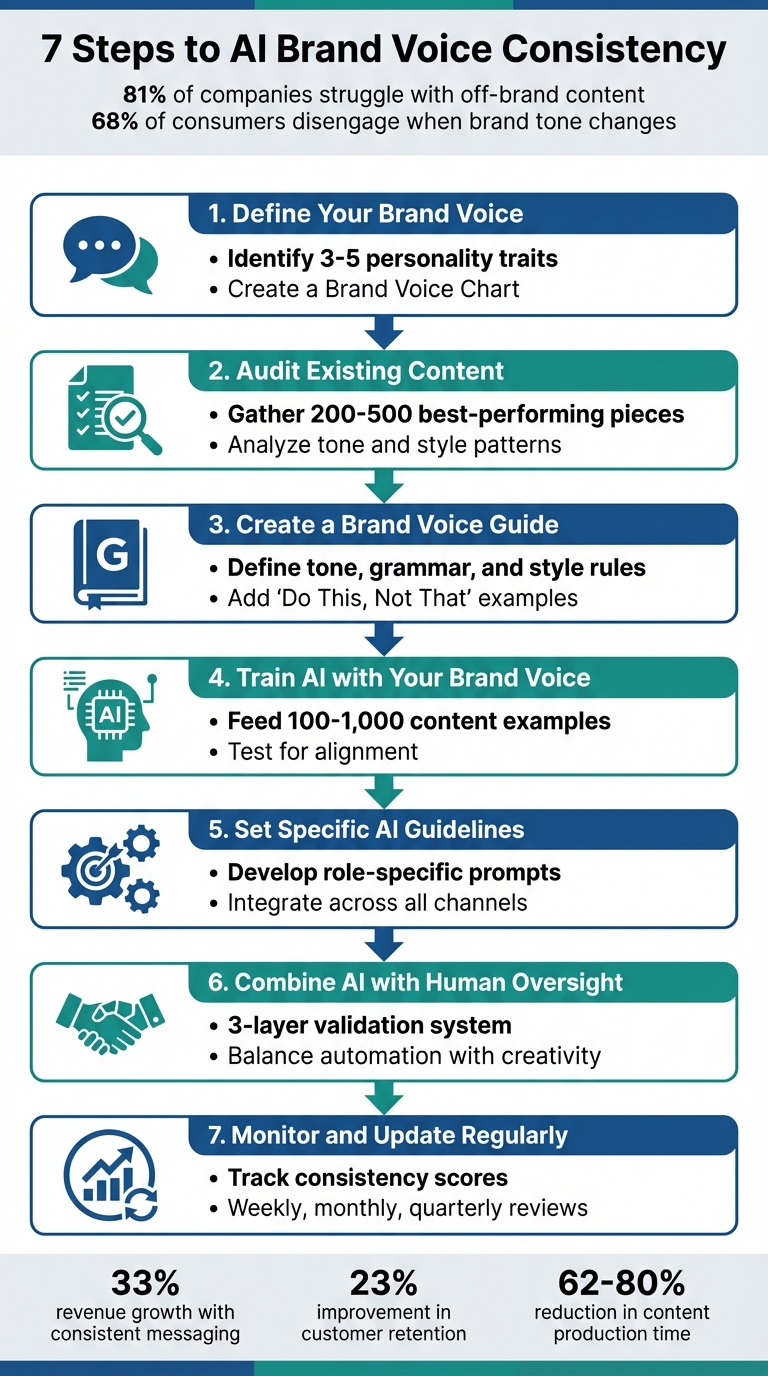
7 Steps to Maintain AI Brand Voice Consistency
Step 1: Define Your Brand Voice
Before you start using AI, it's crucial to define your brand voice. This means clearly outlining the personality traits that make your communication stand out. Think of your brand voice as the steady personality that shines through in everything you do - whether it's a casual Instagram post or a professional response to a customer inquiry. While your tone may shift depending on the platform or situation (think formal on LinkedIn versus playful on TikTok), your voice should remain consistent [8].
Start by imagining your brand as a person. What three words would describe its personality? Maybe it's confident, approachable, and innovative. Or perhaps it's passionate, quirky, and authentic. These descriptors become the foundation for training AI to reflect your brand's identity [7]. Keep in mind, your voice is the anchor, while tone adapts to fit the context.
Identify Core Voice Traits
Once you've outlined your brand's personality, break it down into specific traits. A great way to do this is by creating a Brand Voice Chart. This chart should include four columns: the voice trait, its definition, examples of how to use it (on-brand), and examples of what to avoid (off-brand) [5][9]. This "Do This, Not That" approach ensures your AI stays aligned with your brand's identity, avoiding generic or off-brand language.
For instance, if "approachable" is one of your traits, define it clearly. Use simple, empathetic language and offer clear guidance. But avoid jargon, overly casual slang, or emojis that might feel unprofessional. If "confident" is another trait, focus on strong, decisive language backed by real results. However, steer clear of making exaggerated claims or using vague buzzwords. These detailed guidelines keep AI-generated content distinct and true to your brand.
While refining your brand voice is key, understanding your audience is just as important.
Create Customer Personas
To ensure your voice connects with your audience, you need to understand who they are. Build detailed customer profiles that include their age, location, job roles, interests, and - most importantly - how they communicate. These customer personas should reflect not just demographics but also preferences and communication styles. This Voice of Customer (VoC) data is essential for aligning your brand voice with what your audience expects [9].
Rather than trying to appeal to everyone with the same tone, segment your audience into specific buyer personas. For example, technical buyers might prefer precise, data-driven language, while general consumers respond better to messaging that highlights benefits [9]. Erin Crews, Senior Design Manager of Content Strategy at Mailchimp, sums it up perfectly:
"A distinct voice makes your brand's abstract identity more concrete and helps you connect with your audience. It's an expression of your company's values and point of view, and it should differentiate you from competitors" [10].
When your brand voice reflects what your audience wants to hear, you're doing more than maintaining consistency - you’re building trust. And trust is what turns casual interactions into lasting loyalty and, ultimately, increased revenue.
Step 2: Audit Your Current Content
Now that you've outlined your brand voice, it’s time to evaluate how well your existing content aligns with it. This step is critical for identifying where your messaging hits the mark and where it veers off track. Inconsistent messaging can erode the trust you’ve worked hard to build, which is why conducting a thorough content audit is a must.
Start by gathering content from all customer touchpoints - your website, social media accounts, email campaigns, customer support responses, and even AI-generated messages. Focus on high-value pieces like your "About Us" page, homepage, and top-performing marketing materials. These will serve as the foundation for training AI tools and act as your benchmark for quality. Aim to collect 200–500 of your best-performing pieces to represent your brand at its peak [2].
Analyze Tone and Style Patterns
Take a close look at your most successful content to uncover what resonates with your audience. Pay attention to patterns in tone, word choice, sentence structure, and emotional appeal. Are your top posts conversational and empathetic? Do they consistently use the language and terminology that define your brand voice?
For a more systematic approach, use AI classifiers to evaluate batches of content and compare them against your brand traits. Tools like Vale can help by automatically flagging forbidden terms, missing key phrases, or formatting errors. Additionally, readability scoring can ensure your content maintains a consistent complexity level, making it more accessible to your audience.
These insights will help you identify where your content aligns with your brand voice and where it strays.
Identify Gaps and Inconsistencies
Once you've assessed your content, pinpoint areas where it deviates from your established voice. Look for inconsistencies in tone, phrasing, or terminology - what’s often referred to as "message drift." This issue can arise when content is created by different teams, spread across time zones, or distributed on various platforms. To combat this, consider creating a Brand Dictionary. Include a column of "Must-Use" terms, such as official product names and key value propositions, alongside a column of "Never-Use" terms, like banned buzzwords or off-brand jargon.
When prioritizing fixes, classify them into "Hard Blocks" for non-negotiable issues and "Soft Warnings" for stylistic improvements. This way, you can address critical problems without stalling the overall process.
Make these audits a regular practice. Perform weekly checks on new AI-generated outputs, update your training data monthly, and conduct comprehensive quarterly reviews across all channels. Consistent messaging isn’t just about maintaining your brand’s identity - it can also drive revenue growth by as much as 33% and improve customer retention by 23% [2]. Clearly, the effort pays off.
Step 3: Create a Brand Voice Guide
After completing your content audit, the next step is turning those insights into a practical, standardized messaging guide. This guide serves as a reference point for all teams and AI systems, ensuring every communication aligns with your brand's voice. Essentially, it transforms your audit findings into actionable instructions.
Think of this guide as your brand's communication playbook. Start by identifying 3–5 core traits that define your voice, but don’t stop at vague descriptions like "We are bold." Instead, provide specific behaviors that bring these traits to life. For instance, instead of just saying "bold", explain how that looks in practice: "We begin sentences with strong opinions. Use one-word sentences for emphasis. Avoid hedging with phrases like 'we believe' or 'perhaps.'" This level of clarity ensures both human writers and AI systems can consistently deliver the intended tone.
Consistency in voice isn’t just about sounding polished - it directly impacts your bottom line. Research shows that 81% of consumers need to trust a brand before making a purchase [11].
Define Tone, Grammar, and Style Rules
Your guide should also include clear rules for tone, grammar, and style. Decide on preferences like whether to use the Oxford comma, sentence case versus title case, and how to handle punctuation in casual contexts. Create a vocabulary bank with two columns: one for "Must-Use" terms (e.g., official product names or key phrases) and another for "Never-Use" terms (e.g., jargon or language that feels off-brand).
Next, outline how your tone adjusts based on the situation. For example, Wildride successfully automated 33% of their email tickets by training AI with specific, on-brand examples, ensuring the responses felt natural and human [1]. This tonal flexibility could mean using a friendly phrase like "Here’s a quick guide to get you started" in a marketing email, while in product documentation, it might shift to something more instructional, like "Click 'Settings' to update your preferences." The personality stays consistent, but the delivery adapts to fit the context.
Also, include guidelines for channel-specific adaptations. Whether it’s a tweet, help center article, or email, the way your brand voice comes across should feel appropriate for the platform while remaining true to your identity.
Add 'Do This, Not That' Examples
Abstract descriptions of traits don’t mean much without real-world examples. To make your guide actionable, create a four-column table (Trait, Definition, Do, Don't) that provides clear examples of how each voice trait should - and should not - be expressed. This helps both humans and AI tools understand and replicate your voice effectively.
| Voice Trait | Definition | Do (On-Brand) | Don't (Off-Brand) |
|---|---|---|---|
| Empathetic | Show understanding and care for users. | "We know this can be frustrating. Let’s fix it together." | "Your request has been received. We will respond within 3-5 days." |
| Direct | Get straight to the point, no fluff. | "Here’s the best way to get started." | "Utilize our synergistic solutions to facilitate a seamless transition." |
| Playful | Use light humor without losing clarity. | "Whoops! Our server is taking a nap. We’re waking it up now." | "Catastrophic failure detected. System malfunction imminent." |
For each trait, include at least three examples that reflect different scenarios. You might also run a "writing amnesty" by collecting off-brand communications from various departments to use as real-life "Don't" examples.
Finally, upload this guide to tools like ChatSpark to enable real-time, on-brand AI suggestions. In 2025, 3M implemented a centralized brand voice system across 500+ social accounts in 70 countries. By leveraging AI-powered translations and standardized brand training, they reduced support cases by 90% and response times by 75%, all while maintaining a consistent global brand identity [1].
This guide will be your cornerstone for training AI and empowering your team to maintain oversight in future steps.
Step 4: Train AI with Your Brand Voice
Now that your brand voice guide is complete, it’s time to bring it to life. By training your AI tools with your content and guidelines, you ensure that every automated response feels like it’s coming straight from your team. This step turns your documentation into a dynamic system that delivers consistent, on-brand communication across all customer interactions.
Feed High-Value Content and Guidelines
Start by assembling a collection of your best-performing content - anywhere from 100 to 1,000 examples. Pull from a variety of sources, such as blog posts, email campaigns, social media updates, website copy, and sales materials. These examples should showcase your brand’s personality and how your voice adapts across different contexts.
It’s also helpful to include examples of content that misses the mark. Clearly label these as off-brand to help the AI understand what doesn’t align with your voice.
Next, upload your full brand voice guide. This should include your mission statement, audience personas, core values, and a glossary of terms - both those you want to use and those to avoid. Tools like ChatSpark let you embed these guidelines directly into the AI’s framework using Retrieval-Augmented Generation (RAG). This ensures the AI pulls from your specific knowledge base rather than relying on generic data.
If you’re working with limited resources, don’t worry. Even 5 to 10 high-quality examples can help the AI mimic your style without requiring expensive fine-tuning. Some tools can even analyze 500 to 1,000 words of your best content to automatically detect your brand’s tone and values.
Once your content and guidelines are in place, the next step is to test how well the AI aligns with your brand voice.
Test for Alignment
To confirm the AI captures your brand’s essence, put it through real-world scenarios. Use test prompts that simulate actual customer interactions, such as support questions, product inquiries, or sales conversations. Then, compare the AI’s responses to your brand voice guide to see how closely they align.
For example, in 2024, Wildride successfully automated 33% of their email tickets by training AI with brand-specific guidance. Their AI even replicated their tone by using heart emojis in influencer replies (Source: Gorgias Case Study, 2024).
To maintain quality, combine AI classifiers, rule-based validators, and human editors. These tools can flag tone mismatches, enforce key guidelines, and add subtle refinements. Set up a system with varying levels of severity - use “soft warnings” for minor issues, like overused phrases, and “hard blocks” for critical problems, such as accidental competitor mentions or legal missteps.
Step 5: Set Specific AI Guidelines and Prompts
To ensure every customer interaction aligns with your brand, it’s time to define clear and precise AI instructions. By tailoring these guidelines, you can keep your AI responses consistent and on-point.
Develop Role-Specific Prompts
Crafting role-specific prompts is key to effective communication. For instance, in customer support, you might instruct: "You are a seasoned support agent. Respond in a friendly, professional tone. Avoid technical jargon. Always provide a clear next step." On the other hand, for social media: "Write a short, casual caption in first-person language. Use an upbeat, engaging tone. Keep it under 280 characters."
Your AI persona should reflect specific traits, communication styles, and language rules that align with your brand. Consider this example for a luxury retail brand: "You are an experienced personal shopper. Use elegant, sophisticated language. Be poised and exclusive. Avoid slang or casual abbreviations." This level of detail is crucial, especially when 61.4% of marketers rely on AI for content creation, with success hinging on well-defined parameters [6].
To further refine prompts, include clear "Do" and "Don't" examples. For a brand emphasizing authenticity, you might say:
- Do: "Share genuine experiences and challenges."
- Don't: "Fabricate stories or mislead the audience."
For high-stakes situations, such as handling customer complaints or crisis management, it’s best to leave these to human writers [3].
Integrate AI Across Customer Channels
Once your prompts are ready, deploy them consistently across all customer-facing platforms. Whether it’s your website, Instagram, Facebook, WhatsApp, Telegram, or Slack, your AI should maintain a unified voice. While each platform may require slight adjustments - like a professional tone for LinkedIn or a casual vibe for Twitter - your brand personality should always remain recognizable [1].
Tools like ChatSpark can simplify this process, allowing you to manage prompts across channels from a single dashboard. With support for over 85 languages, you can set role-specific prompts for each platform while keeping responses consistent and accurate. This omnichannel approach matters - a consistent brand voice can boost customer retention by 23% compared to fragmented messaging [2].
Regularly reviewing and refining these prompts ensures your AI communication remains aligned with your brand goals and customer expectations.
Step 6: Combine AI Outputs with Human Oversight
While AI is a powerful tool for content creation, it’s not a substitute for human judgment. Recent stats reveal that 61.4% of marketers are using AI, with 44.4% relying on it specifically for content creation. But here’s the key: automation works best when paired with human review[6]. This partnership helps catch errors, add emotional depth, and ensure your brand’s voice stays consistent and relatable across all customer interactions.
Review AI-Generated Content
A solid review process is essential to get the most out of AI-generated content. Start with a three-layer validation system:
- AI Voice Classifiers: These tools can detect tone inconsistencies with over 90% accuracy.
- Rule-Based Validators: They enforce strict guidelines, like avoiding banned terms or ensuring proper formatting.
- Human Editors: Humans step in to refine nuances, ensure cultural appropriateness, and add emotional resonance[2].
To make this process efficient, create a severity system to prioritize issues. For instance:
- Hard Blocks: These are non-negotiable errors, like profanity, competitor mentions, or missing legal disclaimers, which require immediate action.
- Soft Warnings: These flag less critical issues, such as repetitive phrases or minor tone mismatches, that can be addressed during the review process.
Regular audits are also a must. Despite the risks, 81% of companies admit to publishing off-brand content, which makes consistent reviews crucial[2].
This structured approach ensures AI efficiency is enhanced by human creativity, resulting in polished and impactful communications.
Balance Automation with Human Creativity
Even with a strong review process, there are areas where human creativity must take the lead. Delegate routine tasks - like typo corrections, formatting checks, and bulk content scanning - to AI. But for high-stakes messaging, such as brand origin stories, mission statements, customer complaints, or crisis communications, rely on human insight. These situations demand emotional intelligence and a deeper understanding that AI simply can’t replicate[3].
"Use AI to support storytelling, not replace it - humans should still craft your brand's origin, mission, and voice pillars."
– Leah Messenger, Content Marketing Manager, Optimizely[3]
The importance of human oversight was underscored in the 2023 Mata v. Avianca legal case. A lawyer used ChatGPT for research and submitted a filing with fabricated citations, leading to serious professional consequences[1]. This case highlights why fact-checking and accuracy validation must always involve human review, especially in sensitive areas like legal, financial, or medical content.
To make this collaboration seamless, establish clear handover rules for your team. For example, automate simple inquiries and routine customer questions, but set up triggers to escalate sensitive or complex issues - like customer complaints or cancellation requests - to human agents. These situations require empathy and nuanced problem-solving that AI cannot provide.
Finally, create a feedback loop between human editors and AI systems. When editors refine AI-generated content, they should provide specific feedback - such as preferred phrasing or tone adjustments. This helps improve the AI’s future outputs. Tools like ChatSpark make this process smoother by allowing you to update prompts and guidelines across all channels from a single dashboard, ensuring your AI evolves while keeping your brand voice consistent and sharp.
Step 7: Monitor, Evaluate, and Update Regularly
Your brand voice isn't something you can set up once and forget about. Markets change, customer preferences shift, and messaging priorities evolve. If you don’t keep an eye on things, your AI might stray from the tone and style you've worked so hard to establish. The solution? Put a system in place to regularly review, evaluate, and fine-tune your AI. This approach builds on the earlier steps to make sure your AI stays aligned with your brand's voice.
Track Key Metrics
Using insights from your previous audits and AI training, focus on a few key metrics to measure performance. Start with Consistency Scores - these combine data from AI classifiers, rule violations, and readability levels to give you a clear picture of how well your content reflects your brand voice[2]. Look for patterns in rule violations, such as the use of banned buzzwords or incorrect product names, to pinpoint areas where your AI might need extra training[2].
Another important metric? The number of revisions needed to get AI-generated content up to standard[2]. If your team is spending too much time fixing AI outputs, it’s a sign that your prompts or training data need improvement. Finally, measure customer impact: Are your customers recognizing and connecting with your messaging? Are they remembering your brand? These insights will show whether your efforts are making the desired impression.
Schedule Regular Updates
Regular updates are essential to keep your messaging on track. Start with weekly checks of AI output. Your content team should review the AI-generated material frequently to catch any immediate issues[1].
On a monthly basis, refresh your AI’s training data. Feed it your latest high-performing content and update your lists of must-use and never-use terms[1][2]. These monthly adjustments ensure your AI stays in sync with your most effective messaging strategies.
Every quarter, take a step back for a comprehensive audit. Your brand management team should review all AI-generated content to identify any long-term deviations and update few-shot examples as needed[1][2]. These quarterly reviews help maintain consistency and reinforce customer trust.
Assign Responsibilities
Clear roles are key to making this process work smoothly. Assign specific teams to handle each task:
| Task | Frequency | Responsible Team |
|---|---|---|
| Review AI-generated content for alignment | Weekly | Content Team |
| Update AI training with recent content | Monthly | Marketing Team |
| Refresh must-use and never-use lists | Monthly | Marketing/Legal |
| Conduct full content audits | Quarterly | Brand Management |
| Update few-shot examples and prompts | Quarterly | Marketing Team |
For technical updates, designate a platform admin to manage changes using tools like ChatSpark. This ensures that updates to your brand guidelines are applied consistently across all channels, whether it’s your website, Instagram, WhatsApp, or any of the 85+ languages you support. Create a feedback loop where team members can flag AI responses that miss the mark. Use this feedback to retrain your models monthly, keeping your brand voice sharp and consistent.
Conclusion
A consistent AI brand voice is more than just a nice-to-have - it’s a key driver of trust, and trust is what fuels business success. In fact, 81% of consumers say they need to trust a brand before making a purchase[12]. On the flip side, 68% would walk away from a brand if its tone suddenly felt off[2]. Keeping your brand voice steady is essential for building lasting connections with your audience.
Platforms like ChatSpark make this process easier by ensuring your brand voice stays consistent across every channel - whether it’s your website, Instagram, WhatsApp, or even in over 85 languages. With ChatSpark, your AI can deliver responses that align with your brand 24/7, creating seamless and reliable customer experiences. This consistency turns one-time buyers into loyal customers who not only stick around but also recommend your brand to others.
The numbers speak for themselves: teams using tools like these can cut content production time by 62% to 80%, while identifying tone inconsistencies with over 90% accuracy[4]. That means less time spent on manual checks and more time for your team to focus on strategic, big-picture goals. Start today, and you’ll be on your way to a system that keeps your brand voice consistent, sharp, and ready to grow.
FAQs
How can AI tools help maintain a consistent brand voice across platforms?
AI tools help maintain a consistent brand voice by leveraging a style guide and using your top-performing content to train their language models. The first step is to clearly define your brand voice - this includes tone, personality, preferred phrases, and examples of both what to do and what to avoid. Once you've nailed this down, the guide is integrated into the AI system, which then applies it across different platforms, tweaking the tone as needed. For instance, it might keep things professional in emails but adopt a more casual vibe for social media posts.
After training, the AI can handle tasks like drafting content, offering suggestions, and delivering responses that stay true to your brand across platforms like websites, Instagram, WhatsApp, and more. Tools like ChatSpark simplify this process, letting you upload your brand guide and ensuring real-time, consistent messaging in over 85 languages. While AI takes care of the heavy lifting, regular human input ensures that your brand voice stays current and aligned with your evolving goals.
How can I train AI to reflect my brand's unique voice and tone?
To ensure AI reflects your brand’s voice, start by crafting a comprehensive brand voice guide. This guide should outline key elements like your preferred tone (e.g., casual, formal), vocabulary choices, sentence structure, punctuation habits, and even whether emojis are part of your communication style. Think of it as the blueprint for how your brand "sounds."
Once your guide is ready, gather examples of your top-performing content - this could include blog posts, social media updates, or even customer service responses. Tag these examples with the specific voice traits they embody. These tagged samples act as teaching tools, helping the AI understand and replicate your brand’s style. When configuring the AI, embed these rules into prompts or platform settings, and include examples of both what works and what doesn’t.
Maintaining consistency is all about ongoing feedback. Regularly review AI-generated content to ensure it aligns with your voice guide, and make corrections as needed to fine-tune its output. Tools like ChatSpark can simplify this process by letting you upload your voice guide, enforce tone consistency across platforms, and track performance in real time. With consistent adjustments and clear instructions, your AI can effectively mirror your brand’s personality.
Why is it important to combine AI-generated content with human oversight to maintain a consistent brand voice?
AI can churn out content at remarkable speed, but it lacks the ability to fully understand your brand’s unique personality or the subtleties of every interaction. That’s where human oversight comes in - ensuring that the tone, values, and style of your brand are consistently reflected. It also helps catch errors or off-brand language before anything goes live.
By combining AI’s speed with human judgment, you can protect your brand’s authenticity and reputation. Consistent, well-aligned messaging not only builds trust but also fosters loyalty - key ingredients for long-term success. For instance, tools like ChatSpark can handle customer interactions in over 85 languages. However, it’s up to marketers to define tone guidelines and regularly review AI-generated responses to keep them accurate and aligned with the brand’s vision.