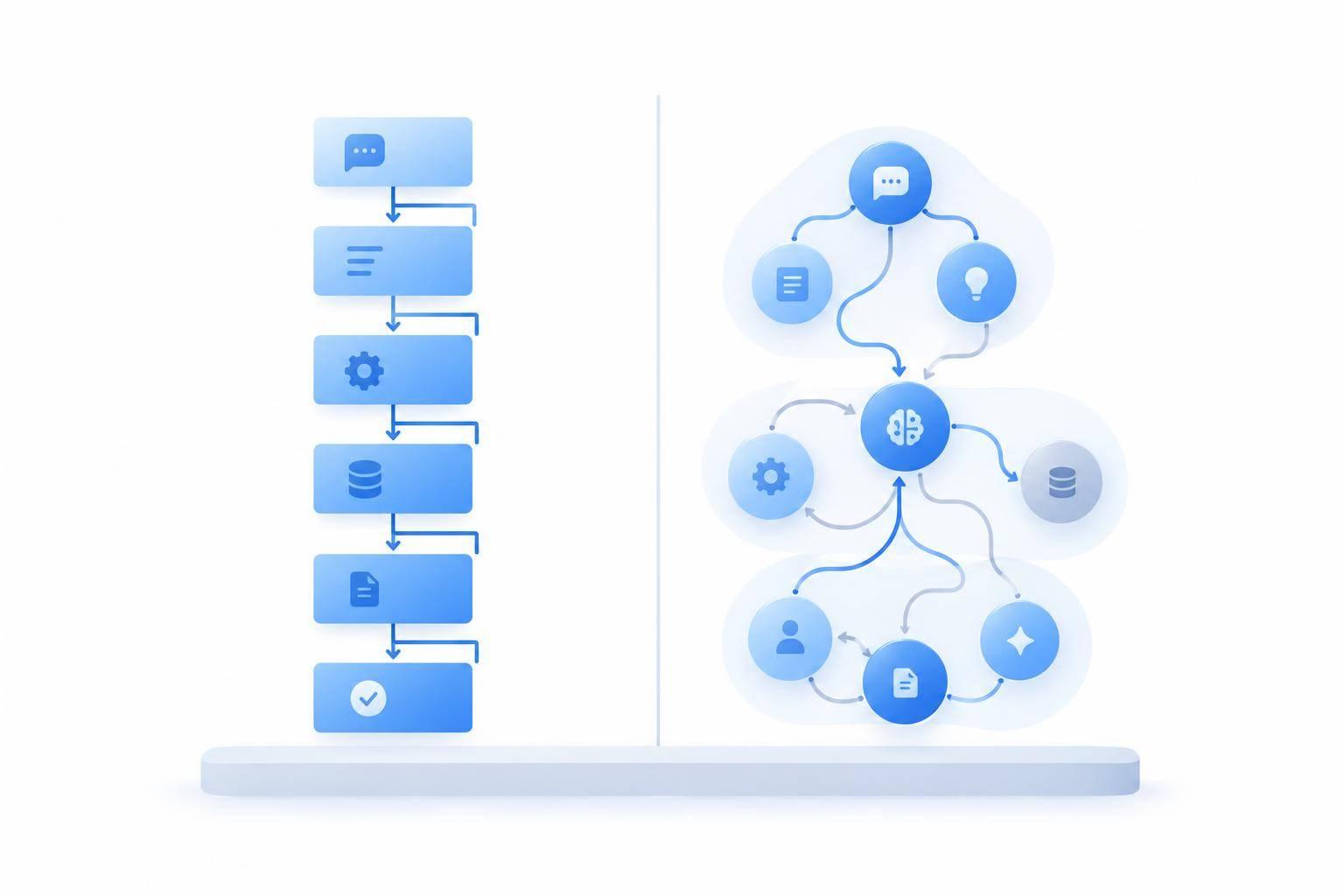

I’d choose a support system by what it remembers, checks, and safely does - not by its “AI” label. Test one simple case: can it tell a replacement order from the original before checking shipping or issuing a refund?
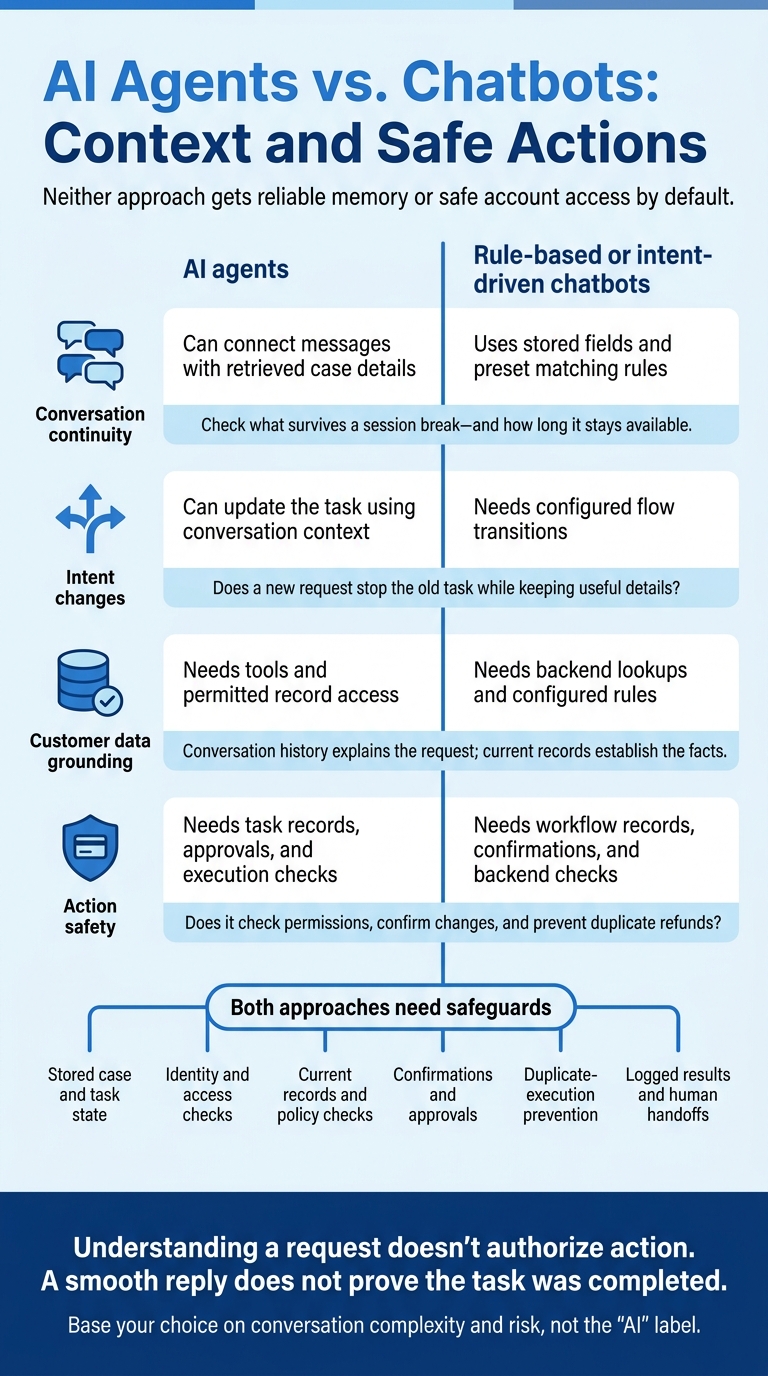
AI agents can follow changing requests using messages, stored task details, and connected tools. Rule-based or intent-driven chatbots need those paths built into their flows. Neither approach gets reliable memory or safe account access by default.
I’d compare four areas:
- Conversation continuity: Can customers return or switch channels without repeating the issue?
- Intent changes: Does a new request stop the old task while keeping useful details?
- Customer data: Does the system check current records instead of guessing?
- Action safety: Does it check permissions, confirm changes, and prevent duplicate refunds?
Quick Comparison
| What I’d check | AI agents | Rule-based or intent-driven chatbots |
|---|---|---|
| Follow-up context | Can connect messages with retrieved case details | Uses stored fields and preset matching rules |
| Changed requests | Can update the task using conversation context | Needs configured flow transitions |
| Current facts | Needs tools and permitted record access | Needs backend lookups and configured rules |
| Safe actions | Needs task records, approvals, and execution checks | Needs workflow records, confirmations, and backend checks |
<u>A smooth reply does not prove the task was completed.</u> I’d test return visits, corrected order numbers, failed lookups, and human handoffs - and inspect the records behind each result.
That applies to ChatSpark, too: its stated support for more than 85 languages does not prove cross-session memory. I’d check its session limits, integrations, and action permissions before choosing it. Narrow requests may suit fixed flows; multi-step cases may suit an agent or a hybrid.
AI Agents vs. Chatbots: Context and Safe Actions
1. AI Agents
In support, AI agents differ in four areas: conversation continuity, changing intent, customer records, and action safety.
Conversation Continuity
An agent should carry a billing, shipping, or return issue across follow-up messages without losing the thread. Recent messages provide context for the current reply, while separate storage keeps approved history and training suggestions.[3] Continuity depends on the context window, memory design, session handling, and authorized access to past conversations.[5] Check what survives a session break - and how long it stays available.
Intent Changes
When a customer changes their request, the agent should update the task while keeping useful details. Its state should separate the current goal from pending actions so old instructions stop running. Test whether valid details carry forward and outdated instructions get dropped.[2]
Customer Data Grounding
Conversation history explains the request; current records establish the facts. Connected tools can retrieve shipment events, return eligibility, or payment status. Check source timestamps and access controls. If records conflict or aren't available, the agent should say so - not guess from the transcript.[1][2]
Understanding a request isn't the same as completing it.
State Retention and Action Safety
A transcript alone can't track completed steps, expired verification, or pending actions. Reliable systems store these details as structured state and keep read permissions separate from write permissions. Before updating an order or issuing a refund, they should check eligibility, apply approval checks, and log the result. Understanding a request doesn't authorize action. Ask how the system tracks completed transactions to prevent duplicates.[3][4][6]
2. Rule-Based or Intent-Driven Chatbots
Rule-based bots retain context only when developers explicitly build that behavior.
Conversation Continuity
Rule-based and intent-driven bots route messages through preset conditions, buttons, or intent categories. To handle follow-up order questions, they need to track fields such as the original and replacement order numbers. Recognizing an intent does not link a request to earlier messages. Unexpected references still need matching rules or clarification.[14][13][11] This limit becomes clearer when a customer changes direction mid-chat.
Intent Changes
Moving from shipment tracking to a refund requires explicit flow transitions. Developers must define which fields carry forward, which steps stop, and whether the earlier task can resume. Interruptions also need handlers that pause the flow, answer the new request, and then resume. Without them, the bot may repeat a prompt or restart.[7][10] Following the shift is only part of the job: the bot also needs live records to answer accurately.
Customer Data Grounding
An intent match selects a workflow, not a verified answer. To answer account-specific questions about a replacement shipment, the bot needs integrations that use stored identifiers to retrieve records it has permission to access. If the lookup fails, it should explain the limit or pass the context to a human agent.[11][15] A correct answer alone is not enough; the flow also needs safeguards before taking any account action.
State Retention and Action Safety
Fixed flows spell out rules for session expiration, field overwrites, and reconnection behavior. Keep separate records when a customer discusses multiple orders, and ask for clarification when a reference is ambiguous. Require confirmation before financial or account changes, and use backend safeguards to prevent duplicate execution.[8][9][12]
How Context Affects Customer Support
Context matters most when a support case involves follow-ups, deadlines, and handoffs. The key is whether the system brings the right information into the next reply.[16]
Conversation Continuity
| Customer outcome | AI-agent behavior | Rule-based or intent-driven chatbot behavior | Prerequisite or failure risk |
|---|---|---|---|
| The customer does not have to repeat the order issue | Connects the follow-up to the correct case using earlier messages and order records | Identifies the case through intent matching and stored order details | Requires order access and identity checks; missing state can lead to the wrong order |
| The customer returns after a long delay without restarting | Retrieves a case summary if cross-session continuity was built in | Usually starts a new session unless a case ID is passed in | Requires stored case context; remembering the current chat does not mean the system has persistent memory |
| The customer resumes on another channel | Retrieves context through an authenticated customer record | Uses an explicit case or session handoff | Requires shared storage, channel access, and identity checks |
Keeping the conversation connected is one step. Handling a changed request without losing the case is another.
Intent Changes
Understanding a changed request does not set up a timed follow-up. To cancel an order only if it remains unshipped by a deadline, the system needs a recorded condition, a deadline with a time zone, and a scheduler. A promise alone won't do it.
| Customer outcome | AI-agent behavior | Rule-based or intent-driven chatbot behavior | Prerequisite or failure risk |
|---|---|---|---|
| The customer switches from tracking to cancellation without repeating order details | Updates the request while keeping the same order identity | Follows a configured transition from tracking to cancellation | Requires task state and cancellation rules; the previous task must stop |
| The order is canceled only if still unshipped by the deadline, including any revised condition | Sets a timed follow-up and rechecks the updated condition | Uses a scheduled workflow and a correction path | Requires scheduling, status checks, and policy validation; conflicting conditions must be resolved before confirmation |
When the request changes, the system must still check the facts before acting.
Customer Data Grounding
Look up records, interpret them, then act. An order number alone does not establish status or eligibility.[17][18]
| Customer outcome | AI-agent behavior | Rule-based or intent-driven chatbot behavior | Prerequisite or failure risk |
|---|---|---|---|
| The customer selects the right order when several match | Retrieves matching orders and asks for confirmation | Presents choices through a predefined ambiguity branch | Check ownership before displaying records; do not guess |
| The customer's corrected order number guides the next action | Updates context, retrieves the order again, and repeats eligibility checks | Replaces the field through a correction path | Update old summaries and any checks that depend on the corrected field |
| The customer receives accurate status and eligibility information | Checks order records and policy sources | Uses backend lookups and configured eligibility rules | Both depend on access, up-to-date data, and the policy version |
Even with the right answer, the system needs durable state to prevent duplicate actions.
State Retention and Action Safety
Task state should record the selected order, verified facts, pending conditions, approvals, and completed actions. A handoff should pass along the verified identity, pending steps, and unresolved issue so a human can pick up the case.[19]
| Customer outcome | AI-agent behavior | Rule-based or intent-driven chatbot behavior | Prerequisite or failure risk |
|---|---|---|---|
| The customer resumes a replacement without restarting | Reloads and validates a stored task record | Resumes from workflow state or case records | Requires durable storage; expired or outdated state can lead to incorrect actions |
| The customer's revised action completes only once | Confirms details, executes the action, and records the result | Uses confirmation and backend execution steps | Recheck details and eligibility; prevent duplicate execution |
| The customer reaches a human without repeating the case | Transfers identity, relevant messages, pending steps, and the unresolved issue | Transfers recorded context through a configured handoff | Include attempted actions and results; a success message does not prove the action finished |
Strengths, Limits, and Features to Check
Use these checks to match the approach to the support task.
| Approach | Decision rule |
|---|---|
| Rule-based or intent-driven chatbot | Works for store hours, billing categories, and guided troubleshooting. Interruptions or mixed requests can break the flow unless those paths are mapped. Exceptions add maintenance work. |
| AI agent with retrieval and tool access | Best for live lookups and multi-step cases. Needs monitoring and controls on its actions. |
| AI agent with unverified memory or tool access | Works for informational questions, but not cases that need verified continuity or account actions. |
Test how the system recovers from interruptions, asks for clarification, handles unsupported answers, retrieves accurate information, and responds to tool failures.
For ChatSpark, check each claim against the exact context it needs to retain, retrieve, or act on.
ChatSpark Capabilities to Check
ChatSpark says it offers knowledge lookup, analytics, and integrations, along with deployment on websites, Instagram, Facebook, WhatsApp, Telegram, and Slack. It also claims support for more than 85 languages. Check which knowledge sources it searches, how updates reach those sources, which analytics expose continuity failures, and what each integration can read or change.
A polished tone does not prove memory. ChatSpark’s documentation describes memory within the current chat session. A returning customer starts over in a new conversation, even when earlier history is still visible in the dashboard.[20] Before claiming cross-session or cross-channel continuity, test whether identity matching and context retrieval let customers pick up where they left off without repeating themselves. Switching languages must preserve product IDs, dates, currencies, and open requests.
Check live lookups and account actions separately. Before claiming support for refunds or cancellations, confirm the supported operations, permissions, failure handling, and logged results.
Choosing an Approach for Your Support Conversations
Use these tests to choose a system that fits your support workload after weighing its strengths and limits. Base your choice on conversation complexity and risk, not the “AI” label. Look at how it maintains context, handles changing intent, uses verified data, and takes safe actions.
Rule-based flows suit narrow, repeatable requests[21][22]. AI agents suit multi-turn cases that need live data or tools. A hybrid approach to support can provide both flexibility and control when actions involve sensitive information or permissions.
Build your test set from real, anonymized support conversations, including the scenarios your team handles most often. Run the same cases across systems and check each one against your requirements.
| Test conversation | Passing behavior | Evidence to inspect |
|---|---|---|
| Delayed follow-up | Connects the follow-up to the earlier issue without asking the customer to repeat known details | Retrieved case records, timestamps, response |
| Return visit | Verifies identity and restores permitted, relevant history | Authentication events, retrieved history, restored state |
| Topic switch | Handles the new request without losing unresolved details from the original issue | State transitions, task outcomes |
| Similar orders | Asks the customer to make one clarifying choice instead of guessing | Candidate records, customer selection, final action target |
| Corrected details | Uses the corrected value in later steps | State updates, later tool-call parameters, outcome |
| Live lookup | Uses current data or clearly reports a lookup failure | Tool calls, returned data, timestamps |
| Policy-limited action | Enforces permissions and hands off unresolved work with full context | Policy checks, approvals, action results, handoff payload |
Score each case as pass, partial pass, or fail. Record unnecessary repetition, wrong references, incomplete tasks, stale data, permission failures, and needless clarification questions.
For handoffs, check that the receiving agent gets the relevant transcript, records, attempted actions, and unresolved request. Judge what you can observe, not internal reasoning.
Favor the approach that passes tests representing your workload without creating too much maintenance work. Give permissions and order accuracy extra weight for financial actions. Run the tests again after policy, tool, or model changes. Use en-US date and dollar formats in test cases for financial or scheduling flows.
FAQs
How can I preserve context without storing sensitive data?
Use Retrieval-Augmented Generation (RAG) to base AI responses on verified, pre-approved knowledge bases - not guesses or stored personal data. Strict system prompts can direct AI to acknowledge information gaps instead of guessing or asking for sensitive details.
You can also host AI systems on internal servers to meet data protection requirements. Use confidence scoring to route unclear queries to human agents before the AI accidentally processes sensitive information.
How should an AI agent handle conflicting customer instructions?
When a customer gives conflicting instructions, an AI agent uses its continuous reasoning loop to check the new input against the conversation so far. It looks for changes in intent, reviews updated details, and decides what to do next.
For high-stakes or complex conflicts, the system requires human oversight or hands the conversation - and its context - to a human agent. This helps ensure the final action follows business policies and meets the customer’s actual needs.
How can I measure whether context handling improves support?
Track efficiency and customer effort, starting with the repeat question rate: how often agents ask for information the AI already collected. Aim to keep it below 5%. Monitor CSAT scores, with a target above 85%, and the escalation rate, which is typically best between 10% and 15%.
Each week, review 5 to 10 escalated conversations. Check whether transcripts and summaries help agents avoid repeating intake questions, which affect resolution times and customer satisfaction.