If I had to pick one KPI for AI support success, I’d pick AI resolution rate. This metric is a cornerstone of conversational AI performance. It tells me whether the customer’s issue was fixed. Deflection rate only tells me the contact stayed out of the agent queue.
Here’s the short version:
- Resolution rate = outcome
- Deflection rate = containment
- High deflection can hide poor support
- For customer experience, resolution should lead
- For volume and staffing, deflection still matters
- Guardrails like re-contact rate, CSAT, and escalation rate keep both metrics honest
A simple example makes the gap clear. If AI refunds a $49.99 charge and sends confirmation, that’s a resolved case. If AI shows a billing help article and the customer leaves chat, that may count as deflected - even if the problem is still there.
The article’s core point is simple: don’t treat “no agent involved” as proof the issue was solved. Use resolution rate to judge whether AI is fixing problems. Use deflection rate to track queue reduction. Then check both against repeat contacts within 48–72 hours, CSAT, and escalations.
Quick Comparison
| Metric | What it measures | Best for | Main risk |
|---|---|---|---|
| AI Resolution Rate | Issues fully solved by AI with no human help | Customer outcomes, task completion, AI performance | Over-counting if “resolved” is based only on chat closure |
| Deflection Rate | Contacts kept away from agents | Volume reduction, staffing, cost tracking | Counting abandonment or dead-end chats as success |
So if you want to know whether AI is working, ask: Did the customer get the result they needed? That’s the standard that matters most.
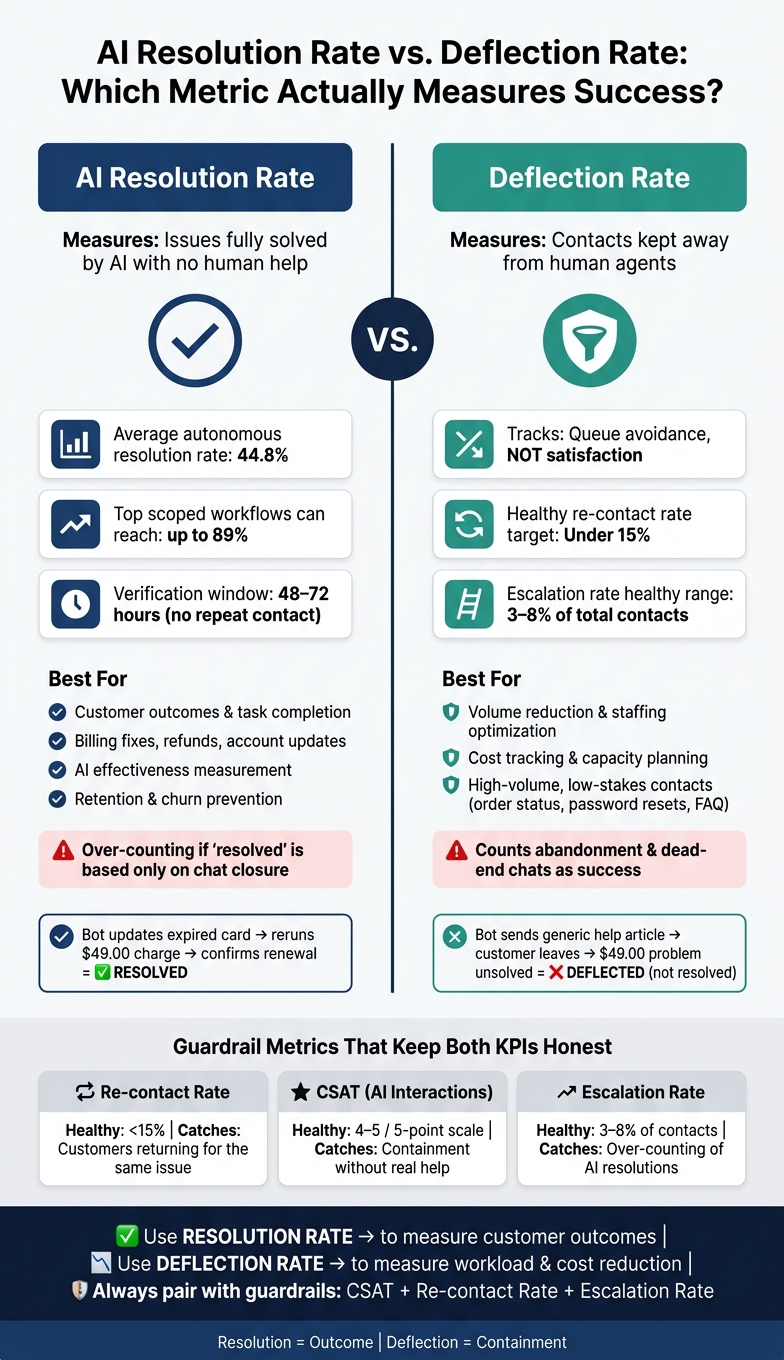
AI Resolution Rate vs. Deflection Rate: Which Metric Wins?
AI resolution rate and deflection rate: what each one means
These two metrics sound close, but they track different things.
AI resolution rate: issues fully solved without human help
AI resolution rate is the share of support issues fully solved by AI, with no human agent, escalation, or follow-up needed.[2][4][5] The bar here is simple: the customer’s need has to be completed, not just acknowledged.
A password reset that goes through or a duplicate charge that gets refunded - those count as resolved. To confirm that, check backend records and use a 48–72 hour no-repeat-contact window.[2][5][1] Post-chat surveys can help as a quality check, but they shouldn’t be your main proof that the issue was solved.
That’s what makes resolution rate a better signal of customer outcome, not just whether a chat ended.
Deflection rate: contacts kept out of the agent queue
Deflection rate is the share of contacts that never reach a human agent because automation or self-service handled them.[6][7][8] This metric tracks queue avoidance, not satisfaction or resolution.
It does include real self-service wins without losing quality. But it can also include people who got stuck in a loop, read a generic article and gave up, or just stopped trying. That can make AI performance look better than it is.[9][3] Track successful deflection apart from abandonment.
So while deflection is useful for measuring volume reduction, it’s weak on its own as a success metric.
Comparison table: what each metric counts, misses, and answers
The difference is easiest to see side by side.
| AI Resolution Rate | Deflection Rate | |
|---|---|---|
| Business question it answers | "How often does AI actually fix the problem end-to-end?" | "How much volume are we keeping out of the agent queue?" |
| Best use case | Measuring AI effectiveness and customer outcomes | Measuring workload reduction and operational cost savings |
These definitions explain why the same dashboard can show strong deflection and weak actual outcomes.
Why these two numbers can disagree in real support operations
You can see the split pretty fast in live support. The same customer contact can look like a win in one metric and a miss in the other.
A chatbot might post strong deflection numbers and still show weak resolution. Why? Because deflection only tells you whether the customer reached a human agent. Resolution tells you whether the issue got fixed.
That gap shows up all the time. Teams often report high deflection, while actual self-service resolution comes in much lower.[12]
Example: a billing issue resolved versus a billing issue avoided
Take a simple case: a customer’s $49.00 subscription payment fails because their card expired.
One bot updates the payment method, reruns the charge, and confirms the renewal. That’s a resolved issue.
Another bot sends a generic help article and marks the contact as deflected, even if the payment problem is still sitting there. The customer didn’t reach an agent, sure. But the issue didn’t go away.
That’s the heart of it: high containment does not automatically mean high-quality automation.
How deflection can overstate success
A few common patterns can make deflection look better than it is:
- Users get stuck in circular FAQ loops and give up instead of escalating
- Abandoned chats are counted as deflected even when there’s no proof the issue was solved
- Escalation is hard to find, so volume stays contained while customer problems stay open[10][11]
When deflection is high but repeat contacts go up, CSAT drops, or cancellations climb, that usually points to containment without resolution.
So the next step isn’t just asking whether AI cuts volume. It’s asking which metric lines up with the business goal.
Which metric measures success depends on your goal
AI resolution rate is usually the better way to measure success because it tells you whether the customer's issue was actually fixed. That said, the right KPI depends on what you're trying to improve. If you care most about customer outcomes, resolution rate should lead. If your main focus is cutting queue volume, deflection rate still matters. It just shouldn't stand in as the whole story.
When AI resolution rate should be the primary KPI
Use resolution rate as the main KPI when the interaction needs to end with a finished task, not just an answer. That includes things like refunds, billing fixes, subscription changes, account updates, and order changes. In those moments, customers don't care that the bot replied. They care that the problem is gone.
This is also where automation gets put to the test. Across real deployments, autonomous resolution rates average about 44.8%, while tightly scoped workflows can reach as high as 89% for one issue type.[13] That makes resolution rate the stronger KPI for outcome-driven workflows. Deflection rate fits better when the goal is handling volume.
When deflection rate is useful but not enough on its own
Deflection rate has a clear role when the goal is to reduce queue volume and labor costs. It works well for high-volume, low-stakes contacts like:
- Order status checks
- Return policy questions
- Password resets
- Basic FAQ lookups
For cases like these, deflection can act as a helpful stand-in when the answer is complete and the issue is simple.
It also helps with capacity planning. If your self-service layer absorbs a big share of demand, that tells you a lot about staffing needs and cost savings. But if you use deflection alone as a success metric - especially for issues tied to money or account status - it can point you in the wrong direction. Fewer agent contacts do not automatically mean the customer's issue was solved.
Decision table: match the KPI to the business goal
| Business Goal | Primary KPI | Guardrail Metric |
|---|---|---|
| Cost reduction / queue relief | Deflection rate | Recontact rate |
| CSAT | AI resolution rate | CSAT for AI interactions |
| Agent avoidance quality | Deflection rate | Abandonment rate, CSAT |
| AI effectiveness | AI resolution rate | Verified resolution, escalation rate |
| Retention / churn prevention | AI resolution rate | Recontact rate (72-hour window) |
The guardrail column matters just as much as the main KPI. If resolution rate goes up but escalations also spike or CSAT drops, that's not a win. It's a warning sign. The same problem shows up with deflection: high containment plus rising recontact rates often means customers are returning because the first interaction didn't solve much.[14][15]
Once you've matched the KPI to the goal, guardrails help you check whether that metric is telling the truth. Next, use guardrail metrics to confirm the KPI reflects actual customer outcomes.
How to pick and track the right KPI
A simple KPI selection framework for support leaders
Once you know which metric matches the goal, the next step is setting up how you'll track it. Start with one plain question: what does success look like here?
Use this sequence:
- Name the business goal in plain language, such as reducing Tier 1 volume or improving billing CSAT. Cost goals usually point to deflection. Outcome goals usually point to resolution.
- Define resolution as a verified outcome, not just a closed chat. For example, no repeat contact within the agreed window.
- Choose one primary KPI and stick with it across dashboards and reviews.
- Add one or two guardrails to catch issues the main metric can hide.
- Review by use case, not just at the program level. An AI may do well on shipping status inquiries but struggle with billing disputes. Looking at billing, shipping, returns, and account-change flows separately makes it easier to see where the program is working and where it isn't.
Guardrail metrics that keep your reporting honest
Guardrails help you check whether your KPI lines up with actual customer outcomes.
They also catch the classic problem where the main metric looks better on paper, but the customer experience hasn't improved much.
| Guardrail Metric | Healthy Range | What It Catches |
|---|---|---|
| Re-contact rate | Under 15%[16][18][19] | Customers returning for the same issue - a sign that deflections may not be resolving the problem |
| CSAT (AI interactions) | 4–5 on a 5-point scale | Low scores alongside high resolution claims can reveal containment without real help |
| Escalation rate | 3–8% of total contacts[17] | Rising escalations alongside high AI resolution numbers may suggest over-counting |
Re-contact rate is one of the best sanity checks for both metrics. If customers come back about the same issue after the first interaction, the AI likely didn't solve the problem. It just delayed the handoff.
Keep these guardrails in the same dashboard as your primary KPI so the report stays tied to actual outcomes.
Use one primary KPI, one or two guardrails, and use-case-level breakdowns.
Conclusion: Use deflection for workload reduction, use resolution for customer outcomes
Deflection rate shows how many customer contacts never made it to an agent. AI resolution rate shows whether the problem was fully solved from start to finish without human help. That gap matters. A high deflection rate can still cover up frustrated customers, repeat contacts, and lower satisfaction.
Once those terms are clear, the next step is simple: decide which metric should lead. Use AI resolution rate as the main KPI for customer outcomes. Use deflection rate as a secondary KPI for workload reduction.
Here’s the plain-English version:
- If your goal is customer outcomes, prioritize resolution
- If your goal is cost and contact volume reduction, prioritize deflection
- Set deflection targets only when resolution and repeat-contact rates stay healthy
You also need guardrails. Otherwise, the KPI can tell a nice story while the customer experience gets worse. If deflection goes up while CSAT drops or repeat contacts climb, the system is optimizing queue avoidance, not customer outcomes.
That’s why the metric means little on its own. You have to read it next to outcome checks. A generic FAQ may count as deflection even when the customer still needs help. A bot that verifies the issue, takes action, and confirms the outcome counts as resolution.
Use deflection to track workload reduction. Use AI resolution rate, backed by CSAT and repeat-contact guardrails, to judge whether AI is actually solving customer problems.
FAQs
How do I verify AI resolution accurately?
Don’t lean on deflection rates by themselves. They only tell you whether a user didn’t reach out to support. They do not tell you if the problem got fixed.
A better metric is Autonomous Resolution Rate or Resolved on Automation Rate. Those measure only the issues that were fully completed without any human help. That’s a much clearer read on how well the system is doing.
It also helps to watch what happens after the first interaction. If people come back within 5 to 7 days, that’s often a sign the first answer missed the mark. On top of that, review 50 to 100 interactions each week to check for accuracy and completeness, and test updates against a golden dataset of 100 to 200 verified inquiries.
Can high deflection hurt customer satisfaction?
Yes. High deflection can hurt customer satisfaction when it traps people in frustrating loops or serves up answers that miss the actual problem.
Stopping a ticket from reaching an agent is not the same as success. If the AI feels like a dead end, satisfaction drops.
The better goal is resolution rate. Did the customer get the issue solved? That’s what matters.
It also helps to keep a clear path to a human agent for complex or sensitive issues. Some problems need nuance, judgment, or a bit of empathy that an automated flow may not handle well.
Which support use cases should prioritize resolution?
Prioritize high-volume, simple, repeat tasks like password resets, order tracking, basic product questions, and appointment scheduling. In many support teams, these account for 60% to 80% of total volume and usually need little subjective judgment.
That’s where AI can make a clear difference. It doesn’t just send people away from your team. It helps handle the routine work that eats up time.
On the other hand, don’t push full automation for complex, sensitive, or emotionally charged issues like billing disputes or legal complaints. In those cases, human empathy and careful thinking still matter.