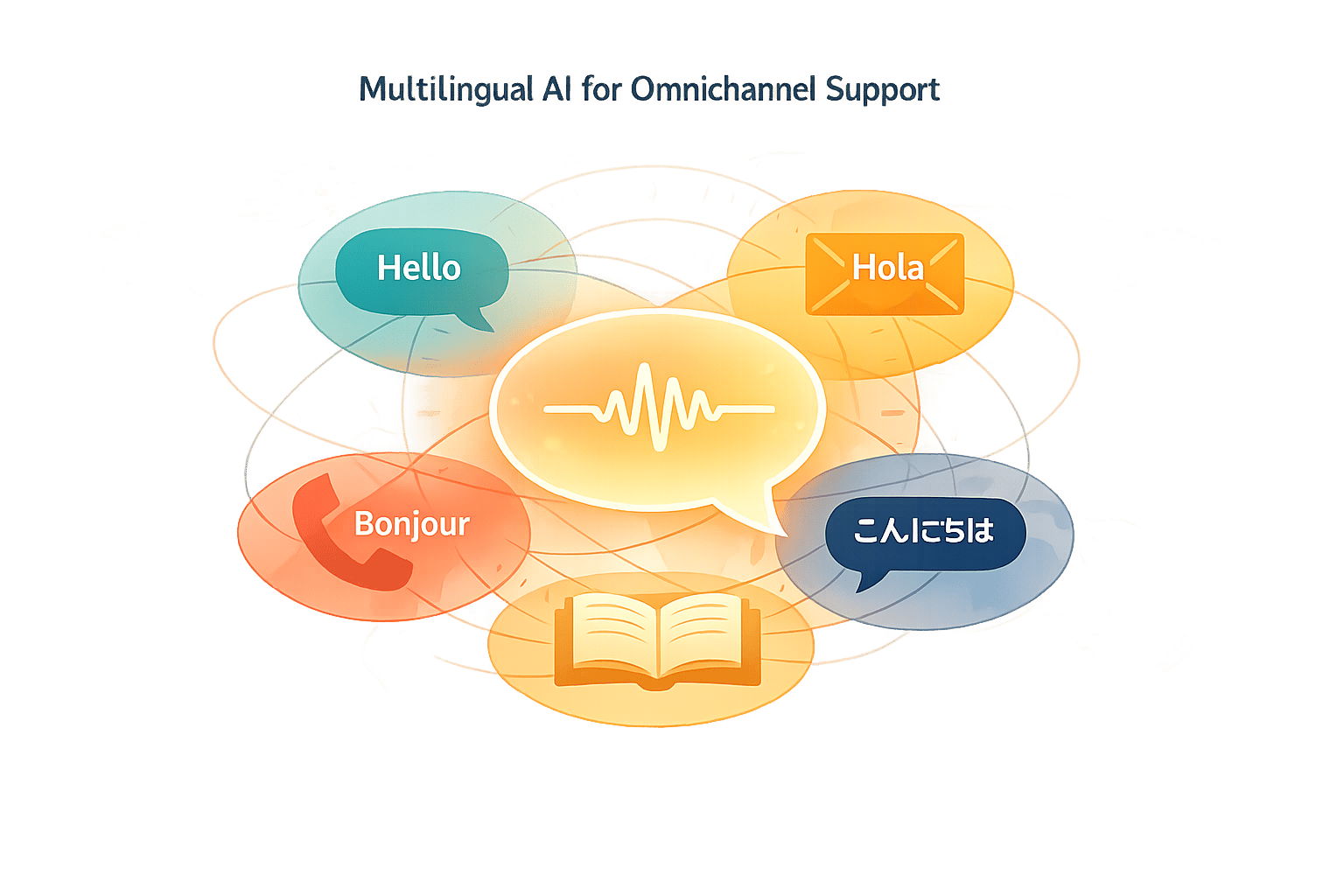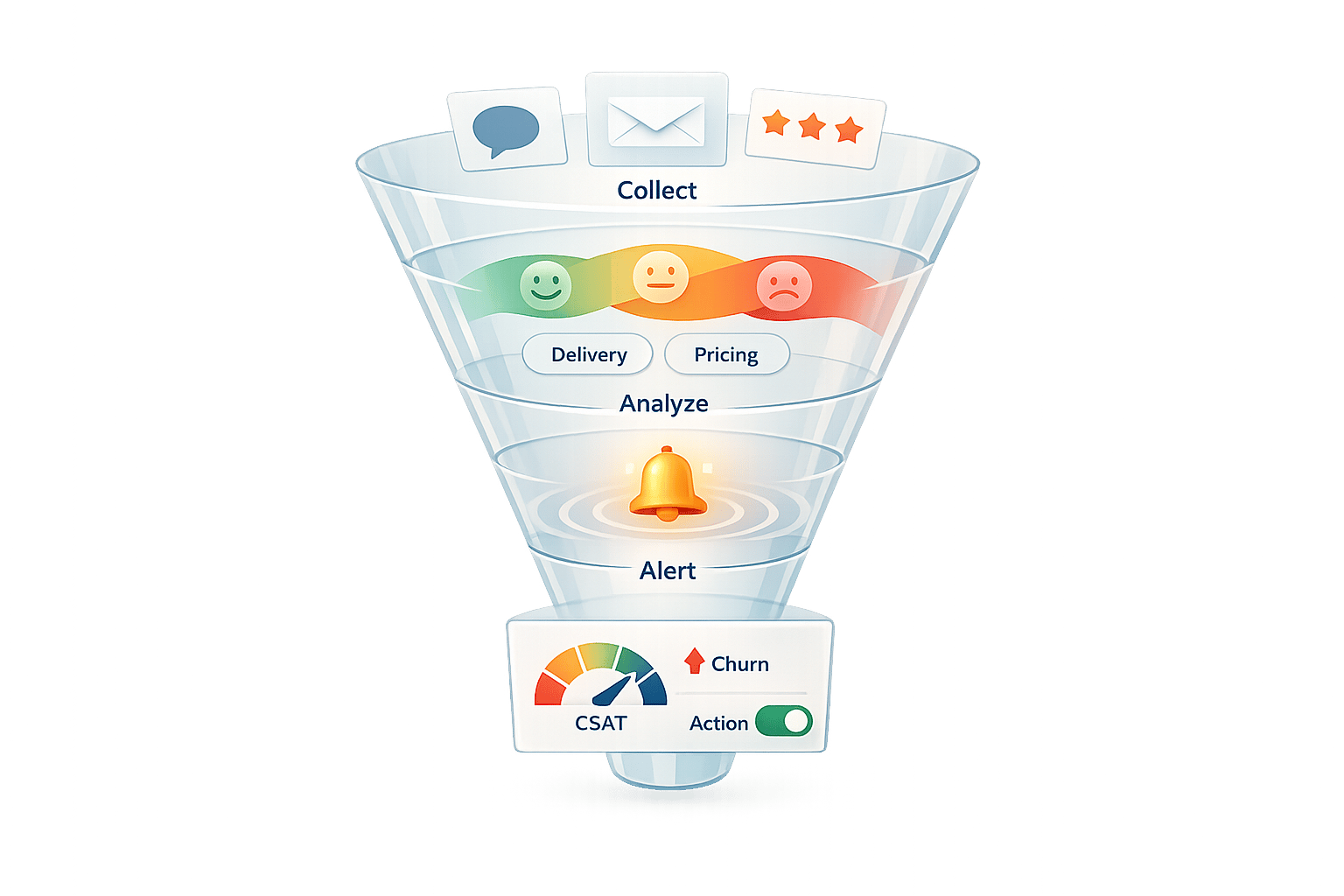
AI feedback loops are transforming customer service by creating systems that learn from every interaction, making communication consistent across multiple platforms. Here's the key takeaway: these loops allow businesses to unify customer interactions across channels like Instagram, WhatsApp, and website chats, ensuring smoother transitions and better experiences.
Why It Matters:
- Consistency: 76% of customers expect the same experience across different channels.
- Efficiency: AI systems improve response accuracy (e.g., 14.8% boost in precision) by analyzing real-time feedback.
- Retention: Shared memory across platforms leads to better customer satisfaction, with some companies achieving 91% higher retention rates.
How It Works:
- Feedback Collection: AI gathers data from customer interactions.
- Validation: Feedback is analyzed to refine responses.
- Real-Time Learning: Systems update continuously, reducing retraining cycles from months to weeks.
Real-World Examples:
- A U.S. pilot program improved response helpfulness by 8.4% by integrating agent feedback.
- Platforms like ChatSpark track conversations across channels, boosting productivity and reducing manual tasks.
AI feedback loops don’t just solve problems - they predict and prevent them. By integrating sentiment analysis and predictive analytics, businesses can address issues before they escalate, cut costs, and enhance customer loyalty.
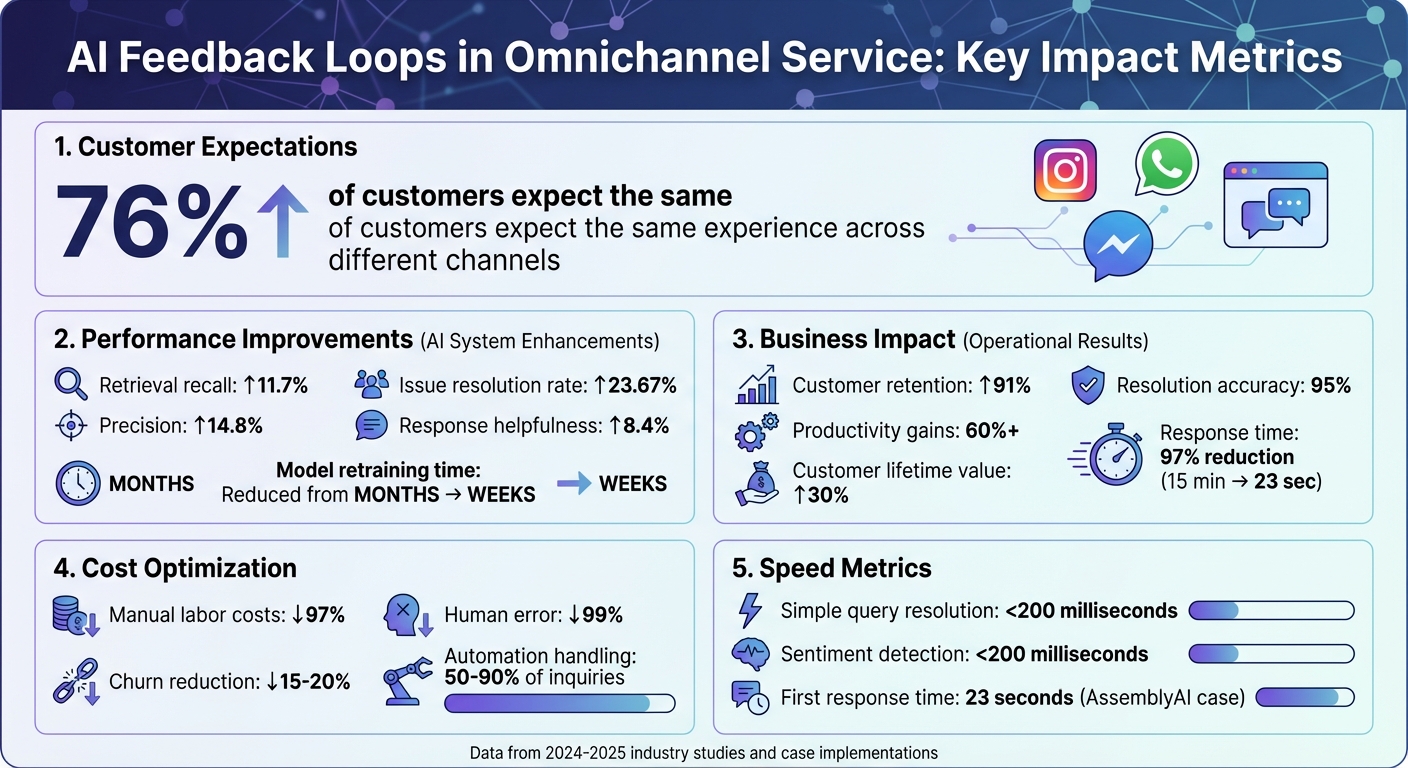
AI Feedback Loops Impact on Omnichannel Customer Service: Key Statistics and Benefits
Research on AI Feedback Loops and Context Preservation
Recent studies highlight how crucial AI feedback loops are for maintaining seamless customer experiences across different communication channels. These loops ensure that when a customer starts a conversation on one platform, like Instagram, and continues it on another, such as a website, the AI retains the context. This capability prevents customers from feeling like they’re starting over, reinforcing their connection to the brand.
Maintaining Conversation History Across Channels
Modern AI systems rely on context managers to keep track of interaction histories. These tools use sliding windows to store embeddings of past queries and responses, creating a continuous record of the conversation [3].
A study published in November 2025 by Zhao et al. showcased this in action. Their team developed an Agent-in-the-Loop (AITL) framework for U.S.-based customer support teams. This system incorporated four types of real-time feedback: pairwise preferences, agent adoption signals, knowledge relevance checks, and missing knowledge flags. This level of integration is a core component of a complete AI customer support implementation strategy. The AI didn’t just gather data - it actively refined its understanding and responses based on these inputs. The results were impressive: retrieval recall improved by 11.7%, precision increased by 14.8%, and model retraining cycles were cut from months to weeks [1].
"These results underscore the effectiveness of embedding human feedback loops directly into operational workflows to continuously refine LLM-based customer support systems." - Cen Zhao et al., EMNLP 2025 [1]
What sets this approach apart is that the AI doesn’t just retain factual information - it also tracks customer preferences, sentiment, and interaction habits. For instance, if a customer prefers detailed technical explanations over simpler ones, the AI learns and applies that preference across platforms, whether the interaction happens on WhatsApp or a website. Researchers refer to this as "hyper-personalization", where conversational AI personalizes customer journeys by tailoring its tone and level of detail to the individual’s history [4]. This context preservation, combined with real-time transfer mechanisms, speeds up issue resolution significantly.
Real-Time Context Transfer for Faster Resolutions
Real-time context transfer plays a key role in accelerating resolutions. A June 2025 study by Pattnayak et al. tested a hybrid AI framework that handled simple queries, like password resets, in under 200 milliseconds. More complex issues were routed through a Retrieval-Augmented Generation (RAG) pipeline. A feedback loop adjusted confidence thresholds every 100 interactions, achieving a 95% resolution accuracy [3].
Another example of real-time optimization is the OlaMind dialogue system. By using continuous feedback to refine AI responses, it achieved a 23.67% increase in issue resolution rates and reduced transfers to human agents by 6.6% [5]. This meant customers received quicker solutions, and when escalation to a human agent was necessary, the agent already had access to the full interaction history.
The shift here is from reactive to proactive. Advanced AI systems now monitor interactions across channels, identifying potential issues - like failed payments or delayed deliveries - before the customer even raises a concern [4]. As beBit TECH aptly noted, "The experience shifts from 'I have to chase the brand' to 'the brand is watching my back'" [4].
AI in Sentiment Analysis and Adaptive Responses
Understanding customer sentiment goes beyond identifying words - it's about recognizing the emotions behind them. AI systems now analyze these sentiments in real-time, adjusting their tone and approach to create interactions that feel more human and empathetic.
Sentiment Analysis for Tone Adjustment
AI has become exceptionally skilled at picking up on emotional cues. Hybrid models like BERT and Bi-LSTM process messages and classify emotions such as frustration, anger, sadness, and satisfaction in under 200 milliseconds [6]. This lightning-fast response time allows AI to detect emotions and adjust its tone before the conversation escalates.
For instance, when frustration is detected - like a customer upset about a delayed delivery - Generative AI produces tailored responses. Instead of offering a generic apology, the system acknowledges the inconvenience, expresses empathy, and suggests actionable solutions. This personalized approach not only defuses tension but also builds trust.
In recent U.S. trials, Agent-in-the-Loop frameworks have shown promising results. These systems improve response quality and agent adoption while cutting down retraining times [2][1].
"The integration of BERT-Bi-LSTM with Generative AI represents a significant step forward in creating empathetic, intelligent, and proactive customer care systems." - Nature (Scientific Reports) [6]
What’s particularly impressive is how these systems maintain emotional context across multiple channels. For example, if a customer switches from a website chat to WhatsApp, the AI carries over both the factual details of the issue and the emotional tone of the previous conversation. This eliminates the need for customers to repeat themselves, making the experience smoother and less frustrating.
This ability to tune into emotions in real-time naturally leads to better escalation and resolution strategies.
Dynamic Escalation and Resolution Strategies
AI doesn’t just adjust responses - it also reshapes how escalations are handled. Instead of relying on outdated keyword triggers, AI systems analyze sentiment and intent in real-time, enabling dynamic escalation protocols [6].
Here’s how it works: when the AI detects signs of aggression or extreme frustration, it doesn’t wait for the customer to demand a manager. Instead, it proactively initiates an "automated investigation." This process pulls data from various systems like CRMs and ERPs to create a detailed summary for managers. The summary includes the customer's history, emotional state, and recommended solutions [7]. This approach has led to a 97% reduction in manual labor costs and a 99% drop in human error [7].
Data from call centers shows that neutral interactions dominate text-based channels at about 61%. However, emotions like anger and sadness, though less frequent (each at 8%), are critical to address. AI systems now use advanced training techniques, including synthetic data generation, to better recognize these rare but important emotional states [6]. This ensures that when a customer is upset, the AI responds appropriately rather than defaulting to a generic template.
Platforms like ChatSpark take this a step further by applying sentiment analysis across channels such as Instagram, Facebook, WhatsApp, and Telegram. Whether it’s 2:00 PM or 2:00 AM, ChatSpark adapts its responses in real-time to meet both the emotional and practical needs of the customer, ensuring support feels personalized and timely.
Predictive Analytics and Cost Optimization Through Feedback Loops
Building on real-time context preservation and sentiment analysis, predictive analytics takes service efficiency to another level. AI-powered feedback loops analyze data from multiple channels to predict and prevent potential issues before they escalate. This approach transforms customer service from a cost-heavy necessity into a strategic tool for improving customer retention.
Churn Prediction and Proactive Outreach
AI feedback loops are particularly effective at predicting customer churn. By examining behaviors like frequent service calls, unusual billing patterns, or shifts in usage, these systems identify customers at risk of leaving before they make the decision.
Take Verizon as an example. In 2024, they used generative AI to predict the intent behind 80% of incoming calls to their service center. By pairing customers with the most suitable agents based on these predictions, Verizon was able to retain around 100,000 at-risk customers [8]. Instead of waiting for complaints to roll in, this system detected early signs of dissatisfaction and acted proactively.
Research highlights how critical early intervention can be. In telecommunications, churn risk spikes dramatically after a customer makes four or more service calls [10]. AI models like Random Forest and XGBoost are now capable of predicting churn with an impressive 95.13% accuracy. When integrated with CRM systems, these predictions can help cut churn rates by up to 15% [10].
Another example comes from a global payments processor. They created a "digital twin" that simulated daily merchant interactions. This system predicted which merchants were likely to scale back their business within seven days. Automated interventions - such as waiving fees or resolving technical issues - helped reduce merchant attrition by an estimated 20% annually [11].
Cost Reduction and Efficiency Improvements
AI feedback loops don’t just help with retention - they also drive operational efficiency and cost savings. For instance, automating ticket triage and classification can recover 2–3 minutes per ticket by eliminating manual sorting [9]. For high-volume support teams, this adds up to thousands of hours saved every year.
AssemblyAI saw dramatic improvements in June 2025 after rolling out AI-powered automation. Their first response time plummeted from 15 minutes to just 23 seconds - a 97% reduction. Their AI agent, "Sonny", now handles 50% of incoming chats independently, freeing the support team to focus on more complex developer queries - all without increasing staff [12].
"Runbooks have helped us handle weird edge cases much more intelligently. Instead of failing the conversation, the agent now guides customers to the right resources automatically." - Lee Vaughn, Manager of Support Engineering, AssemblyAI [12]
Bradesco, a leading Latin American bank, implemented a generative AI chatbot called "Smart PIX" that resolves 90% of customer issues without human involvement [8]. The chatbot allows customers to handle money transfers via voice or text on WhatsApp, eliminating the frustration of navigating complicated menus or waiting on hold.
The Agent-in-the-Loop framework further boosts efficiency by speeding up model retraining cycles - from months to weeks - while enhancing response quality [2][1]. Tools like ChatSpark lower support costs and improve customer satisfaction by identifying knowledge gaps, intelligently routing critical cases, and delivering 24/7 high-quality responses.
Case Studies: Applications of AI Feedback Loops
This section explores how businesses are leveraging AI feedback loops to make measurable progress in delivering seamless omnichannel services.
Retail and E-Commerce Applications
In January 2025, a small Slovak e-commerce company with fewer than 10 employees introduced an AI chatbot to manage routine customer inquiries using AI agents, such as order statuses and delivery updates. The chatbot significantly lightened the workload for staff and sped up response times. However, human oversight remained crucial for handling emotionally sensitive or complex situations [15].
The Agent-in-the-Loop (AITL) framework offers another compelling example of AI feedback in action. In October 2025, a pilot program in the U.S. integrated real-time feedback from customer support agents into the AI system. This created a "data flywheel", where the feedback loop continuously improved the AI's suggestions. By directly incorporating these operational signals, the company shortened model retraining cycles from months to just weeks [1][2].
Specialized platforms further illustrate how feedback loops enhance omnichannel service delivery.
ChatSpark: Improving Omnichannel Services
ChatSpark exemplifies how feedback loops and context preservation can transform customer service. It keeps a consistent chat history across platforms like WhatsApp, Telegram, and Slack, ensuring that customer interactions remain seamless even when switching between channels [13]. This continuity enables the AI to learn from every interaction, identifying gaps in its knowledge base and refining its performance over time.
For example, Fabulash Faces implemented ChatSpark to manage inquiries across phone calls, text messages, and direct messages. As a result, the company saw a 32% boost in bookings while eliminating repetitive, manual tasks [14]. ChatSpark also earned a 5-star rating for its ability to handle routine inquiries and provide 24/7 support [14].
The platform's feedback loop tracks key metrics like the Resolved on Automation Rate (ROAR) and the frequency of handoffs to human agents. These metrics highlight areas where the AI still needs improvement, enabling businesses to fine-tune their systems. This approach not only reduces operational costs but also enhances customer satisfaction by addressing service gaps more effectively.
These examples show how AI feedback loops can streamline operations and improve customer engagement across multiple service channels.
Future Trends in AI Feedback Loops for Omnichannel Models
AI feedback loops are moving beyond simple automation and stepping into the realm of autonomous orchestration. By 2030, the U.S. B2C retail market could see as much as $1 trillion in orchestrated revenue driven by agentic AI, with global estimates ranging between $3 trillion and $5 trillion [20]. This evolution is fueled by AI agents capable of observing customer behavior, planning multi-step solutions, and executing tasks across platforms - all with minimal human oversight.
A key enabler of this transformation is the rise of interoperability standards. Protocols like the Model Context Protocol (MCP) and Agent-to-Agent (A2A) are paving the way for specialized AI agents to share context and seamlessly hand off tasks across different domains and service providers [18][19]. This tackles a major issue: nearly 90% of customer service leaders struggle with fragmented ecosystems of vendors and system integrators [17]. Once these standards reach maturity, a customer's interaction history and preferences will flow smoothly between, say, a banking agent, a travel agent, and a retail agent - creating a cohesive feedback loop that learns and adapts with every interaction. This marks a shift from fragmented interactions to seamless, end-to-end customer missions.
"If AI Agents are the new way in which users interact with applications, then the protocols between them could represent the next layer of this [IP] stack." – J. Rosenberg, Fellow at Five9, and C. Jennings, Fellow at Cisco [18]
Beyond interoperability, the focus is shifting from managing individual customer journeys to orchestrating complex, multi-step missions. These missions - such as relocating a family or planning a vacation - are increasingly being handled by AI networks with minimal human intervention [16][20]. Companies leading in agentic AI aim to achieve productivity gains of 60% or more and boost customer lifetime value by up to 30% [17]. Central to this progress are self-evolving feedback loops, like the Agent-in-the-Loop (AITL) framework, which integrates human feedback into live operations. This approach has significantly reduced model retraining cycles - from months to just weeks [2].
As these capabilities develop further, AI agents are also gaining autonomous transactional abilities. Protocols like the Agent Payments Protocol (AP2) will allow agents to securely make purchases on behalf of users, adhering to set budgets [20]. This advancement means feedback loops will not just learn from interactions but also from transactional data. The efficiency of large language models has been doubling every seven months since 2019, and by 2025, models like Claude 3.7 Sonnet are expected to handle tasks that would traditionally take nearly an hour of human effort [20]. Additionally, ambient interfaces - such as voice commands, augmented reality, and even eye movement - will integrate these agents seamlessly into daily life, enabling feedback loops to operate quietly in the background while users go about their routines [16].
Conclusion
AI feedback loops are reshaping omnichannel customer service by creating systems that learn and improve from every interaction. Companies have reported measurable improvements in both retrieval and generation metrics, shortening model update cycles from months to just weeks [1][2]. Some organizations are now achieving over 60% productivity gains and seeing up to a 30% boost in customer lifetime value [17]. For example, in late 2025, a global tech company reduced its service resolution time by half using agentic AI systems powered by continuous feedback. Similarly, a European energy provider increased customer satisfaction by 18% by proactively identifying and resolving issues with AI [17]. These results highlight the strategic advantage of blending human insights into AI-driven processes for enterprise-scale operations.
Marcus Wittig, Managing Director & Senior Partner at BCG, emphasizes the transformative potential of these systems:
"Agentic AI isn't just a tool. It's a strategic capability that enables customer service to evolve from a reactive cost center to a proactive value creator." - Marcus Wittig, Managing Director & Senior Partner, BCG [17]
One of the standout benefits of these feedback loops is their ability to integrate human judgment where automated systems might fall short. For instance, a production pilot in November 2025 used an Agent-in-the-Loop framework with 40 U.S.-based support agents managing over 5,000 cases. By incorporating four types of real-time feedback into operations, the system continuously improved without disrupting workflows [1][2].
For businesses aiming to stay competitive, AI feedback loops have become indispensable. By ensuring smooth transitions between channels , such as integrating AI with your website, and tailoring responses to customer needs, these systems turn customer service into a strategic driver of growth and loyalty.
FAQs
How do AI feedback loops improve consistency across communication channels?
AI feedback loops work to maintain consistency by constantly learning from user interactions and improving responses across various communication platforms. These loops collect valuable insights - like customer preferences, the accuracy of information, and the effectiveness of responses - enabling the system to adapt in real time. This means responses stay accurate, relevant, and aligned with your brand’s voice, whether it’s on your website, social media, or messaging apps.
By using feedback dynamically, AI systems help eliminate inconsistencies that often occur when different channels are managed independently. For instance, a chatbot can refine its understanding of customer needs, ensuring smooth and consistent support across all platforms. This not only boosts the quality of responses but also creates a unified and dependable experience for customers.
How does sentiment analysis enhance customer experiences in omnichannel service models?
Sentiment analysis plays a key role in shaping better customer experiences within omnichannel service models. By identifying and interpreting emotions like frustration, satisfaction, or confusion across platforms - whether it’s chat, email, social media, or phone calls - businesses can fine-tune their responses in real time. Tools powered by AI and natural language processing (NLP) make this possible, helping interactions feel more personalized and empathetic.
This technology also allows businesses to step in early when things might go wrong. For example, it can pick up on signs of frustration in a customer’s language, triggering immediate actions like offering technical help or tailored solutions. Beyond solving problems, these insights help create stronger customer connections by delivering consistent and thoughtful service across every channel.
How can AI feedback loops help businesses reduce customer churn?
AI feedback loops play a key role in helping businesses keep their customers by analyzing interactions and feedback in real time. By spotting patterns like negative sentiment, unresolved complaints, or service gaps, these systems can quickly identify customers who might be at risk of leaving.
Once these risks are flagged, companies can step in with tailored solutions - whether that’s a personalized offer, a special discount, or improved customer support. What's more, AI systems get smarter over time by incorporating human feedback, leading to better predictions and more effective strategies for keeping customers happy. This not only helps reduce churn but also builds stronger customer relationships and loyalty.