
AI helps businesses reduce customer churn by predicting which customers are likely to leave and addressing their concerns before they disengage. Instead of waiting for missed renewals or negative feedback, AI analyzes real-time customer behavior, sentiment, and usage patterns to identify early warning signs of dissatisfaction. Here's how it works:
- Early Risk Detection: AI assigns churn risk scores based on factors like reduced engagement, shorter session times, or frustrated language in support tickets.
- Personalized Retention: Tailored actions, such as targeted emails or discounts, are triggered automatically for at-risk customers.
- Automation: AI workflows integrate with tools like CRMs and email platforms to provide timely, scalable interventions.
- 24/7 Support: AI-powered chatbots handle routine queries instantly, escalating complex issues to human agents when needed.
- Improved Onboarding: AI simplifies the setup process for new customers, reducing confusion and increasing loyalty.
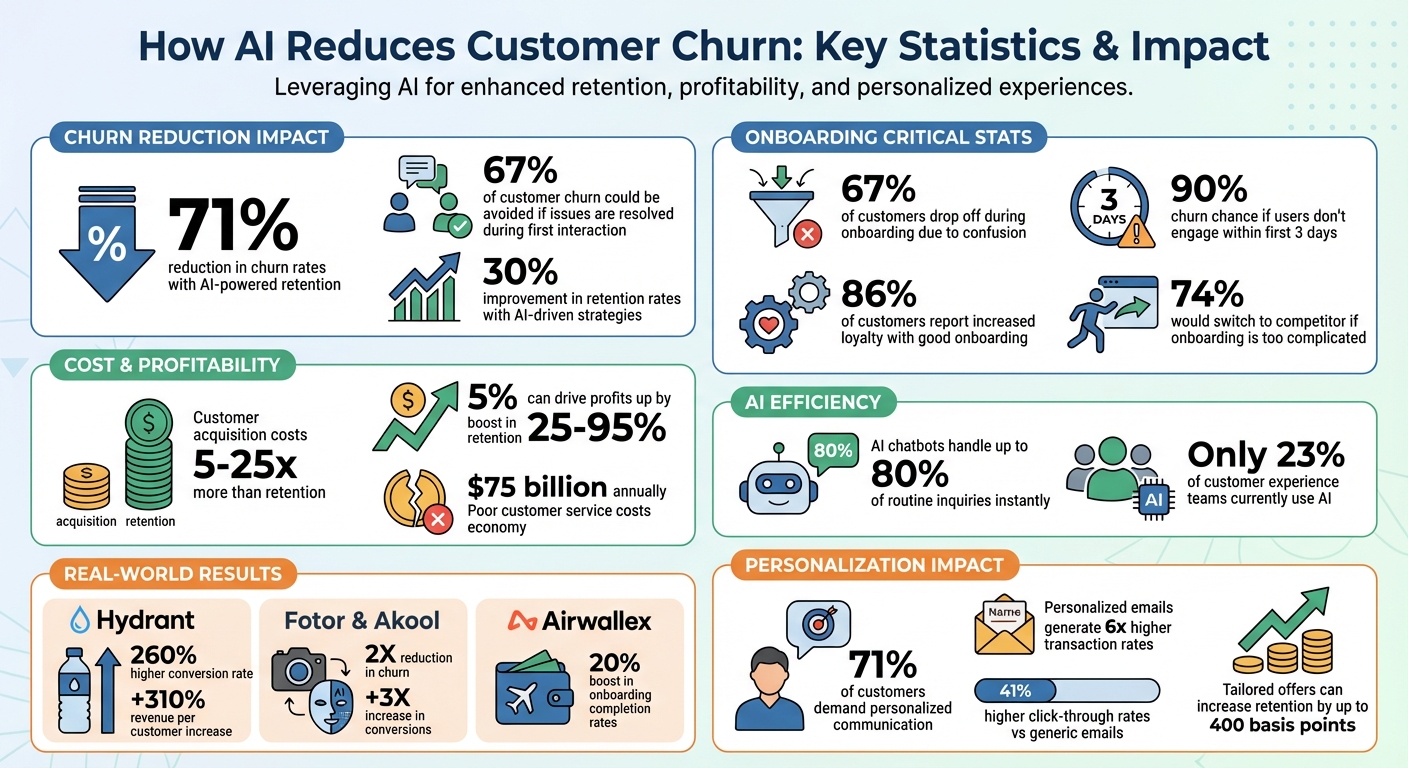
For example, Hydrant, a wellness company, used AI in 2024 to boost conversion rates by 260% and revenue per customer by 310%. Businesses using AI for retention have seen up to a 71% reduction in churn rates. With customer acquisition costing 5–25x more than retention, preventing churn is essential for profitability.
AI Customer Churn Reduction Statistics and ROI Impact
AI for Customer Retention: Reduce Churn and Increase Revenue
Using Predictive Analytics to Identify Churn Risks
Predictive analytics takes raw customer data and turns it into actionable insights by analyzing behavior patterns to predict which customers are likely to leave - often weeks before they make that decision. AI models assign each customer a churn risk score, typically on a scale from 0 to 1 (or 0% to 100%), reflecting the likelihood they’ll stop doing business within a given period. These models focus on early warning signs, such as a noticeable drop in login activity, reduced use of features, or even frustrated language in support interactions.
How AI Assigns Risk Scores
AI uses advanced analytics to quantify churn risk through precise scoring. Machine learning models dig into historical data to uncover patterns linked to churn. For example, they might find that a combination of shorter session times and an uptick in support requests often precedes a customer leaving. With this knowledge, the system assigns a probability score to each customer, estimating their risk of churn.
Different machine learning methods bring unique strengths to this process. Logistic regression offers straightforward, easy-to-interpret results. Random forests and gradient boosting are ideal for handling complex datasets with many variables. Neural networks, on the other hand, excel at identifying intricate patterns in large amounts of data [7][6][4].
Pairing churn risk scores with Customer Lifetime Value (CLV) helps retention teams prioritize their efforts. For instance, a high-value customer with an 80% churn risk demands a different strategy than a lower-value customer with the same risk level [6].
Key Data Points AI Uses for Predictions
AI pulls data from various sources to form a complete picture of a customer’s health. This data falls into several categories, each shedding light on different aspects of the relationship:
| Data Category | Metrics | Insights |
|---|---|---|
| Usage Signals | Login frequency, session length, feature usage | Indicates whether customers are actively engaged or starting to disengage |
| Customer Profile | Plan type, industry, company size, tenure | Provides context for interpreting behavior patterns |
| Transactional | Purchase frequency, order value, payment issues | Reflects the financial health of the relationship |
| Sentiment/Engagement | Support ticket tone, email sentiment, NPS comments | Reveals emotional state and satisfaction levels |
| Contextual | Device type, browser, location, purchase history | Highlights technical or situational factors affecting the experience |
Natural Language Processing (NLP) plays a key role in analyzing unstructured text, such as support tickets or emails. For example, phrases like "This is the third time this has happened" or "I’m considering other options" are flagged as high-priority signals of frustration. These insights allow teams to craft targeted strategies to retain customers.
To keep predictions accurate, models need regular updates - sometimes as often as monthly or even nightly for fast-paced industries. This ensures they stay aligned with changing market conditions and evolving customer behaviors [4][7].
Automating Customer Retention with AI Workflows
Predictive insights are only the beginning - what truly makes a difference is acting on those insights swiftly. Automated workflows take the guesswork out of customer retention by triggering personalized actions the moment churn risks appear. This proactive approach transforms how businesses engage with customers, moving from reactive problem-solving to strategic prevention [5].
Here’s how it works: AI workflows integrate churn risk scores directly with your existing tools, such as CRMs, email platforms, or support systems. When a customer hits a specific risk threshold, the system automatically initiates the appropriate response. For instance:
- A customer with a slight dip in login frequency might get an automated email showcasing new features or helpful tips.
- A medium-risk customer expressing dissatisfaction in recent support tickets could be flagged for a health-check call with a Customer Success Manager.
- A high-risk, high-value account showing a significant drop in usage combined with billing issues might trigger an immediate escalation to senior management for a tailored resolution [5].
This tiered approach ensures that responses are not only timely but also aligned with the customer’s risk level and value to the business. Companies using AI-driven retention strategies have reported a 30% improvement in retention rates, with tailored offers potentially increasing retention by up to 400 basis points. And the payoff is undeniable - a mere 5% boost in retention can drive profits up by 25% to 95% [9][10].
24/7 Support Across Multiple Channels
Customer disengagement doesn’t stick to a 9-to-5 schedule. It can happen at any hour - like when someone struggles to find an answer at 2:00 AM or gets frustrated with an unresolved issue over the weekend. That’s why being available around the clock and across multiple platforms is no longer optional. AI chatbots are a game-changer here, handling up to 80% of routine inquiries instantly, whether through website chat, WhatsApp, Facebook Messenger, or Instagram [9].
Take ChatSpark, for example. This conversational AI tool operates seamlessly across platforms like Instagram, WhatsApp, Facebook, Telegram, and Slack, all from a single setup. It delivers immediate, on-brand responses in over 85 languages, ensuring customers get the help they need, whenever they need it. For straightforward queries - like account settings or billing details - the AI resolves issues on the spot. But when frustration or complex problems arise, it escalates the conversation to a human agent, providing full context for a smoother resolution [8]. This constant availability not only resolves issues quickly but also sets the stage for deeper, more personalized interactions.
Personalized Engagement Strategies
Generic outreach like "We miss you!" emails just doesn’t cut it anymore. Today’s customers expect - and 71% demand - personalized communication that reflects their unique behavior and needs [2]. AI makes this possible at scale by analyzing factors like usage patterns, purchase history, sentiment, and feature adoption to craft highly targeted re-engagement campaigns.
The key is tailoring the intervention to the specific reason behind the customer’s risk. For example:
- A price-conscious customer might receive a special discount.
- A user frustrated with a particular feature could be offered training resources or updates.
- Someone who hasn’t logged in recently might get a message highlighting underused features that match their interests.
A great example of this in action is Hydrant, a wellness brand that leveraged Pecan AI’s predictive modeling in March 2024. By segmenting customers into those likely to make repeat purchases versus those needing win-back efforts, Hydrant achieved a 260% higher conversion rate and a 310% jump in revenue per customer [2].
The numbers back up the power of personalization. Tailored emails generate six times higher transaction rates and 41% higher click-through rates compared to generic ones [9]. But personalization goes beyond just adding a first name. It’s about sending messages at the right time, addressing specific pain points, and offering solutions that feel relevant to each individual. With AI managing this complexity, every interaction feels meaningful rather than intrusive.
Real-Time Insights and Optimization with ChatSpark
By blending AI's predictive capabilities with automated retention workflows, real-time insights take your strategy to the next level. Spotting churn risks early and knowing which retention approaches actually work can shift your focus from scrambling to fix problems to actively preventing them. Real-time analytics transform scattered customer interactions into a clear, actionable roadmap. Instead of relying on quarterly surveys or exit interviews, you can monitor customer health as it happens, catching potential issues before they grow into cancellations. ChatSpark provides the tools you need, offering precise, real-time metrics to guide your customer retention efforts.
Tracking Key Metrics with AI Tools
ChatSpark's dashboard provides a real-time view of customer engagement, capturing every interaction. For example, it tracks initiated chats to measure how often customers reach out - a sudden decline here could indicate waning interest before they even decide to leave [11]. Metrics like average session duration and messages per chat reveal the depth of interactions: sessions that are too short might signal customers aren't finding what they need, while overly lengthy ones could point to frustration or unresolved issues [11].
The platform also highlights Key Queries, identifying the most common customer questions. These often reveal recurring pain points and potential churn triggers [11]. Additionally, ChatSpark tracks Best-Received Responses, showing which messages most effectively resolve tension and satisfy customers [11]. These insights let you step in before small issues snowball into cancellations [5]. When AI insights are paired with human intervention, businesses can prevent up to 71% of churn. Yet, surprisingly, only 23% of customer experience teams currently use AI [5]. With poor customer service costing the economy around $75 billion annually [5], there’s no room for complacency.
Continuous Improvement Through AI
Real-time analytics aren’t just about identifying problems - they’re about driving continuous improvement. ChatSpark’s data allows you to refine your retention workflows on an ongoing basis, rather than relying on outdated assumptions. For instance, regularly reviewing the Key Queries report can help you address friction points in your onboarding materials or customer documentation [11].
Metrics around interaction depth are equally valuable. If certain conversations require excessive back-and-forth, it might indicate gaps in your AI’s training data or a need for quicker escalation to human agents [11]. Insights from Best-Received Responses can also be used to standardize effective tones and solutions across automated workflows [11]. This constant feedback loop ensures your retention strategies become sharper and more effective over time.
"Reducing customer churn starts with understanding what's driving it. After all, you can't reduce customer churn if you're always trying to solve problems after they escalate." - Ciaran Doyle, Loris.ai [1]
With ChatSpark turning every customer interaction into actionable insights, you’re no longer just reacting to churn - you’re actively addressing its root causes.
Using AI for Better Onboarding and Support
The first few days of a customer's journey are critical - nearly 67% of customers drop off during onboarding due to confusion [12]. That's why AI-powered tools are becoming indispensable. They help identify and resolve issues early, preventing them from escalating into cancellations.
Simplifying Onboarding with AI
AI works as a round-the-clock guide for new customers, helping them navigate the setup process step by step. It highlights key actions and explains their importance, cutting down on the confusion that leads to frustration - like searching endlessly for a button or feature [12]. This kind of visual and contextual assistance makes the onboarding process smoother and more intuitive.
Take Airwallex, for example. In 2025, they saw a 20% boost in onboarding completion rates and cut false-positive compliance alerts by half using AI-driven onboarding tools [12]. The impact of a seamless onboarding experience is clear: 86% of customers report increased loyalty when onboarding is handled well [13], while 74% say they’d switch to a competitor if the process feels too complicated [12].
Tools like ChatSpark take things up a notch by offering instant, consistent responses across multiple platforms - whether it's your website, WhatsApp, Facebook, or Instagram. With support in more than 85 languages, ChatSpark ensures customers feel guided and confident during those crucial early days. This not only simplifies setup but also helps identify potential issues before they spiral out of control.
Detecting and Solving Problems Early
AI doesn’t stop at onboarding - it keeps an eye on customer behavior to catch problems before they lead to disengagement. By tracking signals like reduced logins, fewer feature interactions, or shorter session durations, AI can flag users who might be at risk of churning [3][5]. And the stakes are high: users who don’t engage within the first three days have a 90% chance of churning [14].
In 2025, platforms like Fotor and Akool implemented AI-powered onboarding and churn detection systems. The results? A 2X reduction in customer churn and a 3X increase in user conversions by providing timely, personalized interventions [15]. Similarly, Calendly used the AI tool Loris to quickly detect a spike in support tickets related to a missing chat feature after a UI update. This allowed their team to act swiftly and prevent churn [1].
ChatSpark’s analytics dashboard takes this a step further by offering real-time tracking of early warning signs. It enables businesses to step in with targeted support before minor frustrations turn into major deal-breakers. Considering that 67% of customer churn could be avoided if issues are resolved during the first interaction [16], having AI monitor every conversation becomes a game-changer in customer retention.
ChatSpark Plans for Reducing Churn
ChatSpark provides four subscription tiers designed to scale with your business and help tackle customer churn effectively. By combining advanced predictive analytics with real-time insights, these plans integrate seamlessly into AI-powered retention workflows, enabling businesses to address churn before it becomes a problem.
For small businesses and teams with limited resources, the Basic plan ($19/month) and Plus plan ($59/month) are excellent starting points. Both offer self-service AI chatbots and automated FAQs to resolve customer concerns on the first interaction.
If you're a mid-market company handling larger customer bases and more intricate relationships, the Pro plan ($129/month) might be the right fit. It supports up to 2,000 messages per month and includes integrations with tools like Zapier and Freshchat. Additional features, such as sentiment analysis and CRM integration, help create personalized retention strategies [17].
For enterprises managing vast and complex customer data, the Enterprise plan offers custom pricing tailored to your needs. This plan excels at unifying multiple data sources and uses predictive machine learning to identify early signs of churn - like reduced feature usage or negative feedback in support tickets - long before traditional metrics like NPS reveal issues [5]. It also comes with perks like priority support, dedicated account management, and explainable AI insights to clarify why specific customers are flagged as high-risk.
Here’s a quick overview of the plans to help you find the best fit for your business:
| Plan | Monthly Price | Messages/Month | Key Features | Best For |
|---|---|---|---|---|
| Basic | $19 | 100 | 24/7 AI chatbots, analytics, multiple data sources | Solo entrepreneurs, startups |
| Plus | $59 | 250 | Expanded capacity, analytics, multiple data sources | Small growing businesses |
| Pro | $129 | 2,000 | CRM integrations, sentiment analysis, unbranded widgets | Mid-market companies |
| Enterprise | Custom | Custom | Predictive ML, unified data silos, explainable AI, priority support | Large enterprises |
Each plan includes analytics tailored to the scale of your business, ensuring your team can respond effectively as customer behavior evolves.
Conclusion
Customer churn doesn’t have to be a given. AI has shifted retention strategies from reactive fixes to proactive relationship management. By examining real-time behavior, analyzing sentiment in support interactions, and spotting subtle changes in product usage, AI pinpoints customers at risk of leaving - before they make that decision.
Here’s a fact to consider: acquiring a new customer costs anywhere from 5 to 25 times more than keeping an existing one. And, lowering churn by just 5% can increase profitability by 25% to 95% [5].
ChatSpark takes retention to the next level by automating 24/7 support and sentiment analysis. This means you’re no longer scrambling to solve problems after they escalate. Whether you’re a solo entrepreneur using the Basic plan or an enterprise handling complex customer relationships, ChatSpark’s AI works tirelessly to keep your customers engaged and happy. It’s a shift from reacting to problems to preventing them altogether.
What sets AI-powered retention apart is its ability to deepen customer understanding and improve service. Instead of waiting for an exit survey or renewal deadline to uncover issues, you can act in real time - offering personalized support, resources, or solutions just when they’re needed most. That’s how you turn potential churn into lasting loyalty.
FAQs
How does AI predict which customers are at risk of leaving?
AI leverages machine learning models to study past data, including customer behaviors, transaction histories, and engagement trends. By spotting patterns and red flags, it calculates a churn risk score for each customer - higher scores suggest a greater chance of them leaving.
With this information, businesses can take early action to resolve problems, enhance customer experiences, and create focused retention strategies that help minimize churn.
How does AI help businesses reduce customer churn?
AI plays a crucial role in helping businesses tackle customer churn by analyzing vast amounts of data to spot early warning signs of dissatisfaction or disengagement. These might include things like a drop in activity, decreased spending, or negative interactions. Armed with this information, companies can take action before customers decide to leave.
One of AI's strengths lies in its ability to personalize customer interactions. By tailoring offers, content, or support to meet individual needs, businesses can create more meaningful connections. AI also handles routine tasks - like answering frequently asked questions - so human agents can dedicate their time to solving more complex issues. Take ChatSpark, for instance. This platform offers 24/7 automated support in over 85 languages, captures leads, and provides real-time analytics, enabling teams to respond quickly to churn signals.
By blending predictive insights, operational efficiency, and personalized engagement, AI not only helps reduce churn but also boosts customer loyalty and lifetime value. In a competitive market, it’s an essential tool for driving sustainable growth.
How does AI help businesses reduce customer churn?
AI-driven tools are transforming how businesses tackle customer churn by spotting early warning signs of unhappiness and enabling timely, personalized outreach. Using natural language processing and sentiment analysis, AI can uncover patterns in customer interactions - like recurring complaints or a negative tone - and flag customers who might be at risk of leaving. This gives companies the chance to step in, resolve issues, and offer customized solutions, strengthening relationships before customers walk away.
AI is also revolutionizing customer support by offering round-the-clock, instant assistance across various platforms. Tools like ChatSpark blend automation with advanced analytics to streamline service, deliver consistent, brand-appropriate responses in over 85 languages, and continually optimize customer interactions. By speeding up response times and enhancing engagement, businesses can transform their support systems into a powerful tool for retaining customers.