
Consumers expect personalized experiences. In fact, 80% are more likely to buy from brands that deliver them, and 91% prefer relevant offers. Conversational AI enables businesses to meet these expectations by using real-time data to tailor interactions for each customer. This approach improves customer satisfaction by 15–20%, increases revenue by 10–15%, and reduces acquisition costs by up to 50%.
Here’s how it works:
- AI analyzes customer data (like behavior, preferences, and intent) to create a unified profile.
- Personalized interactions are delivered across channels, from websites to social media.
- Automation handles routine tasks while escalating complex issues to human agents.
- Privacy safeguards ensure data security and build trust.
Examples include Starbucks suggesting drinks based on weather and purchase history, and Xbox boosting gamer engagement by 40% with tailored recommendations. Tools like ChatSpark make implementing these strategies easier, offering affordable, scalable solutions for businesses of all sizes.
Bottom line: Conversational AI transforms customer journeys, making them more efficient and tailored - benefiting both businesses and consumers.
What You Need to Know About Conversational AI and Customer Journeys
What is Conversational AI?
Conversational AI uses natural language processing (NLP) and machine learning (ML) to understand human language in a way that feels intuitive and responsive. Unlike systems that rely on rigid rules, this technology adapts to variations in phrasing and context, making interactions more fluid and natural [8][9]. By leveraging tools like large language models (LLMs), sentiment analysis, and predictive analytics, conversational AI goes a step further - it anticipates customer needs rather than just reacting to them [3][7].
"Conversational AI is a tool that uses natural language processing (NLP) and machine learning (ML) to make sense of human language and respond in a way we can understand." – Salesforce [8]
This approach is widely embraced, with 92% of brands now using AI-powered personalization tools to deliver tailored customer experiences [3].
What is a Customer Journey?
A customer journey represents every interaction a customer has with a business, from the first moment they learn about the brand to ongoing support and beyond [3]. Traditionally, it includes four key stages:
- Awareness: When customers first encounter your brand.
- Interest/Consideration: As they evaluate options and learn more.
- Engagement: Post-purchase interactions, such as support or onboarding.
- Loyalty/Advocacy: When satisfied customers return or recommend your brand.
Unlike static customer paths that provide a one-size-fits-all experience, AI enables journeys to adapt dynamically to individual needs. For instance, 71% of consumers expect personalized content from brands, while 67% feel frustrated when interactions lack that personal touch [2]. Personalization programs not only meet these expectations but also deliver measurable results, such as reducing customer acquisition costs by up to 50% [2].
This flexibility allows businesses to create experiences that feel tailored to each individual, setting the stage for AI to enhance every step of the journey.
How Conversational AI Personalizes Customer Journeys
Conversational AI takes the traditional customer journey and transforms it into a personalized, adaptive experience. By analyzing data from sources like CRM systems, e-commerce platforms, and social media, it builds a unified Customer 360 profile [3][5]. This comprehensive view allows AI to predict customer needs - whether it’s a product recommendation, a solution to a problem, or a timely discount.
For example, Starbucks uses machine learning to suggest drinks in their app based on factors like purchase history, time of day, and even local weather [2]. Similarly, Microsoft Xbox tracks gaming habits to deliver personalized recommendations, which led to a 40% boost in gamer engagement [1].
The results speak for themselves: 85% of companies using AI for journey personalization report higher customer retention. Additionally, AI-driven personalization can increase revenue by 10–15% while improving customer satisfaction by 15–20% [3]. This success stems from AI’s ability to create highly individualized experiences, treating each customer as a unique individual rather than a generic demographic [2][3].
Setting Up Your Foundation for Personalization
Gathering and Organizing Data
For conversational AI to work effectively, it needs access to clean and unified customer data. However, many businesses face challenges because their data is scattered - CRM systems store contact details, e-commerce platforms track purchases, and social media platforms log engagement metrics. By integrating these silos with a Customer Data Platform (CDP), businesses can create a single, reliable source of truth [3][10].
With the decline of third-party cookies, the focus has shifted to first-party data - information customers willingly share through interactions on websites, online chats, and phone calls [12]. Take Banner Health, for example. Under the leadership of Chief Digital Marketing Officer Chris Pace, they analyzed call data to segment their audience into loyal, intermittent, and new patients. Using these insights, they tailored website experiences, leading to a 74% reduction in patient acquisition costs [12].
AI thrives on accurate, complete, and real-time data to adapt to changing customer behavior [3]. For instance, a major telecommunications company fed phone call conversion data from Google search campaigns into their bidding algorithms. Over two years, this strategy led to an 82% drop in cost per acquisition and an 18% boost in net revenue [12].
Here’s a breakdown of the types of data you should collect:
| Data Category | What to Collect |
|---|---|
| Behavioral | Page views, search queries, session duration, abandoned carts, feature usage |
| Conversational | Products discussed in calls, objections raised, sentiment, intent, chat transcripts |
| Transactional | Purchase frequency, transaction values, seasonal patterns, promotion responses |
| Contextual | Device type, location, time of day, local weather, inventory levels |
| Feedback | Survey responses, NPS scores, social media comments, support tickets |
Once your data is unified and high-quality, the next step is integrating AI into every customer interaction.
Embedding AI at Key Touchpoints
AI-powered personalization is all about meeting customers where they are. Deploy AI across digital channels to handle FAQs, re-rank products dynamically, and send real-time notifications [11][5][4]. Platforms like WhatsApp, Facebook Messenger, and Slack enable businesses to provide 24/7 support - an essential feature, with 40% of business leaders citing it as a key reason for their AI investments [13].
Maintaining consistency across channels is crucial for a personalized experience. For example, if a customer starts a conversation on Instagram but continues it via email, the AI should remember the earlier interaction to provide a seamless experience. Tools like ChatSpark excel in this area, integrating across websites, Instagram, Facebook, WhatsApp, Telegram, and Slack to ensure smooth omnichannel communication and drive conversions.
AI also enhances contact centers by assisting human agents with real-time scripts and sentiment analysis. If the system detects frustration, it can instantly escalate the conversation to a specialized team trained in de-escalation [11]. Even physical stores aren’t left behind - AI can use geo-targeting to send discounts to customers when they’re near a store [11].
Building this framework requires strong privacy safeguards, which we’ll explore next.
Ensuring Data Privacy and Compliance
As customers grow more protective of their personal information, trust becomes a critical factor [15]. Implementing robust opt-in and consent systems gives customers control over their data [3][4]. To further protect privacy, data anonymization techniques can keep individual identities secure while still allowing AI to learn from broader behavioral patterns [3].
A "human-in-the-loop" approach ensures sensitive issues are handled by experts, addressing ethical concerns [15]. Regular audits help ensure that AI decisions are based on accurate and up-to-date information [3][4]. For example, ChatSpark incorporates these governance practices, offering transparent AI interactions while maintaining strict security protocols across various channels. Clear communication about what data is collected and how it benefits customers helps build trust [15].
Designing Personalized Customer Journeys with Conversational AI
Mapping Conversational Flows to Journey Stages
Customer journey maps used to be static and predictable. But with AI in the mix, they’ve become dynamic, evolving in real time based on customer behavior across countless touchpoints [3][14]. The secret? Aligning conversational flows with the key stages of the customer journey - awareness, consideration, purchase, and support. This alignment ensures the AI knows how to respond based on where a customer is in their decision-making process.
Take natural language processing (NLP), for example. It can detect a customer’s intent instantly. If someone says, “I can’t log into my account,” the AI can bypass sales pitches and send them straight to troubleshooting [1]. This kind of personalization isn’t just about convenience - it’s impactful. Businesses that implement AI-driven personalization often see customer satisfaction jump by 15–20% and revenue climb by 10–15% [3].
A great example comes from Microsoft Xbox. Between 2022 and 2023, they used AI to analyze player login habits and gaming preferences. This allowed them to recommend games tailored to each user, leading to a 40% increase in gamer engagement [1]. The takeaway? Build your conversational flows based on actual customer behavior, not guesses about what they might want.
Once you’ve mapped these flows to different journey stages, the next step is fine-tuning those interactions with advanced AI tools.
Using AI Features to Tailor Experiences
After mapping out your conversational flows, tailoring them with AI features like sentiment analysis, branching logic, and conditional responses can take personalization to the next level. Sentiment analysis, in particular, is a game-changer. If the AI detects frustration or urgency in a customer’s tone, it can escalate the conversation to a human agent before things go south [6].
You can also use AI to merge historical data, like purchase history or loyalty status, with real-time signals like browsing behavior, location, or device type. This ensures customers never have to repeat themselves. In fact, 67% of consumers appreciate content that adjusts automatically, and 91% prefer brands that offer relevant recommendations [1].
Consider these success stories: Photobucket saw a 3% boost in customer satisfaction and cut resolution times by 17% with a personalized AI chatbot [6]. Similarly, Sephora increased bookings by 11% using an AI-powered recommendation engine [6]. These companies didn’t rely on generic responses - they delivered immediate, context-specific solutions.
"Personalized service and immediate solutions are key to customer satisfaction in today's fast-paced digital world."
- Leo, SparkAgentAI [6]
With tailored interactions in place, platforms like ChatSpark make it easy to implement fully personalized journeys.
Implementing Personalized Journeys with ChatSpark
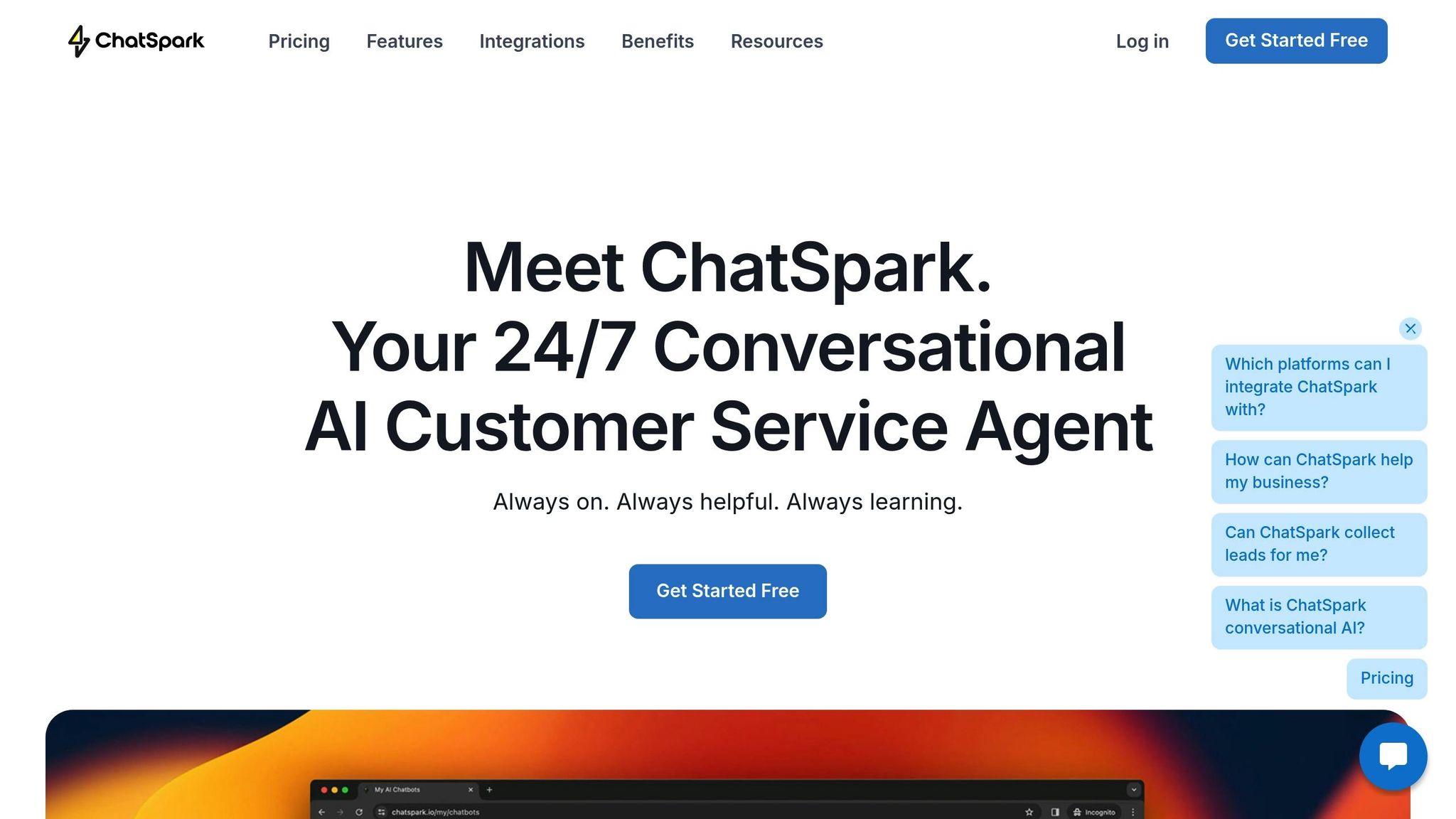
ChatSpark simplifies the creation of personalized conversational flows by adapting responses based on user data and previous interactions [6]. This system uses a unified, real-time data foundation to ensure every touchpoint feels consistent and focused on the customer. It even suggests responses based on your business documents, helping customers make decisions faster while improving resolution times [6].
What sets ChatSpark apart is its transparency. It clearly informs users that they’re interacting with AI at the start of each conversation, which helps build trust [6]. Routine questions are automated, while complex issues are seamlessly escalated to human agents - complete with the full chat history, so customers never have to repeat themselves [6]. This balance keeps satisfaction levels high.
ChatSpark’s omnichannel capabilities mean you can deploy these AI-driven journeys across platforms like websites, Instagram, Facebook, WhatsApp, Telegram, and Slack - all while maintaining context. Inviting users to chat can make them six times more likely to convert into customers [6]. Plus, ChatSpark can handle up to 80% of simple customer inquiries [6], freeing up your team to focus on more complex tasks. With support for over 85 languages and customizable branding, ChatSpark adapts to your business needs without requiring advanced technical expertise.
Automating and Scaling Personalized Interactions
Deploying 24/7 AI Automation
Round-the-clock AI automation can slash service costs by 20–30% while maintaining a personal touch [3][16]. Tasks like order tracking, password resets, and checking product availability are handled seamlessly by AI, letting your team focus on more complex customer needs. AI also enables proactive outreach by analyzing customer behavior patterns.
Many major platforms now rely on AI to automate a large chunk of customer interactions, driving efficiency to new heights [1]. Instead of sticking with basic FAQ bots, businesses are moving toward AI systems capable of managing entire tasks from start to finish [1]. This means customers can get instant, personalized solutions, no matter the time of day.
"Automation is critical to scaling messaging, and can be applied in many ways to help brands meet their customer experience goals and successfully contain conversations within automation."
- Chris Radanovic, LivePerson [1]
Starting with these immediate advantages, a step-by-step rollout strategy can help businesses scale automation effectively.
Gradual Rollout for Scalability
Diving headfirst into full-scale automation can be risky - it might overwhelm your team and confuse customers. A smarter approach is to test the waters with one high-impact use case like order tracking or appointment scheduling [3]. This allows you to evaluate the AI's performance, collect feedback, and fine-tune the system before expanding into more complex areas.
Once your initial project proves successful, you can gradually expand automation to other parts of the customer journey - think onboarding, personalized product recommendations, or post-purchase support. This methodical rollout not only minimizes risks but also gives your team time to adjust. Businesses that adopt this strategy often report customer retention rates as high as 85% [3], thanks to the ability to refine each step of the process before scaling further.
Scaling AI is a lot like building a house. You wouldn’t try to pour the foundation, frame the walls, and put up the roof all at once. Each phase needs to be solid before moving on to the next. The same principle applies to scaling AI-driven personalization - take it one step at a time.
This careful approach also sets the groundwork for smooth omnichannel integration.
Leveraging ChatSpark for Omnichannel Automation
Once you’ve nailed your automation strategy, platforms like ChatSpark can help you deliver consistent, personalized interactions across multiple channels. ChatSpark syncs conversations across websites, Instagram, Facebook, WhatsApp, Telegram, and Slack. For example, a customer who starts chatting on Instagram in the morning can pick up the same conversation on your website later in the day without skipping a beat [16].
This seamless cross-channel experience is exactly what customers expect. Research shows that 76% of customers prefer different channels depending on the situation [4], and 91% are more likely to shop with brands that make relevant recommendations [1][16]. ChatSpark ensures you’re meeting customers where they are, delivering personalized responses that remain consistent across platforms.
Pricing starts at $19/month, with plans that scale to meet enterprise needs. The Pro plan, for instance, supports up to 2,000 messages per month and integrates with tools like Zapier, Freshchat, and Calendly - perfect for businesses looking to handle high volumes of interactions without compromising on quality.
AI personalization strategies that work
Measuring and Optimizing AI-Driven Personalization
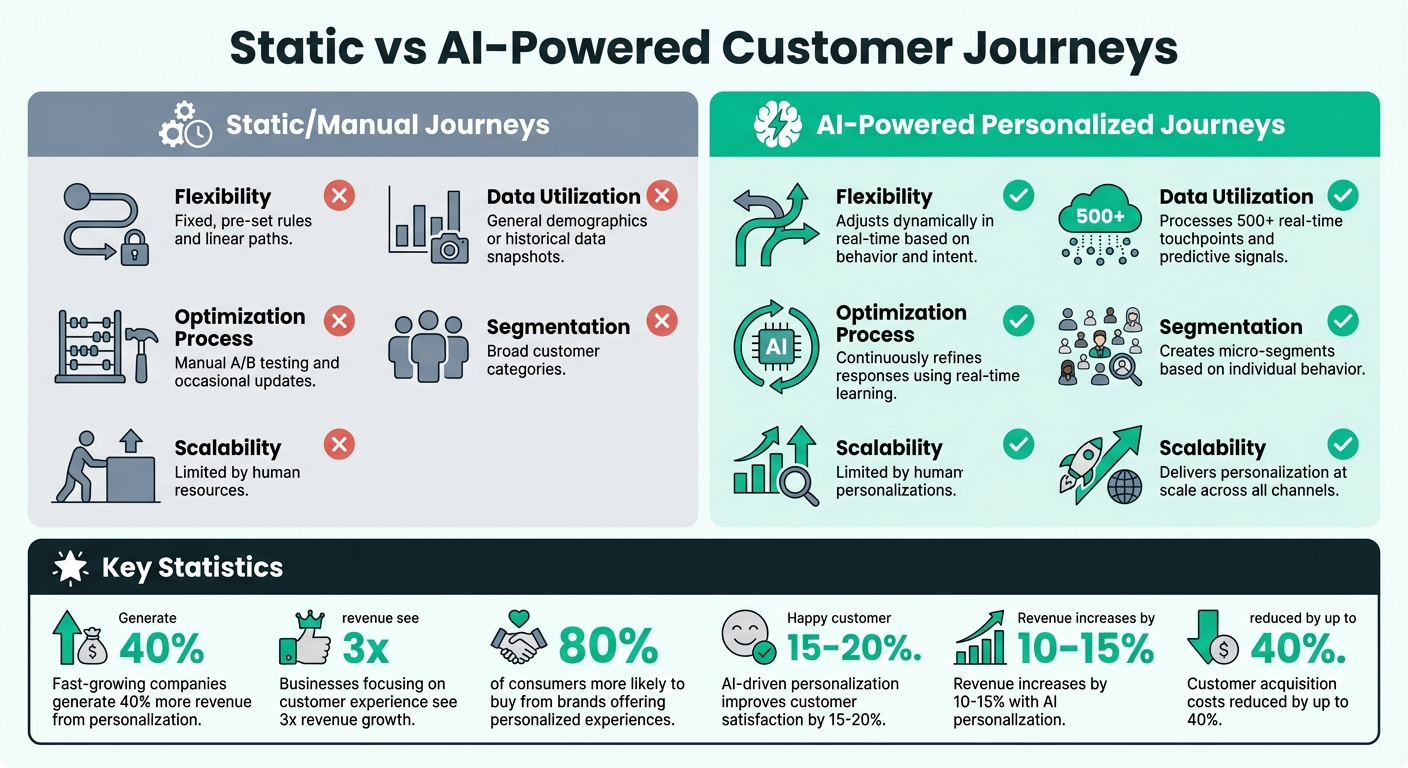
Static vs AI-Powered Customer Journeys: Key Differences and Benefits
Key Metrics for Personalization Success
To measure how well your AI is performing, it’s essential to track specific metrics. Start with AI performance metrics such as accuracy rate - strive for at least 80% [17]. You should also monitor the number of Q&A pairs your bot handles and how many variations of a question it can effectively manage [17]. These technical benchmarks give you a clear picture of how well your AI understands customer inquiries.
Next, dive into engagement metrics to see how users are interacting with your AI. These include site coverage (the number of pages with AI support), engagement rate (the percentage of visitors who engage with the bot), and lead capture rate or the number of meetings booked [17][18]. These numbers reveal how effectively your AI is connecting with your audience.
The metrics that directly impact your revenue are your financial indicators. Keep an eye on chat-influenced pipeline and revenue (deals where AI played a role) and chat-sourced pipeline and revenue (deals initiated by AI) [17][18].
"At the end of the day, what matters is that this is producing revenue for the business...Unless more people are buying because you made it easier for them, none of this matters." - Kyle Bastien, Director of Sales Enablement at Drift [17]
To assess how AI affects your sales process, track metrics like average sales cycle length, average contract value, and win rate [17]. Don’t overlook customer satisfaction metrics such as CSAT, NPS, and retention rates [18][3]. AI-driven personalization can improve customer satisfaction by 15–20% [3], and AI-assisted leads have conversion rates as high as 32%, compared to just 4% for non-AI leads [17].
Finally, refine your AI's performance through continuous testing and feedback loops to keep improving outcomes.
Experimentation and Continuous Improvement
AI systems aren’t "set it and forget it" tools - they thrive on constant refinement. Use A/B testing to experiment with different conversational flows, response styles, and personalization triggers. This helps identify what resonates most with customers. Tools like path analysis algorithms and heat maps can reveal where users drop off or encounter friction [3]. AI can then automatically adjust and implement the most effective changes.
Sentiment and intent analysis adds another layer of refinement by detecting emotional cues in customer interactions [3][11]. If frustration is detected, the AI can escalate the issue to a human agent. On the flip side, positive sentiment might trigger a tailored offer or promotion.
More advanced systems use metrics like the Meaningful Automated Conversation Score (MACS) to catch potential failures before they impact performance [1]. Pair this with continuous learning loops that retrain AI models using fresh interaction data, ensuring your system becomes more accurate and effective over time [3][2].
Static Journeys vs AI-Powered Journeys
Once you’ve established solid metrics, it’s time to assess how AI-driven personalization stacks up against traditional methods.
Comparison of Static vs. AI-Powered Journeys:
| Feature | Static/Manual Journeys | AI-Powered Personalized Journeys |
|---|---|---|
| Flexibility | Follows fixed, pre-set rules and linear paths | Adjusts dynamically in real-time based on behavior and intent [3] |
| Data Utilization | Uses general demographics or historical data snapshots | Processes 500+ real-time touchpoints and predictive signals [3] |
| Optimization Process | Relies on manual A/B testing and occasional updates | Continuously refines responses using real-time learning [3] |
| Segmentation | Groups customers into broad categories [3] | Creates micro-segments based on individual behavior [3] |
| Scalability | Limited by human resources | Delivers personalization at scale across all channels [2] |
The differences between these approaches aren’t just technical - they’re financial too. Fast-growing companies generate 40% more revenue from personalization compared to slower-moving competitors [2]. Businesses that focus on improving customer experience see three times the revenue growth of their peers [2]. With 80% of consumers more likely to buy from brands offering personalized experiences [1], the case for AI-powered journeys becomes undeniable.
Conclusion
Conversational AI has reshaped customer interactions, turning them from predictable and rigid exchanges into engaging, tailored experiences. The results speak for themselves: 15–20% higher satisfaction, 10–15% revenue growth, and up to 40% lower customer acquisition costs [3].
With AI managing as much as 80% of routine inquiries [6], your team can focus on the more complex and meaningful conversations that demand human empathy and creativity. This isn’t about replacing people - it’s about creating a seamless partnership where AI’s efficiency complements human connection [7]. Considering that 71% of consumers expect personalized content and 80% are more likely to buy from brands that deliver it [1][2], the message is clear: personalization isn’t just a bonus - it’s a necessity.
ChatSpark makes this level of personalization accessible. Offering 24/7 automated support across platforms like websites, Instagram, Facebook, WhatsApp, Telegram, and Slack, it supports over 85 languages. Whether you're a solo entrepreneur with the Basic plan at $19/month or a large enterprise needing custom solutions, ChatSpark scales with your needs - no extra headcount required.
Fast-growing companies already see 40% more revenue from personalization compared to their slower-moving peers [2]. So why wait? By implementing AI-driven personalization now, you can give your business a competitive edge.
Bring together your customer data, integrate AI at critical touchpoints, and refine your strategy using real-world performance metrics. The tools are ready, the ROI is proven, and your customers are waiting for a personalized experience.
FAQs
How does Conversational AI create personalized customer experiences?
Conversational AI takes customer experiences to the next level by tapping into data from multiple sources - think browsing history, past purchases, demographics, and even real-time details like location or time of day. Through the power of machine learning and natural language processing (NLP), it understands user intent, predicts what they might need, and delivers recommendations or assistance that feel natural and relevant.
Take ChatSpark, for instance. This platform connects with customer data systems to create personalized interactions on channels like websites, Instagram, WhatsApp, or Slack. It can greet returning customers by name, suggest products based on their recent activity, or even offer timely discounts (like $19.99) when a shopper shows interest. With support for over 85 languages and the ability to align with individual preferences, Conversational AI not only makes interactions smoother but also increases satisfaction, drives conversions, and builds lasting customer loyalty.
What are the benefits of using Conversational AI to personalize customer journeys?
Conversational AI takes customer interactions to the next level by turning them into real-time, personalized experiences. By analyzing data like browsing history, past purchases, and live chat activity, it delivers product recommendations, special offers, and support tailored to each shopper's preferences. This approach not only enhances customer satisfaction but can also lead to higher revenue, better retention rates, and lower acquisition costs.
Platforms such as ChatSpark amplify these advantages by offering always-on, brand-consistent responses across a variety of channels - including websites, Instagram, Facebook, WhatsApp, and Slack - in more than 85 languages. With predictive insights, AI can anticipate customer needs, quickly resolve issues, and guide users toward making purchases. Meanwhile, human agents are freed up to handle more complex tasks, creating an efficient, engaging experience that fosters loyalty and boosts conversions.
How does ChatSpark protect user privacy while personalizing customer experiences?
ChatSpark places a strong emphasis on privacy, ensuring user data is protected at every stage. It carefully processes only the information required to generate responses and retains interactions for a limited, pre-set duration to minimize the chance of exposing personal details. Additionally, any data used for analytics is anonymized, allowing the platform to offer personalized experiences based on general behavior patterns rather than sensitive user information.
The platform adheres to key privacy regulations, including GDPR and CCPA, and employs rigorous security protocols to safeguard data. This thoughtful approach allows ChatSpark to provide tailored interactions - like addressing users by name or recalling previous conversations - while maintaining strict confidentiality and trust.