
Looking for faster, smarter customer support? Conversational AI is changing how businesses interact with customers by offering instant, personalized, and 24/7 assistance. Unlike older systems, it understands intent, handles complex queries, and keeps context throughout conversations.
Key Benefits:
- Speed and Availability: AI cuts response times by up to 83% and works around the clock.
- Cost Savings: Businesses save 30–65% on support costs by automating repetitive tasks.
- Personalization: AI uses customer data to deliver tailored responses and eliminate repetitive steps.
- Multilingual Support: Real-time translation ensures smooth communication in multiple languages.
- Improved Operations: AI reduces agent workload, boosts productivity by 14%, and enables scaling during peak times.
Real-World Results:
- Unity: Saved $1.3M in support costs and improved customer satisfaction to 93%.
- Esusu: Achieved an 80% one-touch response rate by automating 10,000 monthly tickets.
- Curology: Cut support costs by 65% while maintaining high resolution rates.
By combining advanced tools like Natural Language Processing (NLP) and sentiment analysis, conversational AI helps businesses provide faster, more efficient, and tailored customer experiences. Ready to learn what is conversational AI and how it works? Let’s dive in.
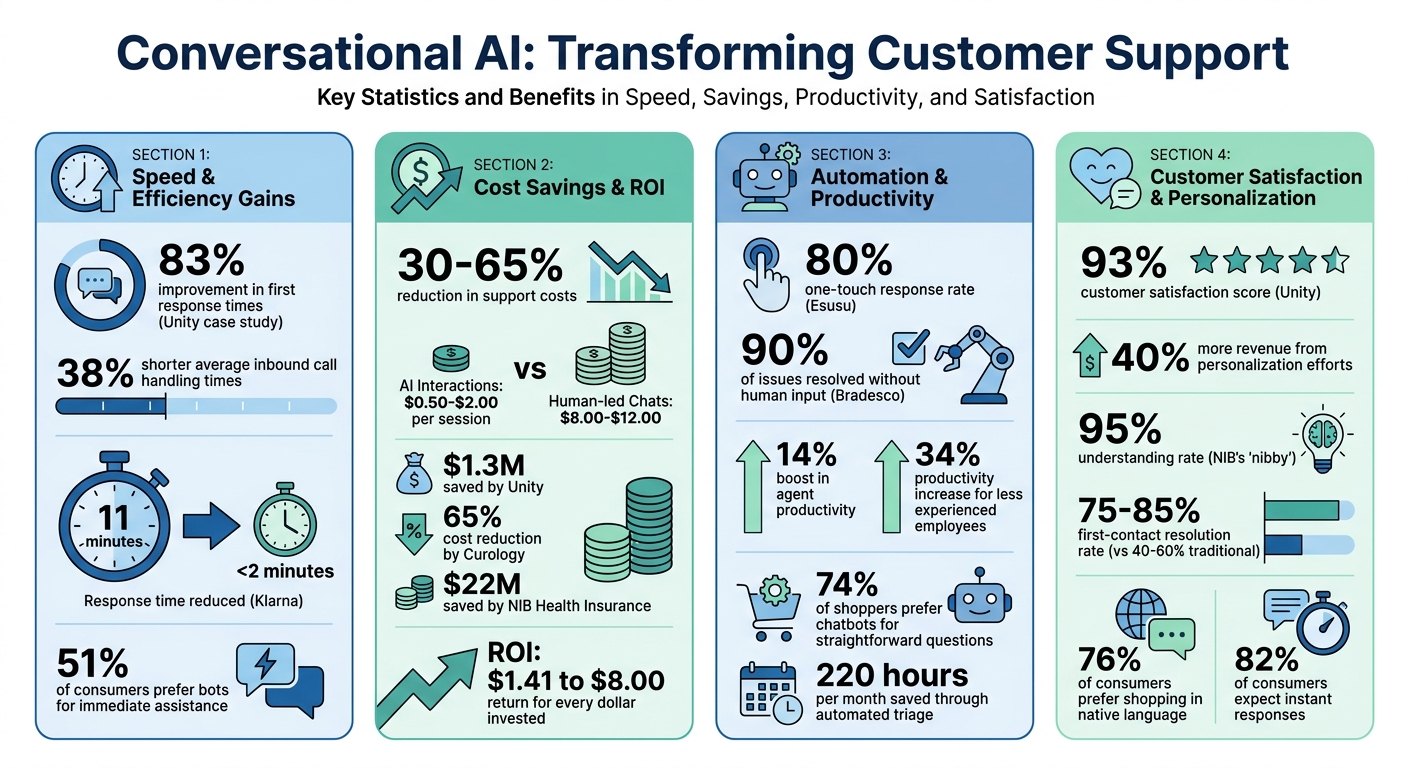
Conversational AI Impact: Key Statistics on Cost Savings, Response Times, and Customer Satisfaction
How Conversational AI Personalizes Customer Interactions
Gone are the days when generic, one-size-fits-all responses were enough. Customers now expect businesses to recognize them, understand their needs, and respond accordingly. Conversational AI makes this possible by leveraging customer data, interpreting intent and emotions, and cutting out the frustrating redundancies that often plague support interactions.
Using Customer Data for Personalized Responses
Conversational AI taps into a wealth of customer information - like purchase history, preferences, past interactions, and account details - to deliver responses that feel tailored and relevant. For example, it can provide real-time order updates without asking for an order number, saving time and effort. Rather than treating every interaction as a standalone event, the AI draws on patterns from previous purchases, browsing behavior, and support tickets to craft answers that make sense in context.
This level of personalization isn’t just a nice touch - it’s a game changer. Research shows that businesses excelling in personalization see 40% more revenue from those efforts compared to their peers [3].
Interpreting Customer Intent and Sentiment
Understanding what a customer wants is only part of the equation. Conversational AI also focuses on why they’re asking and how they feel. Using Natural Language Understanding (NLU) to shape personalized interactions, the AI can differentiate between similar requests, such as whether a customer wants to cancel an order or simply change the delivery address. Sentiment analysis goes a step further, identifying emotions like frustration, excitement, or hesitation based on the customer’s language, tone, and phrasing.
Liberty London demonstrated this in January 2026 by using Zendesk AI to decode customer intent, sentiment, and language. This approach gave their teams instant clarity on whether an issue was positive or negative, helping them respond more effectively [2]. Similarly, Motel Rocks introduced an intelligent triage system that assigns emojis to reflect a customer’s emotional tone - from negative to very positive - allowing agents to respond with the right level of urgency and empathy [2].
Eliminating Repetitive Steps in Customer Journeys
Few things annoy customers more than having to repeat themselves, especially when transferred between agents or channels. Traditional support systems often create this frustration, but conversational AI eliminates it by keeping the context intact throughout the interaction.
Operational Benefits of Conversational AI
Conversational AI doesn't just enhance customer interactions; it also reshapes support operations by driving efficiency, cutting costs, and scaling services. These improvements benefit both businesses and their customers.
24/7 Support and Faster Response Times
Nearly half of customer interactions happen after regular business hours. Conversational AI ensures round-the-clock availability, offering instant responses regardless of time zones or holidays [2].
The speed gains are equally noteworthy. In October 2025, Unity, a 3D development platform, adopted Zendesk AI to handle a spike in support tickets. This led to an 83% improvement in first response times, deflected nearly 8,000 tickets, and saved approximately $1.3 million in support costs, all while maintaining a 93% customer satisfaction score [2]. Additionally, companies using mature AI systems report 38% shorter average inbound call handling times [1], and 51% of consumers prefer bots for immediate assistance [2].
This continuous availability also enables automation of routine tasks, allowing human agents to focus on more nuanced and complex customer needs.
Automating Repetitive Customer Inquiries
Repetitive tasks like password resets or order tracking can eat up valuable agent time. Conversational AI takes over these predictable interactions, freeing agents to tackle more complex issues that require human judgment and empathy [5] [6].
For example, in January 2026, fintech startup Esusu implemented Zendesk Advanced AI to automate macro suggestions and summarize 10,000 monthly tickets, achieving an 80% one-touch response rate [2]. Similarly, Bradesco, one of Latin America's largest banks, introduced a generative AI chatbot in November 2025 that now resolves 90% of customer issues without human input, assisting millions of users daily [8] [1].
"I think automated triage is something any business can benefit from. We've seen time savings of 220 hours per month by eliminating manual triage."
– Gianna Maderis, Principal Customer Experience Manager, Zendesk [2]
Research highlights that 74% of shoppers prefer chatbots for straightforward questions [7]. By taking over these repetitive tasks, AI boosts agent productivity by an average of 14% [1], enabling teams to focus on cases where human expertise matters most.
This shift not only boosts efficiency but also delivers considerable cost savings and operational scalability. Successfully transitioning requires a complete guide to AI customer support implementation to ensure long-term optimization.
Reducing Costs and Scaling Support Operations
Conversational AI significantly lowers support costs while scaling operations seamlessly. AI-led interactions typically cost $0.50–$2.00 per session, compared to $8.00–$12.00 for human-led live chats [2]. Companies using conversational AI can reduce operating expenses by up to 30% [6], with mature AI users reporting 17% higher customer satisfaction scores [1].
In November 2025, skincare brand Curology used Decagon's conversational AI to manage routine inquiries, cutting total customer support costs by 65% while maintaining high resolution rates [2]. Likewise, in March 2026, the Testicular Cancer Foundation launched a Chatbase-powered AI agent to provide clinical information. This AI managed 66% of its interactions between 4 PM and midnight, covering 12 countries in 5 languages without the need for additional staff [6].
Scalability becomes especially crucial during peak periods or product launches, enabling businesses to handle high-volume customer inquiries efficiently without adding extra staff or overhead [2] [7]. These backend efficiencies translate into better customer experiences, proving that operational improvements directly enhance service quality.
How Conversational AI Supports Human Agents
Conversational AI isn't here to take over customer service teams; instead, it works alongside them, automating repetitive tasks and offering intelligent support. This allows agents to dedicate their time to solving more complex problems and fostering genuine relationships with customers, improving both the customer experience and how efficiently teams operate.
AI as a Partner for Customer Service Teams
Think of AI as a real-time assistant. It pulls up important resources, suggests ready-to-use responses, and retrieves customer data automatically. This means agents don't have to dig through piles of documentation or past tickets, helping them resolve issues faster and with greater accuracy.
For example, fashion retailer Motel Rocks uses an intelligent triage system with sentiment analysis. It assigns visual emojis - ranging from negative to very positive - to incoming messages. This helps agents identify and prioritize frustrated customers who need immediate attention while also preparing for the emotional tone of the conversation before they respond [2].
AI tools also play a big role in helping new team members get up to speed. Research shows that for less experienced employees, AI can boost productivity by as much as 34% [10]. These tools provide real-time coaching, enabling new agents to deliver polished, professional responses from day one. On top of that, AI ensures that complex issues are escalated to the right people at the right time, keeping things running smoothly.
Smart Escalation for Complex Customer Issues
When a situation goes beyond routine assistance, AI ensures a seamless handoff to human agents, complete with all the necessary details. Advanced AI systems know when to escalate - whether the issue becomes too complicated or the customer shows signs of frustration - without forcing the customer to repeat themselves. The AI provides a detailed summary, covering customer details, steps already taken, and even a sentiment analysis.
This kind of enriched information allows agents to jump in with a full understanding of the situation, leading to quicker resolutions and less frustration for the customer. For high-stakes decisions, like issuing large refunds or making account changes, many businesses use human-in-the-loop (HITL) systems. Here, the AI suggests actions, but a human reviews and approves them before they’re implemented [9]. This setup ensures AI handles the heavy lifting, while humans retain control over critical decisions.
Reaching More Customers with Multilingual and Omnichannel Support
Conversational AI breaks down language barriers and brings together customer interactions across various platforms. This technology enables natural, language-specific support and ensures a unified customer experience across every channel.
Real-Time Support in Multiple Languages
Modern conversational AI works by grasping intent and context, rather than relying on basic translation. Kara Hartnett from Rasa explains, "Multilingual conversational AI operates at the decision layer, not the translation layer" [12]. This means the AI focuses on understanding the meaning behind the customer’s words and responds naturally in their language, avoiding clunky, word-for-word translations.
One standout feature is live voice translation, which allows, for example, a Spanish-speaking customer and an English-speaking agent to communicate in real time - no interpreter needed [14]. The cost savings are impressive: hiring native speakers for 10 languages could cost $30,000–$50,000 a month, while multilingual AI chatbots cost only $19–$30 and respond in under two seconds [12]. And the need for this is clear: according to CSA research, 76% of consumers prefer shopping on websites in their native language, while 40% won’t buy if the site isn’t available in their language [16].
To maximize efficiency, businesses should create language-specific glossaries for technical terms, product names, and regulated language. This ensures the AI doesn’t misinterpret industry-specific jargon or compliance-related terms [12][13]. For companies going global, start by fully localizing for your top-performing markets using CRM and traffic data. For less common languages, automated translation can fill the gap [15].
Consistent Experiences Across Multiple Channels
Delivering personalized and efficient support isn’t enough - customers now expect the same level of service across every platform. Whether they contact you on your website, Instagram, WhatsApp, or Slack, the experience should feel seamless. Achieving this requires a centralized control layer that defines conversation logic and policies once, then applies them across all channels [12]. This setup ensures that context is preserved even when customers switch platforms, something older systems often fail to do [12].
Consider this: 73% of social media users will turn to a competitor if a brand doesn’t respond [11]. Each channel - whether web, social media, or messaging - has its unique role, but all should work together under the same conversation logic [16]. For example, ChatSpark enables deployment across all these platforms while maintaining consistent responses in over 85 languages. This ensures that your brand voice remains consistent, no matter where your customers choose to engage.
Tracking and Measuring Conversational AI Performance
Rolling out conversational AI is just the beginning - what sets successful implementations apart is how well their impact is measured. Organizations that rely on structured measurement frameworks report 40–60% higher returns compared to those using guesswork [21]. The secret? Tracking the right metrics and leveraging analytics to fine-tune how your AI engages with customers.
Using Analytics to Improve AI Performance
After achieving better operational efficiency, the next step is consistent tracking to improve performance. Sentiment analysis can gauge the tone and emotion in customer messages, flagging frustration in real time [19][20]. For instance, if customers repeatedly express dissatisfaction at specific points, it’s a signal to address those pain points. Intent recognition groups customer queries into themes, helping you uncover patterns like recurring product complaints or new trends your team should act on [19].
Missed utterances - phrases the AI fails to understand - are another critical metric. By analyzing these, you can expand your AI’s vocabulary and refine its natural language processing capabilities [20]. A great example: In 2024, UK beverage company AG Barr introduced the "BruDog" bot using Freshservice. By analyzing and automating over 2,000 IT support tickets each month, they drastically reduced their helpdesk's manual workload [20]. Similarly, Indian FinTech giant PhonePe deployed its Freddy bot to support 300 million users, automating 80% of customer service inquiries and improving customer satisfaction scores [20].
Before launching your AI, it’s essential to document current benchmarks like support costs per conversation, response times, and customer satisfaction levels. This lets you clearly track improvements [21]. Start small with a phased rollout, focusing on low-risk tasks like FAQs or order tracking. Weekly reviews of chat logs will highlight problem areas and refine your AI’s training data [21].
Key Metrics to Monitor
Not all metrics are created equal. Some, like resolution time - the time it takes to solve an issue from initial contact - are directly tied to customer satisfaction [17]. Cost per resolution helps you understand operational savings by comparing AI interactions to those handled by human agents [17]. It’s also important to track revenue-focused metrics, such as lead conversion rates, upselling success, and gross merchandise value influenced by AI recommendations [21][22].
In early 2024, Klarna’s AI assistant managed 2.3 million conversations in its first month, performing the equivalent work of 700 full-time agents. This cut resolution time from 11 minutes to under 2 minutes and is projected to add $40 million in profits for the year [21]. Since 2021, NIB Health Insurance’s AI assistant "nibby" has handled over 4 million queries with a 95% understanding rate, automating 60% of interactions and saving an estimated $22 million in operational costs [21]. Outdoor brand Arc'teryx saw its chat conversion rates climb from 4% to 7% - a 75% boost - after introducing an AI Shopping Assistant that influenced 3.7% of their total revenue [22].
On average, AI customer support delivers $1.41 to $8.00 in returns for every dollar invested [21]. Top-tier systems achieve a 75–85% first-contact resolution rate, far outpacing traditional systems, which hover between 40–60% [21]. Tools like ChatSpark’s analytics dashboard can track these metrics across all channels, helping you pinpoint where your AI excels and where it needs improvement. With 69% of support leaders planning to increase AI investments [18], tracking performance is no longer optional - it’s essential for staying competitive. Analytics not only measure success but also guide ongoing optimization of your conversational AI.
Conclusion
Conversational AI has reshaped customer support, turning it into a tool for building stronger relationships with customers [24]. The results speak for themselves: businesses using conversational AI have cut support costs by 60–70%, all while managing millions of interactions across various languages and channels [23]. Companies like Unity and Curology have already seen faster response times and significant cost reductions [2].
This trend reflects a changing business environment. Sixty-five percent of CX leaders now see AI as essential, making older methods feel outdated [2]. With 82% of consumers expecting instant responses and 71% wanting personalized interactions [4], the pressure is on. But you don’t need to overhaul everything at once - starting small is an option. Launch a minimum viable product in just 30 days, targeting impactful areas like lead follow-ups or recovering missed calls [4][2].
Deep system integration is key to success.
"A true conversational AI platform integrates deeply and securely with your existing systems... This allows it to take action on a customer's behalf."
– Ryan Smith, Writer/Expert, Decagon [23]
To stay competitive, aligning your support strategy with conversational AI is no longer optional. Success hinges on integrating AI with tools like CRMs, support platforms, and backend systems. It’s equally vital to establish clear escalation paths for complex issues, ensuring seamless handoffs to human agents with full conversation history intact [23][6]. Platforms like ChatSpark’s analytics dashboard can help you monitor performance, identifying strengths and areas for improvement across all channels.
The takeaway is clear: conversational AI is changing how businesses engage with customers. Start small, track results, and scale what works. Customers now expect AI-driven support, so the real question is how quickly you can implement it to maintain your edge in the market.
FAQs
What should I automate first with conversational AI?
Start by automating routine, repetitive tasks such as refund processing, order tracking, password resets, and handling common FAQs. These tasks are predictable and occur frequently, making them perfect candidates for automation. By tackling these first, you can cut costs, speed up response times, and free up your human agents to handle more complex or nuanced customer inquiries. Once you've streamlined these foundational processes, you can gradually move on to automating more personalized and advanced support functions.
How do I connect conversational AI to my CRM and support tools?
To link conversational AI with your CRM and support tools, you'll need to integrate your AI platform with your existing systems. This ensures smooth data sharing and automation. Here’s how to get started:
- Pinpoint integration points: Decide which CRM and tools you want to connect to your AI platform.
- Leverage APIs or connectors: These enable real-time data sharing and updates between systems.
- Test and refine: Keep an eye on workflows, making adjustments to maintain accuracy and efficiency.
How do I know when AI should hand off to a human agent?
When certain triggers arise - like low confidence scores, negative sentiment, or a direct request for escalation - AI should seamlessly transition the interaction to a human agent. It's crucial that the full conversation history is passed along to the agent to ensure continuity and prevent customer frustration. Matching the customer with the right agent based on their skills and the urgency of the issue can make a big difference. Clear communication during the handoff process keeps the experience smooth and leaves the customer feeling valued.