AI chatbots are transforming how businesses interact with customers. They automatically engage visitors, gather contact details, and qualify leads in real time. With 24/7 availability, these tools handle routine queries, reduce support tickets, and drive conversions - even outside business hours. Key benefits include:
- Real-Time Conversations: Chatbots respond instantly, capturing leads when interest is highest.
- Lead Qualification: Using frameworks like BANT (Budget, Authority, Need, Timeline), they prioritize high-value prospects.
- Personalized Support: Chatbots remember past interactions, offer tailored recommendations, and integrate with CRM tools for seamless follow-ups.
- Cost Savings: Companies report reduced operational costs and increased efficiency by automating repetitive tasks.
For example, tools like ChatSpark help businesses engage across channels like websites, WhatsApp, and social media. They offer multilingual support, CRM integrations, and features like appointment scheduling and order tracking. Pricing starts at $19/month, making them accessible for businesses of all sizes.
AI chatbots are no longer just support tools - they’re essential for lead generation and customer engagement.
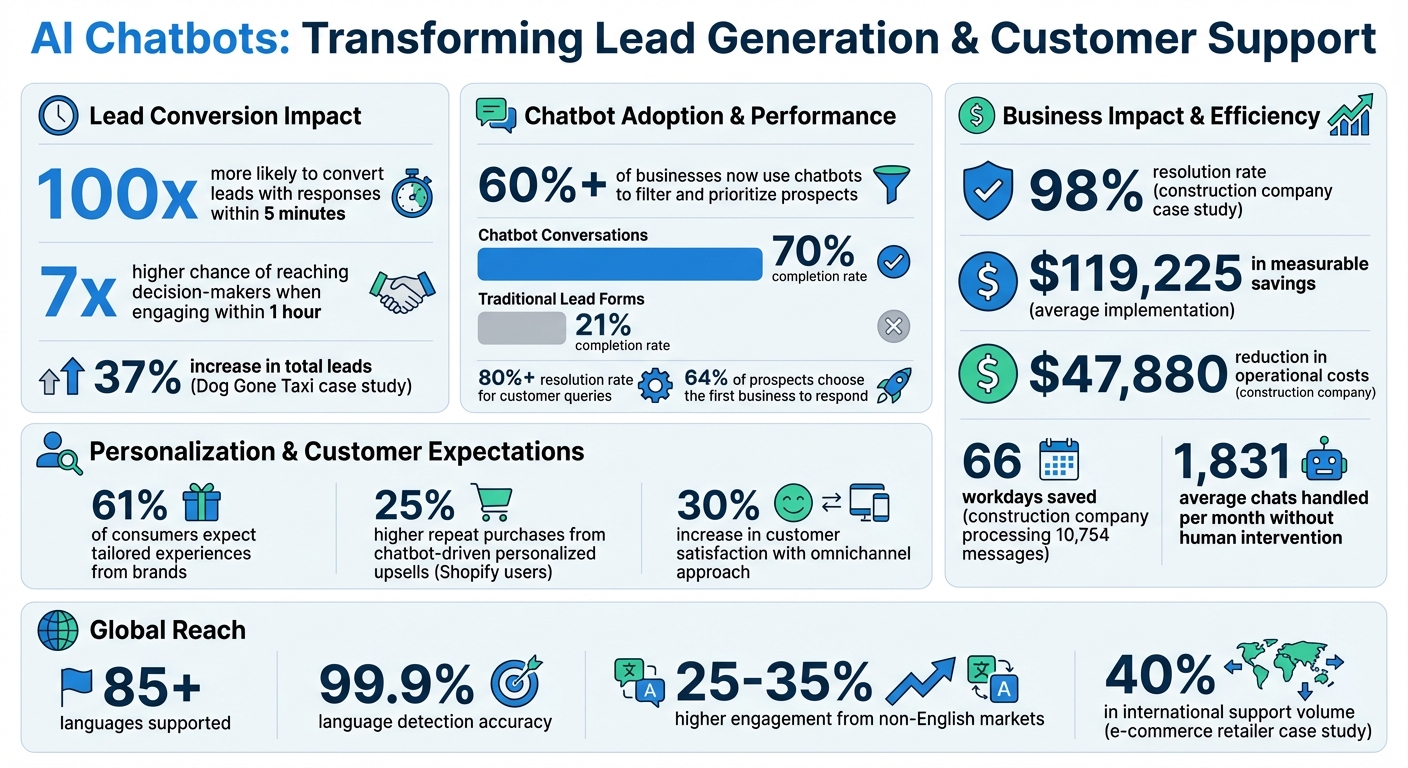
AI Chatbot Benefits: Key Statistics for Lead Generation and Customer Support
Benefits of AI Chatbots for Lead Generation and Customer Support
AI chatbots bring three major benefits to the table: constant availability, smarter lead filtering, and personalized interactions. Together, these features help businesses connect with potential customers more effectively while lightening the load on human teams.
24/7 Availability for Lead Capture and Support
Chatbots are always ready to engage, whether it’s 3 a.m. or during a holiday. This means no more waiting for business hours - leads are captured instantly, and customers get immediate responses. By implementing AI customer support to initiate real-time conversations, chatbots keep the momentum going, which can significantly boost conversions [1][4].
Why does this matter? Businesses are 100 times more likely to convert a lead if they respond within five minutes [6]. Take Dog Gone Taxi, for instance. In 2025, they replaced long, clunky forms with a 24/7 chatbot that provided personalized quotes. The result? A 37% increase in total leads and fewer booking errors [4].
Smarter Lead Qualification with AI
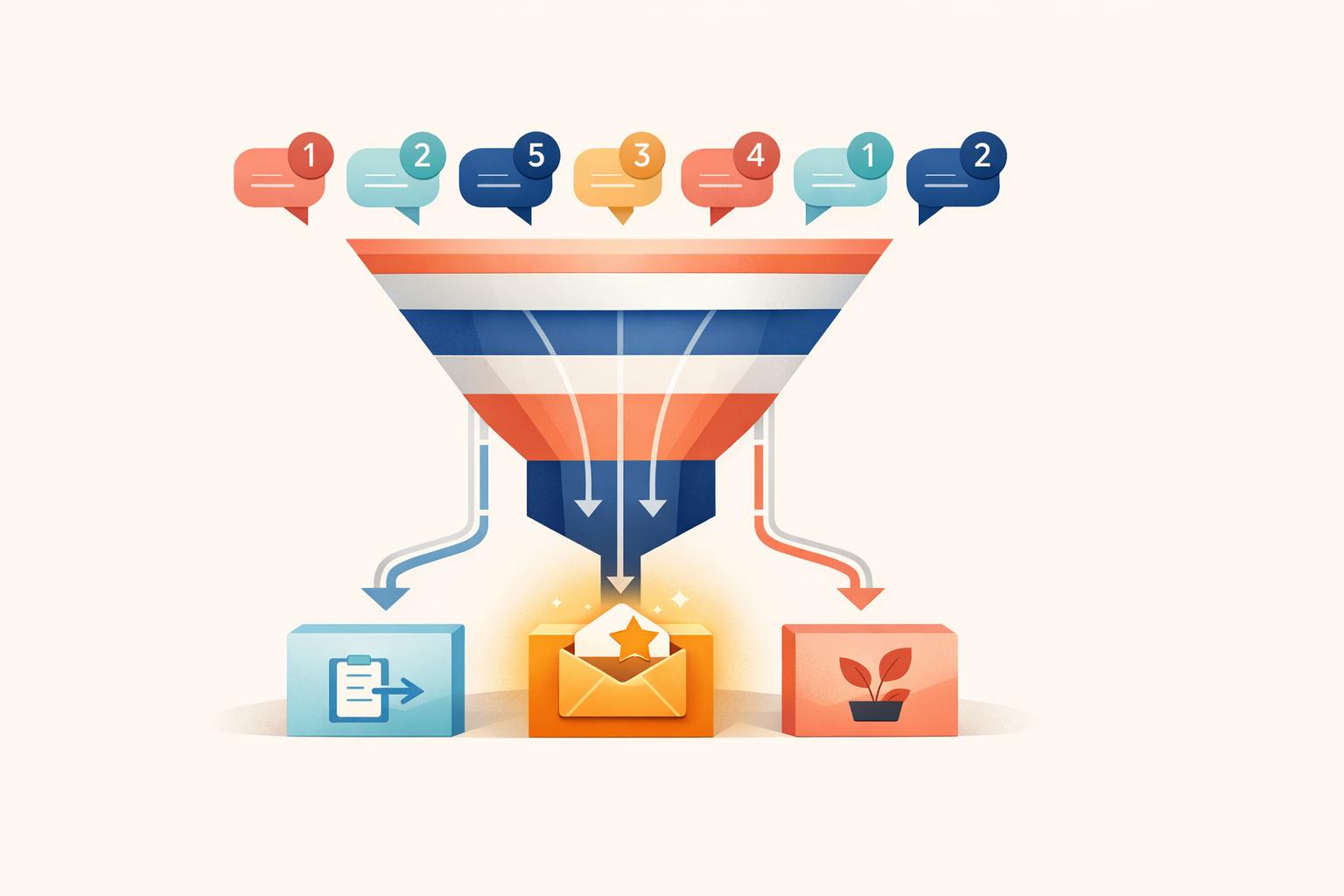
AI chatbots don’t just capture leads - they also sort and qualify them. Using frameworks like BANT (Budget, Authority, Need, Timeline), chatbots ask targeted questions in a conversational tone [3][4]. They then assign scores to responses, prioritizing leads based on factors like decision-making authority or urgency, and rank them accordingly [5].
"Chatbots qualify leads by asking predefined questions, engaging in natural conversations with prospects, and providing sales teams with the data they need to make more informed qualification decisions." – Maddy Martin, SVP of Growth, Smith.ai [3]
This process is catching on fast. Over 60% of businesses now use chatbots to filter and prioritize prospects [3][5]. High-priority leads are instantly routed to live agents or booking systems, while others enter automated follow-up sequences. And here’s a standout stat: chatbot conversations have a 70% completion rate, compared to just 21% for traditional lead forms [6].
Personalized Customer Interactions
Once leads are captured and qualified, chatbots take things a step further with personalized interactions. Today’s chatbots can recognize returning users, remember past conversations, and even skip repetitive questions if the information is already on file [8][9]. By integrating with CRM systems, they ensure a smooth and frustration-free experience [7][6].
This level of personalization isn’t just a nice touch - it’s expected. 61% of consumers now look for tailored experiences from brands [7]. Chatbots make this happen by sending context-specific messages, like offering an ROI calculator on a pricing page or a discount code for an abandoned cart [8]. Shopify users, for example, have seen 25% higher repeat purchases thanks to chatbot-driven personalized upsells [9]. By delivering immediate value in exchange for user details, chatbots create seamless experiences that keep customers engaged and drive results [6].
How ChatSpark Captures Leads for Businesses
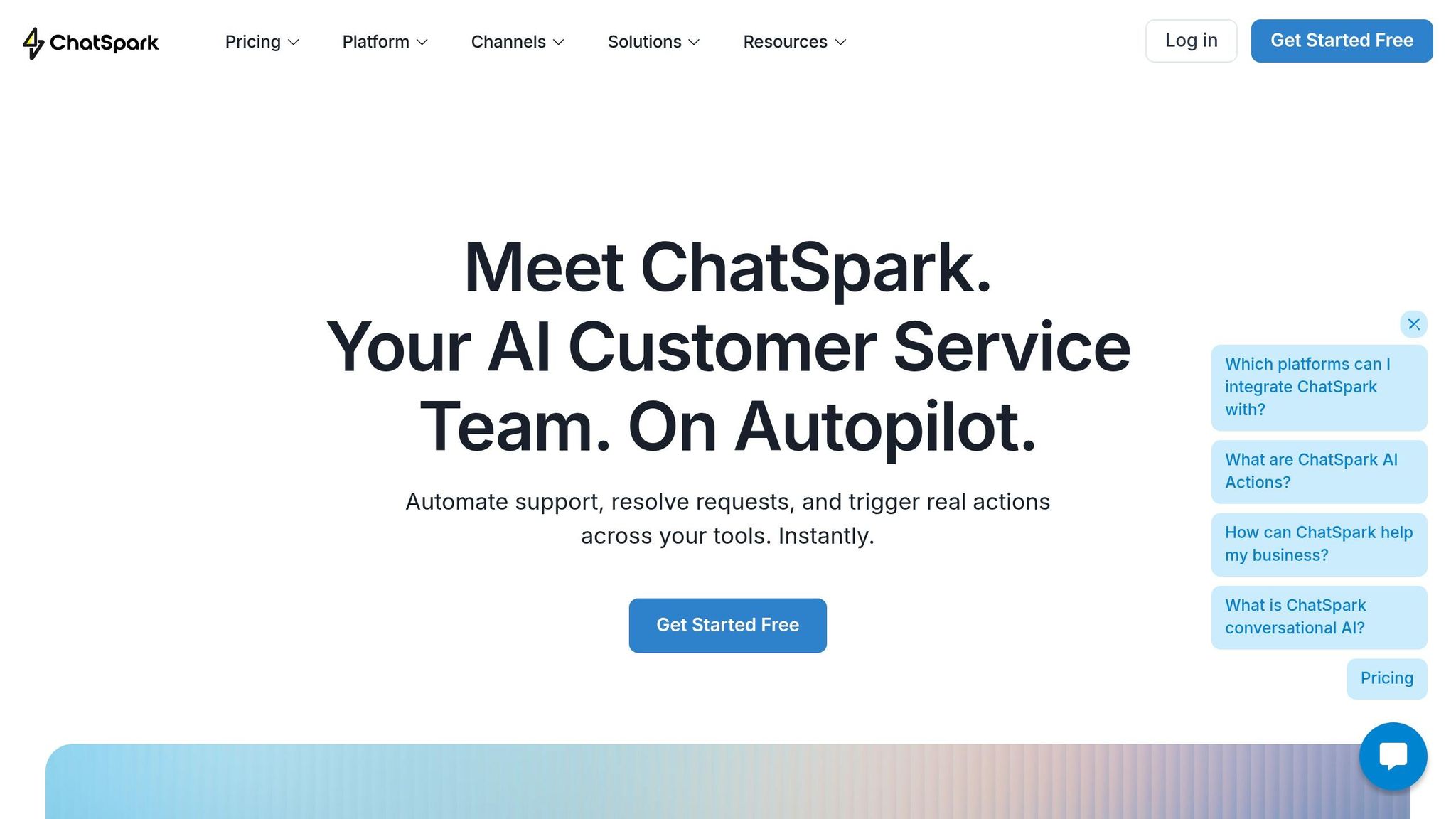
ChatSpark turns casual website visitors into qualified leads through natural, multi-channel conversations. Instead of relying on intrusive pop-up forms, it engages users through websites, SMS, and social media, using triggers like page loads or specific keywords. By adopting a conversational, one-field-at-a-time approach - similar to texting a friend - it minimizes friction and boosts conversion rates. This smooth transition from initial interaction to lead qualification highlights ChatSpark's ability to streamline customer engagement.
Starting Conversations and Collecting Contact Information
ChatSpark makes gathering contact details feel effortless by integrating it into the flow of conversation. It collects essential information like name, email, phone number, company, and address, while also offering unlimited custom fields for deeper insights. Beyond basic details, it tracks key behavioral signals such as page views, time spent on-site, and visited URLs, giving your sales team valuable context. Leads are then scored as High, Medium, or Low engagement to help prioritize follow-ups effectively.
Even on the Free Plan, ChatSpark’s native lead capture forms and Zapier integration allow seamless connection to over 5,000 apps. Professional plans go a step further, enabling AI Actions that sync lead data directly to CRMs in real time during chats. Once contact details are secured, ChatSpark uses proven methods to qualify leads immediately.
Using the BANT Framework to Qualify Leads
ChatSpark employs the BANT framework (Budget, Authority, Need, Timeline) to identify serious prospects. Through conversational, targeted questions, it gathers details about project scope, budget, decision-makers, and timelines. This process helps distinguish high-potential leads from casual inquiries.
For example, between September 2025 and January 2026, a global construction products company processed 10,754 messages through ChatSpark. During this period, the AI agent identified 153 qualified leads and achieved a 98% resolution rate. This saved the company over 66 workdays and reduced operational costs by $47,880 [10]. Quick responses also make a big difference - engaging a lead within one hour increases the chances of reaching a decision-maker by seven times [11].
CRM Integration for Lead Management
Once leads are qualified, ChatSpark ensures they are efficiently managed through seamless CRM integration. There are two main ways to connect:
- Zapier Integration: Available on all plans, this transfers lead data to over 5,000 apps after a conversation.
- AI Actions: Exclusive to Professional plans and above, this feature syncs data in real time during chats, creating contacts, deals, and cases in CRMs like HubSpot, Salesforce, and Follow Up Boss.
ChatSpark also pushes full conversation transcripts, AI-generated summaries, and behavioral data into CRM records, enabling highly personalized follow-ups.
The ChatSpark CoPilot browser extension further enhances productivity by letting sales teams query CRM data, log notes, and track deal progress without switching tabs. Automated follow-up tools can trigger support tickets in Zendesk or Freshdesk and even schedule appointments directly in Calendly or Google Calendar.
As Lorri G., Customer Service & Technical Support Manager, shared:
"ChatSpark has been managing two of our largest product lines over the past year. It currently handles an average of 1,831 chats per month without any human intervention. Since implementing it on our website, we've realized measurable savings of $119,225" [12].
ChatSpark's Features for 24/7 Customer Support
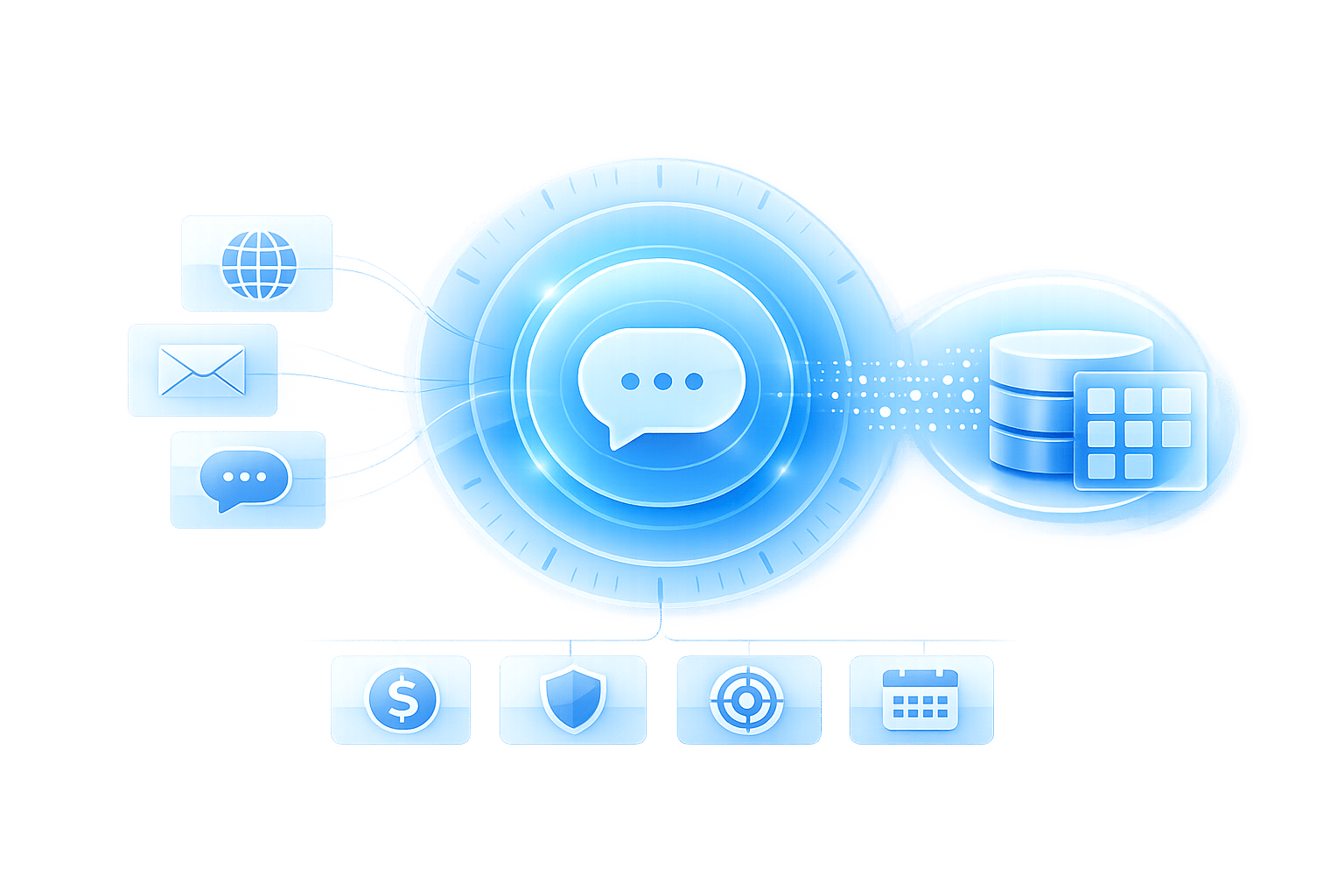
ChatSpark delivers instant customer support across six major channels: websites, WhatsApp, Instagram, Facebook Messenger, Telegram, and Slack. Its proprietary 4-step AI engine powers this functionality by understanding customer intent, retrieving answers through semantic matching, ranking results using over 10 scoring signals, and responding in your brand's tone. This process ensures responses in under 2 seconds on average, with resolution rates exceeding 80% [13].
Real-Time Customer Support Across Channels
ChatSpark’s AI agents provide immediate answers across multiple platforms. Using Retrieval-Augmented Generation (RAG), the system pulls answers directly from your FAQs, PDFs, and website content rather than relying on generic AI responses. This ensures customers get accurate, brand-specific information about your products, services, or policies.
But ChatSpark goes beyond just answering questions. It integrates with over 40 tools to perform tasks like checking order statuses in Shopify, booking appointments in Calendly, or creating support tickets in Zendesk - completely autonomously. For e-commerce businesses, this means customers can track their orders or resolve issues at any time, even outside standard working hours.
Omnichannel Support for Consistent Experiences
In addition to speed, ChatSpark prioritizes consistency. All six communication channels share the same training data and knowledge base, ensuring customers receive uniform information no matter how they reach out. The platform also syncs customer profiles, including conversation history and preferences, across all channels. For instance, if a customer starts a chat on Facebook Messenger but continues the conversation via SMS, the AI picks up right where it left off - eliminating the need for customers to repeat themselves.
This seamless experience has tangible benefits. Businesses using ChatSpark's omnichannel approach report a 30% increase in customer satisfaction, thanks to smooth transitions between platforms. The ChatSpark CoPilot browser extension adds another layer of consistency by embedding the AI's knowledge into tools like Gmail, HubSpot, and Salesforce, enabling human agents to provide answers that align with the AI’s training.
Support in 85+ Languages for Global Reach
ChatSpark automatically detects a customer’s language from their first message with an impressive 99.9% accuracy [14]. You only need to train the AI in English; the system translates your knowledge base into over 85 supported languages, including Spanish, Japanese, and Arabic. It even adapts to mid-conversation language switches and regional expressions, ensuring messages feel natural and culturally appropriate.
For example, a U.S.-based e-commerce retailer used ChatSpark's multilingual capabilities to expand into Latin America and saw a 40% boost in international support volume without increasing staff [15]. Companies leveraging this feature report 25–35% higher engagement from non-English markets, with an average first-contact resolution rate of 85% [15]. Best of all, multilingual support is included in every ChatSpark plan at no additional cost.
ChatSpark Pricing Plans for Businesses of All Sizes
ChatSpark provides pricing options designed to suit businesses of various sizes and needs, offering flexibility and features that grow with you.
There are four pricing tiers to choose from. The Basic plan, priced at $19 per month, is ideal for solo entrepreneurs. It includes 100 messages per month, one AI agent, and 25 pages of training data. Deployment is limited to websites, but it comes with built-in lead capture forms and Zapier integration, allowing you to connect with over 5,000 apps.
The Plus plan, at $59 per month, is tailored for growing businesses. It offers 250 messages per month, 50 training pages, and advanced analytics. While it doesn’t support omnichannel deployment, it provides the extra capacity and insights needed to scale operations effectively.
For businesses ready to take their customer engagement to the next level, the Pro plan costs $129 per month. This tier includes 2,000 messages per month, 500 training pages, and access to six channels: website, WhatsApp, Instagram, Facebook Messenger, Telegram, and Slack. It also comes with 40 AI Actions, enabling the chatbot to handle tasks like booking appointments in Calendly, syncing leads to tools like HubSpot or Salesforce, or checking Shopify order statuses - without relying on Zapier. Additionally, the Pro plan supports two team members and removes ChatSpark branding from the chat widget.
The Enterprise plan is designed for large organizations and offers custom pricing based on specific requirements, such as message volume, number of agents, and integrations. It includes unlimited AI Actions, support for unlimited team members, SOC 2 compliance, 90-day audit logs, and a dedicated account manager.
All plans come with a 14-day free trial on the Basic tier. Opting for annual billing saves you 14%, which is nearly two months of free service. Message limits reset on the first of each calendar month, and you can stack multiple plans under a single account to increase AI agents and expand message capacity. These options make ChatSpark a scalable and efficient choice for businesses aiming to enhance customer engagement.
How Businesses Use ChatSpark: Industry Examples
E-Commerce: Lead Generation and Cart Recovery
Online retailers often lose sales due to abandoned carts or unanswered customer questions. ChatSpark steps in by addressing these issues in real time. If a shopper hesitates over shipping costs, return policies, or product sizing, the AI provides instant answers, preventing them from leaving the site to look elsewhere [16][17].
ChatSpark also tackles cart abandonment by reaching out to shoppers immediately - no waiting for follow-up emails that might never be opened. This proactive approach captures leads while they're still engaged, turning doubts into purchases. Similarly, in SaaS businesses, it converts initial interest into scheduled demos, keeping the momentum going.
SaaS: Demo Booking and Lead Qualification
For software companies, ChatSpark simplifies the process of identifying and engaging potential customers. Using the BANT framework (Budget, Authority, Need, and Timeline), the AI asks targeted questions to qualify leads. It does this in a conversational way, avoiding the feel of a formal interview, and identifies prospects ready for immediate follow-up.
The platform integrates seamlessly with scheduling tools, allowing prospects to view availability and book demos directly within the chat. Once a lead is qualified, ChatSpark syncs the details, including full conversation transcripts, to CRM platforms like HubSpot or Salesforce. This ensures sales teams have all the context they need. Plus, the system operates 24/7, capturing leads from any time zone, even when human teams are offline.
Service Industry: After-Hours Customer Support
ChatSpark also shines in the service industry by providing after-hours support - a critical need when 64% of prospects choose the first business to respond [18]. With its constant availability, the AI ensures no queries go unanswered, eliminating the need for costly night shifts.
But ChatSpark doesn’t stop at answering questions. It can book appointments via Calendly, create CRM entries, or even process payments through Square - all during the conversation [11]. For urgent situations, the AI detects key phrases and notifies on-call staff via SMS while continuing to handle routine inquiries [18]. A practical strategy for service businesses is to activate the widget on Friday evenings, monitor weekend activity, and refine the knowledge base on Monday based on actual interactions [18].
Conclusion
AI chatbots have become a game-changer for businesses aiming to capture leads 24/7 and provide instant customer support. ChatSpark stands out by engaging visitors in a natural way, qualifying leads through the BANT framework, and handling over 80% of routine questions without human intervention. Its versatility spans multiple platforms, including websites, WhatsApp, Instagram, Facebook, Telegram, and Slack, ensuring customers can get assistance wherever they prefer, anytime.
Throughout this guide, we've seen how these features translate into measurable results. From increasing lead generation to cutting costs and boosting customer engagement, the real-world applications of ChatSpark speak for themselves [11][2].
"AI lead gen is the lowest-hanging automation for any company. It's so easy to set up that even if you don't want to prioritize AI lead generation, it's something every company should do." - Matea Vasileski and Milos Arsik, Co-directors, Envyro [2]
In addition to its strengths in lead generation and customer support, ChatSpark adapts to the needs of businesses of all sizes. Pricing starts at $19/month for solo entrepreneurs, with custom plans available for enterprises. The platform supports over 85 languages, integrates with CRMs in real time, and offers AI Actions that can book appointments or process payments during chats. Every interaction becomes a chance to drive revenue, making ChatSpark a powerful tool for businesses looking to grow.
FAQs
How do I train ChatSpark on my business info fast?
To get ChatSpark up to speed with your business details, take advantage of the one-click training feature. Just upload resources like your website pages or PDFs, and the AI will automatically absorb the information. This helps ensure responses stay accurate and aligned with your brand while making the setup process much easier. All you need to do is provide the content - ChatSpark takes care of the rest.
When should ChatSpark hand a chat to a human agent?
When using ChatSpark, it's important to transfer a chat to a human agent in situations where the inquiry involves complex, nuanced, or sensitive topics that the AI isn't equipped to handle. Additionally, if a customer requests to speak with a human, their request should always be honored. This approach ensures that customers receive the personalized support they need, helping to maintain a high level of satisfaction.
How do I track ROI from ChatSpark leads and support?
To effectively track ROI, focus on key performance metrics while leveraging ChatSpark's real-time analytics and CRM integration. Pay close attention to metrics such as:
- Response times: Faster replies (aim for under 5 minutes) can substantially increase conversion rates.
- Lead qualification scores: Evaluate the quality of leads and their potential to convert.
- Conversion rates: Measure how well leads are turning into customers.
By automating CRM data syncing, you can gain a clearer picture of lead-to-customer conversions and their impact on revenue. This streamlined process ensures you’re not just collecting data but actively using it to understand performance.
Finally, use the insights from analytics to refine your strategies over time. Regular adjustments based on data can help you consistently improve results and maximize ROI.