Integrating chatbots with CRM systems solves major customer service challenges by syncing data, improving response times, and personalizing interactions. Standalone chatbots often lose context after conversations, while non-integrated CRMs lead to inefficiencies like manual data entry and fragmented customer records. Here's why integration matters:
- Faster Response Times: AI-driven chatbots integrated with CRMs can reduce routine query response times by up to 70%.
- Improved Lead Management: Automatically qualify and route high-priority leads to sales teams, eliminating manual processes.
- Centralized Data: Sync every interaction in real-time, creating a complete customer profile accessible across teams.
- Cost Savings: Businesses save time and reduce operational costs by cutting administrative tasks by 35%.
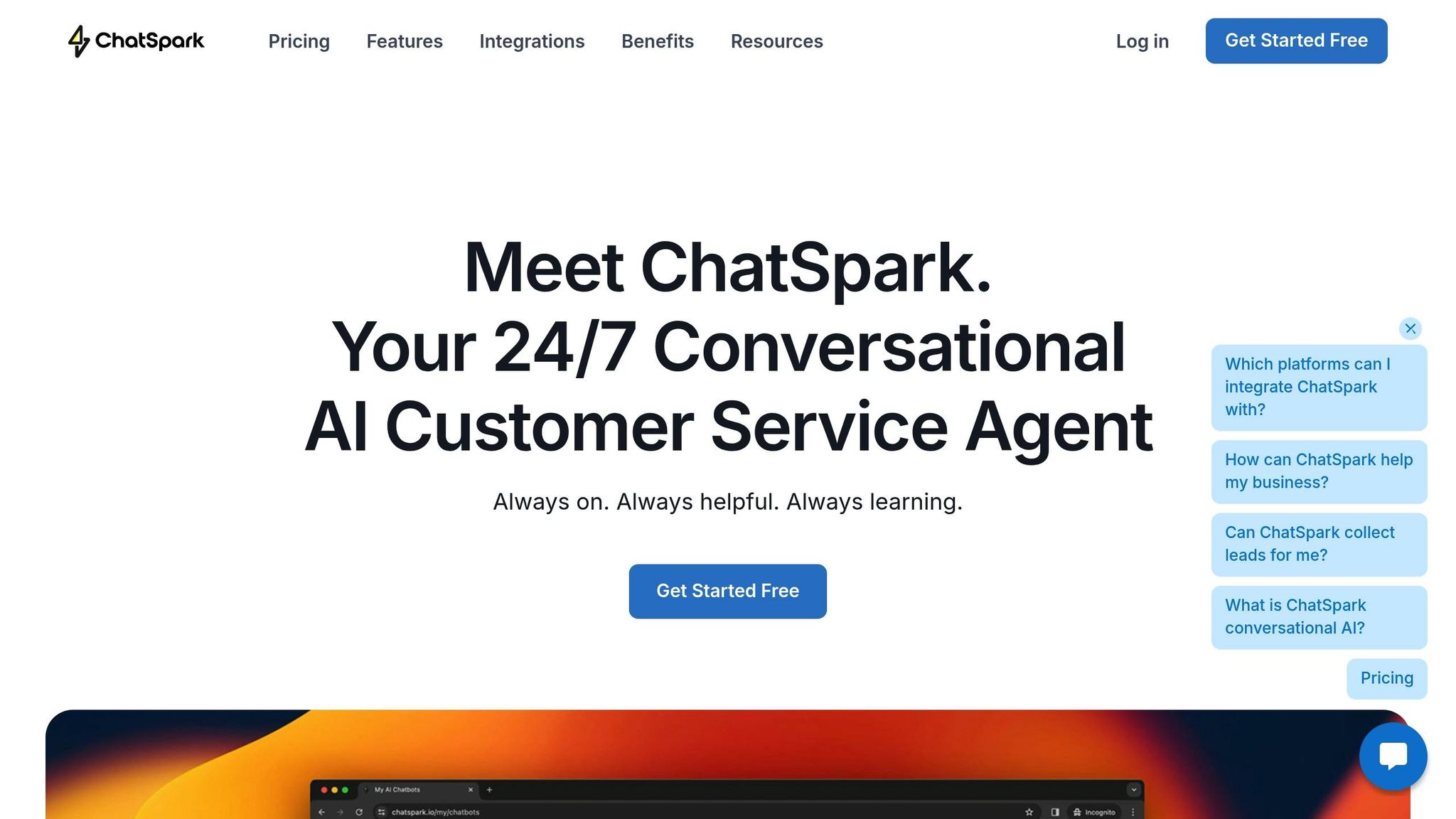
ChatSpark is an AI platform that connects with top CRMs to deliver tailored, 24/7 support, manage leads, and centralize customer data. Its pricing starts at $19/month, making it accessible for businesses of all sizes.
Without integration, businesses face higher costs, slower response times, and fragmented data. Integrated solutions like ChatSpark not only improve efficiency but also enhance customer satisfaction through personalized, real-time interactions.
1. ChatSpark
Customer Experience
ChatSpark is designed to elevate customer interactions by offering 24/7 availability and leveraging real-time CRM data. Imagine a returning customer asking about their order status - they’ll get an instant, tailored update without the hassle of repeating their details.
One of its standout features is maintaining consistent communication across multiple platforms, including websites, Instagram, Facebook, WhatsApp, Telegram, and Slack. Whether a customer starts a chat on social media and picks it up later on another platform, ChatSpark ensures the conversation flows seamlessly, preserving context and brand tone. And when a query becomes too complex for automation, the system smoothly transfers the conversation to a human agent, complete with the full interaction history.
This seamless experience isn’t just for customer support - it also plays a major role in capturing and qualifying leads.
Lead Management
ChatSpark simplifies lead management by automating the process of collecting contact information and qualifying prospects. It asks targeted questions about budgets, timelines, and specific needs, automatically scoring leads based on CRM data and user behavior. High-intent leads are then routed directly to the appropriate sales team member, saving time and ensuring no opportunity slips through the cracks.
By eliminating manual data entry and logging every conversation in real time, ChatSpark not only streamlines workflows but also boosts efficiency. Businesses using chatbots for sales have reported an average sales increase of 67%, with 41% of companies seeing measurable improvements [1].
As leads move through the pipeline, every interaction is recorded, creating a comprehensive view of the customer journey.
Data Centralization
ChatSpark takes the headache out of data management by logging every interaction directly into your CRM. For new visitors, it automatically creates contact profiles, while for returning customers, it updates existing records with the latest details. This includes chat transcripts, customer preferences, and inquiry specifics, ensuring your data remains accurate and accessible across teams.
This centralized approach improves collaboration and ensures everyone, from sales to support, works with the same up-to-date information.
Cost Efficiency
ChatSpark offers flexible pricing to fit businesses of all sizes. Plans start at $19/month for solo users, which includes 100 messages, one agent, and support for 25 pages. The Pro plan at $129/month covers 2,000 messages, one agent, 500 pages, and integrations with tools like Zapier and Freshchat. For larger organizations, custom Enterprise solutions provide unlimited messages and dedicated account management.
Beyond competitive pricing, ChatSpark delivers cost savings by cutting administrative tasks by approximately 35% [4] and significantly reducing response times [8]. By automating customer support and centralizing data, businesses benefit from faster service and reduced operational costs. In fact, 92% of CRM professionals have reported quicker response times after adopting AI tools [8]. The result? A solution that not only saves money but also enhances customer satisfaction and service delivery.
2. Non-Integrated CRM Systems
Customer Experience
When chatbots operate without CRM integration, they lack access to essential data like purchase history or support tickets. This forces every customer interaction to start from scratch. Imagine a returning customer asking about a recent order but being treated like a first-time visitor. They’re left repeating their information, which can feel frustrating and impersonal.
The experience worsens when a customer is handed off to a human agent. Without seamless data sharing, the customer has to re-explain their account details and concerns, leading to robotic, generic responses. This fragmented process not only diminishes service quality but also makes capturing leads more challenging.
"A chatbot by itself, while valuable for front-line customer engagement, pales in comparison to an integrated CRM-chatbot solution when it comes to maximizing revenue and delivering superior customer experiences."
Lead Management
Standalone chatbots create bottlenecks in lead management. Any leads they capture are trapped within the chatbot platform, requiring manual export and entry into the CRM [2][6]. This process delays follow-ups and increases the chances of losing promising prospects.
The inefficiency doesn’t stop there - it’s expensive. Disconnected systems and manual data entry cost businesses an average of $15 million per year [3]. Sales teams often lack the background information needed for meaningful conversations, which can cause high-value opportunities to slip through the cracks [2].
Data Centralization
Without integration, critical customer data remains scattered and disconnected. Chat transcripts, customer preferences, and inquiry details often stay locked within the chatbot platform, leaving teams with incomplete records. This lack of centralized data means marketing, sales, and support teams may each operate with their own, often conflicting, versions of customer information [3][4].
"If that AI chatbot isn't connected to your CRM systems, the information it gathers may stay within the chatbot platform without reaching your sales or customer support teams."
This data fragmentation leads to inaccurate insights and unreliable sales reports [3]. Decision-makers struggle to identify trends or customer pain points, while marketing campaigns risk being based on flawed segmentation.
Cost Efficiency
The inefficiencies of non-integrated systems come with a hefty price tag. Beyond the $15 million annual losses tied to poor data quality [3], businesses also face increased staffing costs to manually bridge the gap between chatbots and CRMs [4][6].
Response times take a hit as well. Integrated AI chatbots can cut response times by up to 70% [5], but non-integrated systems leave agents scrambling to piece together customer information from multiple sources. Without real-time synchronization, sales teams often rely on outdated data, missing crucial opportunities to connect with prospects effectively [4].
Advantages and Disadvantages
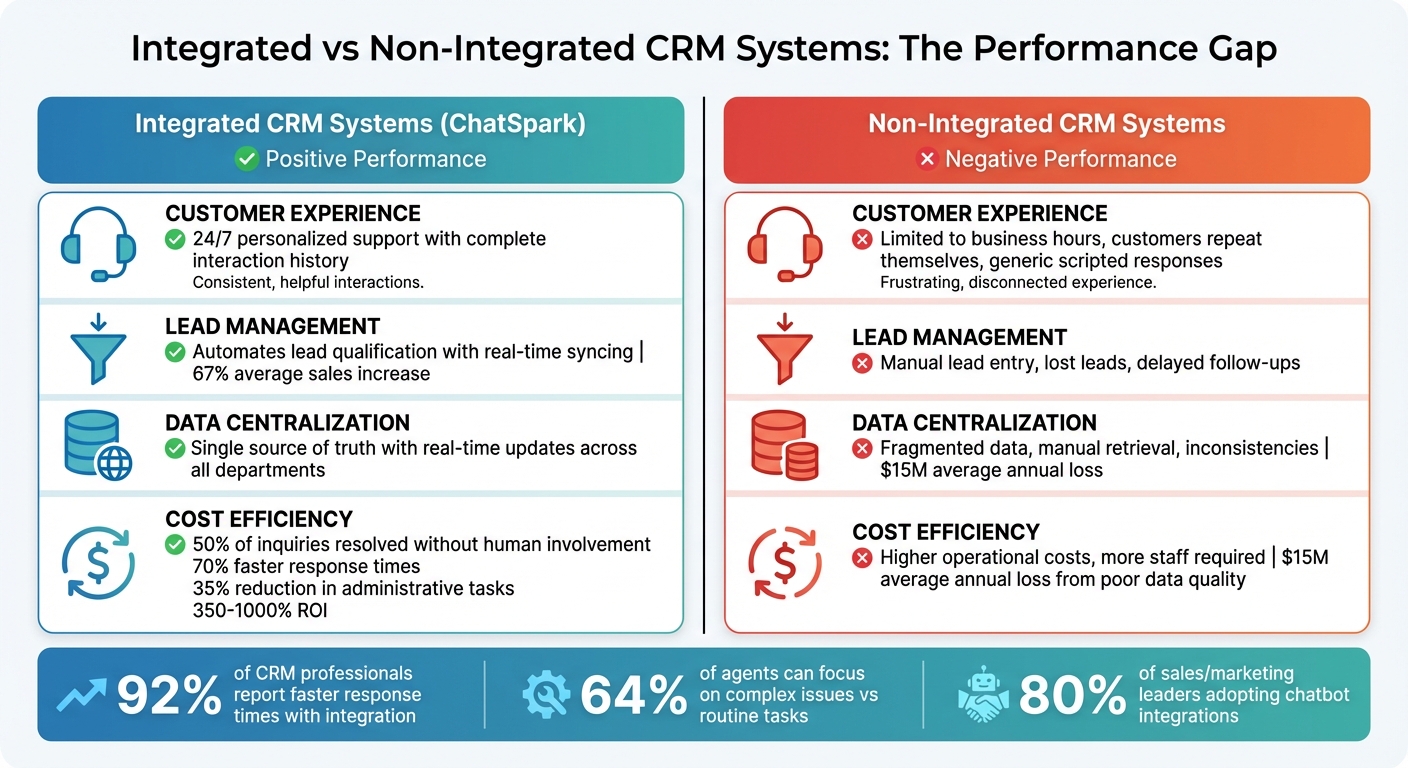
Integrated vs Non-Integrated CRM Systems: Performance Comparison
Here's a comparison of ChatSpark's integrated CRM versus non-integrated systems across four critical areas:
| Feature | ChatSpark (Integrated CRM) | Non-Integrated CRM Systems |
|---|---|---|
| Customer Experience | Offers 24/7 personalized support with complete interaction history [4] [9] | Limited to business hours; customers often need to repeat themselves and receive generic, scripted responses [6] [7] |
| Lead Management | Automates lead qualification with real-time syncing [1] [2] | Relies on manual lead entry, increasing the risk of lost leads and delayed follow-ups [2] [6] |
| Data Centralization | Provides a single source of truth with real-time updates across all departments [1] [3] | Data remains fragmented, requiring manual retrieval and leading to inconsistencies [2] [6] |
| Cost Efficiency | Scales efficiently without needing additional staff; resolves 50% of inquiries without human involvement [4] [8] | Higher operational costs with more staff required; poor data quality results in an average annual loss of $15 million [3] [6] |
These differences highlight the operational strengths of integrating ChatSpark into your CRM system. For instance, integrated systems allow 64% of agents to focus on complex issues rather than routine tasks, and 92% of CRM professionals report faster response times [8]. The financial benefits are equally striking, with integrated AI-CRM solutions delivering returns between 350% and over 1,000% [4].
Amy Velligan, Director of Support at Compass, emphasizes the importance of integration:
"We have a lot of specialists who can provide very high-touch service, but that only works if you get directed to the right specialist… It's really about knowing who your customers are when they're contacting support so that you can get them to the right person and answer them the right way" [9].
Conclusion
As highlighted earlier, top-performing CRM and sales teams are seeing noticeable improvements in response times and overall sales performance. These results underscore the impact of integrated solutions like ChatSpark.
ChatSpark addresses the hurdles of disconnected systems with features like 24/7 automated support, real-time data synchronization, and smooth handoffs to human agents with full conversation history. By automating routine inquiries, businesses can expand their support capabilities without needing to hire additional staff - a clear financial win.
The numbers back this up: integrating an AI chatbot with a CRM can deliver an ROI between 350% and over 1,000%, while also slashing response times for simple queries by up to 70%[4][5]. For businesses considering this step, it’s essential to set clear, measurable goals - like cutting response times by 30% or reducing support costs by 25%[1].
To make the most of these benefits, focus on key factors when selecting an integration solution. Ensure it works seamlessly with your existing CRM, supports accurate data mapping to maintain a unified customer view, and complies with security standards like GDPR and SOC 2.
ChatSpark simplifies deployment across multiple platforms, thanks to its strong integration capabilities.
Shifting from manual workflows to intelligent automation paves the way for long-term growth. With 80% of sales and marketing leaders already adopting or planning to adopt chatbot integrations, the real question is no longer if you should integrate, but how soon you can start seeing the benefits[1].
FAQs
How does integrating chatbots with CRM systems speed up customer responses?
Integrating chatbots with CRM systems enables instant access to real-time customer data. This means automated responses are available 24/7, cutting down wait times and delivering quicker, more precise answers.
By taking over routine inquiries and consolidating customer information, chatbots can manage large volumes of requests with ease. This not only boosts response speed but also enhances the overall customer experience.
What are the cost-saving advantages of integrating a chatbot with a CRM, like ChatSpark?
Integrating a chatbot with a CRM system like ChatSpark can be a game-changer for businesses looking to cut costs and improve efficiency. By automating routine customer interactions 24/7, you can reduce the reliance on additional support staff. This not only saves on labor costs but also ensures your customers receive consistent and reliable service around the clock.
Beyond customer support, automation simplifies tasks such as lead generation and handling customer inquiries. This enhanced efficiency translates into a stronger return on investment (ROI). With centralized data and fewer repetitive tasks to manage, your team can shift its focus to driving growth and exploring new opportunities instead of being bogged down by operational demands.
How does ChatSpark maintain accurate and centralized data across all platforms?
ChatSpark integrates effortlessly with your CRM, automatically logging and syncing every customer interaction, lead, and detail into one centralized database. This gives your team a complete, unified view of all customer touchpoints.
By using real-time validation, ChatSpark ensures records stay accurate and up-to-date across all connected platforms. This helps businesses make smarter decisions and provide a more seamless experience for their customers.