Multilingual AI is transforming customer retention. It eliminates language barriers, provides 24/7 support, and improves customer satisfaction - all while cutting costs and boosting profits. Businesses that offer support in their customers' native language build trust, reduce churn, and drive loyalty. Here's a quick breakdown of the key benefits:
- Removes language barriers: Communicate effectively with customers in over 85 languages.
- 24/7 availability: Offer round-the-clock support across time zones without increasing staff.
- Faster response times: Resolve inquiries instantly, reducing wait times and improving satisfaction.
- Reduces errors: Prevent miscommunication by understanding intent and context.
- Localized communication: Tailor messages to match regional preferences and norms.
- Cuts costs: Replace expensive multilingual teams with AI-driven solutions.
- Expands global reach: Serve international markets without high operational costs.
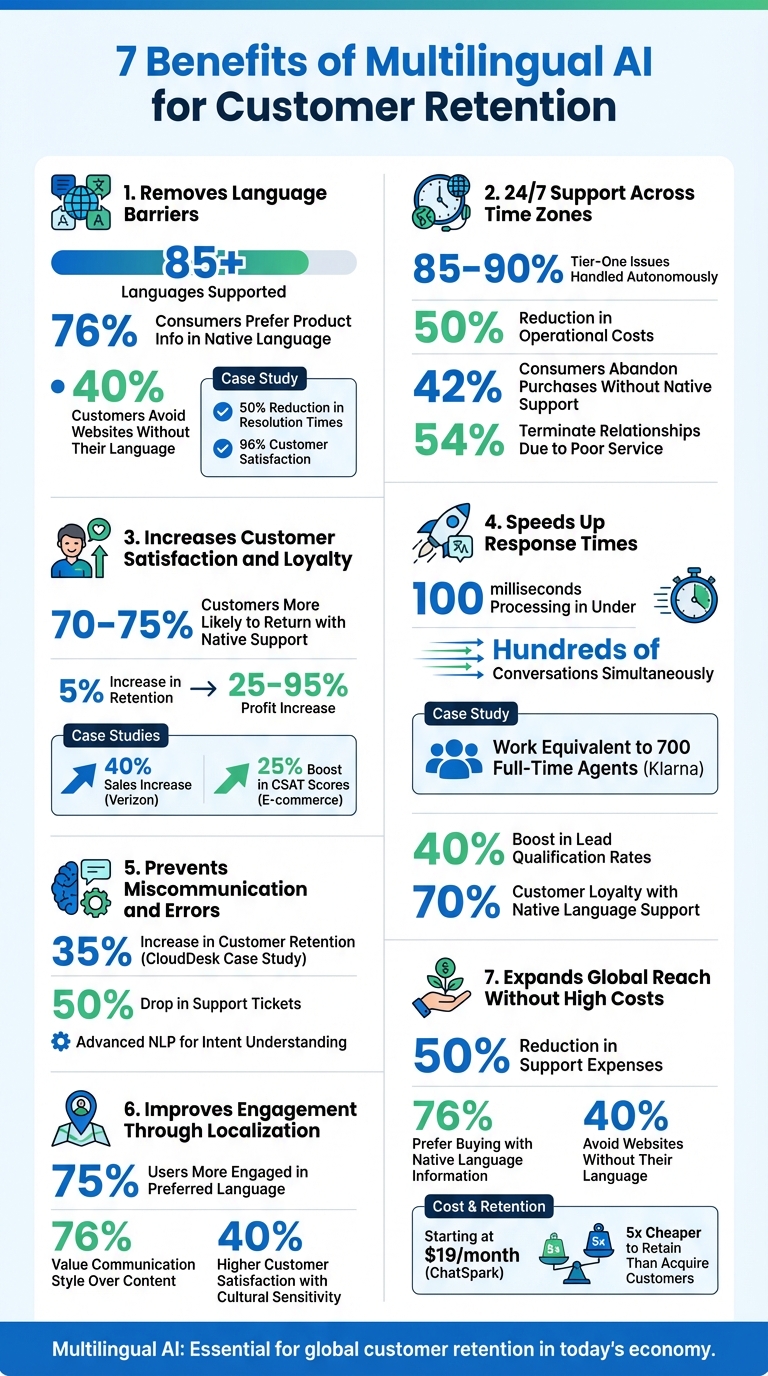
7 Key Benefits of Multilingual AI for Customer Retention with Statistics
1. Removes Language Barriers for All Customers
Quick and effective support is a cornerstone of trust. When customers can't communicate in their preferred language, you risk losing them. Multilingual AI solves this problem by instantly detecting the language and responding naturally - cutting out delays and removing the need for human intervention.
This instant recognition is just the start. It allows AI to dive deeper into understanding the context of the conversation.
Today's AI goes far beyond basic translation. It understands intent, context, and even subtle nuances like slang, idioms, and unique writing styles - all while keeping interactions smooth and human-like.
Take the example of America’s largest online Asian supermarket. By implementing a multilingual AI solution, they managed to slash resolution times by 50%, improve agent efficiency by 20%, and achieve a stellar 96% customer satisfaction rate[2].
The numbers back this up: 76% of consumers prefer to see product information in their native language[1], and many are more likely to return when they feel supported in their language of choice[3]. This connection between language accessibility and customer loyalty directly impacts revenue.
Platforms like ChatSpark make it easy to offer this kind of support. They provide instant, consistent, and on-brand responses in over 85 languages across platforms like websites, WhatsApp, Facebook, Instagram, Telegram, and Slack. The AI not only detects the customer’s language but also adapts to maintain your brand’s tone - whether the conversation is in Spanish, Mandarin, Arabic, or any other language.
Considering that 40% of customers avoid websites that don’t support their language[4], multilingual AI ensures you never miss an opportunity to create meaningful connections.
2. Offers 24/7 Support Across All Time Zones
Beyond breaking language barriers, offering round-the-clock support ensures customers get the help they need no matter where they are or what time it is. People across the globe often require assistance outside of traditional business hours, and multilingual AI makes this possible without skipping a beat.
By implementing AI-powered multilingual support, businesses have managed to cut operational costs by nearly 50% while maintaining constant availability[7]. For example, when your U.S.-based team logs off for the night, AI steps in to handle 85–90% of tier-one issues - like resetting passwords or tracking orders - across various time zones. This ensures that ticket queues don’t pile up overnight, allowing human agents to focus on more complex problems when they return[11].
Here’s why this matters: 42% of consumers will abandon a purchase if native language support isn’t available, and 54% have terminated business relationships due to poor customer service[12][14]. ChatSpark addresses these concerns by providing instant responses in over 85 languages, seamlessly integrating with platforms like websites, WhatsApp, Facebook, Instagram, Telegram, and Slack. This kind of reliability not only resolves immediate concerns but also helps foster long-term customer loyalty.
"24/7 support is key to reducing customer friction, and multilingual support automation lets you provide seamless experiences across markets and time zones."
– Erika Madriñan, Partner Marketing Manager, Ultimate[9]
3. Increases Customer Satisfaction and Loyalty
Breaking down language barriers and offering 24/7 assistance allows multilingual AI to strengthen customer loyalty by creating a deeper emotional connection. When customers can communicate in their preferred language, they feel heard and appreciated - a bond that naturally encourages repeat interactions. In fact, studies indicate that 70–75% of customers are more likely to return for future purchases when support is delivered in their native language [3][15]. This emotional connection is backed by real-world results in both retention and satisfaction.
The impact goes beyond just feelings - it directly affects a business's bottom line. Consider this: nearly one-third of customers will leave a brand if their language needs aren't met, and many would willingly switch to a competitor offering native-language support [2][15]. Furthermore, even a modest 5% boost in customer retention can lead to profit increases ranging from 25% to 95% [2]. Clearly, making language accessibility a priority isn't just good for customers - it's a smart financial move.
What sets multilingual AI apart is its ability to avoid clunky, literal translations. These systems grasp context and nuances, ensuring every interaction feels tailored and personal. This level of personalization builds trust, which lays the foundation for lasting customer loyalty.
"Hearing their own language makes customers feel seen and respected. This emotional connection fosters trust, which is key to long-term loyalty."
– Maeve Sekulovski, Telnyx [3]
The numbers speak for themselves. Verizon reported a 40% jump in sales after enhancing service speed and accuracy with multilingual AI assistants [3]. Similarly, a global e-commerce company saw a 25% boost in Customer Satisfaction (CSAT) scores after deploying AI bots capable of handling inquiries in more than 10 languages [8]. ChatSpark offers this same advantage, delivering instant responses in over 85 languages across platforms like WhatsApp, Facebook, Instagram, and Telegram. This ensures your customers receive consistent, high-quality support no matter where they are.
4. Speeds Up Response Times
Speed is everything when it comes to effective customer support. Multilingual AI steps in to eliminate delays by instantly identifying the language and delivering real-time responses - no need for manual routing [2]. With neural translation processing in under 100 milliseconds, conversations flow naturally and feel immediate [2].
The effect on resolution times is hard to ignore. For example, Klarna launched a multilingual AI assistant in June 2025, capable of handling inquiries in 35 languages across 23 countries. This system managed the workload of 700 full-time agents, slashing response times dramatically [3].
Unlike human agents, who can only manage one conversation at a time, AI handles hundreds simultaneously across multiple languages - all without sacrificing speed or quality. This means no more long queues for customers. The technology autonomously resolves 85–90% of routine tier-one issues, like tracking orders, resetting passwords, or processing refunds, keeping support channels running smoothly and preventing bottlenecks [11]. ChatSpark takes this efficiency even further by introducing advanced features that build on this foundation.
Take Jackpots.ch, Switzerland's first online casino, as an example. During the pandemic, they faced a massive surge in customer inquiries. By integrating multilingual support in English, German, French, and Italian, they offered 24/7 instant responses, even resolving payment issues after hours - all without needing to expand their support team. This saved them from significant hiring costs [9]. As Urs Klingler, Customer Service Manager, explained:
"To start out with, we provided only email to our customers. Then we started with live chat. Everything was under control, but then the pandemic started. And the numbers exploded" [9].
ChatSpark builds on these successes by offering instant responses in over 85 languages on platforms like WhatsApp, Facebook, Instagram, and Telegram. Its round-the-clock availability ensures customers get immediate help, no matter where they are or what time it is - turning long waits into fast solutions.
5. Prevents Miscommunication and Errors
Speeding up response times is great, but preventing miscommunication takes customer support to the next level. Language barriers don’t just create delays - they can lead to costly mistakes. A single misinterpreted word might result in incorrect orders, billing issues, or unhappy customers who decide not to come back. Multilingual AI solves these problems by focusing on intent rather than just translating words.
Modern AI uses advanced natural language processing (NLP) to interpret customer intent, going beyond simple word-for-word translations [3][16]. It even adjusts tone to align with regional expectations [16][2]. Additionally, technical glossaries ensure that information stays accurate across different languages [2].
Take CloudDesk as an example. In June 2025, this B2B SaaS provider tackled high customer abandonment rates in South America by replacing its English-only chatbot with a multilingual system that supported Spanish and Portuguese. The result? A 35% increase in customer retention and a 50% drop in support tickets [16].
As Sobot highlights:
"Effective multilingual AI requires localization, not just translation. A tone that is polite in one culture might seem cold in another. Your AI must adapt to these differences to avoid alienating users" [2].
This careful attention to language nuances helps reduce errors and builds trust with customers.
Platforms like ChatSpark take it a step further by offering support in over 85 languages. With context awareness, these systems automatically detect a customer’s language and maintain conversation details for smooth escalation when necessary. When customers feel truly understood, they’re more likely to stay loyal.
6. Improves Engagement Through Localized Communication
Accurate translations are just the beginning; true engagement happens when communication feels personal and culturally relevant. Localized communication goes beyond simply speaking the customer's language - it resonates with their culture. By tailoring messages to regional preferences, multilingual AI creates a deeper connection that feels natural and authentic.
Here’s a compelling stat: 75% of users are more likely to stay engaged when addressed in their preferred language, and 76% value communication style over content [18][20]. This shift from mere translation to meaningful connection transforms customer interactions. As Anjana Vasan from Parloa explains:
"What feels intuitive in English might sound cold in German. What builds rapport in Brazil might come across as too casual in Japan" [20].
Modern AI systems take this into account by adjusting for formality, tone, and even emoji use based on regional norms. For instance, while a "thumbs up" emoji is friendly in the U.S., it can be offensive in parts of the Middle East and South America [20]. AI equipped with this cultural sensitivity delivers 40% higher customer satisfaction rates compared to those relying solely on basic translation tools [18].
The benefits extend to business outcomes as well. Companies leveraging dynamic content adaptation - where AI modifies communication styles, promotional strategies, and even currency formats to align with local trends - report a 40% boost in lead qualification rates [18]. A great example is ChatSpark, which supports over 85 languages while incorporating cultural nuances. This ensures customers receive responses that feel respectful and natural, not just accurate.
Localized communication doesn’t just improve satisfaction; it builds loyalty. 70% of customers remain loyal when supported in their native language [19][4]. This approach strengthens customer relationships, laying the groundwork for long-term retention and trust.
7. Expands Global Reach Without High Costs
Expanding globally used to mean hefty investments in native-speaking teams and regional offices. Multilingual AI has completely shifted this dynamic. Now, businesses can compete in non-English-speaking markets without needing separate language-specific setups or additional staff [21] [9].
By removing the need for specialized hiring, training, and interpreter services, multilingual AI slashes operational costs [1] [6]. Take this example: a fintech company managed to cut its support expenses by 50% after deploying an AI chatbot that handled English, Spanish, and Mandarin [5]. Another case comes from Swiss online casino Jackpots.ch, which saw a spike in inquiries during the COVID-19 pandemic. Their Customer Service Manager, Urs Klingler, implemented multilingual AI to handle support in English, German, French, and Italian. This move allowed them to scale operations without hiring extra staff, saving hundreds of thousands of dollars [9].
The stats back up the importance of this approach: 76% of consumers prefer buying products when information is available in their native language, while 40% of online shoppers avoid websites that don’t offer content in their language [1] [13]. Multilingual AI bridges this gap by enabling companies to support dozens of languages on a single platform without adding labor costs [17] [8].
A great example of this is ChatSpark, which offers multilingual support in over 85 languages and integrates seamlessly with platforms like websites, WhatsApp, Facebook, Instagram, Telegram, and Slack. Starting at just $19/month, businesses can provide 24/7 multilingual support without the need to hire international teams. This not only reduces expenses but also builds stronger customer loyalty.
The payoff is undeniable: increasing customer retention by just 5% can boost profits by 25% to 95% [2]. Plus, keeping existing customers happy through quality support is five times cheaper than acquiring new ones [9]. With multilingual AI, businesses of any size can scale globally while keeping costs in check and driving growth.
Conclusion
Multilingual AI is reshaping the way businesses approach customer retention. By breaking down language barriers, offering round-the-clock support, speeding up response times, and reducing miscommunication, it allows companies to connect with customers in meaningful ways. Communicating in a customer's native language, while respecting their cultural preferences, fosters trust and loyalty. In fact, 75% of consumers are more likely to make repeat purchases from companies that provide support in their native language [9].
The financial benefits are just as compelling. Research shows that improving customer retention by just 5% can lead to profit increases of 25% to 95% [2]. Ignoring language diversity means missing out on significant revenue opportunities.
ChatSpark brings all these benefits together in one solution. Supporting over 85 languages and integrating seamlessly with platforms like websites, WhatsApp, Facebook, Instagram, Telegram, and Slack, it delivers fast, tailored service that keeps customers coming back. Starting at just $19/month, businesses can expand their global reach without the high costs of hiring multilingual teams or opening regional offices. This integration highlights how AI can combine efficiency with a human touch.
Importantly, multilingual AI doesn’t replace human connection - it enhances it. As Jackie Xu from Callnovo explains, "A combination of AI and manpower is the best" [10]. AI takes care of routine tasks, freeing human agents to handle complex issues that require empathy and careful attention.
In today’s global economy, multilingual AI is no longer optional - it’s essential. Platforms like ChatSpark make adopting this technology simple, delivering measurable ROI while helping businesses retain customers across languages and regions. The real question is: how soon can you start leveraging multilingual AI?
FAQs
How can multilingual AI help businesses save on operational costs?
Multilingual AI offers businesses a smart way to cut operational costs by automating customer support across various languages. Instead of relying on a large team of multilingual staff, AI tools can efficiently manage a high volume of routine inquiries, reducing labor expenses significantly.
What’s more, these AI systems work around the clock, removing the need for multiple shifts and ensuring quicker response times. This setup not only trims staffing costs but also enhances customer satisfaction. By allowing companies to expand globally without a matching rise in overhead, multilingual AI provides an efficient path to international growth.
How does multilingual AI improve customer satisfaction and build loyalty?
Multilingual AI helps businesses improve customer satisfaction by breaking down language barriers. It allows companies to interact with customers in their native languages, creating a more personal and relatable experience. This approach makes customers feel appreciated and understood, which strengthens trust and builds deeper connections with the brand.
Another key benefit is round-the-clock support, which ensures customers receive timely responses without long wait times. This not only enhances the overall experience but also shows a commitment to customer care. By enabling smooth communication and reaching a global audience, multilingual AI helps businesses nurture lasting relationships and maintain loyal customers.
How does multilingual AI help businesses connect with global customers?
Multilingual AI helps businesses connect with customers worldwide by breaking down language barriers. It enables smooth communication in customers' native languages, which builds trust and strengthens relationships. This makes it easier for companies to enter new markets and grow their revenue.
With the ability to automate real-time translations and support over 85 languages, multilingual AI eliminates the need for large multilingual teams. This not only reduces costs but also boosts efficiency. Plus, it ensures interactions are tailored and relevant, creating personalized experiences that increase customer satisfaction and loyalty.
Platforms like ChatSpark make this a reality by delivering instant, brand-aligned responses. They help businesses engage confidently with international audiences and expand their global reach.