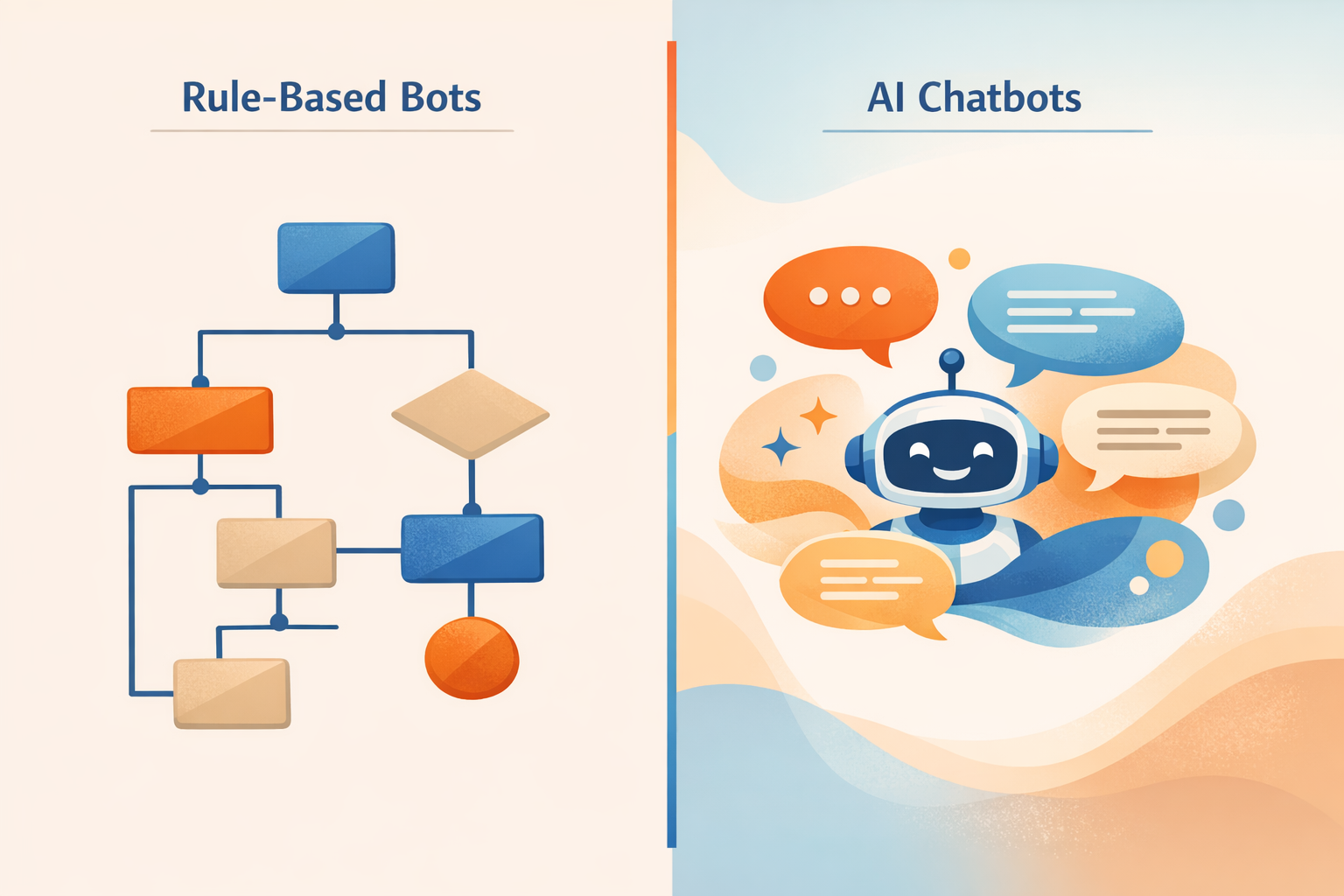
What’s the key difference? AI as infrastructure is like building the foundation for your entire business - integrating AI deeply into systems for scalability, security, and efficiency. It’s a long-term investment. AI as a feature, on the other hand, refers to standalone tools like chatbots or recommendation engines. These are quicker to deploy but often limited in scope and scalability.
Why does it matter?
- Infrastructure: High upfront costs but scales efficiently and supports enterprise-wide AI.
- Features: Low initial cost, fast implementation, but recurring expenses grow with usage.
Quick takeaway:
If AI is core to your business, invest in infrastructure for control and scalability. For smaller, specific tasks, features might suffice. Just remember: long-term success often depends on how well AI integrates into your workflows.
Quick Comparison:
| Factor | AI as Infrastructure | AI as a Feature |
|---|---|---|
| Initial Cost | High ($1.3M–$3.4M) | Low ($330K–$2.5M) |
| Recurring Cost | Predictable, lower over time | Grows with usage |
| Time to Deploy | 6–12 months | Days to weeks |
| Scalability | Supports multiple use cases | Limited by per-use costs |
| Best For | Core, enterprise-wide AI | Specific, isolated tasks |
Bottom line: The choice isn’t just technical - it’s about aligning with your business goals. For lasting impact, focus on embedding AI into your systems, not just adding tools.
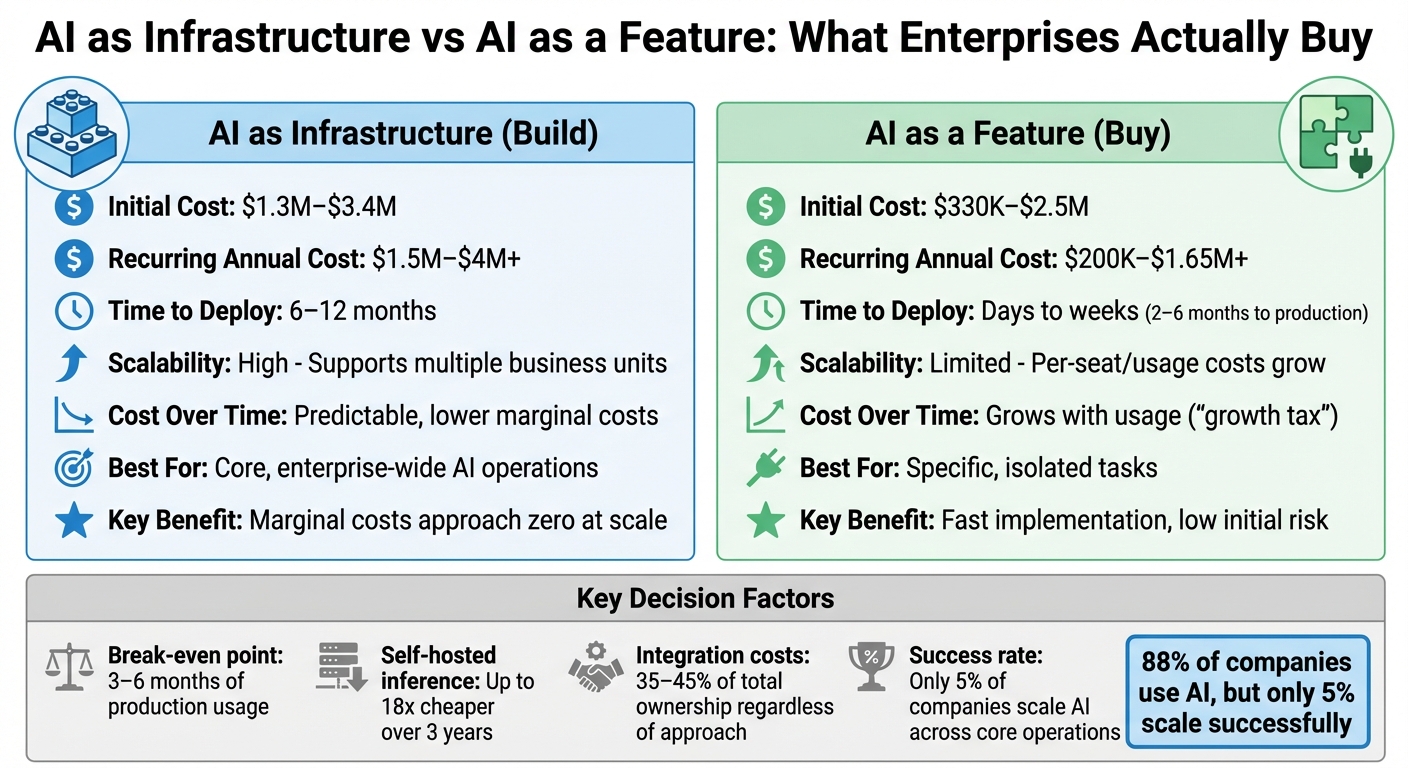
AI Infrastructure vs AI Features: Cost, Timeline, and Scalability Comparison
AI as a Feature: What It Offers and Where It Falls Short
AI features are essentially functionalities embedded within existing applications - think of tools like smart search, recommendation systems, or customer chatbots. Often referred to as "Surface AI", these features operate at the user interface level, altering how users interact with a system rather than fundamentally transforming what work gets done [11]. While they can offer quick wins, they also come with notable limitations that businesses need to weigh carefully before allocating resources.
Benefits of AI as a Feature
One of the biggest selling points of AI features is their speed. They can be deployed in days or weeks, with relatively low upfront costs, making them a great option for testing new business ideas [7][16]. This rapid rollout allows companies to experiment with cutting-edge technology without committing a massive budget right away. If something works, it can be scaled; if not, the risk is minimal [7].
Another advantage is that these features are well-suited for organizations with limited engineering resources. Instead of building complex data pipelines or AI systems from scratch, companies can focus their internal talent on core product development while still leveraging AI [7][16]. This makes AI features an accessible option for businesses looking to adopt emerging technology without overextending their teams.
However, while these benefits are appealing, there are challenges that often prevent AI features from achieving their full potential.
Drawbacks of AI as a Feature
A major hurdle is what experts call "pilot purgatory." While 88% of companies report using AI in some form, only 5% have successfully scaled these tools across their core operations [14]. Many projects get stuck in the proof-of-concept phase, unable to deliver meaningful enterprise-wide impact.
Another issue is the rising cost of scaling. Companies often find that implementing their fifth AI use case is just as expensive and time-consuming as the first. This is because each new feature requires separate negotiations for access, budget, and governance [14]. AI features are typically "stateless", meaning they lose all context once a session ends, forcing users to handle repetitive tasks and increasing workflow friction [12].
Integration challenges only add to the complexity. Around 41% of companies cite "too many disconnected platforms" as a key barrier to scaling AI [14]. Each new feature can increase duplication and create fragmented workflows. On top of that, 43% of organizations face bandwidth shortages when scaling AI, while 34% struggle with limited data center space and power to handle growing workloads [15].
Accuracy is another sticking point. Many off-the-shelf AI features achieve about 85% accuracy, which often falls short for enterprise needs where near-perfect reliability is critical [14]. For businesses using more advanced AI systems that chain multiple processes together, costs can balloon to 10–20 times higher than initial prototype estimates [13].
Given these limitations, businesses need to carefully evaluate when and where AI features make the most sense.
When to Use AI as a Feature
To maximize the value of AI features, businesses should align them with core processes where they can deliver consistent results. These features are particularly effective for "Systems of Record" - standardized workflows like accounting, HR, or CRM systems, where reliability is more important than heavy customization [7][17]. Off-the-shelf solutions in these areas can provide predictable outcomes without requiring deep integration into proprietary systems.
AI features are also a good fit when speed is a top priority, and the use case doesn’t demand long-term differentiation. Examples include customer service chatbots and CRM integrations, analytics tools, or document summarization for routine tasks.
The key question to ask is whether the feature provides lasting value or just a short-term benefit. Features like basic chatbots or summarization tools are quickly becoming standard offerings rather than high-value differentiators [12]. To assess this, companies can apply the "90-Day Test": consider whether a major cloud provider could deliver 70% of the same functionality in a platform update within the next three months [11]. If the answer is yes, the feature may not offer a sustainable competitive edge.
AI as Infrastructure: What It Offers and Why It Matters
AI features often focus on solving specific tasks, but AI infrastructure takes a broader, more foundational role. Think of it as the difference between owning a single tool versus setting up an entire workshop. Infrastructure isn't about flashy features - it’s about creating a system that supports multiple AI applications at once, ensuring control, security, and cost efficiency.
What Makes Up AI Infrastructure
AI infrastructure is built on several interconnected layers that enable large-scale operations. At the hardware level, this includes high-performance compute accelerators like NVIDIA GPUs, AWS Trainium2, or Google TPU v5p, all designed to handle the intense parallel processing demands of AI models [18]. For example, running an A100 GPU 24/7 can cost around $2,700–$3,000 per month [[19]](https://blog.davidlapsley.io/ai infrastructure/enterprise ai/mlops/2025/10/27/enterprise-ai-infrastructure-poc-to-production.html).
Equally important is the storage layer, which relies on tools like data lakehouses and feature stores capable of handling petabyte-scale datasets with high-throughput sequential reads [18][5]. This is where "data gravity" comes into play - since moving massive datasets around is inefficient, it’s better to bring compute power closer to where the data resides [20].
The orchestration layer includes tools like Kubernetes, Ray, and MLflow, which manage workloads, allocate resources, and maintain model registries [18][5]. However, many organizations overlook the critical "enterprise layer", as highlighted by Maria Paktiti from WorkOS:
"Your AI app is no longer just an AI system. It's an enterprise software product. And enterprise software is defined less by what it does and more by how it integrates, authenticates, authorizes, logs, and survives scrutiny." [3]
This enterprise layer includes features like SSO/SAML authentication, role-based access control (RBAC), multi-tenancy isolation, and audit logs - essential for large-scale AI deployments but often underappreciated [3]. Together, these layers form a technical backbone that delivers both operational efficiency and cost predictability.
Business Benefits of AI Infrastructure
A well-designed infrastructure brings significant advantages, particularly in terms of cost management. For instance, while a proof-of-concept AI model might cost $5,000 per month, scaling it to production can increase costs to $57,000 per month - an 11x jump [[19]](https://blog.davidlapsley.io/ai infrastructure/enterprise ai/mlops/2025/10/27/enterprise-ai-infrastructure-poc-to-production.html). By using techniques like GPU pooling and Multi-Instance GPU (MIG), infrastructure can boost hardware utilization from 20% to 75%, potentially saving up to $183,000 monthly on a 100-GPU cluster [[19]](https://blog.davidlapsley.io/ai infrastructure/enterprise ai/mlops/2025/10/27/enterprise-ai-infrastructure-poc-to-production.html).
Infrastructure also ensures compliance and data sovereignty, which are critical for industries like healthcare and finance. For example, HIPAA or SOX regulations often require on-premises data storage and full model lineage [[19]](https://blog.davidlapsley.io/ai infrastructure/enterprise ai/mlops/2025/10/27/enterprise-ai-infrastructure-poc-to-production.html). This is especially important given that only 13% of companies are considered "AI-ready", while 54% struggle to scale their infrastructure to meet growing AI demands [21].
Another key benefit is scalability across departments. Instead of negotiating separate systems and contracts for each AI use case, organizations can deploy multiple applications on a shared foundation. This is a huge advantage, especially when 88% of companies already use AI in at least one area of their business [1].
When to Use AI Infrastructure
AI infrastructure becomes essential when organizations move from experimenting with AI to relying on it for mission-critical tasks. Take real-time fraud detection in financial services, where transactions must be processed in under 50 milliseconds while adhering to strict data controls [[19]](https://blog.davidlapsley.io/ai infrastructure/enterprise ai/mlops/2025/10/27/enterprise-ai-infrastructure-poc-to-production.html). Or consider healthcare, where patient readmission risk models must meet HIPAA compliance and provide rigorous audit trails [[19]](https://blog.davidlapsley.io/ai infrastructure/enterprise ai/mlops/2025/10/27/enterprise-ai-infrastructure-poc-to-production.html).
The tipping point is when AI needs to be "always-on" rather than used sporadically. As Natalie Hwang, Founding Managing Partner at Apeira Capital, puts it:
"The competitive landscape is becoming more about economic durability than technical spectacle." [4]
When your business depends on AI operating reliably around the clock, infrastructure shifts from being an optional investment to an absolute necessity.
Cost and Scalability: Comparing the Two Approaches
How Costs Differ: Initial Investment vs Recurring Fees
The financial dynamics of building infrastructure versus buying features are strikingly different. Building infrastructure comes with a hefty upfront cost - ranging from $1.3 million to $3.4 million in the first year alone [24]. This includes expenses like hardware (a single NVIDIA H100 GPU server costs $25,000–$40,000 [28]), data preparation ($100,000–$380,000+ [22]), and hiring specialized engineers. After the initial setup, annual operating costs hover between $1.5 million and $4 million+ [24].
Buying features, on the other hand, has a much lower initial investment - typically between $330,000 and $2.5 million [24]. Most of this is spent on integration rather than hardware. However, ongoing fees tied to usage can add up quickly. These recurring costs include $50–$500 per user monthly and $3 per million input tokens (for example, Claude 3.5 Sonnet costs about $3 per million input tokens [25]). While initial expenses are lower, these recurring fees act as a "growth tax", scaling directly with adoption [28].
One key insight: self-hosted AI inference can be up to 18x cheaper than cloud APIs over three years [28], but this only holds true if you're using the system heavily. The break-even point generally occurs after three to six months of production-level usage [28]. Below this threshold, you might find yourself paying for unused capacity. These cost structures have a direct impact on how each approach scales over time.
How Each Approach Scales
Scaling is another area where the two approaches diverge significantly. Infrastructure scales economically but requires patience. Once the upfront investment is made, marginal costs approach zero - adding more users or running additional inferences costs next to nothing [28]. However, reaching this stage takes time, usually 6–12 months to achieve production readiness [7]. Additionally, managing infrastructure requires MLOps expertise to handle issues like model drift, updates, and monitoring. On the upside, a single infrastructure setup can support multiple business units without the need for renegotiating contracts or worrying about usage caps.
In contrast, features scale rapidly but can become expensive as usage increases. Deployment is quick - you can launch an AI agent in 20 minutes [26] and reach production in days or weeks [26]. For example, CMI Strategies achieved 95% adoption across 100 consultants in a matter of months, spending just 30–40 euros per consultant monthly [16]. But as Nik Kale from Cisco points out:
"Usage expands quickly once models are introduced into the business. A workflow designed for a single team often becomes a shared service across the company" [23].
This rapid adoption can lead to ballooning costs due to per-seat or per-token fees.
Another challenge? Integration accounts for 35–45% of total cost of ownership regardless of the approach [27]. In fact, 62% of enterprise AI projects exceeded their initial budgets by more than 50% in 2025 [27], with the average deployment costing 2.8x the original estimate [27]. These factors make it essential for organizations to carefully evaluate long-term investments in AI infrastructure.
Side-by-Side Comparison: Infrastructure vs Feature Costs
Here’s a quick breakdown of the cost and implementation differences between building AI infrastructure and buying features:
| Cost Category | AI as Infrastructure (Build) | AI as a Feature (Buy) |
|---|---|---|
| Initial Investment | $1.3M–$3.4M [24] | $330K–$2.5M [24] |
| Recurring Annual Cost | $1.5M–$4M+ [24] | $200K–$1.65M+ [24] |
| Implementation Complexity | High (Requires MLOps, data engineering, and AI engineering) [22][24] | Moderate (Integration & API development) [24] |
| Scaling Capacity | High (Supports multiple business units) [22] | Limited (May hit per-seat/usage cost ceilings) [24] |
| Time to Value | 6–12 months [24] | 2–6 months [24] |
| Hardware Lifecycle | 2–3 year reinvestment cycle [23] | Vendor-managed |
At scale, the cost equation can shift dramatically. For example, a $200,000 custom build with $50,000 annual maintenance adds up to $550,000 over seven years. Meanwhile, a $50,000 SaaS platform with $3,000 monthly fees totals $302,000 over the same period [7]. However, if you're processing millions of tokens daily, infrastructure becomes far more cost-effective. The tipping point? When daily usage exceeds 4.3 hours [29], or when annual SaaS AI tool costs surpass $500,000 [24].
How Enterprises Evaluate Long-Term AI Value
What to Consider When Choosing
When deciding between investing in AI infrastructure or opting for ready-made features, businesses need to align their choice with their overall strategy. The AIM Matrix - Advantage, Integration, and Model Risk - offers a structured way to evaluate options [17].
- Advantage: If AI capabilities are central to driving revenue or creating unique value, building infrastructure is the smarter move. On the other hand, for workflows that competitors can easily replicate, buying off-the-shelf features makes more sense.
- Integration: This measures how well the solution fits into existing systems and processes.
- Model Risk: This assesses the potential impact of errors, especially in critical operations.
Vendor independence also plays a big role. Buying features often means relying on vendor roadmaps and sacrificing transparency. In contrast, building infrastructure offers more control over data rights, risk management, and costs [17].
The Pace-Layered Strategy further breaks AI needs into three tiers: Systems of Record (focused on reliability), Systems of Differentiation (customer-facing tools), and Systems of Innovation (experimental projects) [7]. As Nacim Rahal, VP of Data & AI at Doctolib, aptly puts it:
"Build what's in our core business, buy what will be a side project." [16]
Another critical consideration is time. While off-the-shelf features can be implemented in weeks, infrastructure projects often take 6–18 months to go live [16]. Given that the typical software lifecycle spans seven years [7], speed and long-term value both weigh heavily in these decisions, especially for enterprises needing real-time data access.
The Role of Real-Time Data Access
Real-time data requirements can dramatically influence the choice between infrastructure and features. In today’s AI landscape, data - not code - is the driving force. Moving massive datasets to cloud-based AI models can lead to high latency and expensive egress fees, which can undermine the return on investment for real-time applications [20].
Most enterprise systems were originally designed for batch processing, not continuous inference. This mismatch often causes AI projects to stall when transitioning from pilot to production [2]. To make AI both responsive and cost-effective, compute resources need to be close to the data. For example, switching from legacy NAS to local NVMe-based object storage can slash query times from 4 seconds to just 300 milliseconds. However, scaling from pilot to full production can also cause monthly costs to skyrocket - from $15,000 to $180,000 - due to constant inference demands [20].
This highlights an important principle: enterprises handling massive, dynamic datasets with sub-5ms latency needs are better off with on-premises or edge infrastructure rather than relying solely on cloud-based solutions. This "proximity rule" underscores the importance of aligning infrastructure investments with broader strategic goals [20].
Why Adoption Matters More Than Demos
Choosing the right system is only part of the equation; ensuring widespread adoption is what ultimately defines AI success. Demos might look impressive, but they only represent the "first mile" of an AI initiative. The "last mile" - covering aspects like production governance, data rights, risk management, and uptime - is where long-term value is realized [17].
Currently, 65% of enterprise AI deployments are stuck due to implementation bottlenecks, and 25% of AI investments planned for 2026 are already being pushed to 2027 as organizations struggle to bridge the gap between vendor promises and actual results [30]. While 88% of companies report using AI in at least one area, only a small percentage have fully integrated it into their workflows. AI agents, for example, succeed just 30% to 35% of the time on multi-step tasks [1][30].
Take Wakam, a European insurtech, as an example. Initially, they tried to build a custom AI chatbot with their in-house data science team. However, maintaining the infrastructure consumed too many resources, so they pivoted to a third-party platform. Within two months, they achieved 70% employee adoption and deployed 136 AI agents [16]. Similarly, Ardabelle, a private equity fund, opted to buy an AI platform to focus on core deal analysis. This decision led to 95% adoption across their investment team and a 50% increase in evaluated deals within 90 days [16].
The takeaway? Competitive advantage doesn’t come from simply adopting the latest AI model - it comes from embedding intelligence into workflows, data pipelines, and decision-making processes [1]. As Jay Cadmus puts it:
"The bottleneck isn't model quality. It's implementation infrastructure." [30]
For enterprises to succeed, employees need to go beyond being passive users. They must become active builders, capable of creating and integrating AI agents into their daily workflows. Without this focus on adoption and integration, even the flashiest demo won’t translate into meaningful, long-term value.
The Future of AI Investments: Hybrid Models and CoPilots
Hybrid Models: Combining Infrastructure with Features
Enterprises are increasingly blending infrastructure with features to create more dynamic and adaptable AI systems. These hybrid models use AI Gateways to route requests intelligently between multiple third-party language models and in-house fine-tuned models. Decisions are based on factors like cost, speed, and performance. This approach not only avoids vendor lock-in but also allows companies to adapt quickly, using advanced models for complex tasks and smaller, more affordable models for routine operations [5][31][6].
A good example of this shift: 37% of enterprises now use five or more AI models in production, compared to 29% the year before. This trend reflects the rise of modular AI stacks, where critical layers - like security, context, and orchestration - can be updated independently [36]. In July 2025, Instacart showcased this strategy with its "Ask Instacart" feature. By employing a multi-model architecture, the system routes user queries to either a top-tier language model or internal fine-tuned models, depending on which delivers the best results [31].
Hybrid deployments also rely on AI agents as operational partners. These agents retain long-term context, understand team-specific terminology, and seamlessly integrate into workflows. This creates a continuous feedback loop, improving performance while maintaining governance [32]. Such setups pave the way for AI CoPilots, which take this integration even further.
How AI CoPilots Fit into the Infrastructure Model
AI CoPilots bridge the gap between infrastructure and features. As Microsoft CEO Satya Nadella puts it:
"You can think of Copilot as the UI for AI." [35]
These tools act as user-friendly interfaces for complex systems, but they require deep integration with enterprise data, security, and automation layers to function effectively [33][34]. CoPilots are no longer just chatbots - they are robust components of IT infrastructure, designed to meet strict reliability and security standards [6][35].
Take the ChatSpark CoPilot as an example. It integrates directly into workflows across platforms like websites, Instagram, Facebook, WhatsApp, Telegram, and Slack. Instead of being a standalone tool, it becomes part of the operational ecosystem, handling inquiries, capturing leads, and providing analytics in over 85 languages. It also connects with enterprise tools like Zapier, Freshchat, Square, and Calendly for real-time data sharing and contextual continuity during customer interactions.
In July 2025, Morgan Stanley introduced a custom GPT-powered assistant trained on over 100,000 internal research reports. Embedded into its wealth management platform, the tool allows advisors to access synthesized insights quickly, showcasing the benefits of infrastructure-grade AI integration [31]. Similarly, EY implemented ServiceNow's "Now Assist" GenAI in its global service desk. This tool drafts resolution notes and summarizes incidents, saving agents about 30 minutes per ticket and creating over 50 knowledge articles [31]. The key takeaway: CoPilots thrive when embedded directly into workflows rather than existing as separate tools [31].
Keeping AI Investments Flexible and Relevant
To ensure AI investments stay valuable over time, organizations need systems that adapt to changing technology and business needs. The real asset isn't the AI model itself - it’s the organizational context it operates within. As philippdubach.com explains:
"The defensible asset in enterprise AI is not the model. It's the organizational world model." [36]
What makes AI truly impactful is its ability to leverage your unique processes, historical interactions, and workflow knowledge. Treating this context as portable intellectual property is crucial to avoid being locked into a single vendor's ecosystem [36]. Open standards like the Model Context Protocol (MCP) enable AI agents to securely connect with local data while maintaining flexibility [8][9].
Steer clear of monolithic platforms that bundle models, context, and security into one rigid solution. Since each layer evolves at its own pace, a multi-model strategy allows for independent upgrades as technology advances and costs shift [36]. The focus is shifting from standalone chatbots to autonomous workflows. Gartner predicts that by 2026, 40% of enterprise applications will include task-specific AI agents [36]. To prepare, companies should tailor AI solutions to suit specific tasks without overcomplicating the design [9].
Finally, moving from static rules to "governance as code" - where security and permissions are baked directly into the tech stack - offers scalable control as AI becomes more autonomous [9]. By embracing modular design and integrated governance, organizations can build AI systems that remain competitive and adaptable for the long haul.
Conclusion: What Enterprises Are Really Buying
The choice between AI as a feature and AI as infrastructure isn't just a technical decision - it's a strategic commitment that can define an enterprise's direction for years to come. When organizations decide how to integrate AI, they’re essentially deciding whether it will be a surface-level addition or a deeply embedded system that transforms operations [7].
While many companies dabble in AI, only a few truly integrate it into their workflows. The numbers tell a stark story: 42% of AI initiatives were discontinued in 2025, a sharp rise from 17% in 2024 [10]. The difference between success and failure often lies not in the AI itself but in how seamlessly it integrates with existing data, security protocols, and operations. This makes measurable outcomes - like adoption rates, time savings, and cost reductions - the real benchmarks of success.
Organizations that treat AI as infrastructure focus less on flashy features and more on delivering tangible results. As Todd, President of Ferroque Systems, explains:
"The future of AI is not about AI as a category. It is about intelligence becoming infrastructure" [1].
This vision involves making AI so ingrained in workflows that it becomes invisible - just another part of how work gets done.
The financial landscape is shifting too. AI-assisted development has boosted developer productivity by 55%, significantly lowering the cost of creating custom systems [37]. For example, building a custom BI platform for 3,000 users now costs $1.5M–$2.0M over three years, compared to $4.5M–$7.5M for licensed solutions [37]. The real competitive edge lies in owning the workflows and organizational context that make AI solutions effective. This shift highlights why investing in AI infrastructure can be a game-changer for long-term success.
Ultimately, enterprises that succeed will be those that move beyond isolated features and focus on integrated systems that deliver real, measurable outcomes. They’re investing in systems built for durability, scalability, and adaptability - tools that not only meet today’s needs but also maintain a strategic edge in the future [2].
FAQs
How do I know when to build AI infrastructure instead of buying AI features?
Deciding whether to build AI infrastructure or buy AI features hinges on your organization's priorities and future vision. If your goal is to achieve scalability, maintain control, and deeply integrate AI into your core systems, building your own infrastructure is the way to go. This approach allows you to meet compliance standards, strengthen security, and adapt as AI becomes a more integral part of your operations.
On the other hand, buying pre-built AI features might be a quicker fix for immediate needs. However, these solutions often lack the flexibility to grow alongside your enterprise, especially in complex, data-heavy environments where customization and long-term adaptability are crucial.
What metrics prove AI is actually adopted in the business?
AI adoption becomes evident when projects transition from pilot phases to full-scale production, generating tangible business results. Key indicators of this progress include the percentage of AI projects fully operational at scale, the rate at which pilot programs advance to deployment, and the seamless integration of AI into essential workflows. A successful adoption process also reflects clear business benefits, strong data infrastructures, and consistent performance that meets security and regulatory requirements.
When does self-hosted inference become cheaper than AI API pricing?
Self-hosting inference starts to make financial sense for organizations processing roughly 2 million tokens daily. At this volume, the reduced cost per inference outweighs the upfront setup and ongoing operational costs, allowing businesses to reach a break-even point.