AI is transforming how businesses handle data integration, addressing challenges like poor data quality, slow processes, and scalability issues. Compared to manual methods, AI-powered systems offer faster processing, reduced costs, and improved accuracy. For example, companies using AI report a 20% boost in data quality and save up to 42% on costs. Here's what you need to know:
- Traditional Methods: Depend on manual coding and batch processing, often leading to delays, errors, and scalability problems.
- AI-Powered Approaches: Automate repetitive tasks, such as automating customer support, enable real-time data updates, and improve mapping accuracy to 94%.
- Key Benefits: Faster workflows (up to 80% improvement), reduced manual intervention, and better handling of large, complex datasets.
Quick Comparison:
| Feature | Manual Integration | AI-Driven Integration |
|---|---|---|
| Processing Speed | Hours (batch processing) | Real-time updates |
| Accuracy | 82–85% mapping accuracy | 94% mapping accuracy |
| Scalability | Limited by manual effort | Handles large datasets efficiently |
| Cost Savings | High due to manual work | Saves up to 42% in costs |
| Human Effort | 60% of time spent on prep tasks | Reduces manual work by 80% |
AI integration systems are reshaping workflows and enabling businesses to make faster, data-driven decisions. While initial setup can be challenging, the long-term benefits far outweigh the limitations.
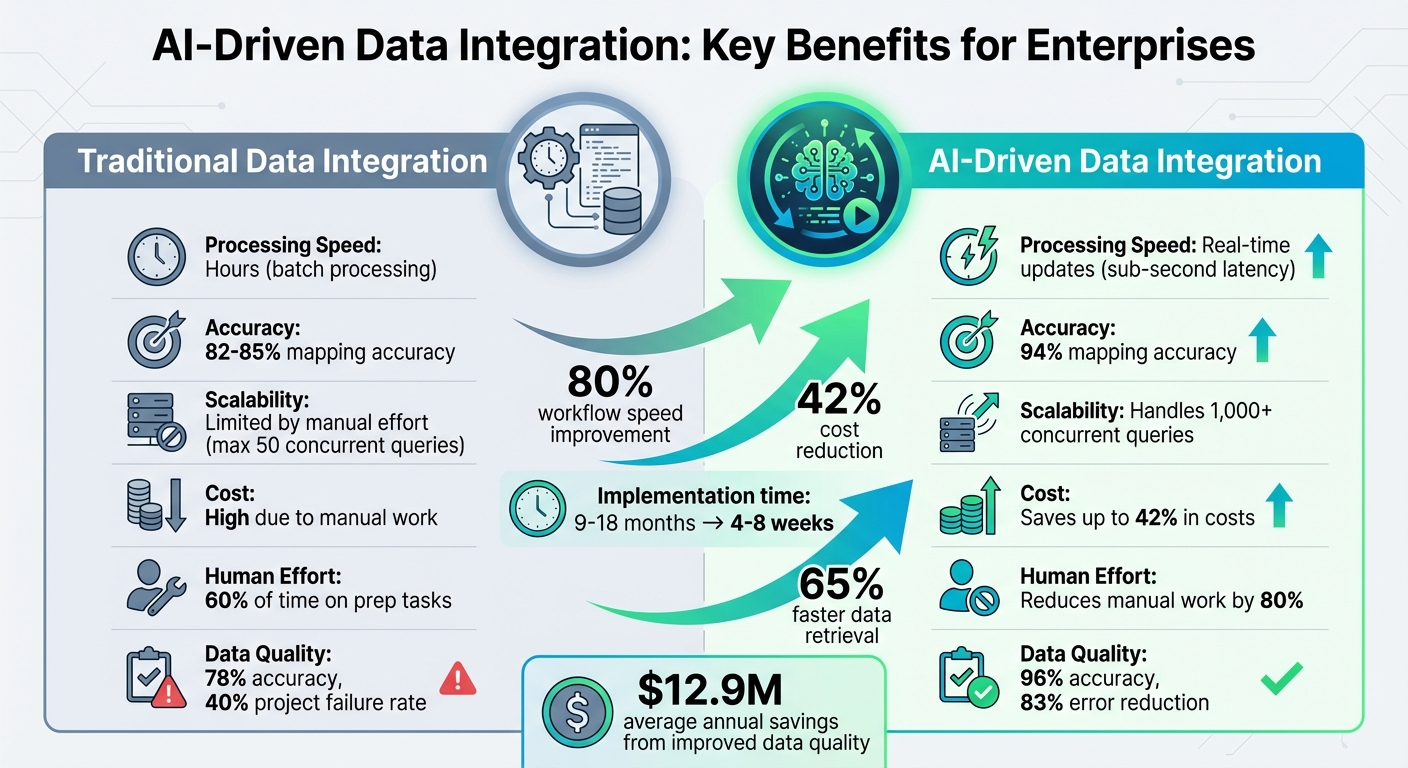
Traditional vs AI-Driven Data Integration: Performance Comparison
1. Traditional Data Integration
Traditional data integration relies on Extract, Transform, Load (ETL) or Extract, Load, Transform (ELT) pipelines to transfer data from systems like CRMs, ERPs, and databases into centralized warehouses [7]. These pipelines are built using hard-coded scripts that need frequent manual updates [7][9]. Even minor changes in source systems can break these pipelines, requiring engineers to recode and retest them [7][9].
Data Processing Approach
The traditional method processes data in batches, pulling information on scheduled intervals rather than in real time [7]. This creates delays - often measured in hours - that don’t meet the needs of modern applications demanding near-instant responses [6]. While these systems work well for human analysts reviewing historical data, they fall short for AI systems that rely on live data [6].
As Vitarag Shah, Senior SEO Analyst at Azilen Technologies, explains:
"Traditional data integration was built around predictability. You knew the source systems, the schemas changed slowly, and downstream consumers were humans reading reports. If data arrived a few hours late, nobody panicked." [5]
Human Intervention Requirements
Data engineers spend up to 60% of their time on preparation tasks like consolidating sources and transforming schemas, leaving little time for actual analysis [6]. Business users, in turn, rely heavily on technical teams for data access, leading to backlogs where integration requests can take months to address [2]. Studies show employees spend 27% of their time fixing data errors, while data teams dedicate over 40% of their time validating data [10]. Despite the effort, manual mapping achieves only 82–85% accuracy, and nearly 40% of traditional integration projects fail [10].
Scalability
Traditional methods struggle to scale as organizations grow. For example, Amazon Redshift supports a maximum of 50 concurrent queries, while Snowflake defaults to just 8 queries per warehouse [6]. Adding more connections increases maintenance complexity and often requires recoding [2]. With 55% of Chief Data Officers managing over 1,000 unique data sources [10], manual approaches simply can't keep up. A regional bank consortium faced this issue when mapping decades of transaction records - manual mapping reached only 78% accuracy and would have taken 12 months to complete [10]. These challenges highlight the need for more efficient, automated solutions.
Data Quality and Reliability
The manual, rigid nature of traditional integration often leads to ongoing quality issues. Legacy systems, such as mainframes and proprietary ERPs, lack proper documentation and have fragile interfaces, making data extraction both risky and time-consuming [5]. This results in disconnected silos where departments like marketing, finance, and operations use separate tools, preventing a unified view of the business [7][11]. These inefficiencies underline the limitations of traditional methods in meeting modern data demands.
2. AI-Driven Data Integration
AI-driven integration is reshaping how businesses manage their data, offering faster, more efficient methods compared to traditional systems. By incorporating machine learning, natural language processing, and pattern recognition, AI automates tasks that once required significant manual effort. Unlike older, rule-based approaches, AI uses semantic analysis to identify relationships between data fields while adapting to changing data structures. The results speak for themselves: some companies have reported workflow speeds increasing by up to 80% and cost reductions of 42% [8].
Data Processing Approach
AI has revolutionized data processing by enabling real-time updates instead of relying on batch processing. For example, Tapi Carpets cut data processing time by 80% with AI-powered ETL, gaining near-instant access to structured data. Additionally, these systems handle both structured and unstructured data, such as text, images, and PDFs, thanks to advanced natural language processing and computer vision capabilities [1].
Human Intervention Requirements
Repetitive tasks like data mapping and transformation are now largely automated, reducing the need for manual intervention by as much as 80%. Self-healing pipelines further streamline operations by automatically adjusting to API changes and format disruptions. Ian Funnell, Data Engineering Advocate Lead at Matillion, highlights this shift:
"AI is no longer just a 'nice-to-have' in data integration; it's becoming essential. Organizations need AI to keep pace with data complexity, automate repetitive tasks, and maintain trust in their data at scale." [8]
Real-world examples underline these benefits. In January 2025, Debut Infotech used AI connectors to synchronize data from Salesforce CRM and multiple SQL databases, ensuring data integrity through automated processes. Similarly, in 2024, the London Stock Exchange Group reduced production pipeline delivery times from several months to just weeks using AI-powered ETL solutions [8] [10]. These advancements demonstrate how AI can scale to meet growing data demands.
Scalability
AI tackles scalability issues by efficiently managing large data volumes with smart resource allocation. It automatically adjusts computing power based on workload demands, making it an ideal solution for expanding data needs. In 2024, UPS Capital introduced the DeliveryDefense™ system through Google’s Data Cloud, enabling real-time processing of updates from multiple sources. This system now manages over 280,000 claims annually for shipments valued at $236 billion [10].
Data Quality and Reliability
AI significantly improves data quality by detecting anomalies like outliers and duplicates in real time. Using techniques such as semantic analysis, K-Nearest Neighbors, clustering, and Isolation Forest, AI has increased mapping accuracy from 82–85% to 94% while drastically reducing errors. For instance, a regional bank consortium used AI to process decades of transaction records, cutting the timeline from 12 months to just 6 weeks and improving accuracy from 78% to 96%. Additionally, continuous learning from past corrections has led to an 83% reduction in errors for high-value transactions [8] [10].
Pros and Cons
The earlier breakdown of traditional and AI-driven methods highlights their distinct effects on enterprise workflows, especially when it comes to collaboration between departments and the pace of decision-making. Here's a summary of the primary strengths and weaknesses of each approach:
| Feature | Traditional Data Integration | AI-Driven Data Integration |
|---|---|---|
| Data Processing Approach | Pros: Relies on predictable, batch-oriented ETL/ELT processes with centralized storage, offering a high degree of control [6][7]. Cons: Uses static logic, making it unable to handle unstructured data. Query times range from 2–5 seconds, while data freshness is measured in hours [6][7]. |
Pros: Supports real-time streaming with a federated "zero-copy" architecture, capable of handling both structured and unstructured data. Achieves sub-second latency and is about 65% faster in data retrieval [6][3]. |
| Human Intervention | Pros: Allows full manual control over connections and mappings [3][7]. Cons: Places a heavy maintenance load on technical teams [3][7][10]. |
Pros: Automates schema detection and mapping, cutting manual effort by up to 80%. Self-healing features minimize downtime [3][8]. Cons: Still requires human judgment for interpreting context [5]. |
| Scalability | Pros: Built on well-established architectures with known best practices [7]. Cons: Has rigid designs - e.g., Amazon Redshift caps at 50 concurrent queries. Schema changes require manual updates, and traditional projects have a failure rate of around 40% [6][10]. |
Pros: Dynamically adjusts to new formats and supports over 1,000 concurrent queries per node through resource allocation [6][10]. Cons: Initial setup can be challenging for companies with older systems. |
| Data Quality & Reliability | Pros: Maintains consistency using deterministic, rule-based validation [7]. Cons: Manual validation is slow and prone to errors [4][10]. |
Pros: Uses real-time anomaly detection with approximately 94% mapping accuracy. Proactively identifies 30–40% of potential errors and reduces mistakes in high-value transactions by about 83% [5][8][10]. Cons: Self-learning systems need safeguards to prevent unexpected behavior [7]. |
This table captures the main contrasts discussed earlier, emphasizing both the advantages and the challenges of each approach.
Traditional methods are predictable and controlled but often struggle to meet the speed and scalability demands of modern businesses. On the other hand, AI-driven approaches can save costs - up to 42% according to recent studies [8] - and significantly shorten implementation timelines, reducing them from 9–18 months to just 4–8 weeks [6]. However, adopting AI-driven systems often requires investments in new skills and infrastructure.
The choice ultimately depends on the specific needs of an organization. Traditional integration works well in stable settings, while AI-driven solutions excel in environments that demand real-time responsiveness and seamless collaboration across departments. As Brooks Patterson, Head of Product Marketing at RudderStack, explains:
"Traditional data integration requires engineers to manually write code for each connection. This approach is time‑consuming and error‑prone" [3].
Conclusion
The divide between older, manual data integration methods and AI-powered solutions is growing fast. Traditional ETL processes and batch systems just can’t keep up with the exploding data volumes, which are expected to double by 2028 [3]. These outdated methods often fall short due to their lack of flexibility, while AI-driven integration slashes implementation times and delivers superior performance.
AI tackles long-standing challenges by boosting data quality - saving businesses an average of $12.9 million annually [4] - reducing infrastructure expenses by up to 70% [6], and offering lightning-fast query responses compared to the delays of batch processing [6]. These improvements highlight a major shift, pushing companies to rethink their data integration strategies.
With the ability to adjust automatically, AI-based systems overcome the limitations of rigid, manual approaches. This evolution not only simplifies data movement across teams but also empowers organizations to make quicker, more informed decisions at every level.
FAQs
When should an enterprise choose AI-driven integration over traditional ETL?
Enterprises should consider AI-driven data integration when they need real-time data processing, consistent data quality, and reliable operational performance. Unlike traditional batch-based ETL processes, AI-driven integration automates workflows, adapts to changing schema requirements, and effectively manages diverse or unstructured data sources. This approach improves anomaly detection, maintains data consistency, and scales seamlessly - making it a perfect fit for modern systems that demand continuous, high-quality data streams to handle increasing complexity and volume.
What data governance and safety controls are needed for self-learning pipelines?
Effective data governance for self-learning pipelines requires a few key practices to maintain both quality and compliance. First, data validation is essential to ensure the information being used meets quality standards. Next, implementing access controls helps restrict data usage to authorized individuals, protecting sensitive information. Additionally, consent tracking is vital for staying aligned with ethical and legal requirements.
To catch problems as they arise, continuous monitoring of metadata, access logs, and data lineage plays a crucial role. This real-time oversight helps identify and address issues before they escalate. By embedding rule validation directly into the pipelines, organizations can automate the enforcement of policies. This approach not only protects data integrity but also ensures compliance, even in complex, multi-platform systems.
How can legacy systems be integrated without breaking existing workflows?
Integrating older systems without causing disruptions in daily operations takes thoughtful planning. Tools like APIs or middleware solutions - such as ESB (Enterprise Service Bus) or iPaaS (Integration Platform as a Service) - help bridge the gap between outdated and modern systems, enabling them to communicate effectively.
A structured strategy, often guided by the "Six R’s" framework - Retain, Retire, Rehost, Replatform, Refactor, Replace - can help businesses strike a balance between updating systems and maintaining stability. Additionally, AI-powered tools can simplify the process by ensuring smooth data exchange and keeping operations running smoothly during system upgrades.