

AI personalization transforms how businesses interact with customers by analyzing real-time data to create tailored experiences. Here's why it matters:
- 78% of customers stay loyal to brands that understand their needs.
- 71% of consumers expect personalized experiences, and 76% feel frustrated when they don't get them.
- Companies using AI personalization see revenue grow by 5%–15% and cut customer acquisition costs by up to 50%.
AI uses customer behavior - like clicks, searches, and purchases - to predict needs and deliver instant, relevant recommendations. For example, if a shopper lingers on a size guide, AI prioritizes fit-related suggestions. This shift from static segments to dynamic, data-driven profiles ensures businesses meet customer expectations.
However, challenges like data privacy, quality, and integration remain. Laws like GDPR and CCPA limit data collection, while fragmented systems complicate creating unified customer profiles. Despite these hurdles, tools like ChatSpark simplify data management, enabling companies to analyze how AI shapes personalized customer interactions across platforms, deliver fast responses, and ensure privacy compliance.
The takeaway? AI personalization isn't just about better customer experiences - it's about driving measurable business outcomes.
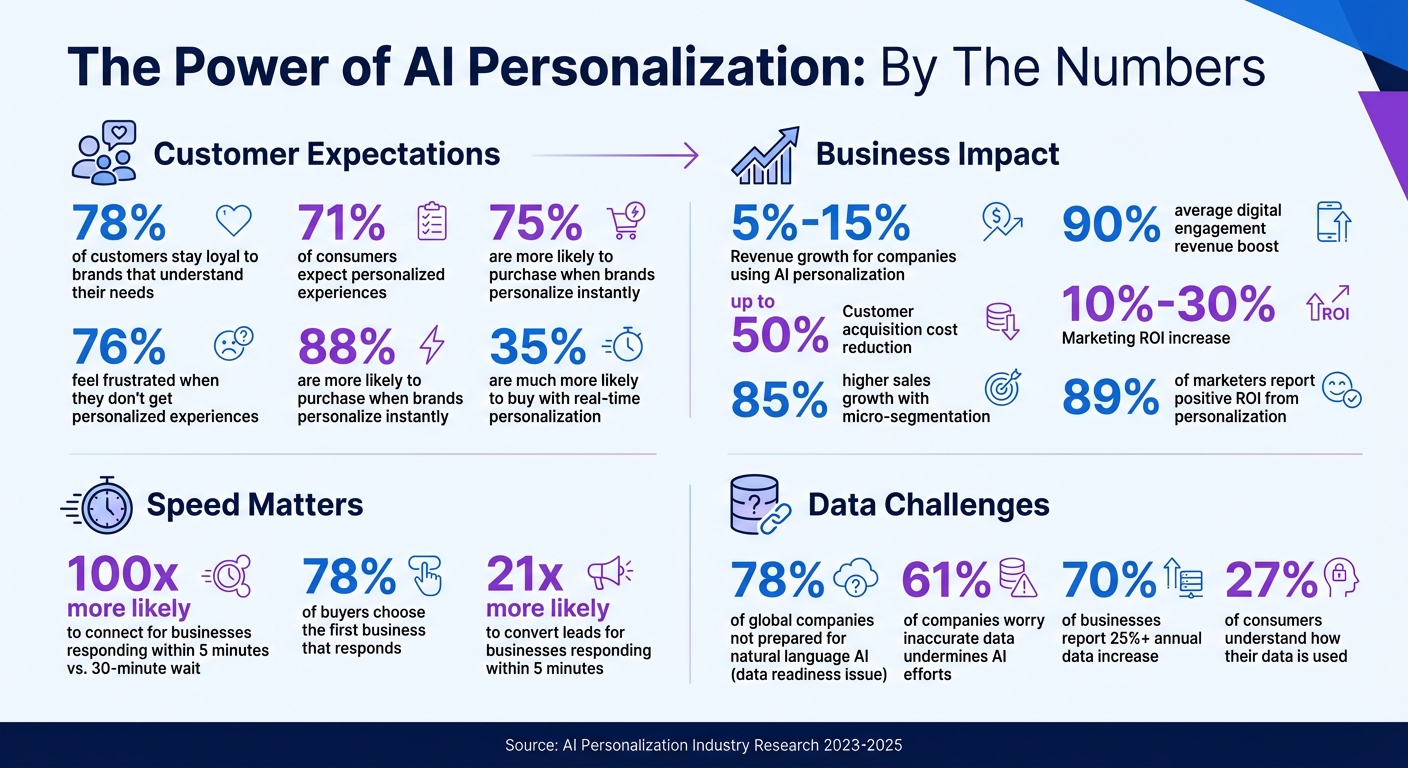
AI Personalization Impact: Key Statistics on Customer Expectations and Business ROI
Common Challenges in Using Customer Data for AI Personalization
Even with the potential of AI personalization, businesses face several hurdles when it comes to using customer data effectively. These challenges span technical, legal, and operational aspects, as companies work to reconcile AI's data demands with strict privacy regulations.
Data Privacy and Security Requirements
Consumers often want personalized experiences but are reluctant to share sensitive information. Privacy laws like GDPR and CCPA require companies to collect only essential data, yet AI models thrive on large datasets. This creates a tricky balance, especially since standard consent methods - like cookie banners - rarely cover the full scope of data use, such as training future AI models or conducting predictive analytics beyond the original purpose [6][7][9].
AI's ability to infer sensitive details from seemingly harmless data adds another layer of complexity. For example, models can predict personal traits - like health conditions or political views - with up to 80% accuracy just from non-sensitive data [7].
A high-profile incident in 2023 highlighted this risk when Samsung engineers accidentally leaked confidential source code by using ChatGPT for debugging purposes. This led to an internal ban on generative AI tools at Samsung [7][8]. The consequences of such missteps can be severe: GDPR fines can reach as high as 4% of a company's global annual revenue [8]. Meanwhile, only 27% of consumers feel they have a clear understanding of how their personal data is used [7]. As Mitrix Technology aptly puts it:
"The era of 'collect everything and apologize later' is over" [8].
However, safeguarding data is just one piece of the puzzle. Ensuring its quality is an equally daunting task.
Difficulty Accessing Quality Data
Turning raw data into actionable insights is no small feat. Identity resolution, for instance, is complicated by details like changing email addresses or names, which can lead to fragmented customer profiles [10][11]. This is a major issue, as 78% of global companies admit they're not prepared to implement natural language AI tools, citing data readiness as the primary obstacle [10].
Despite brands collecting five times more customer data than they did just four years ago [10], many still lack a unified view of their customers. The "garbage in, garbage out" principle is especially relevant here - 61% of companies worry that inaccurate data undermines their AI personalization efforts [4]. Without clean and reliable data, AI systems generate flawed insights, leading to irrelevant or even damaging customer experiences. Jacqueline Woods, CMO at Teradata, emphasizes this point:
"AI is nothing if it doesn't have clean data to essentially build intelligence off of, particularly when you talk about generative AI" [4].
Maintaining quality data requires constant effort. Companies need to regularly clean and update their datasets as upstream information evolves [11]. This challenge is magnified by the sheer volume of data, with 70% of businesses reporting annual increases of more than 25% in their data [9]. These gaps in data quality make seamless AI integration and scaling even harder.
Integration and Scaling Problems
Customer data often sits in disconnected systems - like email platforms, web analytics tools, CRMs, and support logs - making it difficult to create the cross-channel view that AI personalization relies on [14]. Batch processing, while common, introduces delays that reduce the effectiveness of personalization. Real-time processing is much more impactful but harder to achieve [15].
As companies grow, IT teams face mounting challenges. They have to manually map data, maintain customer profiles, and update workflows across multiple tools - all without a unified testing environment. This often forces risky changes to be implemented directly in production [11][13]. Without clean and well-integrated data, AI outputs are prone to errors.
Some organizations have successfully tackled these issues. For example, the Canadian Football League consolidated over 120 data points per fan using Snowflake, which led to a 9x boost in conversion rates and a 3x improvement in retaining marketable fans [14]. Similarly, Autodesk revamped its analytics platform in late 2025, achieving a 10x increase in data ingestion speed while reducing staff requirements by two-thirds [14].
How to Use Customer Data for AI Personalization
Customer data is the backbone of AI-driven personalization. The aim is to go beyond generic assumptions and deliver experiences that genuinely align with each customer's unique needs and behaviors.
Segmenting and Analyzing Customer Data
Traditional segmentation often relies on static demographics, but AI takes it a step further by analyzing behavioral signals to predict customer actions. Machine learning tools can group customers based on these signals, categorize them (like labeling someone as "high churn risk"), and assign predictive scores to estimate the likelihood of specific future actions, such as completing a purchase or upgrading a plan [16].
AI refines this process through micro-segmentation, uncovering detailed patterns that lead to highly targeted actions. For instance, instead of labeling someone simply as "high income", AI might detect nuances like spending volatility, discretionary spending habits, or transaction frequency as more effective predictors of behavior [17]. These insights translate into tangible results, with companies achieving 85% higher sales growth and 25% better gross margins by leveraging such granular data [17].
Unlike traditional methods, these AI-driven segments update in real time as new data comes in. This allows businesses to respond instantly to triggers such as cart abandonment or tutorial completion [16]. The shift from relying on predefined hypotheses to letting AI uncover predictive signals directly from raw data enables a more dynamic and accurate personalization process [17].
Processing Data in Real Time for Instant Personalization
Timing is everything. Personalization delivered in real time can significantly influence customer decisions. In fact, 88% of consumers are more likely to make a purchase when brands personalize their experiences instantly, and 35% are much more likely to buy when that personalization happens without delay [21]. Responding to leads quickly also matters - businesses that engage within 5 minutes are 100 times more likely to connect compared to those that wait 30 minutes [20].
Achieving this level of speed requires an event ingestion system that captures user interactions - like clicks, page views, or scrolling depth - as they occur [19]. This data feeds into a processing layer that analyzes events and triggers personalized actions, such as offering discounts or initiating support chats, in just seconds [19]. Predefined triggers like cart abandonment or reaching usage limits ensure the system responds appropriately and in context [19][21].
To minimize delays, a composable architecture built on existing data warehouses ensures AI operates on fresh data. This infrastructure enables context-aware responses across multiple channels simultaneously [21]. As Megan DeGruttola from Twilio highlights:
"When it comes to personalization, speed is no longer an advantage - it's a requirement" [21].
Start small with simple personalization tests, such as customized email subject lines or product recommendations, before advancing to more complex strategies like dynamic pricing [19]. Even minor improvements in response times can drive major results - 78% of buyers choose to work with the first business that responds to their inquiry [20]. While speed enhances personalization, maintaining customer trust is equally critical.
Building Customer Trust Through Clear Data Practices
Personalization only succeeds when customers trust how their data is handled. While 76% of consumers feel frustrated when their expectations for personalized interactions aren’t met, many remain cautious about data usage [17].
Transparency is key. Use clear permissions and straightforward privacy policies to build confidence [22]. Provide easy-to-navigate settings so customers can manage their data preferences, and communicate changes to data practices openly [22]. Prioritize first-party data, as it ensures better quality and stronger privacy safeguards [18].
Ethical AI practices are just as important. Implement safeguards like explainability and fairness to prevent bias and avoid creating a sense of "surveillance anxiety" [12]. A cross-functional team - including data scientists, risk experts, and executives - should oversee ethical data usage [22]. While AI can handle efficiency, ensure a human touch remains for complex or sensitive situations to preserve empathy and trust [20].
Investing in digital customer engagement can boost revenue by an average of 90% [18]. However, this growth depends on customers feeling secure about how their data is managed. A Customer Data Platform (CDP) can help by creating a unified, accurate view of customer data, ensuring opt-out preferences are respected across all channels [18].
How ChatSpark Solves Customer Data Challenges
ChatSpark tackles the tricky world of customer data management with a solution built for today’s AI-driven personalization needs. Managing data across platforms, ensuring accuracy, and safeguarding privacy are no small feats - but ChatSpark handles them seamlessly.
Bringing Data Together: Multi-Platform Integration
ChatSpark simplifies customer interactions by pulling data from multiple platforms into one place. It connects with websites, Instagram, Facebook Messenger, WhatsApp, Telegram, Slack, and Freshchat, creating a unified view of customer activity. By supporting common file formats, businesses can integrate their existing documents without extra hassle.
One standout feature is its automated website crawling, which keeps the AI agent updated with the latest content changes - no manual updates required. For messaging platforms like WhatsApp, ChatSpark retains chat histories, allowing the AI to provide more personalized responses based on past interactions. An analytics dashboard tracks key metrics like message volume, session duration, and frequently asked questions. This data helps businesses fine-tune their strategies and deliver more tailored customer experiences.
Smarter Responses with a Customizable Knowledge System
ChatSpark’s AI engine works in four key steps to deliver personalized, accurate responses. It identifies customer intent, matches queries to its knowledge base using semantic analysis, ranks potential answers using over 10 signals, and responds in a consistent brand voice. This means it can handle questions even when phrased in ways it hasn’t encountered before.
Here’s an example of its impact: A global construction products company used ChatSpark for four months, during which the AI managed 10,754 messages, captured 153 new leads, achieved a 98% resolution rate, and saved over 66 days of agent time. All this was accomplished with a modest $4,000 investment, resulting in $47,880 in savings[23]. The system also allows instant updates to the knowledge base using a rich text editor and highlights "Top Unanswered Questions" to help teams address any gaps. Plus, with support for over 85 languages, businesses can scale their operations globally while keeping interactions personal.
Prioritizing Privacy and Security
While personalization is key, data privacy is non-negotiable. ChatSpark gives businesses precise control over what data the AI can access. Teams can upload specific files or limit website crawling to certain URLs, ensuring sensitive information stays protected. The knowledge base is easy to manage, with options to edit or remove content as privacy needs change.
For added oversight, ChatSpark includes conversation monitoring tools, enabling businesses to review interactions and ensure adherence to data policies. This balance of personalization and privacy not only builds customer trust but also maximizes the efficiency of AI-driven support. By combining these elements, ChatSpark turns customer data into meaningful, personalized interactions while respecting privacy at every step.
Best Practices for AI Personalization with Customer Data
Maintaining Data Quality and Standards
Accurate data is the backbone of effective AI personalization. Yet, 61% of companies admit that poor data quality is undermining their AI-driven efforts [4]. As Derek Slager, Co-founder of Amperity, aptly puts it:
"If you don't get the input right, that magical-seeming output will be wrong" [11].
The first step is to unify customer data through identity resolution. This means creating a single, comprehensive profile for each customer, rather than treating their website visits, social media messages, and email inquiries as separate entities. By mapping all data sources, you can track where information originates, understand its flow, and establish clear data lineage. Automated monitoring systems are essential to catch errors early - fixing problems after they hit production can disrupt workflows and alienate customers [15].
A great example of this approach is Autodesk. In November 2025, they revamped their Customer 360 analytics platform, achieving a tenfold improvement in data ingestion speed while reducing platform support staff by two-thirds [14]. Their success came from consolidating data into one governed platform, eliminating silos, and creating a single source of truth.
Once your data is clean, the next step is leveraging analytics to fine-tune your personalization efforts.
Using Analytics to Improve Performance
Analytics transform raw data into actionable strategies. Start by tracking metrics that align with your business goals. For example, if you're using AI in customer support, focus on resolution rates and response times. In lead generation, measure how quickly AI qualifies prospects - businesses that respond to leads within five minutes are 21 times more likely to convert them compared to slower responses [20].
A/B testing is a powerful tool to identify which personalized messages resonate most with your audience. Combine that with session recordings to gain deeper insights into customer behavior - why they engage or why they drop off. Keeping an eye on model drift is equally important, as AI accuracy can decline over time when customer behaviors change. Regular retraining ensures your AI stays relevant.
George Salib, Senior Manager of Digital Marketing at Orascom Hotels Management, highlights the importance of this process:
"VWO's personalization features, combined with the Copilot insights and reporting, make it easy to identify opportunities and take action fast, helping us deliver tailored experiences that convert" [1].
With 89% of marketers reporting positive ROI from personalization efforts [15], it’s clear that analytics-driven strategies pay off. Once you’ve mastered this, the next step is scaling personalization through automation.
Scaling Personalization Through Automation
Automation is what makes personalization scalable and efficient. For instance, ChatSpark uses automated website crawling to keep its AI knowledge base up-to-date, ensuring accurate content without requiring constant manual updates. This approach keeps responses aligned with your evolving business needs.
To maintain consistent experiences, deploy AI across multiple platforms simultaneously. By managing WhatsApp, Instagram, Facebook Messenger, and your website from a unified knowledge base, customers receive the same quality interactions no matter how they reach out. This multi-channel strategy also centralizes analytics, giving you a complete view of customer interactions rather than fragmented data.
Start small with high-impact areas to demonstrate ROI. For example, personalize homepage recommendations or email subject lines, then use analytics to showcase the results. Gradual expansion is more effective than trying to personalize everything at once. Automating lead routing is another way to boost efficiency - AI can handle routine data collection while directing high-priority leads to your sales team, ensuring that resources are focused where they’re needed most.
Conclusion
Effective personalization starts with quality data, and AI-driven personalization thrives on a solid data foundation. In fact, 89% of decision-makers consider it a priority for the next three years[5]. The key lies in collecting, unifying, and protecting customer data. Without clean and cohesive data streams, even the most advanced AI models can fall short, delivering generic experiences that leave customers dissatisfied.
The move from static segmentation to real-time, behavior-driven personalization demands a system where every interaction - whether it’s a click, a view, or a purchase - feeds back into the AI to refine future decisions. As Geoffrey Keating of Twilio aptly states:
"Personalization powered by AI is no longer a luxury, but a strategic imperative for businesses across industries"[5].
ChatSpark embodies this principle by transforming these insights into tangible solutions. It tackles challenges through automated website crawling, seamless no-code integrations with over 5,000 tools, and consistent omnichannel support. Its four-step AI engine ensures quick, contextual responses while safeguarding data privacy - all powered by a unified knowledge base.
The benefits are clear: businesses that embrace transparent data practices and automation see significant returns. Digital engagement can boost revenue by an average of 90%[18] and increase marketing ROI by 10%–30%[2]. With consumer expectations for personalization rising[3], companies that fail to prioritize customer data risk falling behind. Success starts with high-quality first-party data, a commitment to transparency, and scaling personalization through automation - not manual effort.
For businesses ready to take the leap, ChatSpark’s Pro plan, priced at $129 per month, offers an accessible starting point for scaling AI personalization. One enterprise reported a staggering 934% annual ROI, turning a $4,000 investment into $47,880 in savings within just four months[23]. With an over 80% AI resolution rate, teams are freed up to focus on complex challenges while the AI continues to learn and improve with every interaction.
FAQs
How does AI-driven personalization boost customer loyalty and sales?
AI-powered personalization boosts customer loyalty and increases sales by creating tailored experiences that align with individual preferences and needs. By examining customer data, AI can suggest products, customize content, and send messages that feel genuinely relevant and personal.
This approach helps build trust, improve satisfaction, and create a stronger emotional connection with your brand. Over time, these deeper relationships lead to repeat purchases and long-term loyalty, driving higher revenue and greater customer lifetime value.
What challenges do businesses face with data privacy when using AI for personalization?
Businesses today grapple with navigating data privacy concerns while leveraging AI for personalization. One of the biggest obstacles is meeting the requirements of privacy laws like GDPR and CCPA. These regulations impose strict standards, and advanced AI techniques - such as predictive profiling and real-time user experience customization - often require processing vast amounts of personal data. This can clash with privacy principles like data minimization, which emphasizes collecting only what's absolutely necessary.
Another pressing issue is maintaining user trust. As consumers grow more aware of how their personal information is handled, any lack of clarity or transparency can quickly erode confidence. To counter this, companies need to adopt privacy-first frameworks, obtain clear and explicit user consent, and be upfront about how data is collected and used. Striking the right balance between personalization and privacy isn't just about compliance - it’s also crucial for building trust and maintaining strong, long-term customer relationships.
How can businesses ensure their customer data is accurate and effectively integrated for AI-driven personalization?
To make AI-driven personalization work effectively, businesses need to prioritize high-quality customer data and ensure smooth integration across all platforms. Reliable AI results depend on data that's accurate, consistent, and complete. Any errors or missing information can compromise the system’s output, so regular checks and updates are essential to maintain data integrity.
Equally important is integration. Data needs to flow effortlessly between various systems and customer touchpoints, allowing AI models to access real-time, unified information. A well-structured data architecture that facilitates continuous updates and alignment can greatly improve the precision and speed of personalization efforts. Focusing on these foundations enables businesses to harness AI’s power to create truly tailored customer experiences.