
Your brand's voice is its identity. But when scaling operations - like sending 50 million emails weekly or managing customer interactions across platforms - consistency often falters. The result? Message drift, where your tone becomes inconsistent, making your brand forgettable. This is a big problem: 68% of consumers abandon brands that change their tone, and 71% expect personalized interactions.
AI solves this by acting as a centralized guard for your brand's identity. Companies like Canva and Kayo Sports have used AI to scale their communication while boosting engagement and revenue. Here's a quick breakdown of how you can do the same:
- Define Your Brand Voice: Audit your content for tone, style, and vocabulary. Create clear "Do's" and "Don'ts" for AI training.
- Train AI with Examples: Use tools like ChatSpark to teach AI your voice using existing content and structured prompts.
- Maintain Consistency Across Channels: Adjust tone for platforms like Instagram or LinkedIn without losing your brand's essence.
- Measure and Refine: Use analytics and audits to track performance and prevent tone drift.
AI lets you scale without sacrificing personality, ensuring every interaction reflects your brand's voice. Tools like ChatSpark make this process efficient, even across languages and platforms. Ready to keep your messaging sharp and consistent? Let’s dive in.
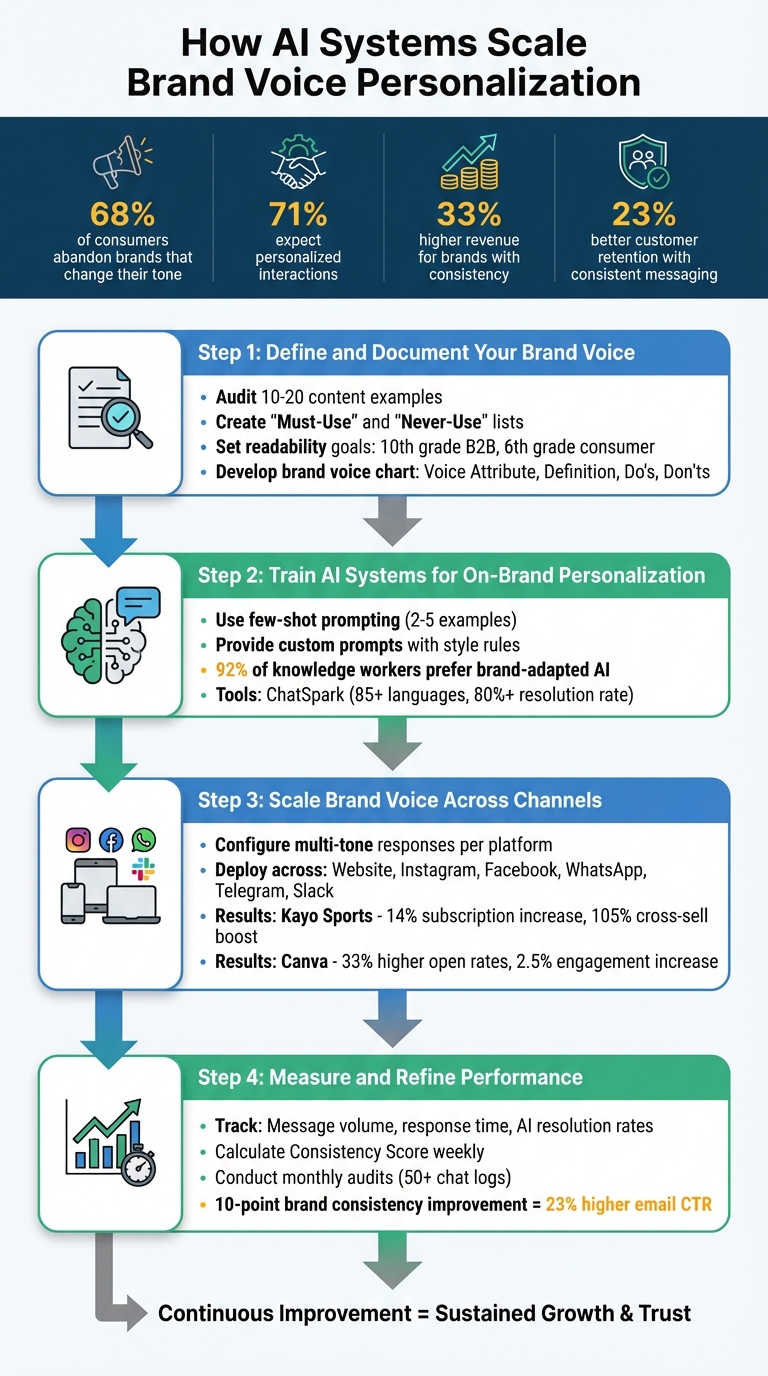
4-Step Process to Scale Brand Voice with AI Systems
Bring Consistency to Your Brand Voice with AI
Step 1: Define and Document Your Brand Voice
Before you can use AI to amplify your brand voice, you need to establish clear, detailed guidelines that the AI can follow. Start by auditing your existing content to identify the traits that define your brand’s personality.
Analyze Existing Communication for Consistency
Gather 10–20 examples of content that reflect your brand’s voice. These could include emails, blog posts, social media updates, landing pages, or even customer support responses. This is especially critical when you automate customer support to ensure consistency. Think of these as your benchmark pieces - content that encapsulates how your brand "sounds" [5][1].
Next, dive into the details. Look at word choices, sentence structure, tone, and formatting preferences. Do you lean toward bullet points or paragraphs? Short, punchy sentences or longer, more descriptive ones? Active voice or passive? Feed these successful examples into an AI tool and ask it to identify patterns in tone, style, and punctuation [6][7].
From this analysis, create two essential lists:
- "Must-Use" List: Include official product names, preferred terminology, and phrases that align with your brand's identity.
- "Never-Use" List: Exclude overused buzzwords, competitor trademarks, or jargon that alienates your audience.
For instance, if your tone is conversational, you might prefer "creative teams" over "users" to keep things personal [7]. Additionally, set readability goals - like aiming for a 10th-grade reading level for B2B content or 6th-grade for consumer-facing material [3].
"AI-generated drafts often sound generic, flat, or emotionally neutral. They also drift from your brand voice unless you teach the model what 'on-brand' means."
– Jolissa Skow, Search Engine Land [7]
These observations form the foundation for your brand voice guidelines.
Develop Brand Guidelines for AI Training
Turn your analysis into a set of actionable brand guidelines. A useful tool here is a brand voice chart with four columns: Voice Attribute, Definition, Do's, and Don'ts. For example, if "authentic" is a key attribute, clarify what that means: Do share real customer stories, but Don’t invent experiences [6].
Set technical rules to maintain consistency. For example, limit sentence length to under 20 words and keep passive voice usage below 10% [7][3]. Decide on specifics like whether to use contractions, the Oxford comma, em dashes, or exclamation points [5][7].
Your guidelines should also account for context. For instance, your voice might be empathetic when addressing customer issues but more aspirational in product announcements [7][8]. If your audience is primarily U.S.-based, make sure to reflect regional communication norms [3][1]. The more detailed your documentation, the better AI can replicate your brand’s unique personality at scale.
Step 2: Train AI Systems for On-Brand Personalization
Once your brand guidelines are documented, the next step is teaching AI to consistently reflect them. The good news? You don’t need deep technical skills or costly fine-tuning. Methods like prompt engineering and few-shot learning are practical, effective, and accessible.
Use Custom Prompts and Examples
Training AI starts with prompt engineering - giving the system clear instructions, context, and style rules to follow.
One of the best approaches is few-shot prompting. Provide the AI with 2–5 examples of your most on-brand content, like customer emails, social media posts, or blog excerpts. These examples allow the AI to pick up patterns in tone, word choice, and structure. To make the training even more effective, show two versions of a message: one generic and one tailored to your brand. This comparison helps highlight differences in sentence flow, vocabulary, and even punctuation. Then, ask the AI to identify and replicate those differences when generating new content.
"Capturing your unique brand voice with Generative AI is entirely possible with the right strategy and intention. It's not about handing over the reins... but rather guiding it, training it, and shaping the conversation."
– Ryan Tepper, Digital Marketing and Design Coordinator, Fishtank
Experts recommend going the extra mile by listing words to avoid (like "synergy" or "game-changer") and providing a preferred vocabulary. Tools like tone sliders can also help define the boundaries of your brand’s voice. A 2025 study revealed that AI trained for personalized output was rated much higher in both creativity and quality compared to generic models. In fact, 92% of knowledge workers expressed a preference for AI that adapts to specific brand guidelines [10].
Platforms like ChatSpark make implementing these strategies straightforward.
Use ChatSpark for AI Training
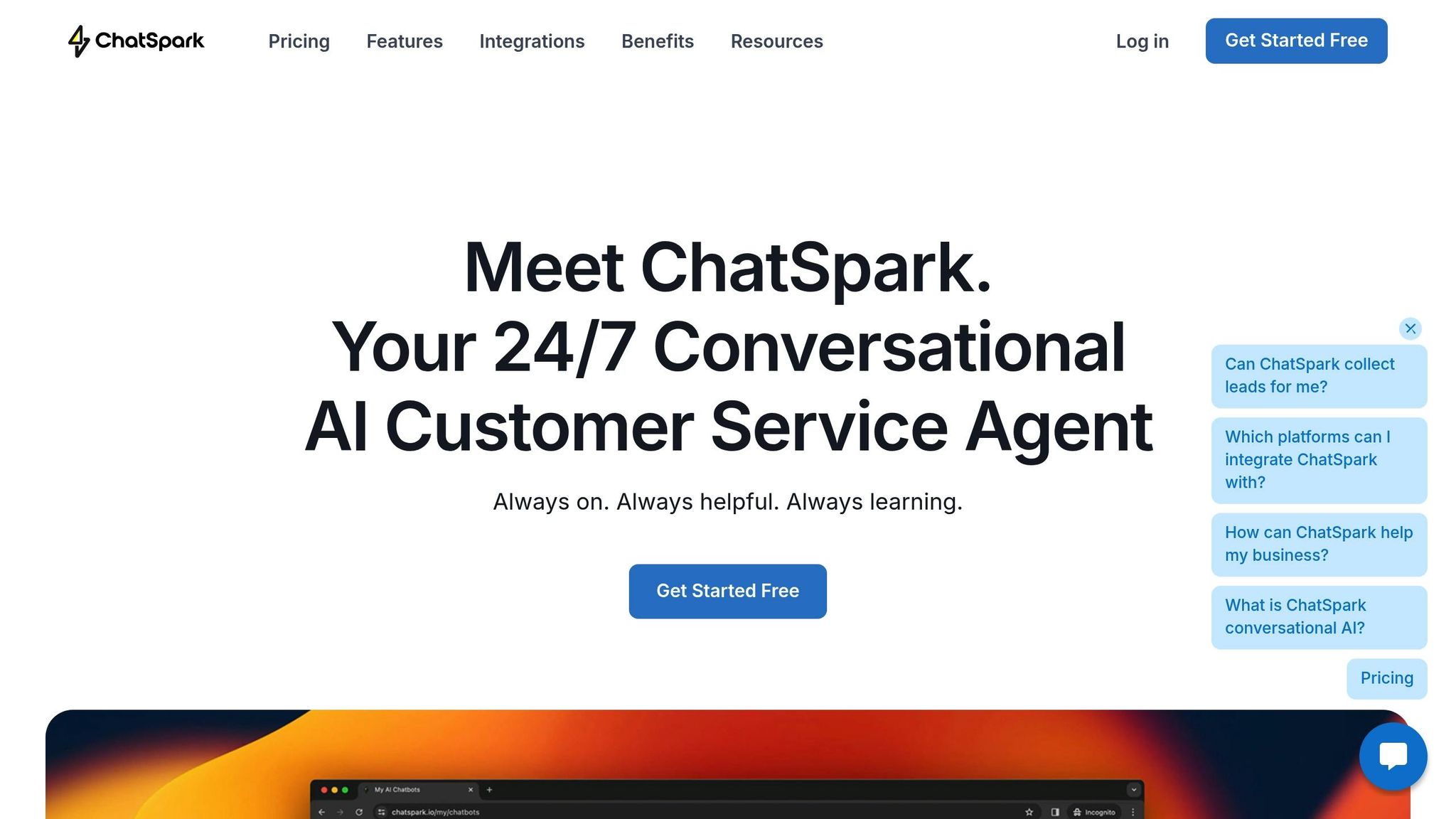
ChatSpark simplifies AI training by automatically aligning your content with your brand voice across channels. You can upload existing materials - like website URLs (which it auto-crawls), PDFs, Word documents, PowerPoint files, CSVs, YouTube transcripts, and Google Docs - and the platform processes everything in minutes to create a brand-aligned knowledge base.
The system operates using a four-step engine that decodes customer intent and leverages over 10 signals in its proprietary ranking system to select the most contextually accurate, on-brand responses. Once trained, you can personalize the AI agent’s name, avatar, color scheme, and personality to match your brand’s visual and verbal identity. ChatSpark typically achieves an 80%+ resolution rate for customer inquiries by delivering precise, brand-consistent answers.
What’s even better? A single trained agent can be deployed across multiple platforms like your website, Instagram, Facebook, WhatsApp, Telegram, and Slack. It ensures your brand voice stays consistent everywhere. Plus, with support for over 85 languages, ChatSpark enables you to maintain that consistency globally - no extra setup required. Its scalable plans cater to businesses of all sizes, making it a versatile solution for any team.
Step 3: Scale Brand Voice Across Channels
Once your AI is trained, the next hurdle is keeping your brand voice consistent across different platforms. Each channel has its own style - Instagram leans toward casual, visually engaging storytelling, while LinkedIn demands a more polished, professional tone. The trick? Adjust your tone to fit the platform without losing your brand’s essence.
Configure Multi-Tone Responses for Different Audiences
Your audience varies by platform, and your tone should reflect that. For instance, LinkedIn users often expect a professional, business-focused voice, while Instagram followers may connect better with a relaxed, conversational style. To tackle this, develop channel-specific training that adapts your tone to the platform while staying true to your brand identity. Use targeted training materials, like professional blogs for LinkedIn and casual updates for Instagram, to fine-tune your AI [12][4].
A tone matrix can be a helpful tool here. By rating traits like warmth, formality, and humor on a 1–5 scale, you can maintain consistency while avoiding "tone drift" [13]. A great example is Bank of America's virtual assistant, "Erica." With over 25 million mobile users, Erica uses formal and precise language to manage sensitive financial data, building trust while staying professional [13].
Personalization is critical, too. Studies reveal that 71% of consumers expect tailored experiences, yet 76% feel let down when companies fail to deliver [4]. Even more striking, 30% of users will walk away from a brand after just one negative interaction [13].
Implement Omnichannel Personalization
Once your training is customized, scaling becomes easier with unified deployment. Instead of juggling multiple systems, a platform like ChatSpark lets you train a single AI agent and roll it out across your website, Instagram, Facebook, WhatsApp, Telegram, and Slack. The system automatically adjusts the tone, length, and style for each channel while keeping your brand voice intact [4].
The impact of this approach is clear. In fiscal year 2024, Australian sports streaming service Kayo Sports leveraged AI-driven reinforcement learning to scale from 300 communication variations to an impressive 1.2 million personalized messages. This strategy led to a 14% increase in subscriptions and a 105% boost in cross-sells [2]. Similarly, Canva expanded its email output from 30 million to 50 million weekly messages during the COVID-19 pandemic. By automating translation and localization across 20+ languages, Canva achieved a 33% rise in open rates and a 2.5% increase in engagement [2].
To ensure accuracy and alignment with your brand, Retrieval-Augmented Generation (RAG) can be a game-changer. This method pulls precise, on-brand answers directly from your knowledge base, allowing your AI to stay consistent and factual - even when managing thousands of conversations across multiple platforms [13]. By using RAG, you minimize the risk of your AI generating inaccurate or off-brand responses, no matter the scale.
Step 4: Measure and Refine Brand Voice Performance
Launching your AI is just step one. To truly maintain your brand voice, you need to measure its performance and refine it regularly. Without proper tracking, your AI could gradually veer off course, and that’s a big risk - 68% of consumers will unfollow or abandon a brand if its tone suddenly shifts [3]. Shockingly, 81% of companies admit to publishing off-brand content, even though they know the consequences [3].
Use Analytics to Track Performance
Once your AI is live, monitoring its performance in real time is essential. Start by focusing on metrics that reveal whether your AI is staying on-brand. Tools like ChatSpark’s analytics dashboard make this easier by tracking key data points such as message volume, response time, and AI resolution rates across platforms like your website, WhatsApp, and Instagram [11][13].
For deeper insights, calculate a "Consistency Score" by combining factors like AI classifier confidence, rule violations, and readability scores to identify trends week by week [3]. A drop in this score can indicate your AI is drifting off-brand. Another valuable metric is the editorial revision rate - how often human editors need to adjust AI-generated content. For example, a global construction products company using ChatSpark handled 10,754 messages in four months, achieved a 98% AI resolution rate, captured 153 new leads, and saved $47,880 [11].
Conduct Regular Quality Audits
Analytics alone won’t catch everything. That’s where quality audits come in. Every month, review at least 50 random chat logs to spot any shifts in tone [13]. Use a structured scoring system that evaluates three critical areas: Tone Accuracy, Vocabulary Alignment, and Style Consistency [1]. This process helps pinpoint patterns, such as frequently broken brand rules or specific channels where tone is drifting.
To enforce consistency, combine AI classifiers, rule-based validators, and human reviewers. Set up "hard blocks" for non-negotiable issues like legal disclaimers, while using "soft warnings" for minor tone inconsistencies. Additionally, test your AI monthly with at least 25 realistic scenarios, scoring each response for tone, accuracy, and overall effectiveness [9].
Why does this matter? Companies with consistent messaging see 23% better customer retention, and improving brand consistency by just 10 points can lead to a 23% increase in email clickthrough rates [3]. Regular audits ensure your AI-driven messaging stays aligned with your brand’s identity while delivering personalized experiences at scale.
Conclusion
AI offers a way to balance consistency with customization in your brand voice. As discussed, the foundation for scalable brand voice personalization lies in clear guidelines, tailored AI training, and seamless deployment across multiple channels. By following the outlined steps - from defining your voice to conducting thorough performance checks - you strengthen your brand's identity across every customer interaction.
Brands that maintain consistency see 33% higher revenue[3], and 71% of consumers now expect personalized experiences in every engagement[4]. Tools like ChatSpark serve as a centralized hub for your brand identity, ensuring that every touchpoint - whether it’s your website, WhatsApp, Instagram, or Facebook - reflects your brand’s tone. These systems handle thousands of interactions in more than 85 languages, cutting down on manual effort while maintaining the authenticity of your voice.
"In adopting AI, you don't hand over the reins but equip yourself with a powerful ally that ensures your brand's voice is heard, recognized, and trusted across every touchpoint." - Erika Heald, Content Marketing Consultant[6]
This highlights the importance of a disciplined approach. In a world where every interaction is measured against the best personalized experiences, can your brand afford to lose focus on its voice?
Define your brand voice clearly, train your AI with high-quality data, and implement a robust three-layer validation process. The future of your brand’s consistency - and its profitability - relies on it.
FAQs
How do AI systems ensure brand voice stays consistent across platforms?
AI systems ensure a brand's voice stays consistent by relying on structured guidelines that outline the tone, style, and specific terminology associated with the brand. These systems can be trained with tools like voice profiles, pre-approved templates, and detailed language rules, helping every interaction reflect the brand's personality.
To avoid mismatches, many AI platforms use validation processes such as pre-publish checks, content audits, and ongoing monitoring. This approach ensures that even as personalized messaging expands across different platforms, the brand's voice stays true to its identity. When paired with human oversight, this framework becomes a dependable way to deliver consistent, on-brand communication across the board.
How can AI be trained to reflect a brand's unique voice?
Training an AI to mirror a brand's distinct voice takes a thoughtful approach. It starts with crafting brand voice guidelines - a detailed document that defines the tone, style, and vocabulary your brand uses. This ensures consistency across every interaction, whether it's a social media post or customer service response.
Next, the AI needs to be trained with high-quality examples of content that reflect these guidelines. These examples help the AI grasp the brand's personality and replicate it in its responses. Think of it as teaching the AI to "speak" your brand's language fluently.
To keep the AI aligned, prompt engineering plays a crucial role. This involves designing templates and instructions that guide the AI to stay in line with the brand's voice. But no system is perfect without human oversight - regular reviews help fine-tune the AI's output and keep it updated as the brand evolves.
Platforms like ChatSpark make this process easier by offering tools for customization and continuous learning. With these, your AI can deliver consistent, on-brand communication, no matter the scale.
How does AI personalization improve customer engagement and build brand loyalty?
AI-driven personalization transforms how businesses connect with customers by delivering interactions that feel both tailored and genuine. By matching communication to a brand’s tone and aligning it with individual customer preferences, AI helps foster familiarity and trust. This creates experiences that go beyond mere transactions, building deeper emotional ties with the brand.
What’s more, AI ensures that personalized messaging remains consistent across various platforms - whether it’s social media, websites, or messaging apps. This unified approach, paired with fast and accurate responses, minimizes frustration and enhances customer satisfaction. Over time, these positive experiences not only build trust but also inspire repeat purchases and long-term loyalty.