AI copilots like ChatSpark CoPilot are transforming how sales, operations, and leadership teams work by automating tasks, improving efficiency, and transforming customer service with actionable insights. Here's the gist:
- Sales Teams: Automate CRM updates, summarize calls, and extract deal insights. Result? 31% more conversations closed daily and 5–10 hours saved weekly.
- Operations Teams: Streamline ticket management with 95% accurate routing and faster responses. Microsoft saw a 12% drop in case handling time.
- Leadership: Skip complex dashboards - ask plain questions and get clear answers. Teams using AI copilots report 20+ hours saved per month and up to 3.7x ROI.
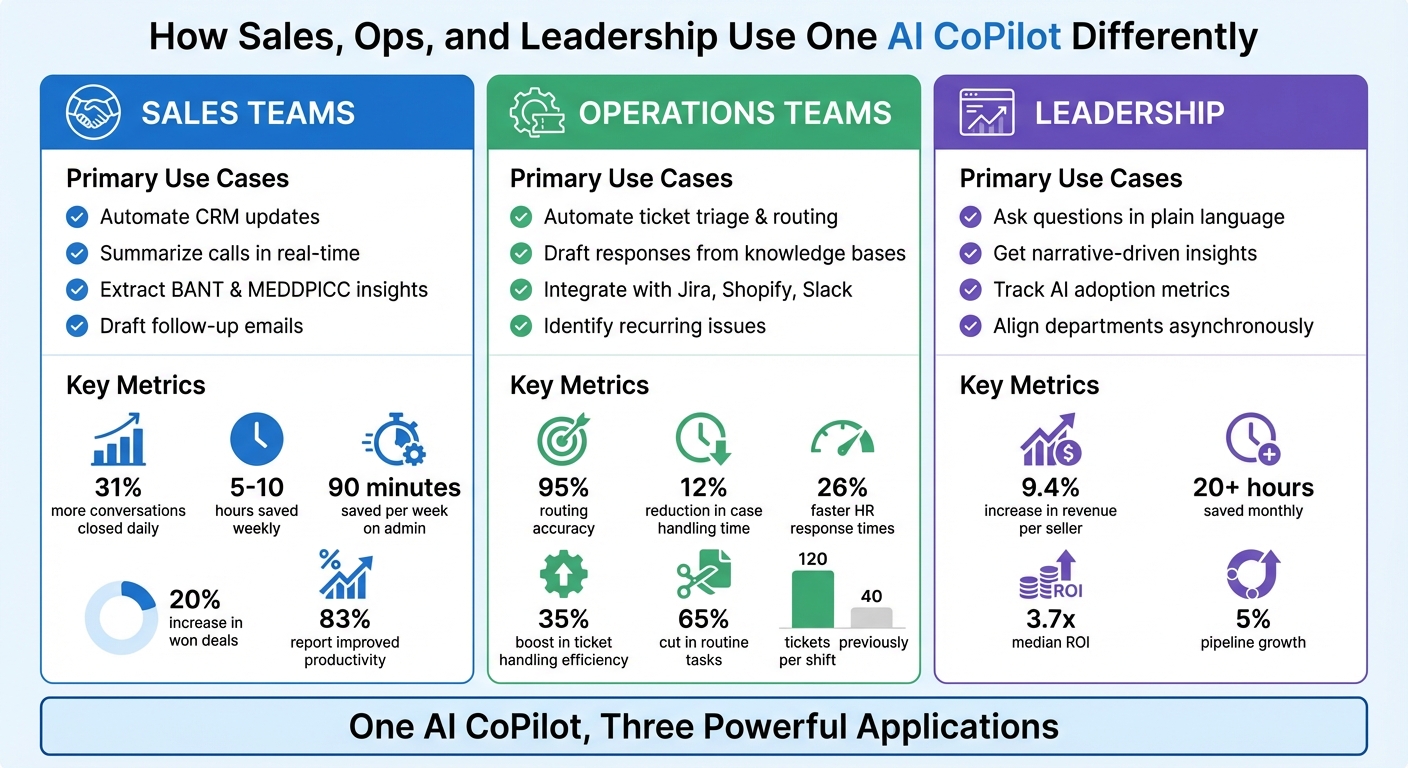
How Sales, Operations, and Leadership Teams Use AI CoPilot: Benefits and Impact by Role
1. Sales Teams
Sales representatives spend about 70% of their time on tasks like research, data entry, and internal meetings - leaving less time for actual selling [10]. ChatSpark CoPilot changes this by automating routine tasks and offering real-time insights during live customer interactions.
During calls or chats, this tool acts as a smart assistant, conducting contextual searches through technical documents and FAQs to instantly provide answers to complex buyer questions [6]. This allows reps to respond on the spot, enhancing their credibility and keeping the conversation flowing. After the interaction, the system takes over administrative tasks: summarizing calls, identifying action items, drafting follow-up emails, and syncing everything to the CRM [6][12].
"If conversation intelligence was about 'what happened on the call,' the AI copilot is about what to do next – and how to do it better, faster, and with less friction." – Federico Presicci, Enablement Leader [6]
The tool speeds up the qualification process by extracting BANT data (Budget, Authority, Need, Timing) and MEDDPICC insights from emails and transcripts [13][6]. It also identifies potential risks, such as stalled progress, missing decision-makers, or a lack of recent activity, giving managers a clear view of where to step in [1][7].
With the AI copilot, sales reps close 31% more conversations per day and save 5–10 hours of administrative work each week. Abel Solutions consultants, for instance, reduced their post-meeting wrap-up time by over 50% in July 2025 [11][6][14].
Next, let’s explore how operations teams are using the AI copilot to optimize their processes.
2. Operations Teams
Operations teams often face the tough task of managing a high volume of support tickets while ensuring every customer interaction meets quality standards. Tools like ChatSpark CoPilot step in to simplify this process. By automating ticket triage, the platform categorizes incoming issues, assigns priority levels based on factors like sentiment and customer tier, and directs them to the right specialist. Impressively, this routing system achieves over 95% accuracy in predicting ticket categories, ensuring urgent cases are quickly escalated to experienced agents [15].
The tool doesn’t stop there. It also drafts responses by pulling information from knowledge bases, past tickets, and technical documentation. Agents review these drafts, typically needing to adjust only 10–20% of the content [15]. This setup not only speeds up response times but also lays the groundwork for smoother operations overall.
In February 2024, Microsoft rolled out ChatSpark CoPilot to nearly 10,000 support agents. The results? A 12% reduction in case handling time and a 10% improvement in case resolution rates. Their HR department also benefited, reporting a 26% reduction in initial response times for complex employee inquiries [3].
"Our HR service professionals are able to handle employee inquiries more efficiently. So far we are seeing a 26 percent reduction in initial response time thanks to Copilot." – Kathleen Hogan, Chief People Officer, Microsoft [3]
Beyond ticket management, ChatSpark CoPilot integrates seamlessly with tools like Jira, Shopify, and Slack, allowing teams to trigger actions in these systems without switching platforms [16]. It also analyzes support data to identify recurring issues, helping teams address problems before they grow [25, 26].
In 2024, Rotho’s digital growth team, led by Sr. Manager Jeroen van den Broek, adopted ChatSpark CoPilot to enhance their support operations. The results were striking: expert agents could handle up to 120 tickets per 8-hour shift - a massive jump from their previous capacity of 40 tickets. Overall, operations teams boosted ticket handling efficiency by 35% per hour while cutting routine tasks by 65% [24, 26].
3. Leadership
With streamlined workflows now in place for sales and operations, executives can access critical business insights in a whole new way. Tools like ChatSpark CoPilot make it possible to skip the clutter of complex dashboards. Instead, leaders can simply ask questions in plain language - like, "Why did revenue slow last quarter?" - and instantly receive narrative-driven answers. These responses don’t just list numbers; they explain trends, compare past performance, and even suggest actionable steps [18][19].
Take the Microsoft Customers and Partners (MCAPS) team as an example. In April 2025, they used Copilot Analytics to measure AI's influence on their sales organization. The results? A 9.4% increase in revenue per seller, a 20% boost in won deals, and a 5% growth in the overall pipeline - all driven by daily usage from over half of their 30,000 sales professionals [4].
"This ability to instantly gather and process information gives me a strategic advantage. Be it identifying growth opportunities, addressing customer challenges, and spotting market trends; Copilot empowers my leadership decisions." – Joacim Damgard, President, Microsoft Western Europe [21]
The platform also helps align departments by summarizing missed meetings and facilitating timely asynchronous feedback [21]. On top of that, organizations leveraging AI copilots for reporting and analytics save over 20 hours each month, with 58% of AI-adopting companies reporting such efficiency gains [19]. And the financial payoff is clear: for every $1 spent on generative AI, companies report a median ROI of 3.7x [19].
To ensure successful AI adoption, leadership uses specialized dashboards to track metrics like active users, retention rates, and AI agent performance. Companies utilizing these dashboards have seen their tool usage more than double compared to those that don’t [20]. By shifting the focus from data collection to strategic planning, these tools enable better cross-department collaboration and make shared intelligence a reality [21][22].
Advantages and Limitations by Role
Different roles within an organization experience the benefits and challenges of an AI copilot in unique ways. Here's a closer look at how sales, operations, and leadership teams are impacted.
For sales teams, the AI copilot delivers impressive time savings - 90 minutes per week on average - by automating CRM updates and providing real-time deal guidance. Additionally, 83% of sales professionals report improved productivity [3]. However, there are trade-offs. Real-time AI nudges can be distracting if not fine-tuned, and over-relying on generic automated outreach may harm customer relationships when human judgment is overlooked [1].
Operations teams see a 12% boost in case handling speed and a 26% reduction in HR response times [3]. These gains depend heavily on clean data and smooth integrations. On the flip side, siloed data and automating flawed processes can undermine these benefits. As Maria Akhter aptly puts it:
"Organizations that automate broken processes get broken automation; workflow redesign must precede technology deployment" [17].
For leadership, AI simplifies strategic oversight by synthesizing emails, meetings, and documents into clear, actionable insights. This eliminates the need to sift through endless dashboards. However, 84% of data and analytics leaders admit their strategies need a complete overhaul to fully support AI initiatives [8]. There's also the risk of focusing on "vanity metrics" like login counts instead of meaningful outcomes, such as improved forecast accuracy or reduced cycle times [5].
Here’s a summary of the advantages and limitations across these roles:
| Role | Primary Advantages | Key Limitations |
|---|---|---|
| Sales | 90-min weekly time savings [3]; 20% increase in won deals [4]; automated data entry [6] | Risk of over-automated outreach [1]; requires prompt literacy training [9] |
| Operations | 12% faster case handling [3]; 26% faster HR response [3]; reduced admin burden [21] | Data silos keep valuable data inaccessible [8]; integration failures common [17] |
| Leadership | Real-time strategic insights [21]; asynchronous alignment via meeting summaries [21] | Risk of vanity metrics [5]; depends on manager buy-in [3] |
To overcome these challenges, teams must focus on improving data hygiene, consolidating technology stacks, and establishing governance protocols before scaling AI solutions. High-performing teams are 1.5x more likely to prioritize these steps, with 84% planning to consolidate their tech stacks to ensure smoother implementation [8][17]. By addressing these issues upfront, organizations can maximize the benefits of their AI copilots while improving overall processes.
Conclusion
ChatSpark CoPilot enhances productivity across all roles by automating workflows, providing unified data access and lead capture, and offering real-time insights. This means teams in sales, operations, and leadership can work more efficiently, saving time and focusing on what matters most [6][8][1]. At the same time, it caters to specific needs within each role, delivering tailored solutions that drive deeper impact.
By streamlining individual tasks and fostering better collaboration between departments, the platform ensures that everyone - whether in Product, Marketing, or at the executive level - can access and act on consistent customer data. Features like call snippets and summaries give teams a clear view of the "voice of the customer", helping them align their strategies and decisions.
As more organizations adopt unified AI copilots, they gain not only immediate efficiency but also long-term advantages. A single AI solution across roles builds institutional intelligence that grows over time, turning everyday insights into a lasting competitive edge [8][2].
FAQs
What are the best AI copilot use cases for sales vs. ops vs. leaders?
AI copilots are tailored to meet the specific needs of different roles. Sales teams leverage them to increase engagement, streamline pipeline management, and close deals faster by providing real-time insights and guidance. Operations teams depend on them to handle repetitive tasks, ensure data accuracy, and refine workflows for better efficiency. Leaders turn to AI copilots for strategic decisions, using AI-driven insights to unify data and strengthen organizational focus. These role-specific applications drive productivity and streamline efforts across the board.
What data and integrations do we need before rolling out an AI copilot?
To implement an AI copilot successfully, start by collecting essential data and connecting it with your existing tools - think CRM platforms, email systems, and document management software. Set up a framework to measure how the AI is being used and its impact, using specific metrics and KPIs. Make sure you have the right analytics tools to track adoption rates and return on investment (ROI). Lastly, give top priority to protecting sensitive information by focusing on data privacy, proper governance, and compliance measures.
How do we measure AI copilot ROI beyond time saved?
To truly understand the return on investment (ROI) of an AI copilot, you need to look beyond just the time it saves. Consider its influence on critical business metrics like pipeline hygiene, deal velocity, or revenue per seller. The key is to align the use of AI with your broader strategic objectives - whether that's increasing revenue, elevating customer satisfaction, or streamlining operations.
It's also worth examining how AI contributes to innovation, better decision-making, and faster project execution. These factors provide a more well-rounded perspective on its value, moving beyond mere efficiency to its broader impact on your business.