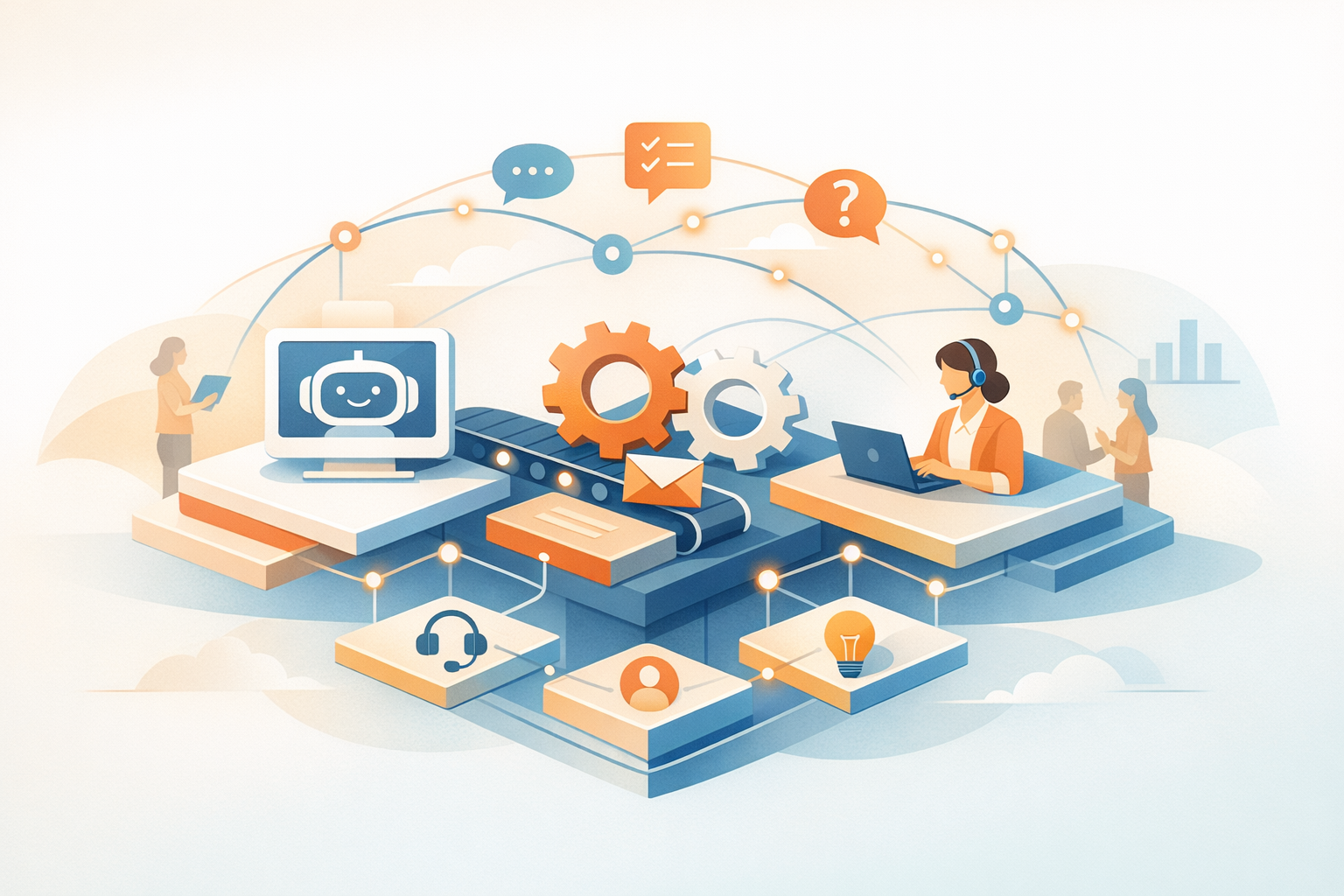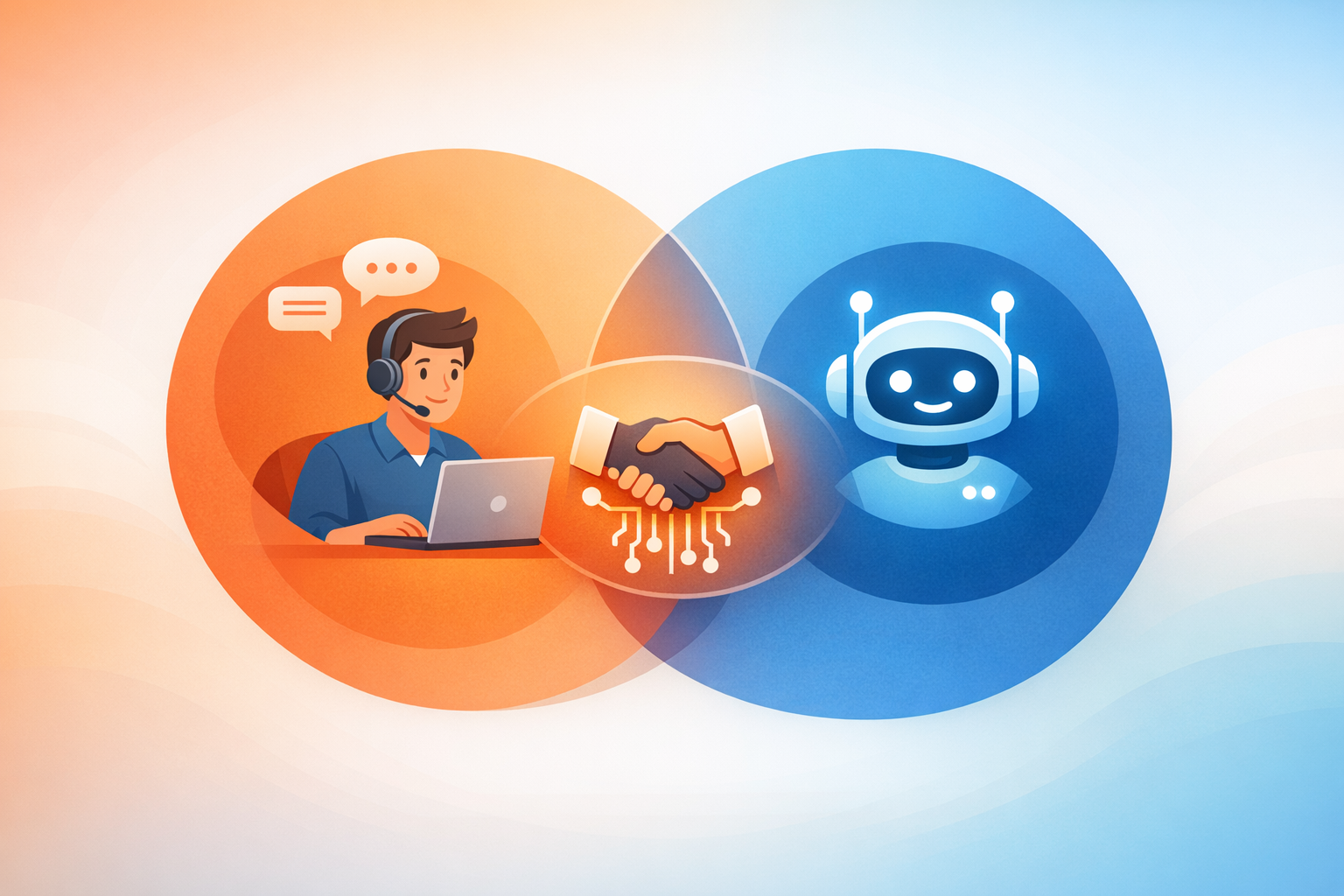

AI-powered ticket assignment systems simplify customer support by automating how tickets are categorized, prioritized, and routed. They use natural language processing (NLP) to understand customer intent and sentiment, ensuring requests are assigned to the right agents quickly and efficiently. These systems process tickets from multiple channels - email, chat, social media - while saving time and reducing manual work.
Key Features at a Glance:
- Intent Detection: Understands the purpose of a ticket using NLP, reducing internal transfers.
- Priority Setting: Uses sentiment analysis to identify urgency and address critical issues faster.
- Smart Routing: Assigns tickets based on agent skills, workload, and availability.
- Automated Classification: Tags and organizes tickets instantly, saving 30–60 seconds per ticket.
- Omnichannel Support: Integrates with platforms like Instagram, WhatsApp, and email for consistent communication.
Businesses using AI-powered systems report faster resolutions, improved customer satisfaction, and the ability to handle more tickets without adding staff. This technology is transforming customer support by making it faster, more accurate, and scalable.
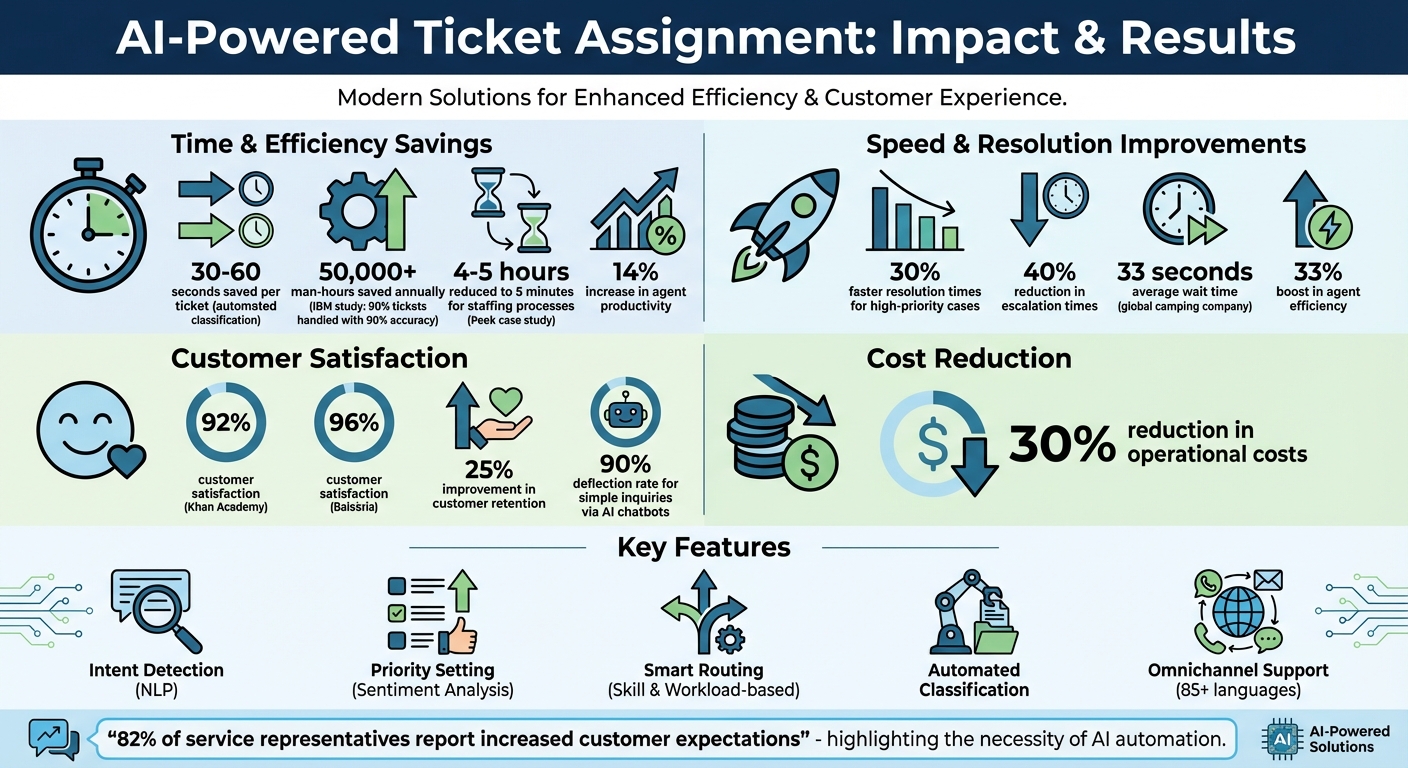
AI-Powered Ticket Assignment: Key Benefits and Performance Metrics
How to Automate Customer Support Ticket Categorization using AI
Core Features of AI Ticket Assignment Systems
AI ticket assignment systems streamline how support teams manage incoming requests by combining three key capabilities: intent detection, priority setting, and load balancing. These features work together to ensure that every ticket is routed to the right agent as quickly as possible. Let’s break down how each one contributes to the process.
Intent Detection with Natural Language Processing
Natural language processing (NLP) enables AI to grasp the true purpose behind a customer’s message, going beyond simple keyword matching. By understanding the intent of an inquiry, these systems ensure tickets are routed to the correct department or specialist on the first try, cutting down on unnecessary internal transfers. This capability is especially powerful for handling large volumes of tickets in real time.
NLP doesn’t just stop at intent recognition. It also extracts structured data like order numbers or product IDs, providing agents with the context they need to address issues more efficiently. To maintain accuracy, the system assigns confidence scores to its predictions. If the AI isn’t confident about a ticket’s intent, it flags it for human review. For example, Khan Academy implemented AI-driven triage to categorize and assign tickets based on intent, achieving an impressive 92% customer satisfaction score [5]. By automating this process, teams save 30 to 60 seconds per ticket, eliminating the need for manual review [2].
Once the system identifies the intent, it moves on to assess the emotional tone of the ticket to determine its urgency.
Priority Setting with Sentiment Analysis
AI uses sentiment analysis to evaluate the emotional tone of customer messages, assigning urgency scores based on detected feelings like frustration, anger, or delight. This allows the system to uncover "hidden" urgency in messages that might not explicitly use words like “urgent” or “immediate.” By identifying these subtleties, teams can address potential issues before they escalate into major problems or public complaints.
The benefits of prioritization are clear. Companies using AI-powered sentiment analysis report 30% faster resolution times for high-priority cases [9]. Additionally, real-time sentiment monitoring can reduce escalation times by 40%, improve customer retention by 25%, and cut operational costs by 30% [10]. Baleària, a maritime transportation company, successfully combined intent detection and sentiment analysis to automate responses for common inquiries, achieving a 96% customer satisfaction score [5].
Load Balancing and Smart Routing
Once intent and urgency are identified, AI systems use this information to distribute tickets among agents in a way that maximizes efficiency. Tickets are assigned based on factors like agent workload, expertise, and real-time availability. By analyzing ticket content and metadata - such as order details, customer history, and purchase information - the system ensures agents are fully prepared to handle each case [4][7].
AI routing employs several strategies to optimize assignments:
- Skill-based routing matches tickets to agents with the specific expertise required, such as technical knowledge or language proficiency.
- Workload-based routing ensures tickets are evenly distributed, preventing agent burnout.
- Predictive routing uses historical data and machine learning to anticipate ticket urgency and send it to the best-suited agent [11][12].
For instance, a global camping company reported a 33% boost in agent efficiency and reduced average wait times to just 33 seconds after implementing AI-driven routing [12]. Overall, these systems enhance agent productivity by 14% [12].
Automated Classification and Tagging
AI systems have transformed how incoming requests are organized and labeled. By using natural language processing (NLP), these systems can analyze text and tag tickets based on intent, sentiment, product details, and language. This eliminates the need for agents to manually read and categorize each message. Instead, the system instantly identifies essential details - like product names, order numbers, or specific locations - and applies the proper labels [2][7].
This automated triage process saves 30 to 60 seconds of manual work per ticket [2]. For large-scale operations, the savings add up quickly. For instance, an IBM research study revealed that an automated email ticket assignment system handled at least 90% of incoming tickets with nearly 90% accuracy, saving over 50,000 man-hours annually [3].
The technology combines several AI capabilities to enhance efficiency. It detects the language of incoming messages to route them to the correct regional team, filters out spam, and enriches tickets with customer details, purchase history, and prior interactions [2][7][8]. Businesses can opt for prebuilt, industry-specific intent models for rapid implementation or train custom machine learning models using their historical data for even greater precision [2][8]. This level of classification creates a solid foundation for scalable and efficient support systems.
In August 2025, Peek, a travel and activity booking company, adopted automated ticket allocation through Zendesk Workforce Management. This upgrade reduced a manual staffing process that previously took four to five hours to just five minutes [1]. The system also learns and improves over time, as agents provide feedback on incorrectly tagged tickets. This feedback loop ensures continuous refinement of classification accuracy with every interaction [13][14].
Integration Capabilities for Scalable Support
After automating ticket classification, the next step is seamless integration to expand support operations. AI-driven ticket assignment systems pull inquiries from multiple sources like email, chat, social media, SMS, and voice using APIs and webhooks [7][15]. This integration processes messages from platforms such as Instagram, Facebook, and WhatsApp, intelligently routing them based on factors like intent, language, and sentiment detected during the initial analysis [2][5]. The result? A unified system that delivers consistent, omnichannel customer experiences.
Maintaining context across channels is another key benefit. Conversation history follows the customer, so they don’t have to repeat themselves. For example, if someone starts a query on Facebook and later follows up via email, the AI system ensures agents have the full background, saving time and reducing frustration [4].
Omnichannel Support for Consistent Service
ChatSpark ensures businesses deliver consistent, branded support across platforms like Instagram, Facebook, WhatsApp, Telegram, Slack, and their own websites. By integrating with these channels, companies can maintain a unified presence while managing inquiries in over 85 languages. The system automatically detects the language of each message and routes it to the appropriate team, ensuring customers get help in their preferred language - no manual effort required [2][7].
A great example of this in action is Baleària, a maritime transportation company. In 2025, they implemented a Zendesk-powered travel chatbot integrated across multiple channels to handle routine customer questions. This approach reduced unnecessary ticket creation and earned a 96% customer satisfaction score [5]. AI chatbots can also deflect up to 90% of simple, repetitive inquiries, solving problems before they even reach human agents [15].
Customizable and Scalable Options
Modern AI systems go beyond integration by offering flexible, scalable options. Many use low-code or no-code tools, making it easy to connect AI agents to existing workflows without requiring heavy DevOps involvement [7]. ChatSpark, for instance, allows businesses to customize integrations and scale from small operations to enterprise-level support.
Thanks to cloud-based infrastructure, these systems can handle sudden spikes in demand without the need to hire temporary staff. Research shows that top-performing customer service teams are three times more likely to rely on AI and automation compared to underperforming teams, proving that scalable integration is critical for staying competitive [15].
Conclusion
AI-driven ticket assignment is revolutionizing customer support by taking care of repetitive tasks like identifying intent, setting priorities, and routing requests across multiple channels. These tools ensure that tickets are directed to the right agents quickly, all while preserving the full context of each conversation.
The efficiency improvements are undeniable, showcasing how AI is reshaping the way support teams operate. Platforms like ChatSpark are at the forefront of this shift. As customer demands continue to grow - 82% of service representatives report facing increased expectations - automation has become a necessity to remain competitive [6].
ChatSpark stands out by offering round-the-clock automated support, seamless integration with platforms like Instagram, Facebook, WhatsApp, Telegram, Slack, and websites, and support for over 85 languages. It handles routine queries effortlessly while directing more complex issues to the appropriate agents, ensuring they have all the context needed to resolve them effectively.
FAQs
How does AI decide which tickets are most urgent?
AI leverages natural language processing (NLP) and machine learning to dig into ticket details and figure out how urgent they are. It picks up on crucial elements like intent, emotional tone (think frustration or anger), and key terms such as "outage" or "urgent." On top of that, it adds helpful metadata - like customer tier or service-level agreements (SLAs) - to give a clearer picture of the situation.
By blending this data with historical insights - like previous resolution times, financial impact, or account value - the AI generates a priority score for each ticket. High-priority issues are flagged automatically and sent to the right agents or escalation teams, making sure the most pressing problems are handled without delay.
ChatSpark uses this smart, AI-powered process to simplify ticket management, helping your support team save time and focus on the issues that truly need their attention.
What are the benefits of using AI-powered ticket assignment systems?
AI-powered ticket assignment systems simplify support operations by automating tasks such as routing, prioritizing, and identifying intent. Instead of relying on manual processes, incoming tickets are quickly categorized and directed to the appropriate team or workflow. This not only saves time but also speeds up responses and resolutions, leading to happier customers and fewer missed service-level agreements (SLAs).
Beyond efficiency, these systems help cut costs by taking care of routine tasks, freeing up agents to handle more complex and impactful issues. Over time, the AI becomes smarter, learning from past data to enhance routing accuracy and reduce mistakes. Additionally, built-in analytics offer valuable insights into ticket patterns and customer sentiment, helping businesses make better staffing choices and plan proactive improvements.
ChatSpark’s AI-powered ticket assignment platform takes things further with features like multilingual intent detection, real-time load balancing, and around-the-clock automated routing. These tools empower U.S. businesses to provide faster, more precise support while keeping expenses in check.
How do AI-powered systems manage communication across multiple channels?
AI-powered ticket assignment systems act as a central hub, bringing together messages from multiple communication channels like email, website chat widgets, social media messengers, and collaboration tools. They achieve this through pre-built connectors or API integrations, seamlessly pulling in messages from platforms such as WhatsApp, Instagram, Facebook, Telegram, Slack, and others.
When a message comes in, the AI gets to work, using natural language understanding to figure out the intent, sentiment, and urgency. Based on this analysis, it creates or updates a ticket and assigns it to the best-suited agent or workflow. By standardizing input from all channels, these systems ensure consistent service, quicker response times, and balanced workloads, making sure no customer interaction slips through the cracks.
Take ChatSpark, for example. This platform consolidates all communication channels into one streamlined, AI-driven workflow. The result? Businesses can provide consistent, high-quality support while keeping a comprehensive view of customer interactions across every platform.