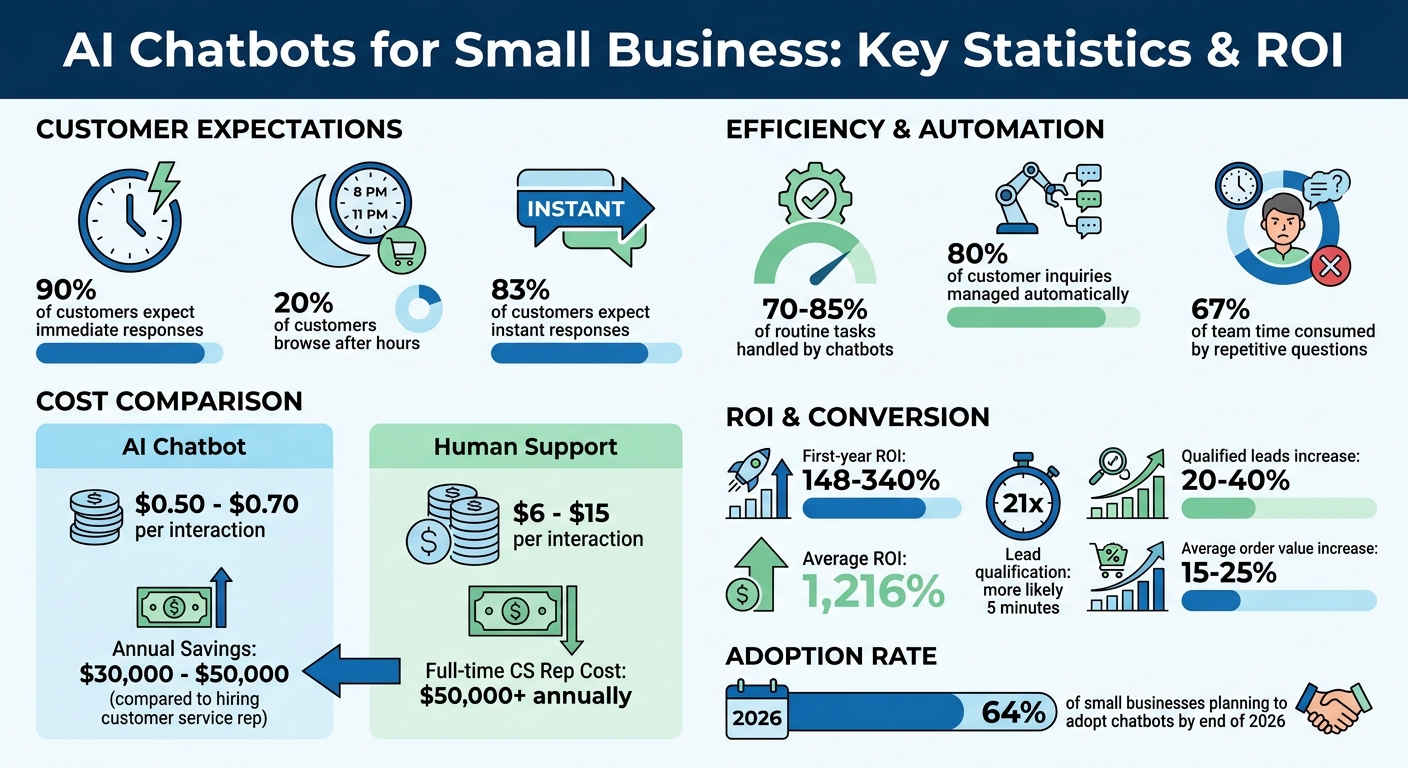
AI chatbots are now a must for small businesses in 2026. They provide 24/7 customer support, reduce costs, and help capture leads faster. With 90% of customers expecting immediate responses, chatbots fill the gap for small teams that can’t always be available. Businesses using AI report savings of over $70,000 annually and an ROI of 1,216%. Chatbots handle 70–85% of routine tasks, freeing up time for business owners to focus on growth.
Key benefits include:
- 24/7 support: Engage customers even after hours.
- Cost savings: Handle inquiries at $0.50–$0.70 per interaction compared to $6–$15 for human support.
- Lead generation: Respond to leads within minutes, increasing conversion rates by 20–40%.
- Customer insights: Gather structured data to refine strategies and improve satisfaction.
Chatbot solutions like ChatSpark make implementation simple, offering multilingual support, CRM integration, and automation for tasks like booking appointments and processing payments. Starting at just $19/month, ChatSpark offers small businesses an affordable way to improve efficiency and customer service while saving thousands annually.
AI Chatbot ROI and Cost Savings for Small Businesses
Benefits of AI Chatbots for Small Businesses
24/7 Customer Support
AI chatbots give small businesses the ability to offer round-the-clock customer support, eliminating the restrictions of traditional business hours. This is especially helpful during the evening hours - between 8 PM and 11 PM - when many potential customers browse online, even though the business itself may be closed[4]. Using advanced techniques like Retrieval-Augmented Generation (RAG), modern chatbots can pull accurate answers from your website, PDFs, or FAQs, avoiding the generic responses that frustrate users[4]. Whether it’s checking an order status, booking an appointment, or finding product details, customers can get the help they need, even when your team is unavailable. With nearly 20% of customers browsing after hours, having an AI chatbot ensures they don’t leave without answers.
Lower Costs and Better Efficiency
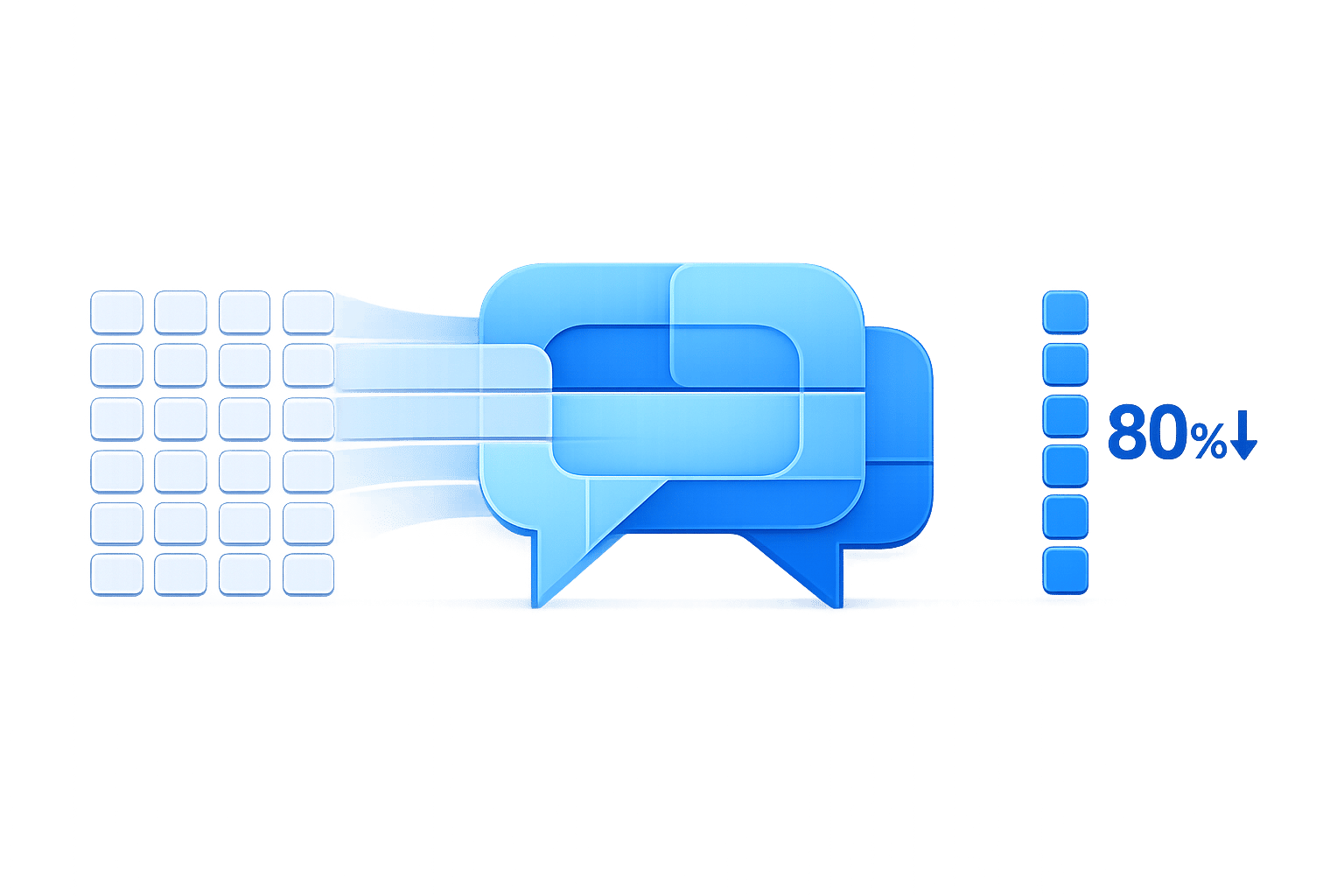
AI chatbots aren’t just about being available - they’re also about saving money. By managing up to 80% of routine customer inquiries[5], these bots free up your team to tackle more complicated issues. On top of that, they’re cost-effective. While a chatbot interaction costs between $0.50 and $0.70, human support can range from $6 to $15 per interaction. And the financial payoff is significant, with businesses seeing a first-year ROI of 148–340%[2][4].
Lead Capture and Sales Conversion
AI chatbots don’t just assist customers - they actively help grow your business. They work around the clock to turn website visitors into qualified leads by gathering essential details like names, emails, and specific needs. Speed matters here: businesses that respond to leads within 5 minutes are 21 times more likely to qualify them compared to waiting 30 minutes[4]. Chatbots use conditional logic to filter prospects based on factors like budget and timeline, ensuring your sales team focuses on the most promising opportunities. This process can increase qualified leads by 20–40%[4]. Plus, chatbots guide users through the sales funnel, reducing the chances of drop-offs. Many systems even sync with calendars to schedule appointments in real time, keeping the sales process smooth and efficient.
Analytics and Customer Insights
Every interaction with an AI chatbot generates valuable data. This structured information helps identify customer needs and pinpoint areas of confusion on your website. Not only does this reduce support volume, but it also provides critical first-party data - a growing advantage as third-party cookies become less common[3]. Advanced chatbot systems can even enhance lead profiles by integrating external data before sending it to your CRM, giving you a fuller picture of each prospect. For small businesses, aiming for a resolution rate of 60–70% is a good target; if your bot resolves less than 50% of inquiries, it might need better training data[2]. These insights allow businesses to fine-tune their strategies, improving both customer satisfaction and revenue growth.
Use Cases for AI Chatbots in Small Businesses
Answering Common Customer Questions
For small business teams, repetitive questions can consume a staggering 67% of their time [7]. AI chatbots step in to tackle this challenge by managing routine inquiries like pricing, operating hours, service locations, and company policies - all without needing human input. These bots pull accurate answers straight from your knowledge base, cutting down on support tickets [6] and allowing your team to focus on more complex customer needs. A great starting point? Automate responses for your top 10–20 most frequently asked questions [1][7].
Managing Orders and Appointments
Chatbots are not just about fielding questions - they also simplify appointment scheduling and order management. For service-based businesses, lengthy scheduling calls can be a major time sink. AI chatbots integrate seamlessly with tools like Google Calendar and Calendly, offering real-time availability and enabling instant booking, even after hours. E-commerce businesses benefit too, with bots connecting to order systems to share tracking links, check inventory, and process returns. In healthcare, AI scheduling has led to an 87% drop in patient no-shows [1]. By automating these tasks, chatbots free up your staff to handle higher-priority responsibilities.
Gathering Customer Feedback
AI chatbots go beyond just answering questions - they’re great for collecting feedback, too. Unlike traditional email surveys that often go ignored, chatbots gather opinions in real time through quick, conversational prompts. They might ask why a customer abandoned their cart, whether a policy was helpful, or how satisfied they were with a recent purchase. AI then analyzes the tone and sentiment of these responses, categorizing feedback as positive, neutral, or negative while spotting recurring themes. This organized data highlights trends that manual reviews might miss, making feedback collection both faster and more actionable [8].
Engaging Customers Automatically
AI chatbots don’t just respond - they initiate. These bots can proactively engage customers at pivotal moments, like when they’re browsing key pages or have abandoned their carts. By offering assistance, suggesting upsells, or recommending products based on browsing history, chatbots can increase average order values by 15–25% [6]. They can also notify shoppers about back-in-stock items or follow up after a purchase to ensure satisfaction. For small businesses, this level of proactive engagement captures opportunities that might otherwise slip through the cracks, especially since 90% of customers expect immediate responses [1].
ChatSpark: An AI Chatbot Solution for Small Businesses
ChatSpark is stepping up to meet the growing demand for AI-powered customer service, offering a solution tailored specifically for small businesses.
Features and Capabilities
ChatSpark brings high-level automated customer service to small businesses at an affordable price. Setup is quick and effortless—follow a customer service automation checklist to get started with no coding required. Simply paste your website URL and upload your FAQs, PDFs, or text to train the AI in under five minutes[9].
It ensures seamless customer interaction across six major channels: your website, Instagram, Facebook Messenger, WhatsApp, Telegram, and Slack. This means your customers can connect with you wherever they prefer. What's more, ChatSpark supports over 95 languages automatically, making it easy to assist international customers without extra effort[9].
One standout feature is its AI Actions, which go beyond basic customer support. These actions can book appointments, process payments, and update CRM records. With 140+ native integrations across platforms like Calendly, HubSpot, Zendesk, Stripe, Square, and Google Calendar, plus access to over 5,000 apps via Zapier, ChatSpark becomes a true productivity tool. It can handle over 80% of customer inquiries on its own, helping small businesses save between $30,000 and $50,000 annually compared to hiring a dedicated customer service representative[9].
"ChatSpark has been managing two of our largest product lines over the past year. It currently handles an average of 1,831 chats per month without any human intervention. Since implementing it on our website, we've realized measurable savings of $119,225."
– Lorri G., Customer Service & Technical Support Manager[9]
ChatSpark also equips your team with its Internal CoPilot feature, which provides instant access to business data from all integrated platforms. For example, staff can check HubSpot deals or Stripe invoices directly within the chat interface. Additionally, you can customize the chatbot to reflect your brand by adjusting colors, adding your logo, and personalizing its tone and greeting messages[9].
These features not only improve customer service but also lead to substantial cost savings, as outlined in the pricing section below.
Pricing Plans
ChatSpark’s pricing is straightforward, based on message volume and training data rather than per-user fees. This keeps costs manageable as your business grows[10]. The Basic plan starts at just $19/month and includes a 14-day free trial. Opting for annual billing gives you a 14% discount, essentially providing two months free[10].
| Plan | Monthly Cost | Message Limit | Training Pages | Key Features |
|---|---|---|---|---|
| Basic | $19 | 100 | 25 | Basic analytics, multiple data sources, 1 AI agent |
| Plus | $59 | 250 | 50 | Advanced analytics, REST API, 5 AI Actions, CoPilot |
| Pro | $129 | 2,000 | 500 | Omnichannel support (e.g., WhatsApp, Slack), 40 AI Actions, integrations |
| Enterprise | Custom | Custom | Custom | Unlimited AI Actions, dedicated account manager, priority support |
Message limits reset on the first of every month, and you can stack multiple plans within a single account for flexibility[10]. To put things into perspective, hiring a full-time U.S. customer service representative costs over $50,000 annually for 8-hour daily coverage. ChatSpark, on the other hand, provides 24/7 support starting at just $19/month[9].
How to Implement AI Chatbots in Your Small Business
Define Your Business Needs
Start by tracking customer interactions for a week to uncover your top 10–20 recurring questions and repetitive tasks [1][2]. This step helps you pinpoint where automation can make the biggest difference.
Set clear goals from the beginning. For instance, you might aim to cut support tickets by 50%, generate 20+ new leads each month, or respond to common inquiries in under 10 seconds [12]. These specific targets let you measure whether your chatbot is delivering results.
Focus on tasks that are high in volume, low in risk, and have straightforward answers - like store hours or shipping details. You can rank tasks based on three factors: Volume (how frequently they occur), Risk (the consequences of a wrong answer), and Clarity (how clear the solution is) [11].
Plan for when the chatbot should transfer users to a human. Define "red flag" situations, such as handling high-value customers, financial issues, or when a user shows signs of frustration [11]. Quick handoffs in these scenarios can improve lead qualification [4].
These foundational steps will help you choose a chatbot platform that aligns with your business needs.
Choose the Right Chatbot Platform
For businesses with fewer than 50 daily inquiries and standard FAQ needs, off-the-shelf solutions are a good fit. If you're managing over 100 inquiries daily or need advanced integrations with tools like CRM or ERP systems, a custom-built chatbot might be better [2].
Look for platforms that offer features like Retrieval-Augmented Generation (RAG), which ensures responses are accurate and context-aware [4]. Before committing, verify that the chatbot integrates smoothly with your current tools - like Shopify, WordPress, HubSpot, or Zendesk - to avoid compatibility headaches [2][14].
Calculate the Total Cost of Ownership (TCO) over 18 months. This includes subscription fees, the time your team spends on workarounds, and any missed opportunities [2]. For perspective, chatbot interactions typically cost $0.50–$0.70 each, compared to $6–$15 for human support interactions [2]. When well-implemented, chatbots often deliver an ROI of 148–200% within the first year [2].
Choose a platform that directly addresses the high-priority tasks identified in your initial audit.
"The real question isn't which chatbot. It's what kind of chatbot your business actually needs." – Dmitri Bogatenkov & Sergei Bogatenkov, ForBroTeam [2]
Configure and Brand Your Chatbot
Once you've selected a platform, tailor the chatbot to fit your exact business processes.
Start small by automating one or two high-value workflows, like FAQs or lead qualification [12]. Gather all the necessary materials - shipping policies, pricing guides, return forms - and create a centralized knowledge base for your bot [11][4]. Update this information monthly using insights from real conversations [16].
Design a chat flow that feels natural and intuitive: Greet → Identify Intent → Provide Answer/Guide → Collect Details → Confirm Resolution → Escalate if needed [11]. Use features like buttons, quick replies, and menus to make navigation easy [15][17]. Keep messages concise and add short pauses to avoid overwhelming users with too much text at once [15][17].
Let users know upfront that they’re speaking with a chatbot. This transparency sets realistic expectations and builds trust [17]. Personalize the chatbot’s appearance to reflect your brand by tweaking colors, adding your logo, and adjusting the tone of messages. Test its functionality on mobile devices to ensure proper spacing and button sizes [16].
"Automate the predictable, assist with the complex, and escalate the emotional." – Curtis Nye, AffinityBots [11]
Examples of Small Businesses Using AI Chatbots
Real-life examples highlight how AI chatbots are reshaping operations and customer engagement for small businesses. These stories show how well-targeted AI solutions can improve efficiency, cut costs, and boost revenue.
Take EvryJewels, a family-owned Canadian jewelry brand, for instance. In February 2026, the company saw customer inquiries skyrocket from 18,000 to 150,000 in just one month. To tackle this overwhelming demand, Customer Service Director Alejandro Reyes introduced an AI chatbot. The results were impressive: the chatbot achieved an 89% automation rate, slashed the cost per ticket by 63% (from $5.50 to $2.00), and reduced response times from hours to under a minute.
"The AI agents handled a staggering number of inquiries, equivalent to the workload of nearly 50 human agents. Without them, we'd have faced days of backlog, frustrated customers, and lost sales." - Alejandro Reyes, Customer Service Director, EvryJewels [20]
This success story has inspired other businesses to consider similar AI-driven solutions.
Michelle Chen's Bakery is another great example. Michelle Chen, who was working 90-hour weeks and stuck at $8,000 in monthly revenue, adopted an AI chatbot to manage custom cake orders, answer allergy-related questions, and process payments. The results were transformative. In just three months, her monthly revenue surged to $97,000, and her order volume grew from 67 to 892. Automating 80% of her customer interactions allowed her to cut her workweek down to 45 hours, completely changing her work-life balance and business operations [21].
AI chatbots are also making waves in professional services. Thompson Legal Services, led by attorney Robert Thompson, used an AI chatbot to pre-qualify personal injury cases and gather documents around the clock. This change reduced his workweek from 70 hours to just 30 hours and boosted his monthly revenue from $15,000 to $112,000 [21].
Retail businesses are seeing similar benefits. Lincoln Davies Building Supply, a long-standing hardware store, implemented a chatbot on their website to handle FAQs and promote special offers. Owner Ed Jones reported a 25% drop in online support costs and a 111% increase in their customer loyalty list.
"This campaign has freed my staff to focus on potential client interest from a more educated customer. For a growing business, this is critical." - Ed Jones, Owner, Lincoln Davies Building Supply [18]
Even small, family-run shops are reaping rewards. Sweet Delights Bakery, for example, introduced an AI chatbot to offer 24/7 ordering and menu browsing. The results? A 200% increase in online orders and a 25% boost in average order value. After six months, their total sales had tripled compared to the previous year [19].
These examples underscore the potential of AI chatbots to revolutionize small businesses, whether it’s through improved customer service, streamlined operations, or increased revenue.
Conclusion
AI chatbots have become a must-have for small businesses navigating the competitive landscape of 2026. They provide round-the-clock availability, drastically reduce costs (from $6–$15 per interaction to just $0.50–$0.70), and ensure immediate lead capture - especially important when 83% of customers expect instant responses [4]. From answering FAQs to booking appointments and collecting feedback, chatbots take care of repetitive tasks, freeing you to focus on scaling your business.
The numbers speak for themselves. Small businesses see an average first-year ROI of 340% [4], while early adopters report a 128% higher ROI [13]. With 64% of small businesses planning to adopt chatbots by the end of 2026 [2], the competitive landscape is evolving quickly.
This is where ChatSpark becomes a game-changer. Starting at just $19 per month, ChatSpark allows you to deploy a fully functional chatbot in as little as five minutes by training it on your website content or FAQs [9]. It integrates seamlessly with platforms like WhatsApp, Instagram, and your website to automate key tasks [9][22]. With support for over 95 languages, ChatSpark expands your customer service capabilities without the hefty expense of hiring additional staff - which can exceed $50,000 annually.
To get started, identify your top 20 customer questions, test ChatSpark in real-world conditions, and aim for a resolution rate of 60–70% [2][4]. The gap between businesses leveraging AI and those that don’t is growing, with 70% of consumers noticing a clear difference in service quality [13]. The real question is: how soon can you implement AI chatbots?
Take the first step by pinpointing your customers’ most common inquiries and let ChatSpark revolutionize your support system - giving you the edge in today’s fast-paced market.
FAQs
What should my chatbot handle first?
Start by setting up your chatbot to tackle common customer questions, such as business hours, store location, or basic product information. These are the types of inquiries that pop up often and can be resolved quickly, offering customers the convenience of instant answers - even after hours. Once you've nailed down these essentials, you can broaden its capabilities to include tasks like capturing leads, scheduling appointments, or processing orders. This approach builds a strong, dependable system for engaging with your customers effectively.
How do I know if my chatbot is working well?
To gauge how well your chatbot is performing, focus on tracking a few key metrics:
- Engagement: Keep an eye on stats like sessions per user and the number of active users. These numbers can give you a sense of how often people interact with your chatbot.
- Efficiency: Metrics such as first response time and resolution rate are crucial. A quick response and high resolution rate suggest your chatbot is doing its job well.
- Business Impact: Look at conversion rates and how accurately your chatbot qualifies leads. These figures show how much it's contributing to your business goals.
By regularly reviewing these metrics, you can ensure your chatbot continues to align with the needs of your small business.
How can I keep my chatbot’s answers accurate?
To make sure your chatbot provides accurate answers, base its responses on reliable and current information from your website or knowledge base. Keep this content updated to match any changes in your business details. Connecting the chatbot to your content management system or FAQ database ensures consistent and dependable replies. Relying only on generic AI models without verified, tailored data can result in errors or misleading information.