Conversational AI refers to technology that enables machines to understand, process, and respond to human language naturally. It uses tools like natural language processing (NLP), large language models (LLMs), and workflow automation to facilitate seamless interactions. Unlike traditional chatbots, conversational AI can handle complex tasks such as booking appointments, processing payments, and answering nuanced customer queries - all without human intervention.
Why It Matters:
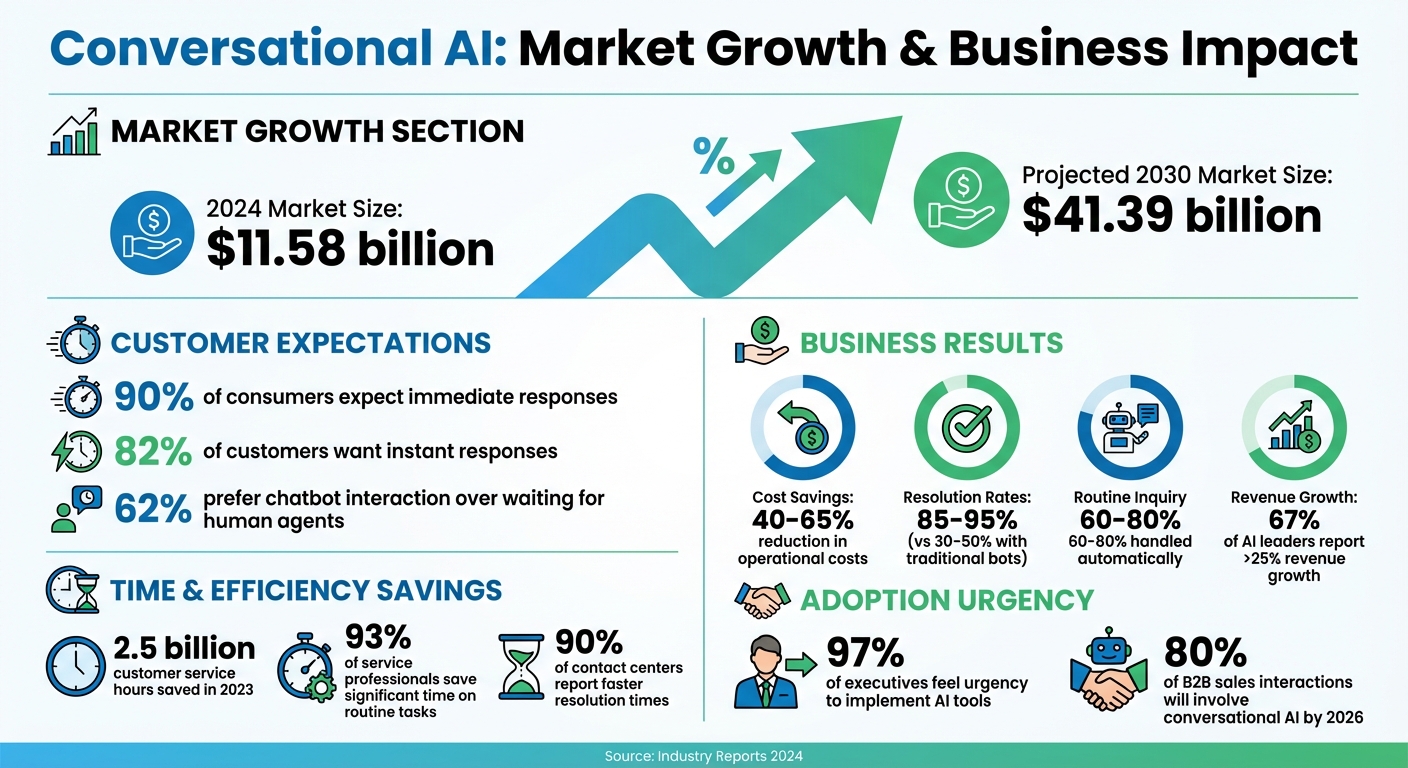
- The market is projected to grow from $11.58 billion in 2024 to $41.39 billion by 2030.
- 90% of consumers expect immediate responses, and conversational AI delivers this even during peak demand.
- Businesses using conversational AI have reported 40%–65% cost savings and increased efficiency.
Key Applications:
- Customer Support: Automates FAQs, resolves issues, and escalates complex cases when needed.
- Internal Communication: Simplifies HR queries, IT support, and admin tasks for employees.
- Sales: Qualifies leads, initiates real-time conversations, and improves conversion rates.
How It Works:
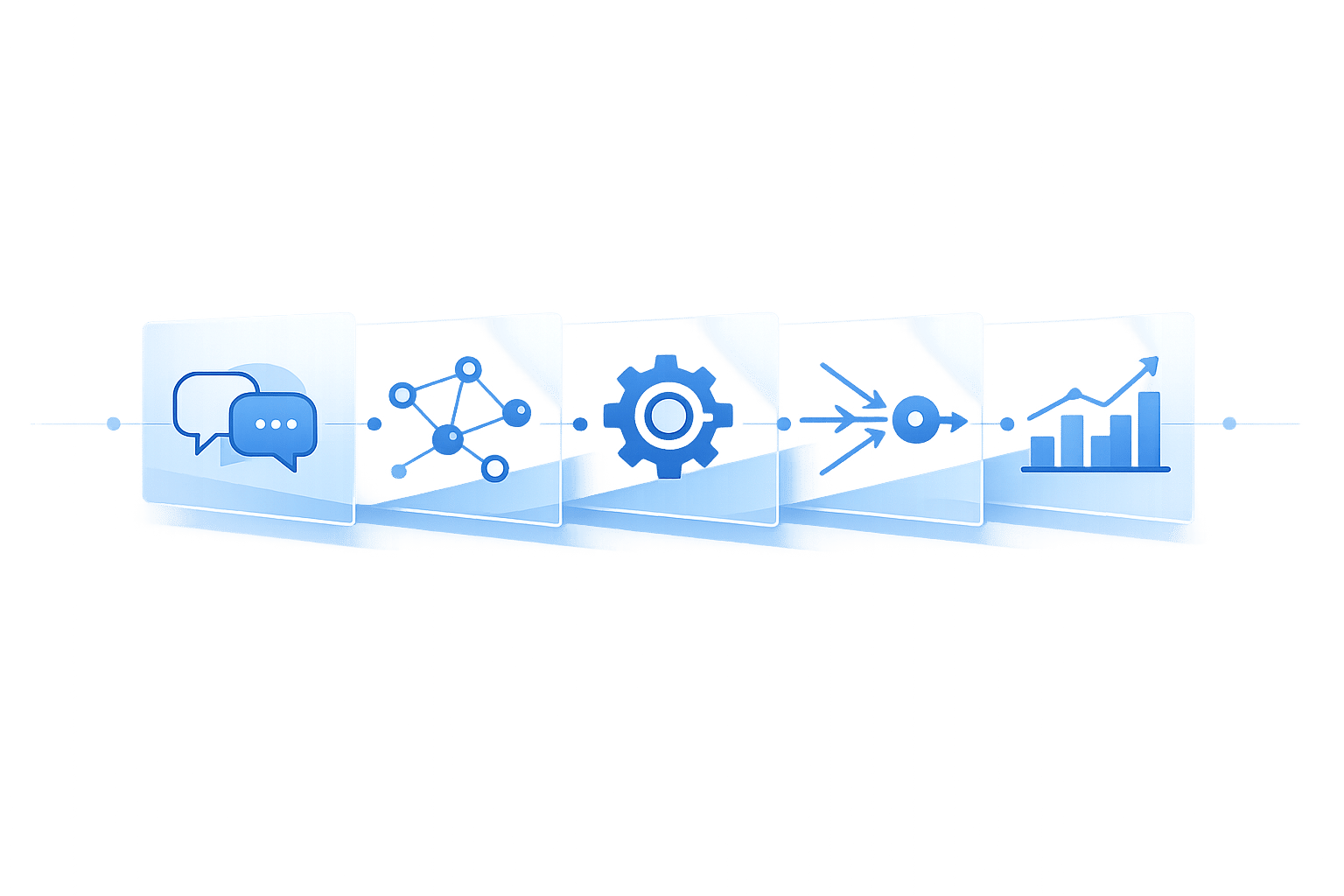
- Input Reception: Processes text or voice inputs.
- Intent Analysis: Understands user intent with NLP.
- Response Decision: Determines the best reply using dialogue management.
- Response Delivery: Generates and delivers human-like responses.
Example Success Stories:
- Bank of America’s AI assistant Erica supports over 42 million users with financial tasks.
- Delta Airlines uses AI to handle millions of customer queries across messaging platforms.
- MSU Federal Credit Union reduced internal support tickets by 42% with AI.
Why Businesses Are Adopting It:
- Automates routine tasks, saving time and resources.
- Enhances customer experiences with fast, accurate responses.
- Boosts revenue by engaging high-intent prospects in real time.
Next Steps: Identify repetitive tasks in your business, refine your knowledge base, and consider tools like ChatSpark to deploy conversational AI quickly and effectively.
Conversational AI Market Growth and Business Impact Statistics 2024-2030
How Conversational AI Works
Core Components of Conversational AI
Conversational AI operates through five key components, all working in harmony to create smooth, human-like interactions. At its heart lies Natural Language Processing (NLP), which translates human language into a format computers can understand. Within NLP, Natural Language Understanding (NLU) identifies the user's intent and extracts specific details like dates, names, or locations. Dialogue management ensures the system keeps track of the conversation's context, avoiding repetitive questions or responses. Then, Natural Language Generation (NLG) takes the system's decisions and turns them into natural-sounding replies. Finally, machine learning helps the AI learn from past interactions, improving its accuracy over time.
"Dialogue management is the equivalent of the conversation's brain. It uses this to maintain context and guide interactions toward successful outcomes." - DigitalOcean [2]
These components form the building blocks for a structured, efficient conversation process.
The 4-Step Process Behind Conversational AI
Every interaction with conversational AI follows a four-step process:
- Input reception: The system receives the user’s input as text or voice. For voice inputs, Automatic Speech Recognition (ASR) converts spoken words into text.
- Intent analysis: NLU examines the text to understand the user’s intent and extract important details.
- Response decision: Dialogue management references the system's knowledge base and conversation history to determine the best response.
- Response delivery: NLG generates a reply, which can be delivered as text or synthesized speech.
This workflow is lightning-fast, typically completing in less than a second. That speed aligns with the expectations of 90% of consumers who want immediate answers to their questions [1]. To ensure accuracy, modern systems often use grounding - basing responses on verified company data - to minimize errors and maintain reliability.
Technologies That Power Conversational AI
A range of advanced technologies drives conversational AI. Deep learning uses neural networks to process data at high speed, while sentiment analysis detects the emotional tone of a user’s input, allowing the AI to adjust its responses or escalate issues when necessary. Orchestration layers link the AI to business systems like CRMs and ERPs, enabling it to perform tasks such as processing refunds or updating account details.
Many platforms now incorporate Large Language Models (LLMs) for more advanced reasoning capabilities. These are often paired with structured workflows to ensure the AI adheres to specific business rules. Some systems also utilize Small Language Models (SLMs), like Llama 8B, to reduce response times and operating costs while maintaining strong performance.
In 2023, businesses saved an estimated 2.5 billion customer service hours by using these technologies. Nearly 90% of contact centers reported faster resolution times after adopting conversational AI, showcasing how these tools streamline operations and improve customer experiences [3]. Together, these systems allow businesses to automate tasks while delivering efficient and engaging interactions.
Business Applications of Conversational AI
Conversational AI has become a game-changer for businesses, driving efficiency in customer support, internal communications, and sales. By leveraging its advanced capabilities, companies can streamline operations and improve both customer and employee experiences.
Customer Support Automation with Conversational AI
Conversational AI is transforming customer support by providing instant, round-the-clock assistance. It can handle everything from simple FAQs to more intricate issues, freeing up human agents to focus on complex cases that require a personal touch.
Take Golftini, for example. In January 2026, this apparel company used conversational AI to cut manual ticket triage by 80%, leading to a 60% improvement in first-response times - all without adding to their support team [5]. Similarly, in 2025, Curology, a skincare brand, slashed customer support costs by 65% by adopting Decagon's conversational AI platform, which resolved customer issues autonomously [6].
A survey found that 93% of service professionals save significant time on routine tasks, enabling them to focus on high-value activities [4]. Modern AI systems integrate seamlessly with CRMs and knowledge bases, pulling up-to-date information to answer queries about orders, returns, or product details. When an issue requires human involvement, the AI passes it along with full context, sparing customers from repeating themselves.
But conversational AI isn’t limited to customer interactions - it’s also making a big impact on internal business operations.
Internal Business Communication
Conversational AI is simplifying internal workflows by automating tasks like HR inquiries, IT support, and administrative processes. Employees can ask natural language questions such as, "How much PTO do I have?" or "How do I reset my password?" and get instant, accurate responses without waiting for a ticket to be resolved.
For instance, in March 2026, MSU Federal Credit Union saw its virtual assistant grow from handling 2,000 to 15,000 monthly interactions [7]. By integrating a Microsoft-native AI assistant into Microsoft Teams, the credit union reduced the time spent searching for policy details by 85% and cut internal support tickets by 42%. Impressively, 93% of responses were rated as accurate by staff [7].
The benefits extend across the employee lifecycle. Unilever implemented "Una", a multilingual AI chatbot accessible via Skype for Business, to manage HR tasks in 32 languages [7]. From onboarding and benefits inquiries to expense reporting and meeting scheduling, Una streamlined processes that typically consume administrative time. Employees using the chatbot completed tasks 12.2% more often, 25.1% faster, and with 40% better accuracy than non-users [7].
While internal efficiency is a clear advantage, conversational AI also plays a pivotal role in boosting revenue through sales and lead generation.
Sales and Lead Generation
Conversational AI is reshaping sales by engaging prospects in real time, qualifying leads automatically, and directing high-intent buyers to human representatives while they’re still actively browsing. Unlike static forms that passively wait for input, AI actively initiates conversations when it detects interest, such as when a visitor lingers on pricing pages.
Advanced AI systems analyze behavioral cues - like scrolling depth or mouse movements - to assign lead scores on a 0–100 scale. When a prospect meets a predefined threshold, the system triggers alerts for immediate follow-up. For example, Pipedrive used its LeadBooster Chatbot to collect contact details from over 1,000 new leads. According to Account Manager Fabiana Barbosa, 30% of these leads converted into paying customers after a free trial, thanks to the chatbot’s ability to record visitor details directly into the CRM for quick action [9].
Companies leveraging conversational AI report 2.5x faster deal cycles and 15–20% revenue growth [8]. By 2026, it’s projected that 80% of B2B sales interactions will involve conversational AI [8]. These systems can handle up to 70% of the initial qualification process - addressing questions about budget, authority, and timelines - so sales teams can focus on closing deals with highly qualified prospects. Plus, the AI ensures no lead is lost during peak traffic or after hours, maximizing every opportunity [8][10].
ChatSpark Features and Benefits
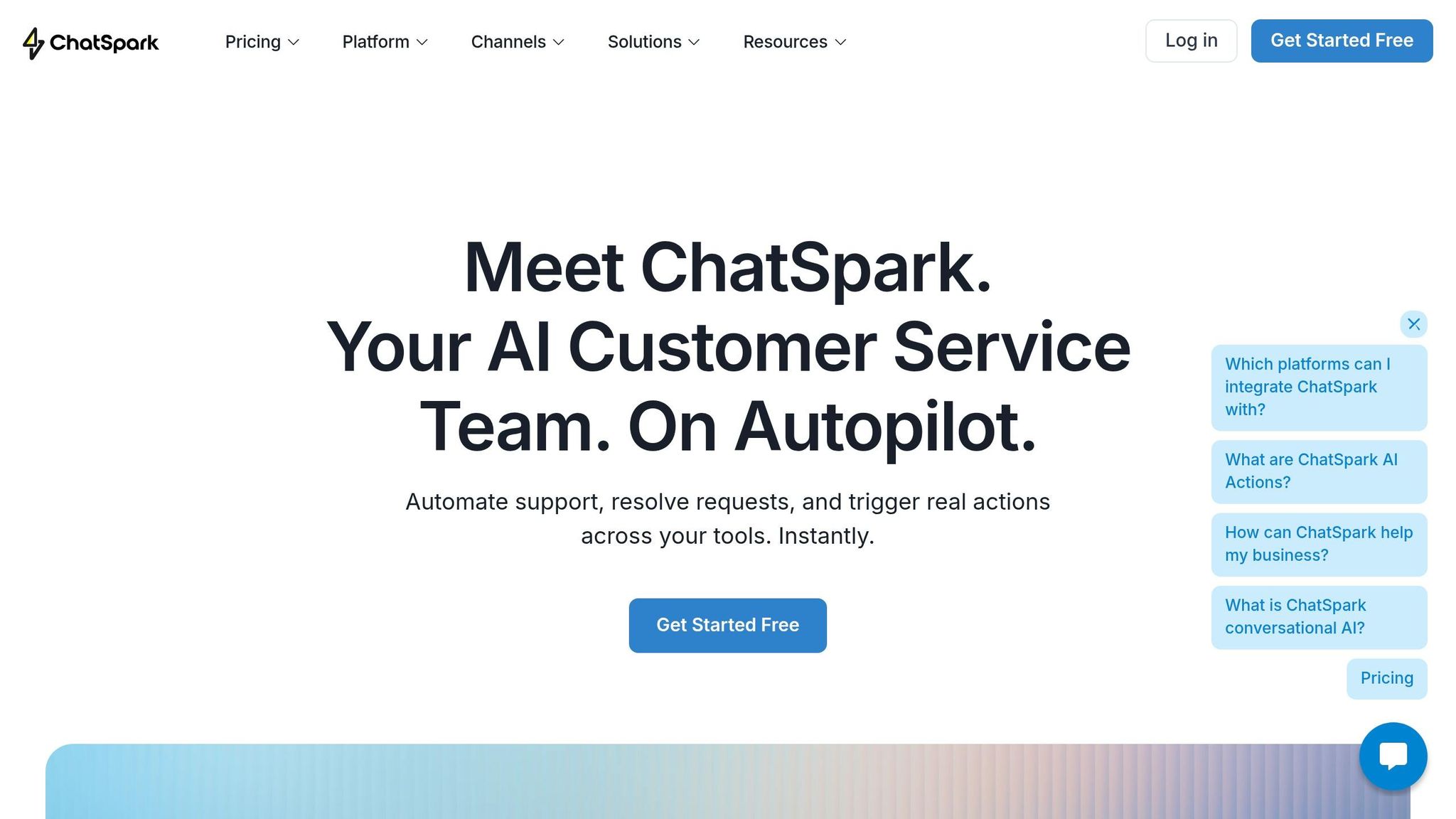
ChatSpark simplifies customer interactions by automating AI-powered customer service on a large scale. It delivers responses in under 2 seconds and resolves over 80% of customer inquiries automatically [12][16]. This efficiency allows teams to dedicate their time to more complex, high-priority issues that need human attention.
Core Features of ChatSpark
ChatSpark supports AI-driven communication across six major channels: Website, WhatsApp, Instagram, Facebook Messenger, Telegram, and Slack. Customers can reach out using their preferred platforms, making interactions seamless [12][16]. The platform employs Retrieval-Augmented Generation (RAG) to ensure every response is grounded in your business-specific data - whether that's URLs, PDFs, or other document formats. This method minimizes errors and ensures responses align with your policies and product details [13][15].
With support for 95+ languages and automatic detection, businesses can train the AI in English and effortlessly serve a global audience without extra configuration [11][12]. The platform also includes 140+ pre-built AI Actions for tasks like checking order statuses, booking appointments, and updating CRM records [12][14].
Customizability is another standout feature. Businesses can personalize the agent's name, avatar, and tone to match their brand identity [15]. For internal teams, the ChatSpark CoPilot browser extension integrates AI into tools like Gmail, Salesforce, and Zendesk, helping employees surface information and draft responses. This feature alone can save up to 2 hours per employee daily [12][15].
These features create a strong foundation for improving efficiency and delivering measurable results.
Business Benefits of ChatSpark
Between August and December 2025, a global leader in construction products implemented ChatSpark on a flagship brand website. Over just four months, the platform managed 10,754 messages, captured 153 new leads, saved 66 agent workdays, and generated $47,880 in cost savings from a $4,000 investment - a 1,097% ROI [17][18].
"ChatSpark has been managing two of our largest product lines over the past year. It currently handles an average of 1,831 chats per month without any human intervention. Since implementing it on our website, we've realized measurable savings of $119,225." - Lorri G., Customer Service & Technical Support Manager [12][17]
The platform also excels at lead capture. By gathering contact details through natural conversations, it can sync this data directly to CRMs or export it for later use [15]. On G2, users frequently highlight ChatSpark's ability to handle first-level questions, its straightforward training process, and its role in reducing operational costs [12]. One enterprise even reported a 20-point boost in customer satisfaction scores after adopting the platform [12].
ChatSpark Integration Capabilities
ChatSpark integrates effortlessly with existing systems, boosting operational efficiency across the board. By connecting to over 40 platforms, including e-commerce systems, CRMs, and support tools, it ensures businesses can fully leverage its capabilities [12][14]. Most integrations require just API credentials or a simple code snippet, making setup quick and easy [12][14].
For more advanced workflows, ChatSpark's Zapier connectivity unlocks access to 5,000+ apps, enabling tasks like automated lead routing, ticket creation, and email marketing [19][20]. When a situation requires human intervention, the platform integrates with tools like Freshchat, Intercom, and HappyFox Chat for smooth handoffs [19][14]. Additionally, businesses can link ChatSpark to Google Analytics 4 to track bot interactions, clicks, and lead generation alongside other website metrics [15].
| Category | Supported Platforms | Key Actions |
|---|---|---|
| E-commerce | Shopify, WooCommerce, BigCommerce | Order status, tracking, inventory, product info |
| Support/Helpdesk | Zendesk, Freshdesk, HappyFox | Create tickets, check status, search knowledge base, live handoff |
| CRM | Salesforce, HubSpot, Follow Up Boss | Create/update contacts, leads, and deals |
| Booking | Calendly, Google Calendar, Square | Schedule meetings, check availability, book appointments |
| Payments | Stripe, PayPal | Check payment status, invoices, process refunds |
How to Implement Conversational AI
Identifying Business Needs and Goals
Start by analyzing recent support interactions - review support tickets, chat logs, and call transcripts from the past 30–60 days. This will help you identify repetitive, high-volume queries like order tracking, appointment scheduling, password resets, and FAQs as prime candidates for automation [22][1][2].
Next, outline measurable goals to address these needs. For instance, you might aim to reduce wait times, improve first-contact resolution rates, or handle demand spikes more effectively [21]. To track progress, document key metrics like current support costs per conversation, response times, and CSAT scores. This baseline will make it easier to demonstrate ROI later on [25].
Also, evaluate where your current service model is falling short. Are response times too slow? Is 24/7 support unavailable? Do you struggle to scale during peak seasons? These gaps should guide your priorities. Given that 82% of customers expect immediate responses [22], improving speed and availability often yields the biggest impact.
Deployment Best Practices
Once your goals are clear, align your deployment strategy accordingly. Begin by auditing and refining your FAQs, manuals, and policies. Conversational AI relies heavily on accurate knowledge bases, so ensure the content is well-organized and up-to-date [22].
Design conversational flows with clear outcomes in mind. Include fallback responses for misunderstood inputs and recovery paths for low-confidence scenarios [21]. Use real historical data, such as actual call transcripts and chat logs, to train the system. This ensures the AI can recognize natural language variations and respond appropriately [21].
Integrate your AI with essential systems like your CRM, ticketing software, and backend databases via APIs. This allows the AI to perform actions - such as processing refunds, updating addresses, or checking order statuses - rather than just answering questions [21][6]. For complex or emotionally sensitive issues, create seamless escalation paths that transfer the full conversation history to a human agent [22][6].
Start small with a phased rollout. Test initial use cases, then gradually expand to include more channels, languages, or features once the system demonstrates stable performance [21]. Involve non-technical testers to identify confusing prompts or rigid logic that internal teams might miss. A gradual rollout (e.g., 10% → 50% → 100% of traffic) allows you to review daily transcripts and fine-tune the AI before full deployment [22].
| Implementation Phase | Key Activities | Timeline |
|---|---|---|
| Phase 1: Strategy | Define use cases, set KPIs, develop user personas | Weeks 1-3 |
| Phase 2: Knowledge Prep | Audit content, reformat for AI, generate embeddings | Weeks 4-6 |
| Phase 3: Development | Select LLM, integrate APIs, design escalation logic | Weeks 7-10 |
| Phase 4: Testing | Conduct internal tests, release beta, optimize prompts | Weeks 11-12 |
| Phase 5: Launch | Roll out gradually (10% → 50% → 100%), review transcripts | Weeks 13-16 |
Measuring ROI and Success Metrics
After deployment, measure the AI's impact across four key areas: Direct Revenue (sales), Cost Savings (efficiency), Indirect Revenue (leads and upsells), and Customer Lifetime Value [23]. Traditional ROI calculations often overlook the broader benefits, capturing only 15–25% of the total value [23].
To calculate costs accurately, include taxes, benefits, and overhead for human agents. For example, a $60,000/year agent costs about $0.52 per minute [24]. Compare this to AI-handled conversations, which typically cost $0.50–$2.00, versus $8.00–$12.00 for human-led live chat [23].
Monitor performance metrics like intent recognition (should exceed 85%) and containment rates (target above 70%) [26]. Keep fallback rates - instances where the AI fails to understand - below 15% to minimize user frustration. Use thumbs up/down ratings at the end of interactions to gather feedback, and follow up on negative ratings with specific questions to identify areas for improvement [26].
"Most chatbot ROI calculations only count deflected tickets. They treat the AI as a cost center that saves money on support staff. But modern conversational AI does far more than answer FAQs." - Mosharof Sabu, Neuwark [23]
Adopt a structured measurement approach. Track automation rates weekly for the first three months, then shift focus to long-term efficiency and strategic value after month four [25]. Companies with formal measurement frameworks report 40–60% higher returns compared to those relying on intuition [25].
Conclusion
Key Takeaways
Conversational AI is transforming customer service. It now resolves 60–80% of routine inquiries and achieves 85–95% resolution rates, compared to the 30–50% seen with traditional bots. On top of that, it can cut operational costs by 40–65% - some businesses have slashed their annual support expenses from $8.2 million to $3.4 million [1][22].
Customer expectations are evolving, too. 82% of customers want instant responses, and 62% would rather interact with a chatbot than wait for a human [22][27]. Companies embracing AI are seeing the benefits: 67% of AI leaders report revenue growth exceeding 25% [5]. With the global conversational AI market expected to hit $41.39 billion by 2030 [1] and 97% of executives feeling the urgency to implement AI tools [4], early adopters are gaining a clear edge.
ChatSpark offers a simple way to tap into these advantages. The platform manages customer inquiries, generates leads, and provides useful analytics across channels like websites, Instagram, Facebook, WhatsApp, Telegram, and Slack. It supports over 85 languages, integrates with tools like Zapier and Freshchat, and offers pricing plans starting at $19/month for solo entrepreneurs, with custom options for enterprises. Most businesses see a full ROI within 3 to 6 months [1][22].
Ready to take advantage of conversational AI? Here’s how to get started.
Next Steps for Your Business
Start by identifying areas where conversational AI can make the biggest impact. High-volume, repetitive tasks - like order tracking, password resets, appointment scheduling, and FAQs - are ideal for automation. A well-organized knowledge base is also key, as clear documentation improves AI performance [22].
ChatSpark’s phased rollout makes adoption easy. Begin with one channel and expand as you see results. Track metrics like automation rates and customer satisfaction to measure success. With ChatSpark, you can have a conversational AI agent up and running in just a few days.
FAQs
What’s the difference between conversational AI and a chatbot?
The main distinction lies in their sophistication and functionality. Chatbots operate using predefined scripts and rule-based systems, making them suitable for straightforward tasks like responding to FAQs. Conversational AI, however, leverages advanced tools such as natural language processing (NLP) and machine learning (ML). This allows it to grasp context, identify intent, and deliver personalized, human-like interactions - perfect for managing intricate workflows and enterprise-level applications.
What should I automate first with conversational AI?
Automate tasks that offer quick wins, such as managing repetitive inquiries. These typically include FAQs, order status updates, appointment scheduling, and account management - tasks that often account for 60-80% of support interactions. By automating these, businesses can reduce costs by 30-60%, speed up response times, and allow human agents to concentrate on more complex challenges. This approach lays a solid groundwork for expanding automation efforts later.
How do I measure conversational AI ROI?
To figure out the return on investment (ROI) for conversational AI, focus on a few critical metrics: cost savings, revenue growth, and efficiency gains. Start by assessing how much you've reduced costs in areas like customer support. Then, look at how well the AI contributes to lead conversion rates and boosts customer satisfaction. Don’t forget to track operational metrics like call deflection rates and average resolution times.
Once you’ve gathered this data, calculate ROI by comparing the total value created (combining savings and revenue impact) to the cost of implementing the AI system. Some reports suggest that businesses can see as much as an $8 return for every dollar invested in conversational AI.