A high fallback rate usually means your bot is missing intents, missing answers, or sending people into a bad handoff path. If your fallback rate is under 5%, your bot is likely in good shape. If it climbs above 20%, you likely have a support problem that customers can feel.
Here’s the short version:
- Fallback rate = fallback messages ÷ total user messages × 100
- It works best at the message level, not just the chat level
- It helps you spot failure points that containment rate and CSAT can miss
- Most fallback problems come from intent gaps, knowledge gaps, or weak escalation flows
- To fix it, I’d review transcripts, group failed requests by cause, and track results after each change
A fallback reply is more than a bot error. It’s often an early sign of friction, repeat contacts, more agent handoffs, and lower trust. The main job is simple: cut avoidable fallbacks without letting the bot give wrong answers.
That means I’d focus on three areas:
- Intent handling: train on the words customers use
- Content coverage: fill missing or stale help content
- Recovery flow: ask clarifying questions, then hand off with context if needed
If I saw one blended fallback rate like 12%, I wouldn’t stop there. I’d break it down by intent, topic, channel, and customer group to find where the issue sits. Then I’d compare fallback rate with resolution rate, escalation rate, abandonment rate, FCR, and CSAT to see how much damage it’s causing.
The bottom line: fallback rate tells you where your chatbot starts to fail, and why customers may be having a rough time before bigger support metrics drop.
What a high fallback rate reveals about support weaknesses
High fallback clusters show you where automation is breaking down. In most cases, the failure comes from one of three places: intent handling, knowledge coverage, or escalation flow. Each cluster points to a different kind of problem, so the next move is to figure out whether the issue sits in intent, content, or flow.
Unclear intent handling and ambiguous customer requests
Bots break when the way people talk doesn't line up with the training data. A customer might say, "Can I send this back?" or "Is it too late to get my money back?" and neither phrase may map cleanly to a return intent. Broader requests can be even messier. "I have an issue with my order" could mean shipping, damage, replacement, or billing. If everything gets pushed into a vague "order issue" intent, the bot may route the request the wrong way or fall back when confidence is low. To the customer, it feels like the bot just isn't listening.
A better fix is usually pretty simple:
- Add clarifying questions for intents that overlap
- Review top fallback utterances each week by theme, like billing, returns, account access, and shipping
- Train exact phrases such as "my card got hit twice" or "this package is taking forever" instead of assuming the bot will figure them out [2][1]
If the bot understands the request but still can't help, the issue is usually the content, not the intent.
Knowledge gaps and outdated support content
Sometimes the intent is right, but the bot still falls back because the answer, policy, or action isn't there. That often shows up in missing or thin articles for common topics like refund windows or account recovery. It also happens when a policy changed but the knowledge base didn't. If a customer asks about a refund and the bot pulls an old policy, it may give the wrong answer or send the customer to an agent instead [2][3][1]. The result is stale, partial, or flat-out wrong help.
One clear signal of a knowledge gap is when the same intent fires again and again but still ends in fallback or an agent handoff. In that case, routing is working. The content isn't [2][1].
If the path is right but fallback keeps happening, the answer library needs attention.
Weak fallback flows and broken escalation paths
The worst experience is the error loop: no clarifying question, no next step, no clear route to a person. The customer just hits a wall.
This gets even worse when "talk to a support specialist" is buried behind several clicks. People who can't find a way out keep rewording the same question and losing time. Then, when escalation finally happens, they have to explain the whole issue again to a live agent. That's a fast way to burn trust [3][4][1].
After a few low-confidence turns, the bot should offer clear options to narrow things down. If that still doesn't solve it, it should escalate and pass along the full conversation context. At that point, fallback stops being only a language issue. It's also a flow issue.
How to diagnose fallback problems using metrics and conversation data
AI Chatbot Fallback Rate: Key Metrics & What They Reveal
A single blended fallback percentage can be misleading. An overall fallback rate of 12% may seem fine at first glance. But once you break it down, you might find a 35% fallback rate for billing disputes on mobile chat. That’s where the actual issue is.
So instead of looking at fallback as one big number, break it out by intent, channel, topic, customer segment, and revenue impact. Once you see where fallback shows up, you can use metrics and transcripts to figure out why.
The support metrics that give fallback rate meaning
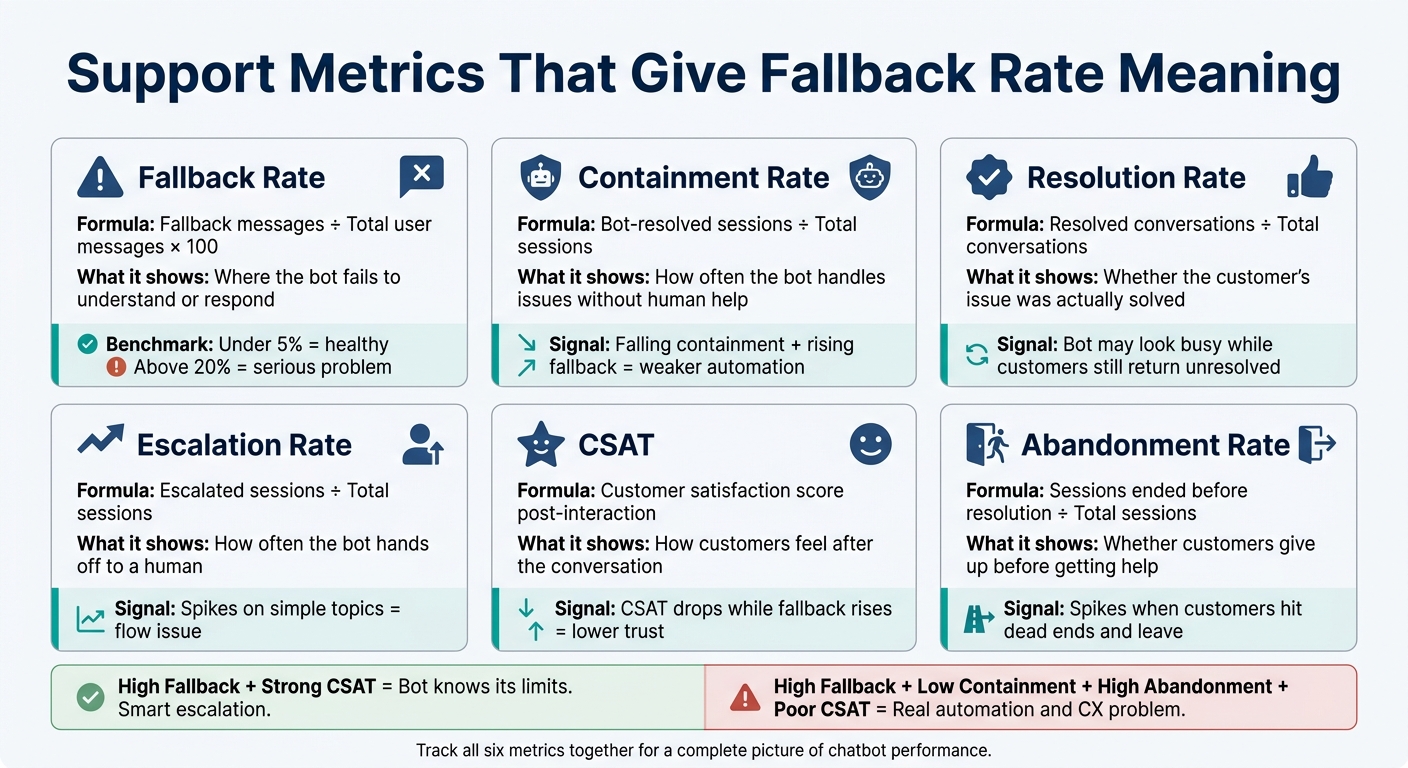
Fallback rate tells you something failed. The metrics below show how serious that failure is and where it hurts.
| Metric | Formula | What It Shows | Why It Matters |
|---|---|---|---|
| Containment Rate | Bot-resolved sessions ÷ total sessions | How often the bot handles issues without human help | Falling containment alongside rising fallback points to weaker automation |
| Resolution Rate | Resolved conversations ÷ total conversations | Whether the customer's issue was actually solved | The bot may look busy while customers still come back because the issue wasn’t fixed |
| Escalation Rate | Escalated sessions ÷ total sessions | How often the bot hands off to a human | Spikes on simple topics the bot should handle point to a flow issue |
| CSAT | Customer satisfaction score post-interaction | How customers feel after the conversation | Drops while fallback rises point to lower trust |
| FCR (First Contact Resolution) | Issues resolved on first contact ÷ total contacts | Whether customers had to come back | It drops when fallback leads to repeat contacts |
| Abandonment Rate | Sessions ended before resolution ÷ total sessions | Whether customers give up before getting help | Spikes when customers hit dead ends and leave |
High fallback with strong CSAT can be fine if the bot is sending complex cases to a human at the right time. That’s not failure. That’s the bot knowing its limits.
But high fallback paired with low containment, high abandonment, and poor CSAT is a different story. That points to a real automation and customer experience problem. At that stage, the numbers tell you something is off. The transcripts show you what it is.
How to use fallback logs and transcripts to find root causes
Fallback counts on their own don’t tell you what to fix. The answer is in the transcripts.
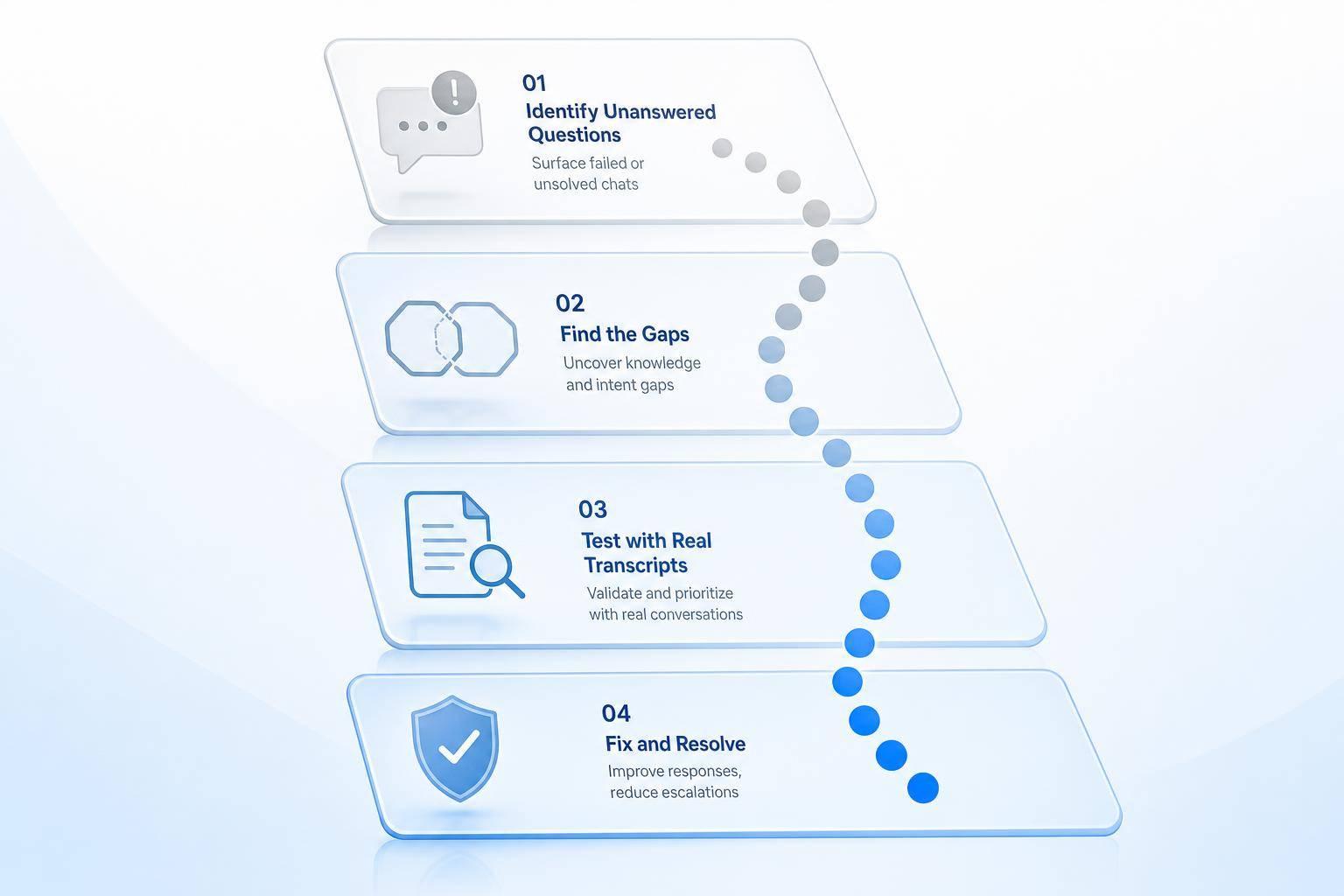
Review failed conversations, group similar messages together, and label each group as a missing intent, knowledge gap, ambiguous phrasing, out-of-scope request, or broken flow.
Here’s a simple example. Variants of “cancel my order” should all map to one cancellation intent. If they don’t, you’ve got an intent coverage issue. That’s a direct fix.
After labeling those clusters, sort them by volume and revenue impact. A fallback on a simple FAQ matters less than a fallback during a payment dispute or a cancellation attempt. Billing, refunds, and account access are the kinds of topics that can hit revenue fast, even when the raw fallback count looks similar to lower-stakes requests.
How ChatSpark analytics can support fallback diagnosis
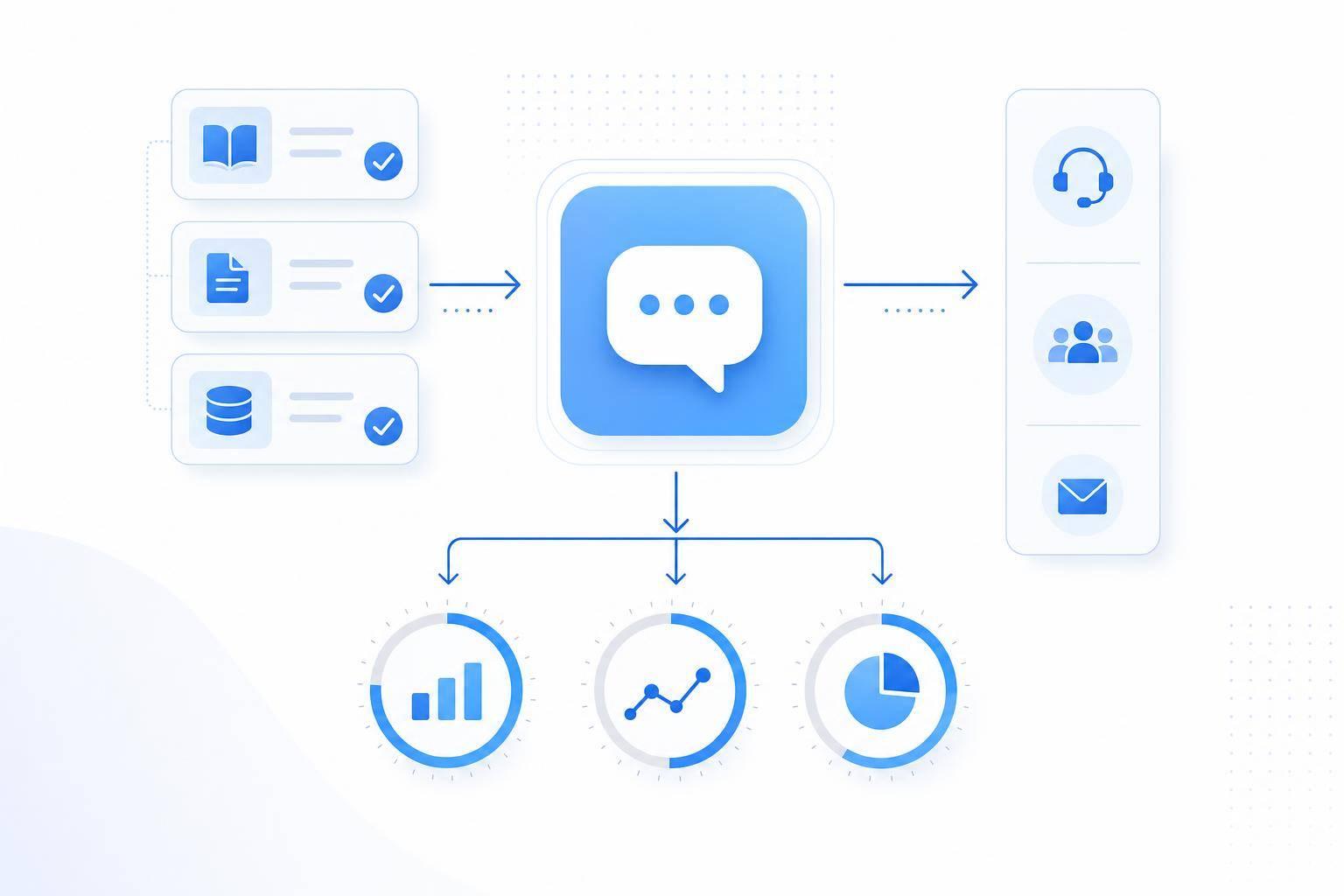
Once you spot the pattern in the data, use ChatSpark to review the sessions behind it more quickly. ChatSpark analytics let teams review recent fallback transcripts, compare patterns by channel, and track whether fixes improve resolution and CSAT.
The key move here is simple: compare fallback, resolution, and CSAT before and after each fix. If the numbers improve, the change worked. If they don’t, keep digging.
How to reduce fallback rate without hurting resolution quality
Once you've labeled fallback clusters, the next step is to fix the root cause. In most cases, the issue sits in one of three places: intent, content, or flow. The goal is simple: cut avoidable fallbacks without causing more wrong answers or pushing people into human support too soon.
Improve intent coverage and confidence handling
Start with the fallback logs and transcripts you've already reviewed. They show you how people actually ask for help, which is often very different from how teams describe the same issue internally.
Use real customer language in your training examples. If people say “my payment didn’t go through,” train on that wording instead of only using internal terms like “transaction failure.” That small shift can make a big difference.
It also helps to clean up your intent structure:
- Split broad intents when they push very different goals into the same path
- Merge overlapping intents when they lead to the same answer
- Review low-confidence turns to see where the model is hesitating
- Measure top-pick accuracy before changing thresholds
When predictions are close, don't rush into escalation. Ask a clarifying question first. That's often the easiest way to keep the conversation on track without making the user start over.
Fill knowledge gaps and improve retrieval quality
If intent routing looks fine, retrieval is often the next weak spot. Start with the fallback topics that show up most often: payments, shipping, refunds, scheduling, order changes, subscriptions, and account access.
Coverage matters, but article quality matters just as much. A help article can exist and still be hard for the bot to find. In practice, retrieval gets better when content includes clear titles, question-style headings, synonyms, short summaries, and metadata that matches the way customers speak.
Think of it this way: if a customer types “can I switch my delivery day,” but your article only talks about “modifying fulfillment windows,” the bot may miss the match completely.
After you update content, test the bot using real user phrasing. That includes abbreviations, typos, and half-finished sentences. Then compare performance before and after the change. Watch fallback rate, containment, task completion, escalation rate, repeat contact rate, and CSAT. If those numbers move in the right direction, the fix likely worked.
Design better recovery flows and escalation experiences
Even with better intent handling and stronger retrieval, some issues still won't be resolved by the bot. When that happens, the recovery flow matters just as much as the answer itself.
The handoff should keep context intact. A tiered recovery path keeps customer effort low and avoids that frustrating “let me repeat everything again” moment.
| Fallback Level | Action | Goal |
|---|---|---|
| Level 1 | Clarifying question or button options | Resolve ambiguity without escalating |
| Level 2 | Suggest related knowledge base articles | Provide a self-service path for partial matches |
| Level 3 | Human handoff with full transcript and context | Protect the experience for complex or sensitive issues |
Here’s the basic flow. On the first failure, the bot asks a targeted clarifying question. If that still doesn't clear things up, it offers a small set of structured options. If the issue remains unresolved, it hands the conversation to a human agent.
Each step should reduce effort, not add more of it. Pass the full context during handoff: the last user message, key details already collected like an order number or appointment date, and a summary of what the bot already tried. That lets the agent skip the re-introduction and move straight to the problem.
Track clarification success, abandonment, and task completion after each change.
Conclusion: Treat fallback rate as an early warning system
Fallback rate shows you where your chatbot starts to miss the mark. Every fallback adds friction to the customer journey, and a rising fallback rate often points to gaps in intent coverage, content, or escalation design before CSAT starts to slip. That’s why fallback rate matters as an early warning signal, not just another bot metric. When you look at it alongside containment rate, escalation rate, and CSAT, you get a much clearer view of where automation is doing its job and where it’s quietly letting customers down.
Once you know what’s causing the fallback, the next move is to fix the system behind it. That means improving intent coverage, keeping your knowledge base up to date, and building recovery flows that guide customers instead of leaving them at a dead end. The three repeat causes - unclear intent, missing content, and weak escalation - don’t come from the same problem, so they shouldn’t get the same fix. Working on all three is what pushes resolution quality, CSAT, and support automation performance in the right direction.
Fallback analysis also can’t stop after launch. Customer language shifts. Products change. Policies get updated. Regular review and iteration are what keep a bot getting better instead of slowly wearing down customer trust. If fallback rate stays high or starts climbing, treat that as a signal to dig in and find out why. The aim is simple: a bot that gets better month after month, with better resolution, better recovery, and stronger customer trust over time.
FAQs
What counts as a fallback?
A fallback happens when the AI doesn’t give a relevant or helpful response to what the user is trying to do.
That can look like:
- an “I don’t understand” reply
- repeated clarification with no progress
- vague or unhelpful answers
- a handoff after failed attempts
Fallback rate measures the share of interactions that end in that failed, stalled, or escalated state.
How often should I review fallback logs?
Review fallback logs every week, especially early in your AI rollout. During each review, export the logs and look at the top 10 unhandled topics so you can update your knowledge base.
After the first month, when performance starts to level out, you can switch to a monthly review. That steady check-in helps you spot repeat patterns, fill knowledge gaps, and cut future fallback rates.
Can a high fallback rate ever be acceptable?
No. A 0% fallback rate isn't realistic.
But a high fallback rate is still a red flag. It usually means your chatbot isn't understanding what people want, and that can hurt customer satisfaction and trust.
A good benchmark is to keep fallback rate below 5%. If it stays above that, your conversation design may have gaps, your knowledge base may be missing answers, or both.