Want faster, scalable chatbot APIs? Event-Driven Architecture (EDA) might be the answer. Unlike traditional request-response models, EDA uses asynchronous messaging to handle high traffic, reduce latency, and deliver real-time responses. It’s perfect for chatbots needing to process thousands of interactions simultaneously.
Here’s the breakdown of three architectures for AI agents and chatbot APIs:
- Event-Driven Architecture (EDA): Uses message brokers (e.g., Kafka) for asynchronous, scalable communication. Great for high concurrency and real-time token streaming but requires careful system design.
- API-Based Architecture: Simple, synchronous request-response model. Easy to implement but struggles under heavy load and offers limited real-time capabilities.
- Webhook-Driven Architecture: Pushes event updates directly to endpoints. Efficient for real-time notifications but can face challenges with duplicates and traffic surges.
Quick Comparison
| Feature | API-Based | Webhook-Driven | Event-Driven (EDA) |
|---|---|---|---|
| Communication | Synchronous | Asynchronous/Push | Asynchronous/Pub-Sub |
| Scalability | Limited | Moderate | High |
| Resilience | Low | Moderate | High |
| Complexity | Low | Moderate | High |
| Real-Time Capability | Limited | High | High |
For chatbots handling multi-channel interactions or unpredictable traffic, EDA stands out. This approach is essential for gathering omnichannel chatbot data insights across complex enterprise environments. While it requires more setup, the benefits in scalability and real-time performance are unmatched.
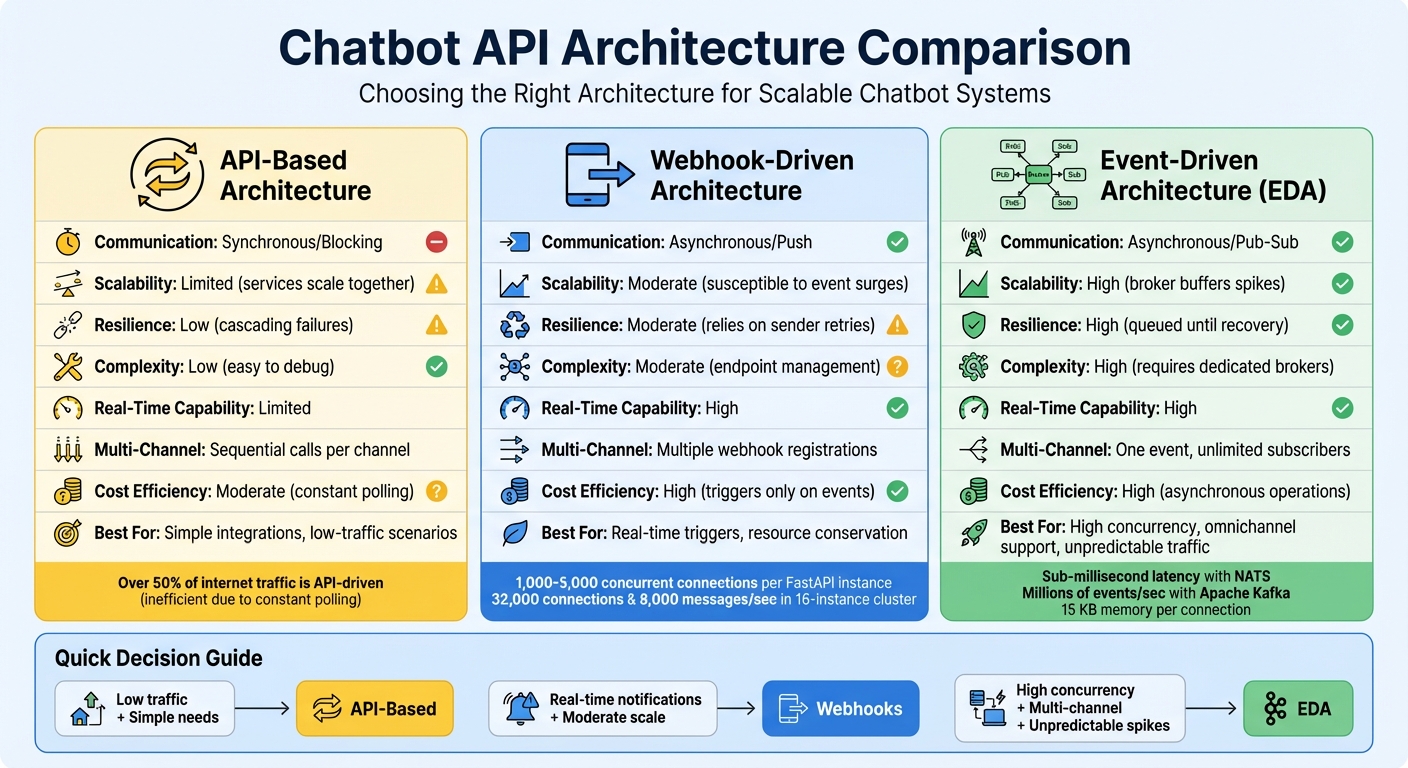
Chatbot API Architecture Comparison: API-Based vs Webhook vs Event-Driven
1. Event-Driven Architecture (EDA)
Event-Driven Architecture shifts away from traditional polling methods by using server-push updates. Instead of clients constantly checking for updates, the server sends notifications as soon as an event occurs - like getting instant alerts rather than repeatedly refreshing a page.
Communication Pattern
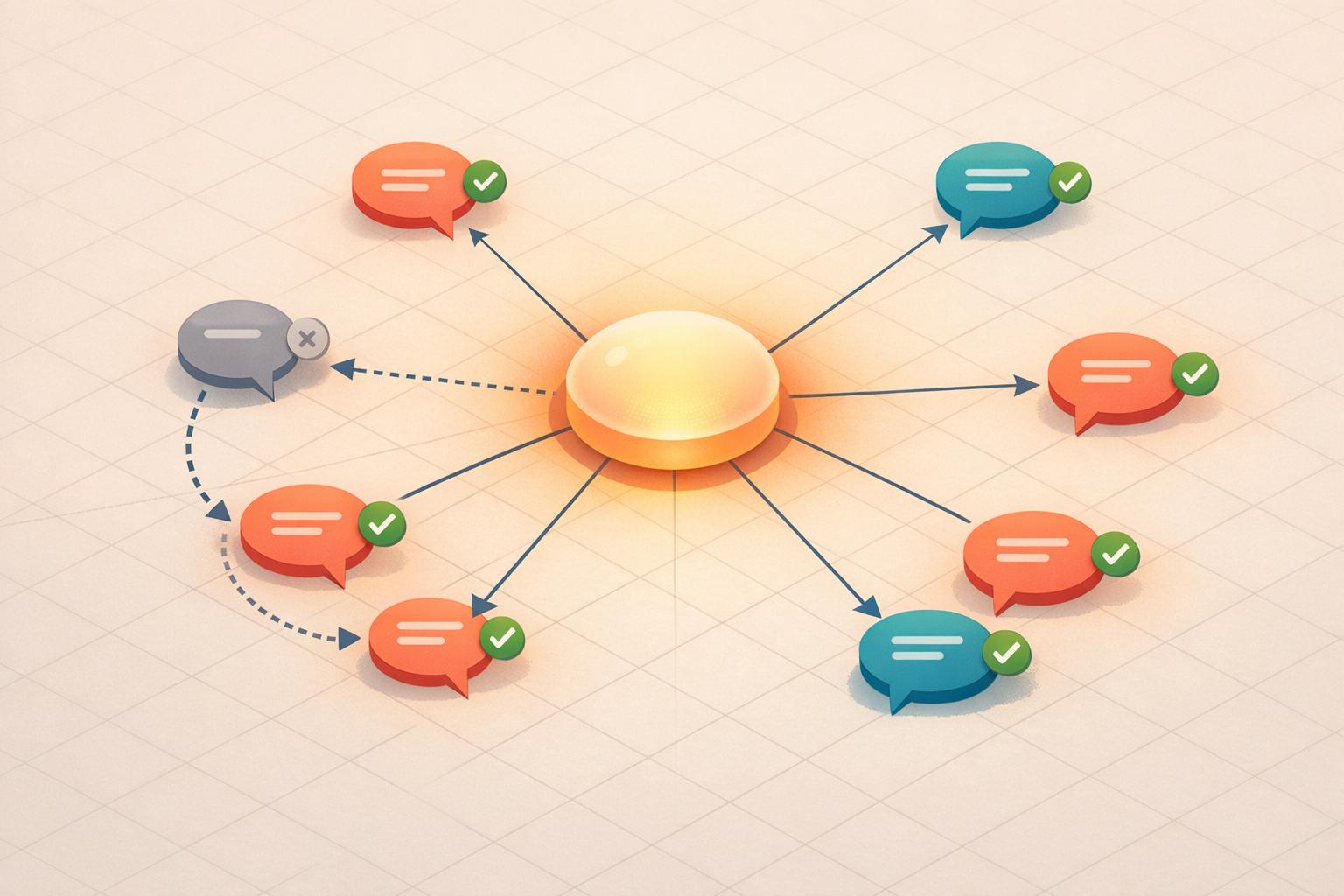
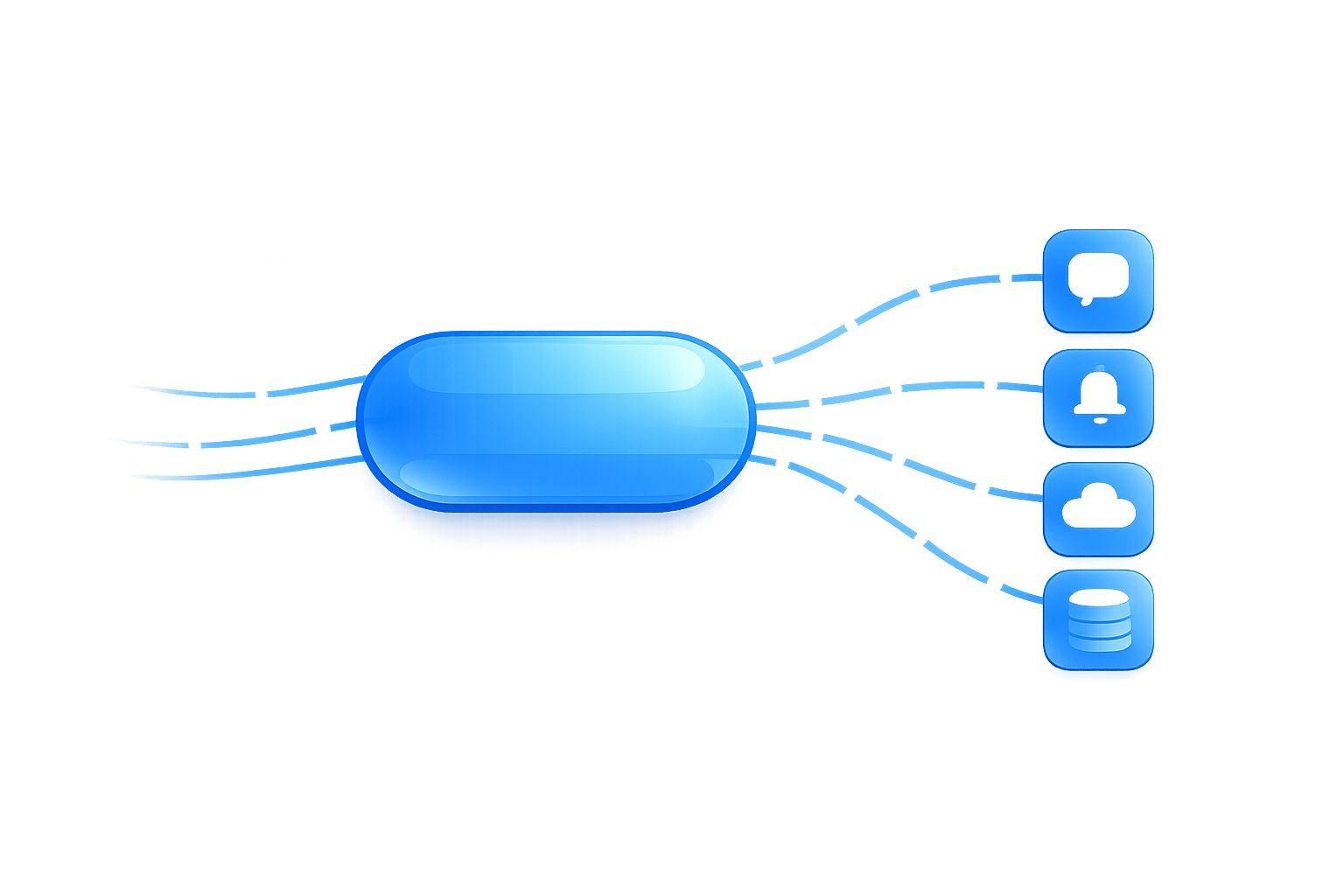
EDA relies on asynchronous messaging, where producers and consumers communicate through an intermediary, often a message broker like Kafka or RabbitMQ [2]. For instance, when a user interacts with a chatbot, the system can continue processing other tasks while the language model (LLM) generates a response. Once the LLM finishes, it sends its response as an event, which gets pushed directly to the user interface [8].
This server-push model eliminates the inefficiency of polling. A 2021 study revealed that over half of all internet traffic is API-driven, with much of it stemming from inefficient polling methods [8]. By reducing unnecessary traffic, EDA supports more efficient, real-time interactions.
Real-Time Capability
Switching from polling to push updates enables true real-time interactions. For example, LLM-generated tokens can stream to users almost instantly [8][4]. This is particularly important for chatbots, where users expect responses to appear character by character, mimicking a natural conversation.
EDA also enables proactive chatbots that can initiate conversations based on system triggers [9]. For example, instead of waiting for a customer to ask about a delayed order, the chatbot can notify them as soon as the delay is detected. It can also alert users about payment issues, price changes, or other events as they happen, rather than waiting for user input.
Scalability
EDA systems handle traffic spikes more effectively than traditional request-response architectures. Since producers and consumers are decoupled, each can scale independently based on demand [2][8]. For instance, if your LLM service experiences a surge in activity, you can scale it up without affecting other components.
The asynchronous nature of EDA allows systems to manage thousands of simultaneous interactions without bottlenecks. A single FastAPI instance, for example, can handle between 1,000 and 5,000 concurrent connections. In a 16-instance cluster, this scales up to 32,000 connections and 8,000 messages per second, with each connection requiring only 15 KB of memory [7].
Error Handling
EDA systems are designed to handle errors gracefully. If a consumer service crashes or goes offline, events are queued and retried later rather than being lost [2]. This feature helps prevent cascading failures that are common in tightly coupled systems.
To manage persistent errors, Dead Letter Queues (DLQs) store events that fail after multiple retry attempts [2][3]. These problematic events can then be inspected and resolved manually. To avoid duplicate notifications caused by "at-least-once" delivery guarantees, implementing idempotency keys ensures that repeated events are processed correctly [2][3].
Complexity
While EDA offers many advantages, it also comes with its own challenges. Event storms - sudden surges in event volume - can overwhelm the system during viral moments or widespread alerts [2][9]. To handle this, you'll need mechanisms like backpressure and throttling to manage the load.
Another challenge is managing event brokers and designing self-contained event payloads. These payloads should include all necessary data (e.g., order status or tracking details) to avoid additional API calls [8][3]. Additionally, ensuring proper event ordering in distributed systems is critical; processing a "Payment Refunded" event before a "Payment Completed" event could disrupt business logic [10].
Modern API gateways can help by translating internal Kafka or RabbitMQ messages into client-friendly formats like WebSockets or Server-Sent Events (SSE) [2][8]. This keeps the internal event system separate from external client connections, simplifying integration. However, understanding and addressing these complexities is crucial when comparing EDA to other models like API-based or webhook-driven architectures.
2. API-Based Architecture
API-based architecture operates on a synchronous request-response pattern, where the client sends a request and waits for the server to process and respond. Think of it like making a phone call: the client stays on the line until the server replies. While this direct communication is simple to implement, it creates a tightly coupled relationship between the client and server, which can pose challenges [11]. Unlike the asynchronous nature of event-driven architectures (EDA), this model keeps both parties locked in a wait-for-response cycle.
Communication Pattern
In contrast to the push model of EDAs, API-based systems depend on a pull mechanism, often using polling [12]. For instance, in a REST-based chat application, a user might experience delays of over 12 seconds while waiting for the server to sequentially complete tasks like saving data, generating thumbnails, and sending notifications [11]. This blocking process becomes particularly problematic when the system is under heavy traffic.
Real-Time Capability
Because this architecture relies on pull-based communication, achieving real-time responsiveness is inherently difficult. Traditional API systems often suffer from high latency since there’s always a gap between when an event occurs and the client’s next poll [12]. Additionally, standard HTTP/1.1 browsers limit connections to six per domain, further restricting real-time updates [7].
As API7.ai highlights:
"The traditional request-response model of REST APIs... often struggles to deliver this level of immediacy efficiently" [12].
Polling exacerbates inefficiency by consuming network and CPU resources, even when no new data is available [12].
Scalability
When faced with high volumes of interactions, API-based systems encounter significant bottlenecks due to their sequential nature. Each requesting service must wait for a response before proceeding, which can cause the system to slow down or even fail under heavy load [5][15][1]. As concurrency rises, latency increases, and messages may queue unpredictably, leading to a sluggish user experience [1].
Tim Bray from Amazon encapsulates the challenge:
"The proportion of services I work on where queues are absolutely necessary rounds to 100%" [14].
This tight coupling means that if any downstream service slows or fails, the entire interaction chain is affected [13][12]. These scalability concerns highlight the importance of robust mechanisms for managing errors, which we’ll explore next.
Error Handling
Errors in API-based systems have immediate and often disruptive effects. If the server goes down, client requests fail instantly [12]. Unlike event-driven systems, there’s no built-in way to retry or queue these requests for later. To maintain stability, WebSocket connections require strategies like automatic reconnections with progressively longer intervals (e.g., 1s, 2s, 4s, 8s) and heartbeat monitoring (server-side pings every 30 seconds with a 10-second timeout) to detect and recover from disconnections [7].
3. Webhook-Driven Architecture
Webhook-driven architecture offers another approach to real-time chatbot communication. Unlike the traditional API model, where the chatbot continuously polls for updates, this system flips the script. The server sends data directly to a pre-configured callback URL as soon as an event occurs[6]. This "reverse API" setup allows for near-instant notifications.
Communication Pattern
Here's how it works: whenever a specific event happens - like a payment being completed or a support ticket being updated - a webhook sends an HTTP POST request to your chatbot's endpoint. This creates a direct, point-to-point connection between the event source and the chatbot, differing from the asynchronous nature of event-driven architecture or the synchronous polling of API systems.
As Hooklistener aptly describes:
"A webhook represents a paradigm shift from the request-driven dialogue of traditional APIs. Instead of the client pulling data, the server pushes data to the client in response to an event, enabling real-time communication with remarkable efficiency."[6]
However, one downside is that you lose control over when data arrives, as it depends entirely on the event producer's timing.
Real-Time Capability
Webhooks excel at delivering the real-time responses users now expect. Notifications typically arrive within seconds of an event, which is crucial since delays over 100 milliseconds can feel sluggish to users. To ensure accuracy, many webhook systems use a "Configure, Notify, Enrich" approach: the chatbot receives a basic notification and then calls a REST API to fetch the full, up-to-date data. This ensures the chatbot has the latest details without overloading the webhook itself.
Scalability
Webhooks are generally efficient because they only activate when an event occurs. But challenges arise during traffic spikes, like Black Friday sales or viral campaigns. For instance, Hookdeck's Event Gateway handled a tenfold traffic increase during Black Friday by using adaptive rate limits and retries[17]. A significant challenge here is that you can’t pause incoming webhook traffic during system maintenance or high-stress periods.
James Higginbotham highlights this issue:
"The developer experience of processing a large number of messages is often overlooked when a large number of event messages published to a Webhook endpoint might overwhelm the HTTP receiver with hundreds or thousands of HTTP POST requests to process."[3]
To address this, many systems decouple message ingestion from processing. By quickly enqueueing payloads and responding with a 200 OK status, you can handle the actual processing asynchronously. This avoids timeouts and prevents retry storms during peak loads.
Error Handling
Webhooks operate on an "at-least-once" delivery model, which means duplicates and out-of-order events are a given. As Phil Leggetter from Hookdeck explains:
"Webhooks are usually delivered at-least-once. You will get duplicates. You will get out-of-order events. If your logic isn't idempotent, retries will break things."[17]
To manage this, your chatbot should track unique event IDs and use timestamp-based updates to ensure your database reflects the latest state. Implementing a Dead Letter Queue (DLQ) can also be helpful. This captures events that fail after maximum retries, allowing you to review and resolve issues without losing data. Unlike API calls, where errors are immediately visible, webhook failures can go unnoticed unless you actively monitor delivery logs and queue activity.
Complexity
Setting up webhooks requires a secure, publicly accessible HTTP endpoint. This involves implementing measures like HMAC signature verification, timestamp validation to prevent replay attacks, and possibly IP allowlisting. The endpoint must also be highly available, often relying on serverless functions or load-balanced microservices for reliability.
Debugging webhooks can be more challenging compared to traditional APIs. Failures often require checking both the provider's delivery logs and your internal processing queues, rather than receiving instant HTTP error codes. Additionally, webhooks are inherently read-only - they notify you about events but don’t allow you to push changes back to the source. For chatbots integrating with platforms like the WhatsApp Business API, which serves over 2 billion users, careful planning is essential to handle thousands of events per minute effectively.
Advantages and Disadvantages
After diving into the specifics of each architecture, here's a streamlined look at their strengths and weaknesses. Each approach comes with its own set of trade-offs, and understanding these can help you pick the right framework, especially when dealing with multi-channel integrations and scaling challenges.
Event-Driven Architecture (EDA) stands out for its ability to decouple services and handle sudden traffic spikes. Marcus Rodriguez, Lead DevOps Engineer at ZeonEdge, highlights this advantage:
"In EDA, the message broker absorbs the spike, and downstream services process events at their own pace." [19]
What does this mean in practice? A single "UserMessageReceived" event can kick off multiple processes - like sentiment analysis, response generation, and live-agent handoff - without any of them blocking the others [19][2]. Tools like Apache Kafka can process millions of events per second, while NATS offers sub-millisecond latency for edge deployments [19]. But there's a catch: EDA adds complexity, requiring specialized message brokers and careful system design [19][5].
API-Based Architecture is simpler and provides immediate feedback, making it easier to design and debug [5]. Developers can trace requests end-to-end without juggling multiple queues. However, this setup struggles under heavy loads, as all downstream services must scale simultaneously [19].
Webhook-Driven Architecture excels at delivering real-time push notifications without the need for constant polling, making it resource-efficient. Still, as James Higginbotham from Hookdeck points out:
"The developer experience of processing a large number of messages is often overlooked when a large number of event messages published to a Webhook endpoint might overwhelm the HTTP receiver." [3]
For platforms like ChatSpark, which integrates with websites, Instagram, Facebook, WhatsApp, Telegram, and Slack, EDA offers a clear edge. Its ability to distribute a single event to multiple channel-specific consumers is invaluable. While ChatSpark also provides standard REST API endpoints (like POST /api/v1/agents/{id}/training), these can easily fit into an EDA workflow. For example, an "UpdateDocumentation" event could automatically refresh a knowledge base across all channels [18]. The trade-off? Greater infrastructure complexity, but with the payoff of resilience and scalability to support 24/7 operations in over 85 languages.
| Feature | API-Based | Webhook-Driven | Event-Driven (EDA) |
|---|---|---|---|
| Communication | Synchronous/Blocking | Asynchronous/Push | Asynchronous/Pub-Sub |
| Scalability | Limited; services scale together [19] | Moderate; susceptible to event surges [3] | High; broker buffers spikes [19][5] |
| Resilience | Low; cascading failures [19] | Moderate; relies on sender retries | High; queued until recovery [2] |
| Complexity | Low; easy to debug [5] | Moderate; endpoint management | High; requires dedicated brokers [19][5] |
| Multi-Channel | Sequential calls per channel | Multiple webhook registrations | One event, unlimited subscribers [19] |
| Cost Efficiency | Moderate; constant polling | High; triggers only on events | High; operates asynchronously |
Weighing these factors is crucial for selecting the best architecture to build scalable and reliable chatbot APIs.
Conclusion
Choosing the right architecture for your chatbot API boils down to matching the architecture to your performance and scalability needs. API-based architectures are ideal for straightforward integrations and low-traffic scenarios where ease of maintenance takes priority. On the other hand, webhooks excel in situations requiring real-time triggers, helping conserve resources and avoid constant polling, which can drain compute power and hit API rate limits [16]. For more complex demands, like omnichannel support, high concurrency, or unpredictable traffic spikes, Event-Driven Architecture (EDA) becomes a game-changer.
EDA stands out when high concurrency and omnichannel interactions are non-negotiable. Its ability to decouple services allows your chatbot to scale across various communication channels independently. For instance, platforms like ChatSpark, which operates across websites, Instagram, Facebook, WhatsApp, Telegram, and Slack in over 85 languages, rely on this decoupling. A single "UserMessageReceived" event can trigger multiple processes - sentiment analysis, response generation, and analytics tracking - all at once, without causing bottlenecks [20][2].
Of course, EDA comes with its own set of challenges. Implementing message brokers, designing schemas carefully, and ensuring idempotency to avoid duplicate processing require meticulous planning [20][16]. However, the benefits - resilience, scalability, and cost efficiency - make it indispensable for production environments that need to withstand heavy traffic. As Tim Bray from Amazon aptly states:
"The proportion of services I work on where queues are absolutely necessary rounds to 100%" [14].
FAQs
When should I choose EDA for a chatbot API?
Event-Driven Architecture (EDA) works perfectly for chatbots that need instant responses, scaling capabilities, and asynchronous communication. This approach shines when managing large volumes of events, predicting user actions, or connecting with microservices and messaging platforms. EDA thrives in situations requiring minimal delay, such as live customer support, where the system reacts to events in real time instead of depending on the usual request-response model.
How do I prevent duplicate events in EDA or webhooks?
To avoid duplicate events in event-driven architecture (EDA) or webhooks, you can use idempotency by assigning a unique identifier to every event. Implement a deduplication method, such as caching recent event IDs, to identify and filter out duplicates effectively. Additionally, verifying payload signatures (like using HMAC-SHA256) ensures the integrity of the event data, while promptly sending 200 OK responses helps prevent unnecessary retries. It's also important to design your system to process each event only once within a specific time window.
What’s the best way to stream LLM tokens to users?
The most effective method for streaming LLM tokens is server-sent events (SSE). SSE allows token-by-token streaming directly from the server to the browser with minimal overhead, creating a seamless and responsive experience for users.
When it comes to bidirectional communication - like real-time collaboration or sending progress updates - WebSockets are a more appropriate choice. Additionally, in controlled environments, HTTP/2 or HTTP/3 streaming can provide efficient handling of structured data flow.