

Conversational AI is reshaping how businesses interact with customers across platforms. It enables seamless communication through chat, email, voice, and social media, while maintaining context and continuity. Unlike older systems, modern AI handles complex tasks like refunds, scheduling, and lead qualification.
Key Points:
- Efficiency: AI reduces costs per interaction (as low as $0.50 vs. $7–$13.50 for human agents) and resolves 70–85% of queries without human involvement.
- Customer Experience: Faster responses (under 30 seconds), 24/7 availability, and personalized interactions improve satisfaction and retention.
- Business Impact: Companies like Brightree and Unity have saved millions and boosted revenue by implementing conversational AI.
By integrating with existing systems, conversational AI creates a unified, omnichannel experience where customers don’t need to repeat themselves. This technology isn’t just about answering questions - it’s about driving growth, cutting costs, and delivering better service. Let’s break down how it works and why it matters.
What Is Conversational AI and How Does It Support Customer Engagement?
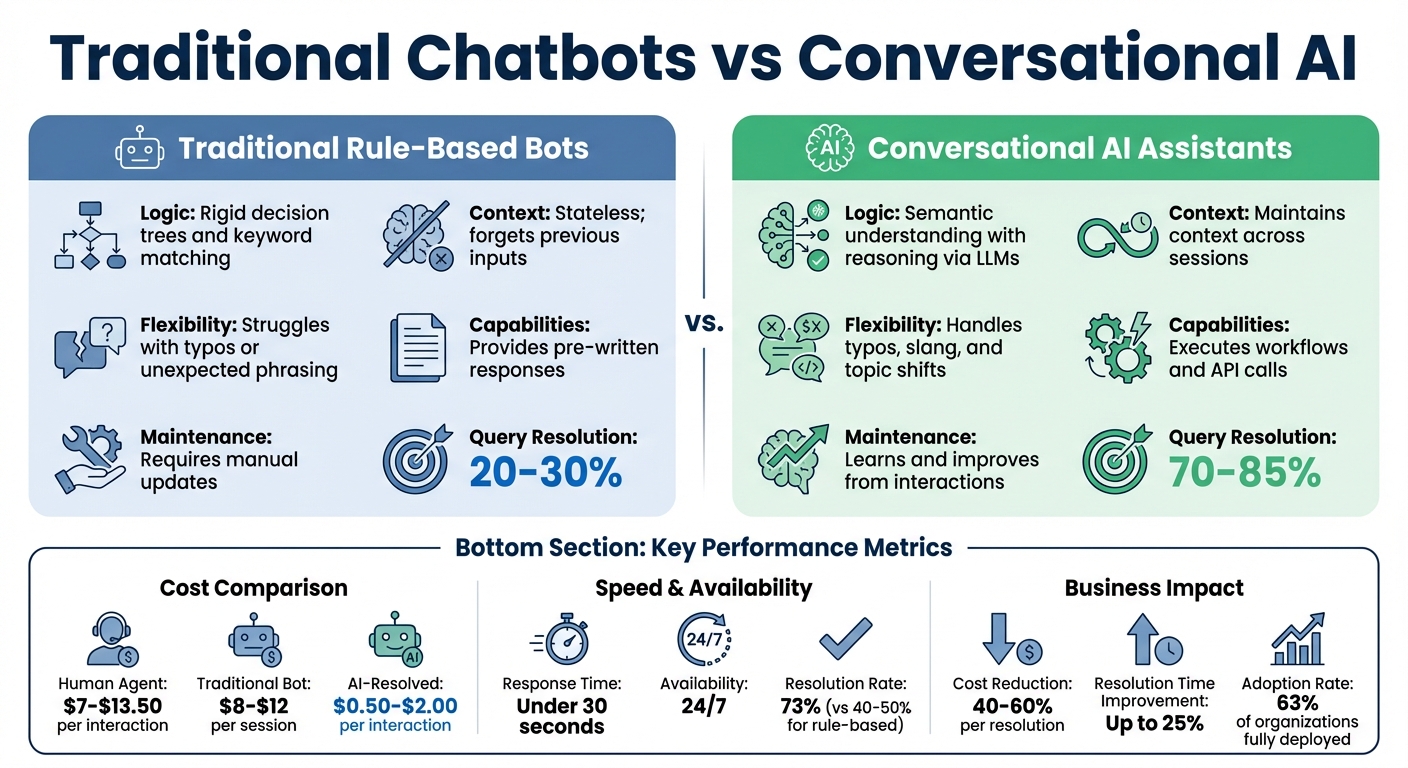
Traditional Chatbots vs Conversational AI: Key Differences and Performance Metrics
Conversational AI Defined
Conversational AI refers to advanced software that uses Natural Language Processing (NLP), Machine Learning (ML), and Natural Language Understanding (NLU) to interpret and respond to human language in a way that feels natural [9][11]. Unlike older, rule-based chatbots that stick to rigid scripts and keyword matching, conversational AI systems can grasp the meaning and intent behind a user's words - even when slang, typos, or abrupt topic changes are involved [7][11].
This technology relies on four key components working together:
- NLP: Breaks down raw text or speech into structured data for machines to process [7].
- NLU: Identifies the user’s intent, such as distinguishing between "I want to cancel my order" and "Can I change my delivery address?" [7][9].
- Dialogue Management: Keeps track of the conversation's context to decide the next action [7][11].
- Natural Language Generation (NLG): Converts the system's responses into human-like language [9][11].
What makes modern conversational AI stand out is its ability to go beyond simple responses. These systems can now take autonomous actions - like processing refunds, scheduling appointments, or updating subscriptions - by integrating with APIs [1][3].
"A true conversational AI platform integrates deeply and securely with your existing systems... This allows it to take action on a customer's behalf." - Ryan Smith, Decagon [13]
These advancements benefit both businesses and customers in very real ways.
Benefits for Businesses and Customers
Conversational AI offers personalization, speed, and scalability, creating better experiences for customers while driving efficiency for businesses.
- Personalization: These systems can tap into CRM data, purchase history, and previous interactions to deliver tailored messages at scale [10][9]. This is critical when 71% of consumers expect personalized interactions, and 76% report frustration when they don’t get them [10].
- Speed: AI-powered agents are available 24/7 and typically respond in under 30 seconds, which 92% of consumers appreciate [8]. This is especially important as 82% of consumers expect instant replies to sales or marketing inquiries [10]. Businesses also report faster resolutions, with 84% saying AI reduces resolution time, and 55% seeing improvements of up to 25% [12]. When AI supports human agents, issue resolution speeds up by 47%, and first-contact resolution rates improve by 25% [12].
- Scalability: AI enables businesses to handle millions of interactions simultaneously across SMS, voice, email, and chat - without increasing staff or costs [10][3]. For example, in October 2025, Unity cut $1.3 million in support costs and improved first response times by 83% by using AI to manage high-volume tickets [9]. Similarly, TaskRabbit handled a surge of 158,000 tickets per month by deploying an AI agent that automated initial responses and deflected 28% of total tickets [9].
| Feature | Traditional Rule-Based Bots | Conversational AI Assistants |
|---|---|---|
| Logic | Rigid decision trees and keyword matching | Semantic understanding with reasoning via LLMs |
| Context | Stateless; forgets previous inputs | Maintains context across sessions |
| Flexibility | Struggles with typos or unexpected phrasing | Handles typos, slang, and topic shifts |
| Capabilities | Provides pre-written responses | Executes workflows and API calls |
| Maintenance | Requires manual updates | Learns and improves from interactions |
These features explain why conversational AI adoption is growing rapidly and delivering measurable business outcomes.
Adoption Trends and Business Impact
The adoption of conversational AI has seen a sharp rise, with 63% of organizations fully deploying these systems [8]. This surge is driven by their ability to handle 70–85% of customer queries, compared to just 20–30% for rule-based bots [7]. The financial impact is equally compelling, as businesses implementing AI-driven support often reduce costs per resolution by 40–60% [7].
The technology is advancing beyond simple text-based interactions. Multimodal systems now process not just text but also images, documents, and audio [7][1]. AI agents are becoming proactive, reaching out to customers based on behavioral triggers - like notifying them of shipment delays before they even ask [7][1]. Sentiment analysis adds another layer, allowing AI to adjust its tone based on a user’s emotional state [7].
For instance, in November 2025, Curology reported a 65% reduction in support costs by using conversational AI for routine inquiries [13]. Similarly, Accor Plus saw a 20% boost in customer satisfaction and a 352% improvement in response times after deploying AI agents for 24/7 support [9]. These examples highlight how conversational AI has evolved into a critical tool for modern businesses, delivering both efficiency and improved customer experiences.
How Conversational AI Enables Omnichannel Customer Engagement
Connecting Multiple Communication Channels
Today’s conversational AI bridges the gap between platforms like web chat, SMS, email, voice, social media, and messaging apps, creating one seamless conversation flow [14]. Through identity resolution, it matches customer data - such as email addresses, phone numbers, or account IDs - across platforms. This means a customer can start a conversation on Instagram and pick it up later via email or phone without losing any context [14][15].
The AI tailors its communication style to suit each channel. For example, SMS messages are kept short and proactive for urgent updates, while voice interactions use empathetic tones to handle more complex issues [4]. Web chat offers interactive product suggestions, and email provides detailed follow-ups [14]. Some systems even synchronize channels in real time. Picture this: a voice AI agent walks a customer through setup instructions while simultaneously sending a visual diagram via SMS [4].
These systems also integrate with tools like CRMs and order management platforms, allowing the AI to handle tasks directly within conversations. Whether it’s processing a refund, rescheduling a delivery, or updating a subscription, customers don’t have to jump between systems or repeat their requests. This interconnected approach ensures a unified customer experience across all channels [3][14].
Maintaining Customer Context Across Channels
At the heart of omnichannel engagement is a shared memory layer that tracks every detail of a customer’s journey [3][14]. Using a "5W1H" framework (Who, What, When, Where, Why, and How), the system keeps tabs on every interaction [15]. So, if a customer switches from chat to phone, the AI already knows what troubleshooting steps have been attempted and what information has been shared.
"Omnichannel is less about being 'present everywhere' and more about maintaining continuity everywhere - identity, history, decisions, and next actions." - Ameya Deshmukh, EverWorker [14]
This memory system updates in real time, reflecting changes like a new shoe size after a return, while preserving the full interaction history for compliance or debugging purposes [15]. It ensures the AI doesn’t rely on outdated information, maintaining consistency across interactions. If an issue needs escalation, the AI sends an "escalation packet" with the complete interaction history and suggested next steps, so customers never have to repeat themselves [14][2].
Examples of Omnichannel Success
The value of unified channels and consistent context is clear in real-world examples. In 2025, Hobbycraft, a U.K.-based arts-and-crafts retailer, integrated social media, email, voice, and chat into a single AI-driven platform. This boosted first-contact resolution to 82% and improved customer satisfaction by 25% [16]. Similarly, travel company Digitrips streamlined its fragmented support channels into one unified workspace, reducing first-response times by 75% and doubling the number of tickets agents could resolve daily [16].
For more complex scenarios, Brinks Home implemented voice AI agents to manage multi-step troubleshooting across phone and digital channels. Veronica Moturi, SVP of Customer Experience, shared:
"Our voice AI Agent guides customers through complex, multi-step troubleshooting scenarios... We've been able to significantly improve our issue resolution rates and elevate the overall customer experience simultaneously" [4]
Platforms like ChatSpark make this level of engagement possible by integrating with websites, Instagram, Facebook, WhatsApp, Telegram, and Slack. They maintain a single knowledge base and customer profile, ensuring consistent responses whether a customer reaches out via social media in the middle of the night or through live chat during regular hours - all without requiring them to re-explain their issue.
How to Design and Implement Conversational AI Systems
Creating a conversational AI system that genuinely meets user needs requires more than just deploying a chatbot template. It starts with a thoughtful design process that prioritizes customer behavior, needs, and expectations. The difference between an AI system that engages users and one that frustrates them often lies in the planning stage - before any coding begins.
Mapping Customer Intents and Conversation Flows
Start by analyzing around 200 recent customer interactions - emails, messages, and calls - and group them into 12–25 distinct intents like "track my order", "change subscription", or "reset password" [17]. Once you’ve identified these intents, map out conversation flows. Each flow should include a clear starting point, steps for gathering information, decision branches, and a defined endpoint. Keep responses short and to the point - aim for no more than two sentences per message. This is important, as 68% of users abandon interactions when faced with lengthy sequences [17].
Successful bots, those with over 73% completion rates and fallback rates below 12%, are typically planned out on paper before moving to a flow editor [17]. To handle errors effectively, design three fallback levels: clarify by offering options, suggest related solutions, and, if necessary, transfer users to a human agent with full context [17][18]. This is critical because 54% of customers say they’re likely to switch providers if they have to repeat their issue after being transferred between channels [17].
For a quick win, try the "90-Minute Sprint" method: choose a high-volume intent, map out the ideal flow in 15 minutes, write responses in 30 minutes, build the bot using a no-code platform in 15 minutes, and test it with three users in 10 minutes [17]. This approach helps you avoid endless pilot testing and start delivering results right away. A well-planned flow also ensures consistency across channels, so customers don’t have to repeat themselves.
Creating AI Personas and Brand Voice
Your AI should reflect your brand’s personality. Start by creating a one-page blueprint that outlines the AI’s name, role, personality traits, expertise, and boundaries [17][18]. Use a scoring system to ensure the tone stays consistent across all channels [19].
Tailor your messages to fit the platform. For instance, SMS messages should be brief and proactive, while web chat can allow for more interaction. Voice interactions, on the other hand, should emphasize empathy. Tools like ChatSpark can help maintain a unified brand voice across platforms like your website, Instagram, Facebook, WhatsApp, Telegram, and Slack. This ensures your AI sounds consistent, whether a customer contacts you during business hours or late at night via social media.
It’s also important to be upfront about your AI’s identity. Let users know they’re interacting with a bot right from the start. Transparency can increase trust by 15–20% [17], whereas users who discover they’ve been misled report trust scores that are 40% lower [17].
Testing and Improving Your AI System
Testing is an ongoing process. Evaluate your AI on both "happy paths" (ideal scenarios) and "unhappy paths" (scenarios with errors, typos, or nonsensical inputs) [17]. Use real users to identify where the bot might cause hesitation or confusion [17].
If more than 25% of users drop off after the initial greeting, revisit and improve the opening sequence immediately [17]. Focus on making your AI excel at 3–5 key tasks rather than spreading its capabilities too thin.
Introduce slight response delays to mimic processing time, which can help build user trust [20]. Additionally, review ten chat transcripts weekly to check for clarity, inclusivity, and consistency.
Roll out your AI system in phases. Launch a minimum viable product (MVP) within 30 days, then use the next 30 days to add features like proactive outreach and A/B testing. By day 90, expand the system to handle additional customer journeys [3]. Continuous iteration is key to keeping your AI aligned with changing customer needs.
How to Measure the Impact of Conversational AI on Customer Engagement
Conversational AI can streamline interactions across multiple channels, but to truly understand its value, you need to measure its performance carefully. Simply automating customer support isn’t enough; its success lies in the measurable outcomes it delivers. By establishing a clear measurement framework, you can validate your investment, uncover areas for improvement, and demonstrate real business results. Once the AI is up and running, tracking meaningful metrics and calculating ROI ensures continuous progress and tangible benefits.
Metrics That Matter
To gauge the effectiveness of conversational AI, focus on three key categories: efficiency, customer experience, and business impact.
- Efficiency Metrics: These reveal how effectively your AI operates. Start by measuring the automation rate, which should ideally reach 70–85% for a well-optimized system [23]. Another critical metric is the resolution rate - modern AI using advanced language models achieves a 73% resolution rate, compared to just 40–50% for older, rule-based bots [24].
- Customer Experience Metrics: These metrics show how users perceive the AI. Key indicators include Customer Satisfaction (CSAT), Net Promoter Score (NPS), and Customer Effort Score (CES). Speed plays a big role here - users who receive responses in under five seconds rate their experience 1.7 points higher than those waiting over five minutes [24].
- Business Impact Metrics: These connect AI performance to financial outcomes. Track your conversion rate (how many conversations lead to sales), ticket deflection rate, and improvements in Customer Lifetime Value (CLV). Focus on containment, which measures end-to-end resolution without human involvement, as it offers a more accurate picture of workload reduction [22]. Interestingly, 42% of chatbot conversations happen after 5 PM, a time when businesses typically have limited or no human support available [24].
These metrics provide the foundation for assessing ROI, which we’ll explore next.
Calculating and Presenting ROI
Many businesses focus solely on cost savings when calculating ROI, but that approach misses the full picture. A broader perspective includes additional revenue contributions. Use the Four-Pillar Framework to capture all aspects of value:
- Direct Revenue: Sales generated during AI-driven conversations.
- Cost Savings: Reductions achieved through ticket deflection.
- Indirect Revenue: Leads captured and upsells made possible by the AI.
- CLV Impact: Gains in customer retention [21].
For instance, handling live chat interactions with human agents costs $8.00–$12.00 per session, while fully AI-resolved interactions cost just $0.50–$2.00 [21]. Cost savings typically account for 15–25% of total value, while direct and indirect revenue contribute 35–50% and 20–30%, respectively [21].
"Most chatbot ROI calculations only count deflected tickets... modern conversational AI does far more than answer FAQs. It sells products, captures leads, prevents churn, and drives upsells." – Mosharof Sabu, Neuwark [21]
Case studies back this up. Klarna’s AI assistant, for example, handled 2.3 million conversations in its first month - the equivalent of 700 full-time agents. This reduced resolution times from 11 minutes to under two, delivering a projected $40 million profit boost [25]. Similarly, NIB Health Insurance’s AI system processed 4 million member queries, saving $22 million and increasing self-service adoption by 29% [25]. These results show how conversational AI can integrate seamlessly into customer support systems across channels.
When presenting ROI, use the formula:
ROI = [(Total Value Created – Total Investment) / Total Investment] x 100%
If you only measure cost savings, ROI estimates usually range from 300–800%. However, when you include revenue contributions across all four pillars, ROI can exceed 1,500% [21]. Companies that use structured measurement frameworks often see 40–60% higher returns than those relying on intuition [25]. To keep your data credible, define "resolution" as an issue that remains closed with no follow-up contact within 7, 14, or 30 days [22]. Also, use conservative projections - 50–75% of vendor benchmarks - to build trust [26].
Conclusion
Conversational AI has grown far beyond its roots as a cost-saving tool, becoming a powerful driver of revenue and customer engagement across all channels. The numbers speak for themselves: businesses with strong omnichannel AI strategies retain 89% of their customers, compared to just 33% for those relying on disconnected systems. By 2025, an estimated 95% of all customer interactions will involve AI in some capacity[5][2][6].
This shift reflects a new era of customer engagement. AI isn’t just answering questions anymore - it’s handling refunds, scheduling appointments, and qualifying leads in real time.
"The era of chatbots as a cost-cutting measure is over. In 2026, conversational AI assistants have evolved into intelligent systems that qualify leads, close sales, and generate measurable revenue." - Samuel Godfrey, CEO of Luminous Digital Visions[1]
The impact is clear: businesses leveraging AI-powered omnichannel strategies report 23% higher revenue than those sticking to single-channel approaches[6]. At the same time, they’re cutting customer service costs by up to 30%[5]. Conversational AI ensures consistent, tailored experiences, whether customers connect through chat, email, WhatsApp, or voice.
Platforms like ChatSpark make this transformation achievable for businesses of all sizes. Starting at just $19/month and supporting over 85 languages, ChatSpark offers 24/7 intelligent AI solutions[27]. Its integration features help unify systems, enabling AI to remember context, understand customer intent, and drive actionable results.
In today’s omnichannel world, businesses that succeed treat every customer interaction as part of a seamless, intelligent conversation. The key? Start small with a high-impact use case, focus on measurable outcomes, and scale from there.
FAQs
What’s the difference between automation rate and containment?
In conversational AI, the automation rate represents the percentage of customer inquiries managed entirely by AI, with no human input required. On the other hand, containment measures the AI's ability to completely resolve issues without needing to escalate them to a human agent.
While the automation rate emphasizes the quantity of tasks handled by AI, containment zeroes in on the quality of resolution, ensuring that customers get their issues resolved smoothly without human involvement.
How does conversational AI keep context when I switch channels?
Conversational AI keeps track of context across different channels through a centralized memory system. This system records conversation history, customer identity, and case details, enabling the AI to recognize users and recall previous interactions. Whether the conversation moves from chat to email, social media to voice, or even SMS, the AI maintains continuity. By preserving this context, it delivers smooth, personalized support and speeds up issue resolution - even when customers return after a pause or switch platforms unexpectedly.
What’s the safest first use case to launch in 30 days?
Adopting an AI-powered omnichannel customer engagement platform is the safest first step you can implement within 30 days. This approach brings all interactions - across chat, email, social media, and voice - into one unified system. The result? Faster response times, improved customer satisfaction, and a scalable setup that ensures smooth and consistent customer experiences.