AI chatbots are transforming how businesses retain customers. They offer instant, 24/7 support, analyze customer behavior to prevent churn, and re-engage inactive users with personalized outreach. Businesses using these tools report reduced churn rates, increased customer loyalty, and significant cost savings.
Key Takeaways:
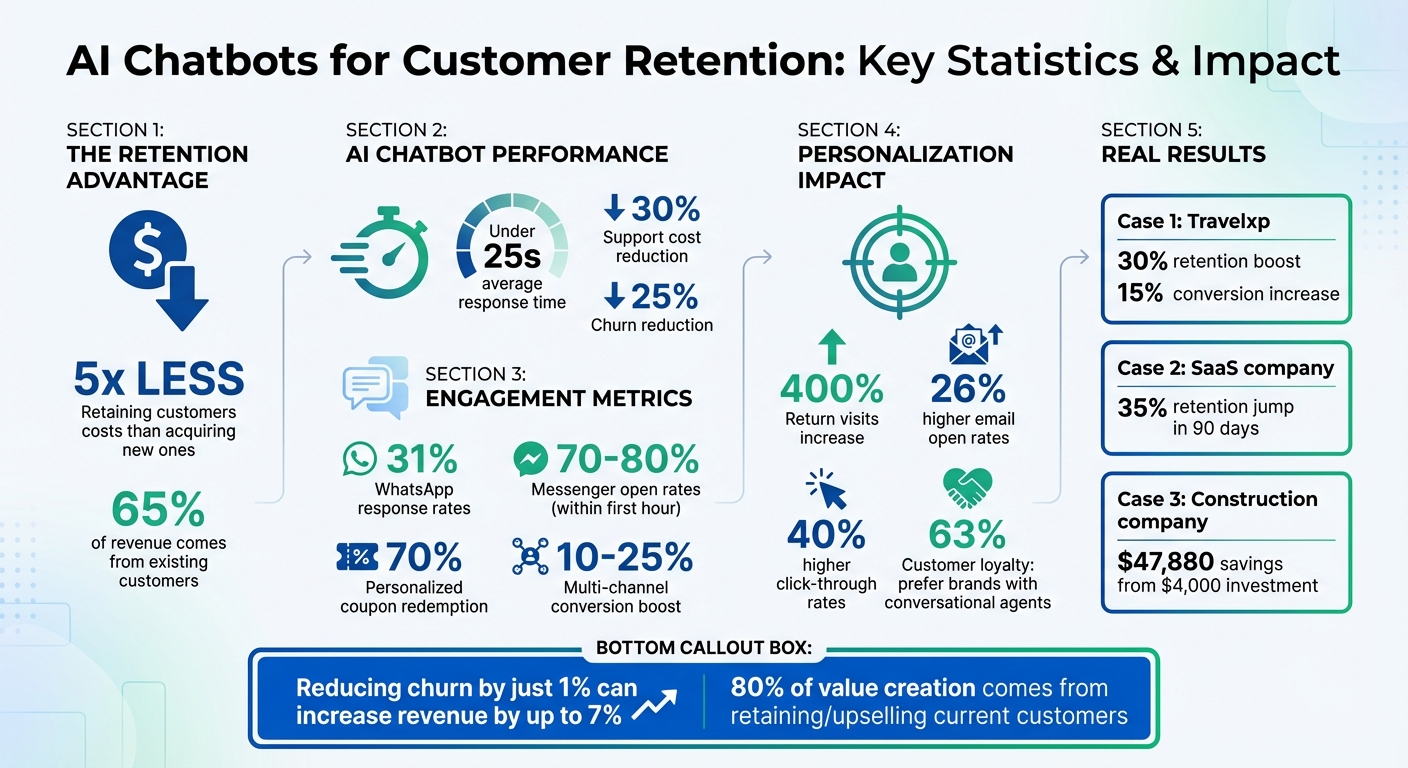
- Customer Retention Costs Less: Retaining customers is up to 5x cheaper than acquiring new ones, contributing 65% of revenue.
- 24/7 Personalized Support: AI chatbots respond in under 25 seconds, ensuring customers feel valued anytime.
- Proactive Re-Engagement: Tools like WhatsApp chatbots achieve response rates as high as 31%, far outperforming email campaigns.
- Predictive Analytics: AI identifies churn risks early, cutting churn by 25% and boosting retention rates.
- Real Results: Companies like Travelxp and Zorro.lv have seen retention rates soar by up to 30% with targeted campaigns.
AI-powered platforms, such as ChatSpark, combine multi-channel support, automated follow-ups, and advanced analytics to make retention efficient and cost-effective. With AI, businesses can focus on building lasting customer relationships while saving time and money.
AI Chatbot Customer Retention Statistics and ROI Impact
Use Case 1: Automated Follow-Ups for Customer Loyalty
Automated follow-ups have become a game-changer for businesses aiming to build strong customer loyalty. By leveraging AI chatbots, companies can deliver timely, personalized interactions that go beyond a single transaction. This combination of speed and tailored engagement helps keep customers coming back.
Personalized Follow-Up Messages
Personalization is at the heart of effective follow-ups. AI chatbots use customer data - like names, past purchases, and browsing habits - to create messages that feel relevant and thoughtful. For instance, a chatbot might send care tips after a recent purchase or suggest complementary products based on prior buying behavior.
A 2024 case study highlighted how automated chatbot follow-ups reduced response times to just 25 seconds [3]. This quick turnaround, combined with personalized recommendations, ensures customers feel valued and supported.
The numbers back this up: businesses using tailored follow-ups have seen up to a 400% increase in return visits. Personalized messages also achieve 26% higher open rates and up to 40% higher click-through rates [7]. Imagine a chatbot that remembers a customer’s last purchase and follows up with a discount code or a timely reminder - this simple gesture builds trust and encourages repeat business.
Instant Response Times
Speed is just as important as personalization when it comes to retaining customers. AI chatbots excel at providing immediate answers to common questions, whether it’s about tracking orders, return policies, or troubleshooting issues.
Take the example of a company in October 2024 that routed all initial customer queries to an live chat vs AI chatbot strategy. This approach reduced the need for human intervention in support tickets to just 10% [3]. While the chatbot handled routine inquiries, human agents could focus on more complex problems, ensuring efficient and effective service across the board.
Availability is another key factor in customer loyalty. Research shows that 63% of consumers are more likely to stick with a brand that uses conversational agents for communication [7]. Whether it’s a late-night question or a mid-day concern, instant assistance reassures customers and strengthens their connection to the brand.
Use Case 2: Re-Engaging Inactive Customers
Chatbots aren't just good at fostering loyalty - they're also incredibly effective at re-engaging customers who have gone quiet. And here's why this matters: winning back inactive customers often yields a better return on investment than constantly chasing new ones. In fact, about 65% of a company's business typically comes from existing customers [1]. AI chatbots make this process easier by identifying dormant users and reaching out at just the right time.
Targeted Outreach and Special Offers
AI chatbots use data like purchase history and engagement trends to spot inactive customers. For example, they might flag users who haven't logged in for 30 days in a SaaS platform or those who haven't made a purchase in three months for an e-commerce store [8]. Once identified, these chatbots can send personalized outreach messages, referencing past purchases and offering tailored incentives like discount codes or limited-time deals.
This approach works even better when combined with a multi-channel strategy. For instance, pairing chat with SMS and email can increase conversions by 10–25% [9]. Platforms like Facebook Messenger have proven particularly effective, with open rates hitting 70–80% within the first hour [6]. And when personalized coupons are delivered through chat, redemption rates can climb as high as 70% [11].
Case Example: Travel Agency Results
A great example of this in action is Travelxp. They implemented an AI chatbot across WhatsApp, Instagram, and their website to offer customized vacation package recommendations through their "All About Stays" service. The results? A 30% boost in customer retention and a 15% increase in conversion rates [10]. By creating personalized, one-on-one interactions, AI chatbots breathe new life into relationships with inactive customers.
Use Case 3: Using Analytics to Improve Retention
AI chatbots are game-changers when it comes to turning everyday interactions into actionable retention strategies. By combining tools like automated follow-ups and re-engagement tactics with analytics, businesses can proactively build customer loyalty. Each interaction generates data that helps predict which customers are likely to leave - and why. This means businesses can identify potential issues weeks in advance and take immediate action.
Detecting Early Churn Indicators
AI chatbots excel at spotting both obvious and subtle signs that a customer might be disengaging. The obvious ones include things like logging in less often, making fewer purchases, or using fewer features. But the subtle clues are just as critical: repeated requests for help with the same issue, abruptly ending conversations, or even showing frustration through their language [3].
These patterns are fed into predictive models that assign users a churn risk score (usually on a scale of 0–100) based on their behavior [12][13]. Take, for instance, a global telecommunications company that used AI to analyze millions of call transcripts. Their system flagged 33% of potential churners that traditional models overlooked - customers who seemed fine on paper but expressed frustration during support calls. As a result, the company was able to retain 7,000 to 12,000 customers every month [17].
Timing is everything. Research shows that 65% of customers who re-engage naturally do so within just two weeks of showing disengagement signs [18]. This tight window calls for real-time alerts instead of slow, monthly reports. For example, if a chatbot notices a high-risk behavior - like a user hovering over the cancellation button - it can instantly trigger a conversational survey to uncover the problem and offer a tailored solution [2][15]. These insights pave the way for more precise, predictive engagement.
Predictive Insights for Better Engagement
Once potential churners are identified, the next step is understanding why they’re leaving. AI segmentation helps pinpoint the root causes. The reasons vary: some customers leave over pricing concerns, others because they can’t find a needed feature, and some due to unresolved support issues [13][14]. AI chatbots go beyond surface-level responses by asking follow-up questions tailored to the context. For example, if a customer says, "too expensive", the bot might ask whether it’s due to a tight budget or a perceived lack of value [15].
A SaaS company specializing in project management tools used this approach with an AI chatbot equipped with sentiment analysis. In just 90 days, they saw a 35% jump in customer retention and a 40% reduction in support workload [16]. The chatbot not only identified frustrated users but also escalated them to human agents when necessary, ensuring they automate customer support without losing quality.
The financial benefits of retention are clear. Acquiring a new customer costs five times more than keeping an existing one [13][14][4], and reducing churn by just 1% can increase revenue by up to 7% [15]. For many growing companies, 80% of their value creation comes from upselling or retaining current users rather than focusing solely on new customer acquisition [14]. With AI-powered analytics, retention becomes a strategic, data-driven process that delivers tangible results and builds stronger, long-term customer relationships.
ChatSpark's Features for Customer Retention
ChatSpark blends smart analytics with practical tools to keep customers engaged throughout their journey. It connects with users on platforms they already use - like WhatsApp, Instagram, Facebook, Telegram, or Slack - while ensuring a seamless, personalized experience at every stage. Here's how ChatSpark helps businesses retain their customers.
Multi-Platform Customer Support
These days, customers want to interact with businesses on their favorite channels. ChatSpark makes this easy by working across websites, WhatsApp, Instagram, Facebook, Telegram, and Slack. This ensures that 79% of consumers can get instant support no matter where they are [5]. The platform keeps conversations smooth and consistent. For example, if a customer starts chatting on Instagram and later switches to WhatsApp, ChatSpark remembers the previous conversation, so they don’t have to explain everything again. With support for 85 languages, it also delivers personalized communication worldwide, meeting the expectations of 71% of customers [5]. On top of this, ChatSpark actively reaches out to re-engage inactive customers across these channels.
Automated Re-Engagement Campaigns
ChatSpark’s automation tools give businesses the ability to reconnect with inactive customers through tailored campaigns. These campaigns can be triggered by behaviors like cart abandonment, long periods of inactivity, or frequent support requests. For instance, in September 2025, a pet food retailer used ChatSpark to send targeted incentives via WhatsApp, resulting in a 31% response rate and a 4% conversion rate [1]. Messenger-based communication through the platform also boasts open rates as high as 90% [6], showing how effective it is for timely and channel-specific outreach.
Analytics for Measuring Retention
To complement its multi-channel support and re-engagement tools, ChatSpark offers robust analytics that help businesses fine-tune their retention strategies. The analytics dashboard tracks key metrics like conversation abandonment rates, sentiment analysis, interaction frequency, and average conversation duration. These insights help businesses identify where customers are experiencing friction. For example, ChatSpark’s real-time message analysis can spot signs of frustration or dissatisfaction and flag those interactions for human intervention. This proactive approach has been shown to reduce churn by up to 25% [5], while AI-driven retention methods can boost overall retention by 30% [19]. Additionally, ChatSpark monitors engagement patterns, such as reduced logins or underused features, and automatically triggers re-engagement campaigns. Considering that retaining an existing customer costs five times less than acquiring a new one [4], these analytics turn retention into a strategic, data-driven process.
Conclusion
AI chatbots have proven their worth by cutting support costs by 30% and reducing churn by 25%, making a strong case for their ability to lower customer acquisition expenses and boost retention strategies [5].
One standout example is ChatSpark, a platform that transforms these insights into practical, everyday solutions. With features like 24/7 support across multiple platforms, automated re-engagement, and real-time analytics, ChatSpark ensures customers enjoy personalized customer journeys. Its ability to maintain conversation context across platforms like WhatsApp, Instagram, Facebook, Telegram, and Slack means customers never have to repeat themselves - a major win for user experience.
The financial impact is hard to ignore. In 2025, a global construction products company used ChatSpark for just four months. The result? A 98% AI resolution rate, over 66 days of agent time saved, and $47,880 in savings - all from a $4,000 investment [20]. These numbers clearly illustrate how AI-powered retention tools like ChatSpark can turn customer support from a cost-heavy operation into a strategic asset.
FAQs
How do AI chatbots improve customer retention through personalization?
AI chatbots play a key role in keeping customers engaged by making interactions feel personal and relevant. Imagine being greeted by name, having past interactions referenced, or receiving recommendations that align perfectly with your preferences - this is the kind of experience these chatbots deliver. By analyzing customer data, they can spot patterns and send timely, tailored communications, like special offers or reminders based on past purchases or browsing activity.
What’s more, chatbots respond instantly, adapting in real-time to provide support that feels effortless and customized. When integrated with CRM systems, they ensure communication stays consistent across different platforms, which helps build trust and loyalty over time. This personalized touch not only strengthens customer relationships but also encourages them to come back for more.
How does predictive analytics help prevent customer churn?
Predictive analytics plays a key role in reducing customer churn by spotting early warning signs of dissatisfaction or disengagement. By examining data like purchase history, engagement patterns, and customer support interactions, businesses can identify which customers might be at risk of leaving.
Armed with this information, companies can act quickly to address concerns. Whether it’s offering personalized support, exclusive discounts, or customized engagement plans, these timely actions help retain customers. The result? Lower churn rates, stronger loyalty, and a more stable revenue stream over time.
How can AI chatbots help businesses reconnect with inactive customers?
AI chatbots have become an effective way to re-engage customers who’ve gone quiet, thanks to their ability to deliver personalized and timely outreach. By analyzing behavioral data, chatbots can detect when a customer stops interacting and automatically send tailored messages. These could include reminders about previous activities, exclusive discounts, or special offers - nudging customers to reconnect with your business.
Chatbots are also great for running reactivation campaigns. For example, they can address specific triggers like abandoned shopping carts or expired subscriptions with messages designed to match individual preferences. Tools like ChatSpark make it possible to reach customers across multiple platforms, including websites, social media, and messaging apps. This ensures smooth communication and round-the-clock availability. By blending automation, personalization, and instant responses, businesses can rebuild relationships and encourage lasting customer loyalty.