AI chatbots are transforming customer service by delivering faster responses, improving satisfaction, and reducing costs. Here's what you need to know:
- Faster Responses: AI chatbots can reply in under 3 seconds, compared to the 6.8-hour average for human agents. Quick replies directly impact customer satisfaction, with a 0.72 correlation between response time and happiness.
- 24/7 Availability: 42% of customer interactions happen after business hours. Chatbots ensure support is always accessible, even during holidays or weekends.
- Cost Savings: AI interactions cost around $0.50 each, compared to $6–$8 for human agents, cutting operational costs by up to 30%.
- High Resolution Rates: 73% of chatbot conversations are resolved without human intervention, freeing up agents for complex issues.
- Personalization: AI uses customer data to deliver tailored responses, increasing satisfaction and loyalty.
From slashing response times to saving businesses millions annually, AI chatbots are becoming essential tools for meeting rising customer expectations.
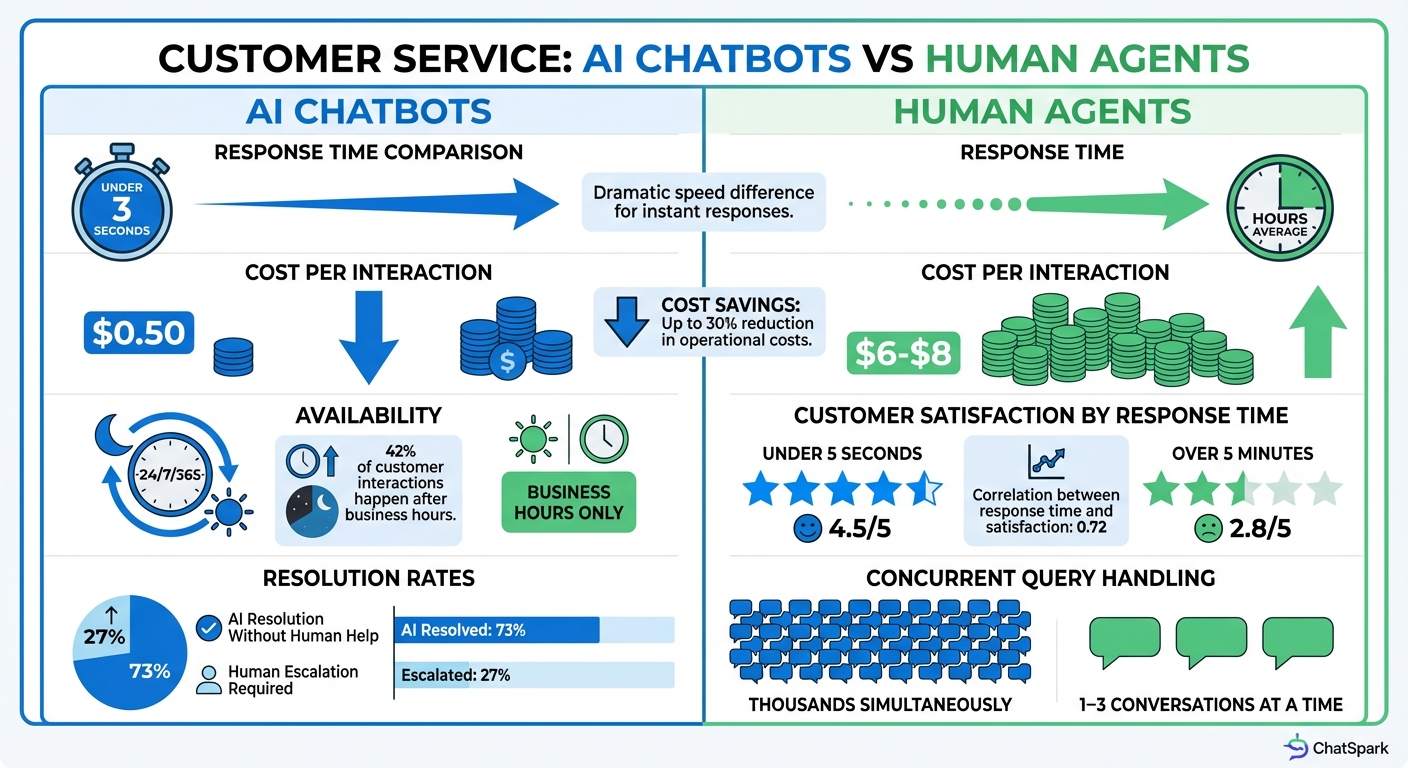
AI Chatbot vs Human Agent Performance: Response Time, Cost & Satisfaction Metrics
Core Features That Speed Up Response Times
Fast and efficient customer support is essential for keeping customers happy, and AI chatbots deliver on both fronts with features that transform how businesses handle customer interactions.
Always-On, Instant Availability
AI chatbots are ready to assist 24/7, providing answers in under 3 seconds, compared to the human average of 6.8 hours [1]. As the LoopReply team explains:
"The AI advantage in response time is structural - it cannot be closed by hiring more agents" [2].
This constant availability is critical, as 42% of interactions happen when live agents aren’t available [2]. And with 82% of customers expecting an immediate response during live chat [4], AI ensures satisfaction by meeting these demands. Quick responses make a noticeable difference: queries answered in under 5 seconds earn an average satisfaction score of 4.5 out of 5, while delays over 5 minutes cause satisfaction to plummet to 2.8 [2]. AI’s ability to handle large volumes of queries simultaneously only enhances this advantage.
Managing Multiple Queries at Once
Unlike human agents who can handle 1–3 conversations at a time, AI chatbots can manage thousands simultaneously [4]. This eliminates wait times, even during high-traffic periods like product launches or holiday sales.
For example, the salon chain HelloSugar automated 66% of its customer queries, saving $14,000 per month while expanding its locations without increasing support staff [6]. Similarly, appliance brand Atomberg handles over 2,500 daily queries on WhatsApp with an impressive 86% resolution rate, leaving only 14% of cases for human agents [6]. By using NLP to classify customer intent in seconds, AI efficiently resolves routine inquiries or escalates complex issues to the right team [3][4]. This capability extends across platforms, ensuring smooth customer experiences.
Multi-Platform Integration
Modern customers expect seamless support across channels, with 76% preferring multi-modal communication within a single thread [1]. Tools like ChatSpark make this possible, connecting websites, social media, email, SMS, and messaging apps like WhatsApp into one cohesive experience. Customers can switch channels without repeating details, keeping response times low and frustration minimal.
Personalizing Customer Interactions with AI
Speed is crucial for customer service, but personalized AI support takes it a step further by using historical data to provide context-aware solutions. Today’s customers expect tailored, data-driven support, and AI chatbots deliver just that. By analyzing customer data and past interactions, these tools provide precise and relevant responses. The results? Customers who experience personalized support are three times more likely to recommend the company and show a 20% increase in lifetime value (LTV) [7]. With 67% of consumers now expecting more personalized service thanks to AI's ability to analyze past interactions [8], personalization isn’t just a bonus - it’s essential. Here's how AI achieves this tailored approach.
AI-Powered Knowledge Retrieval
AI chatbots excel at pulling up accurate answers from vast knowledge bases, eliminating the need for manual searches. For returning customers, the chatbot’s ability to remember past interactions, preferences, and purchase history makes the experience even smoother [7].
Take ChatSpark, for example. Its knowledge retrieval system can process up to 500 pages of content per agent on the Pro plan, giving the AI a deep understanding of products and services. This capability contributes to the impressive 73% resolution rate that AI-powered chatbots achieve without needing human help [2]. This is a major improvement over older rule-based systems. Considering that 61% of abandoned chats are linked to poor first responses, training the AI on high-demand topics like order status or product details ensures customers get immediate, helpful answers [8].
Custom Branding and Communication Style
AI chatbots do more than just provide information - they can also reflect your brand’s unique voice and communication style. Whether your business leans toward a formal tone or a casual, conversational approach, the chatbot can adapt to maintain consistency across all interactions. This creates a natural and cohesive experience that aligns with your brand identity.
ChatSpark, for instance, allows businesses to tailor both the chatbot's branding and tone, ensuring every response matches company values and customer expectations. This personalization works seamlessly across all 85+ languages supported by the platform, whether customers connect through website chat, WhatsApp, or Instagram. The result is a smooth, human-like interaction that addresses customer needs at every stage of their journey [8].
Measuring Impact: CSAT and NPS Results
When it comes to customer satisfaction, speed and personalization are key drivers of success. Studies show a 0.72 correlation between response time and customer satisfaction - making it nearly twice as impactful as whether the interaction is handled by a human or AI [2]. Customers value quick replies, and AI chatbots excel in this area. For instance, when customers receive a response in under 5 seconds, they report an average satisfaction score of 4.5 out of 5. However, if the wait time exceeds 5 minutes, the satisfaction score plummets to 2.8 out of 5 [2].
AI adoption consistently boosts customer satisfaction, with typical increases of 10–20% [10]. Looking ahead, executives anticipate a 35% increase in NPS by 2027 [5]. A hybrid support model - where AI handles initial triaging before transferring to a human - delivers satisfaction scores of 4.4 out of 5, slightly outperforming human-only support at 4.3 out of 5 and AI-only interactions at 4.2 out of 5 [2].
ChatSpark Implementation Examples
Real-world applications highlight how AI transforms customer service. Take New Look, a British fashion retailer, as an example. In late 2024, they introduced AI agents to manage 9,500 weekly inquiries. This move slashed their First Reply Time by an incredible 99.5%, dropping from 16.5 hours to just 5 minutes. Additionally, full resolution times were cut by 30%, and AI independently resolved 42% of all customer queries [9]. Sam Ashton, Senior Customer Care Manager, remarked:
"Our AI Agents currently operate without integrations, yet they already resolve an average of 42% of customer queries independently." [9]
Another success story comes from Klarna, a fintech giant serving 150 million customers. In 2025, they implemented an AI assistant that reduced average resolution times from 11 minutes to just 2 minutes - an 82% improvement. This change also boosted customer satisfaction from 75% to 90% and saved the company $14.7 million annually in labor costs [10].
Meanwhile, TechCorp, a project management platform, faced a CSAT drop to 68% in late 2023. After a seven-month rollout of AI agents, their CSAT soared to 95.2%, marking a 40% relative improvement. Response times plummeted from 47 minutes to under 2 seconds, and the system achieved a 68% containment rate [11]. CEO James Wilson explained their approach:
"We treated this as a strategic transformation, not an IT project. That meant adequate budget, cross-functional collaboration, and patience." [11]
These examples underscore how faster, more accurate AI responses can significantly enhance customer satisfaction and loyalty.
Before and After Metrics Comparison
The data speaks for itself. Here's a comparison of key metrics before and after AI implementation:
| Company | Metric | Before AI | After AI | Improvement |
|---|---|---|---|---|
| New Look | First Response Time | 16.5 hours | 5 minutes | 99.5% decrease |
| Klarna | Resolution Time | 11 minutes | 2 minutes | 82% decrease |
| Klarna | CSAT Score | 75% | 90% | 20% increase |
| TechCorp | CSAT Score | 68% | 95.2% | 40% increase |
| TechCorp | Response Time | 47 minutes | Under 2 seconds | 99.9% decrease |
With ChatSpark, businesses can achieve similar outcomes, offering rapid and precise support in 85+ languages across various channels.
Getting Started with ChatSpark Plans
Ready to improve response times and customer satisfaction? Here's how you can dive into ChatSpark's plans and find the right fit for your needs.
Selecting Your ChatSpark Plan
Choosing the right ChatSpark plan depends on factors like monthly message volume, the size of your knowledge base, and the integrations you require. Here’s a breakdown:
- Basic Plan: Priced at $19/month, this plan supports up to 100 messages and 25 training pages. It's perfect for solo entrepreneurs looking to test AI support.
- Plus Plan: At $59/month, it expands capacity to 250 messages and 50 training pages. It also includes 5 AI Actions, which can handle tasks like booking appointments or tracking orders.
- Pro Plan: This plan, priced at $129/month, is designed for businesses needing omnichannel deployment. It supports 2,000 messages, integrates with websites and major social platforms, and includes 500 training pages, 40 AI Actions, GA4 event tracking, and monthly ROI reports.
- Enterprise Plan: With custom pricing, this plan is tailored for large-scale operations. It offers unlimited AI Actions, dedicated account management, and custom SLAs.
Here’s a real-world example: Between October 2025 and February 2026, ITW, a global leader in construction products, used ChatSpark for a flagship brand under Lorri G., their Customer Service & Technical Support Manager. Over four months, ChatSpark handled 10,754 messages with a 98% resolution rate, saving $47,880 on an investment of about $4,000 [12]. Lorri G. shared:
"ChatSpark has been managing two of our largest product lines over the past year. It currently handles an average of 1,831 chats per month without any human intervention. Since implementing it on our website, we've realized measurable savings of $119,225." [12]
Pro Tip: Start with the 14-day free trial on the Basic plan to see how it performs with your actual customer data. You can save 14% by opting for annual billing - almost like getting two months free! Need multiple AI agents? You can hold multiple plans under one account, and the limits will combine.
Expected Results by Plan Level
Each ChatSpark plan is designed to scale with your needs while delivering tangible results.
- The Basic plan ensures 24/7 availability for up to 100 queries each month, eliminating wait times for smaller businesses.
- The Plus plan steps it up with advanced intelligence and the CoPilot extension, handling 250 queries with better context awareness.
- The Pro plan offers omnichannel capabilities, managing 2,000 messages across platforms while maintaining conversation context.
- The Enterprise plan provides dedicated support and custom SLAs, ensuring instant responses even at a large scale.
Most clients notice a return on investment within the first month [12], with resolution rates typically ranging from 80% to 98% [12].
| Plan Level | Monthly Price | Message Capacity | Response Time Reduction | Primary Satisfaction Driver |
|---|---|---|---|---|
| Basic | $19 | 100 messages | Instant for all queries | 24/7 Availability |
| Plus | $59 | 250 messages | Instant for all queries | Advanced Intelligence & CoPilot |
| Pro | $129 | 2,000 messages | Instant for all queries | Omnichannel & ROI Reporting |
| Enterprise | Custom | Bespoke | Instant at scale | Dedicated Support & Custom SLAs |
Getting started is quick - setup takes less than 5 minutes for your first AI agent. Pro and Enterprise plans allow for immediate deployment across all channels. Plus, every automated resolution saves around 10 minutes of human agent time [13].
Conclusion
AI chatbots have proven their impact, with median response times as quick as 1.8 seconds, interaction cost reductions of up to 96%, and resolution rates hovering between 70% and 80% [2]. These capabilities are reshaping customer support while fostering stronger customer loyalty.
ChatSpark embodies these benefits for businesses of all sizes. Whether you're a solo entrepreneur managing 100 monthly queries on the Basic plan or a large enterprise juggling thousands of conversations across multiple channels, the platform scales effortlessly to meet your needs. Its hybrid approach - where AI handles routine questions and escalates more complex issues to human agents - consistently achieves an impressive satisfaction score of 4.4 out of 5 [2]. This balance between automation and human touch proves that efficiency and personalization can go hand in hand.
One standout advantage is scalability. ChatSpark adjusts seamlessly to seasonal demand surges, supports customers across time zones, and frees up your team to focus on higher-value tasks. With AI resolving 73% of conversations entirely [2], businesses can grow while maintaining top-notch customer experiences.
The evidence is clear: AI chatbots enhance response times, reduce costs, and improve satisfaction. The real question is, are you ready to embrace a solution that grows with your ambitions and keeps your customers happy 24/7?
FAQs
What should I automate with a chatbot first?
Automating repetitive, high-volume queries is a smart first step. Tasks like handling FAQs or managing routine support requests are perfect examples. These kinds of queries don’t usually need detailed human input, making them ideal for chatbot implementation.
The benefits? Faster response times, reduced costs, and happier customers. Plus, by letting chatbots take care of straightforward questions, human agents can focus on more complex, high-priority issues. This not only enhances service quality but also ensures a smoother rollout of chatbot technology with immediate, noticeable results.
How do I train a chatbot on my help docs and policies?
To create a chatbot that can assist customers using your help docs and policies, you'll need a knowledge-based AI system. This type of system processes your documentation and ensures responses are strictly based on that content. Start by uploading materials such as troubleshooting guides and company policies. These documents are then transformed into a structured dataset that the AI can reference.
When customers ask questions, the chatbot pulls relevant sections from your materials to provide accurate answers. The best part? If you update your documents, the chatbot automatically incorporates those changes, ensuring responses stay consistent and up-to-date.
When should a chatbot transfer to a human agent?
When a situation becomes too complex, requires a personal touch, or goes beyond what the AI is programmed to handle, a chatbot should seamlessly transfer the conversation to a human agent. This approach ensures that customers receive accurate information and the empathy they need, helping to maintain their trust and overall satisfaction.