
AI is transforming customer support by drastically reducing response times and improving efficiency. Here are five ways it achieves this:
- Automated Responses for FAQs: AI instantly handles common queries like password resets or order tracking, cutting response times from hours to seconds.
- Predictive Analytics: AI anticipates customer needs by analyzing behavior, addressing issues before they arise, and prioritizing urgent cases.
- Smart Ticket Routing: AI assigns tickets to the right agents based on urgency, sentiment, and expertise, ensuring faster resolutions.
- Multi-Channel Support: Tools like ChatSpark manage thousands of simultaneous conversations across platforms like WhatsApp, Instagram, and Slack, with consistent responses in under 2 seconds.
- AI-Powered Knowledge Bases: Customers can resolve issues independently through self-service options, reducing wait times and freeing up agents.
AI delivers round-the-clock support, handles high volumes, and integrates with existing tools to provide a seamless experience. Businesses adopting these strategies have reported up to a 97% reduction in response times, improved customer satisfaction, and significant cost savings.
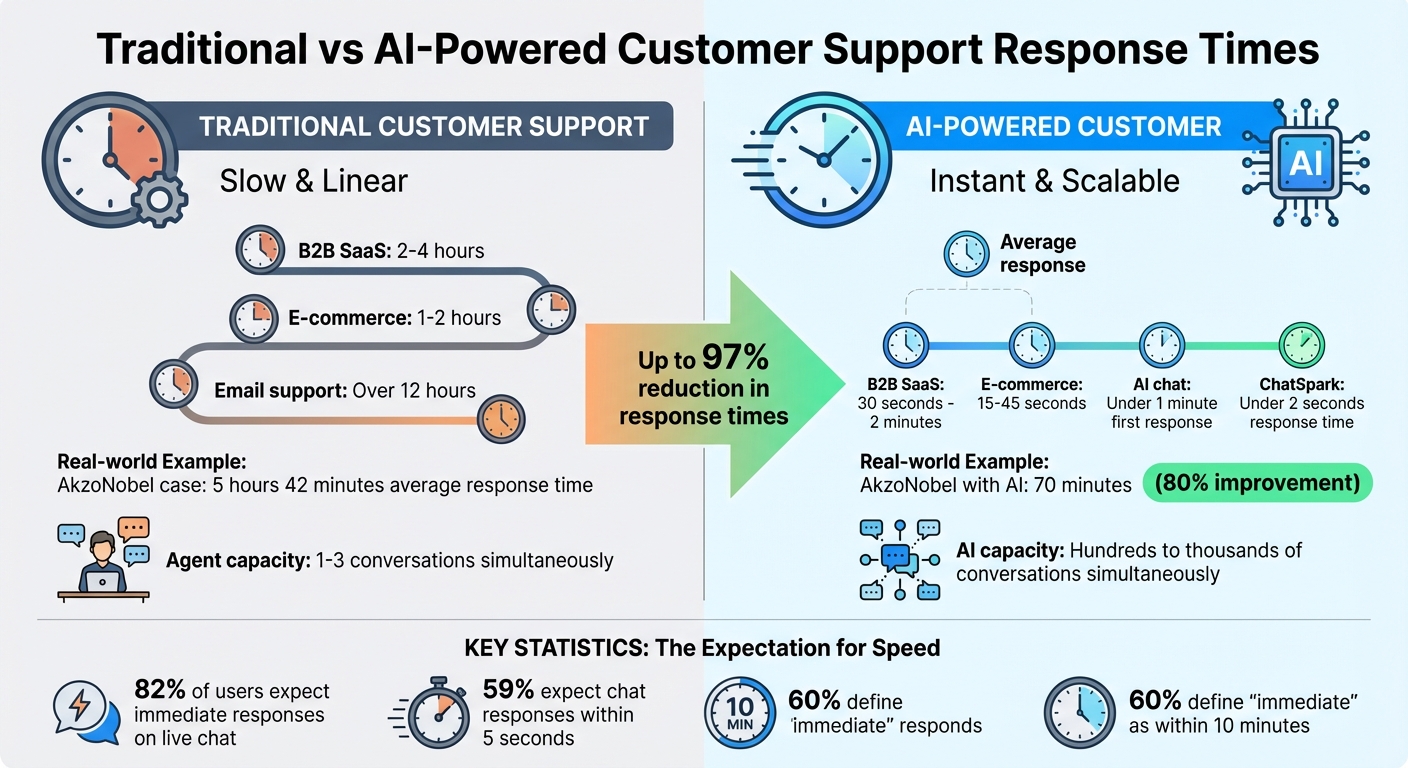
AI vs Traditional Customer Support Response Times Comparison
1. Automated Responses for Common Questions
Implementing AI to handle common customer inquiries is a game-changer for improving response times in customer support. Tasks like password resets, order tracking, and store hours often take up a lot of time for support teams. With AI, these questions are answered instantly by pulling information directly from your knowledge base, cutting out delays and manual effort.
Impact on Response Time Reduction
In traditional customer support, response times average between 2–4 hours for B2B SaaS and 1–2 hours for e-commerce. With AI, these times shrink dramatically - down to just 30 seconds–2 minutes for B2B and 15–45 seconds for e-commerce [3]. A notable example is AkzoNobel, which reduced its average response time from 5 hours 42 minutes to just 70 minutes, an impressive 80% improvement [2].
For more complex issues that still require a human touch, AI can assist by pulling up relevant knowledge base articles or suggesting prewritten responses. This allows agents to respond faster without starting from scratch [2][1].
Scalability Across Customer Support Channels
AI doesn’t just speed up responses - it scales seamlessly across multiple channels. While human agents can manage one to three conversations at a time, AI can handle hundreds or even thousands simultaneously without breaking a sweat [4]. By drawing from a centralized knowledge base - like FAQs, product guides, or internal manuals - it ensures accurate, consistent answers on websites, social media platforms, messaging apps, and email [6][4].
For example, a global construction products company used ChatSpark for four months in 2025 and achieved a 98% AI resolution rate across 10,754 messages. This saved over 66 days of agent time and delivered $47,880 in operational savings from an investment of just $4,000 [5].
Availability and Language Support
AI’s ability to provide instant, round-the-clock support is critical in meeting customer expectations, with 82% of users expecting immediate responses on live chat [4]. Tools like ChatSpark also support more than 85 languages, enabling businesses to serve global audiences without needing multilingual teams or worrying about time zones [5]. By starting with high-volume FAQs - like order tracking or other "Level 1" questions - you can immediately reduce queue congestion and improve efficiency [6].
2. Predictive Analytics for Customer Needs
Predictive analytics goes beyond simple AI-powered reactions by forecasting what customers might need before they even reach out. Instead of waiting for tickets to pile up, AI examines behavioral cues - like clicks, search queries, scrolling habits, and purchase patterns - to spot trends and predict potential issues. This forward-thinking approach allows support teams to tackle problems early, reducing the risk of a ticket backlog. Essentially, it builds on automated responses by addressing concerns before they become problems.
This strategy not only minimizes delays but also enhances the efficiency of other AI-driven tools, creating a more streamlined support system.
Impact on Response Time Reduction
Data highlights just how transformative predictive analytics can be. For instance, a case study revealed that combining predictive analytics with routing automation slashed first response times by an impressive 97%. This proactive approach also boosted the AI resolution rate from 25% to 50%. Additionally, predictive routing - which pairs customers with the most suitable agents - reduced repeat calls by 40%[2].
Integration Capabilities with Existing Tools
Predictive analytics isn’t just about faster responses - it also integrates effortlessly with the tools you already use. By syncing with CRMs, help desks, and e-commerce platforms, AI can access real-time data to provide instant updates on things like order statuses, account renewals, or refunds - all without needing manual input from agents[4].
A real-world example: Between 2020 and 2024, MetLife introduced AI tools in its call centers that could detect emotional cues, such as changes in voice pitch or overlapping speech. The result? A 3.5% improvement in first-call resolution rates and a 13% increase in customer satisfaction[4].
Platforms like ChatSpark make integration even easier. By connecting with thousands of tools via Zapier and working directly with systems like Shopify and Freshchat, businesses can unify their data into one reliable source. For instance, in October 2024, a global telecommunications company used AI to analyze millions of call transcripts. This flagged 33% of at-risk customers that traditional methods had overlooked, helping the company retain 7,000 to 12,000 customers every month[4].
3. Smart Ticket Routing and Priority Assignment
Smart ticket routing uses AI to analyze incoming requests and direct them to the right place. Through natural language processing (NLP), AI scans for keywords, gauges sentiment, and assesses urgency. It flags terms like "urgent" or "error" to ensure critical issues are addressed promptly, avoiding unnecessary back-and-forth between departments[7].
But it doesn’t stop at analyzing what customers say - it also considers who they are. By pulling data from CRMs and historical logs, AI evaluates factors like account value, SLA commitments, and past interactions to make more informed routing decisions[8]. For example, a high-value customer disputing a bill might be prioritized over someone needing help with a password reset. AI even assigns tickets to agents based on their expertise, workload, and past performance. This ensures that complex problems reach the right specialist, leading to faster and more effective resolutions[8][6].
Impact on Response Time Reduction
AI-driven routing significantly improves response times, complementing earlier automation efforts. By streamlining the triage process, AI reduces average handling time by 40%[6]. Companies have also reported a 17% boost in customer satisfaction scores, consistent with earlier findings[6]. This is critical because customer expectations for speed are high: 59% of consumers expect chat responses within 5 seconds, and 60% define "immediate" as a reply within 10 minutes or less[9]. While traditional email support often takes over 12 hours, AI can cut first response times to under 1 minute[9].
Integration Capabilities with Existing Tools
Smart routing becomes even more powerful when integrated with existing tools and data sources. By tapping into knowledge bases and customer histories, no-code platforms can help you automate small-business customer service and establish effective routing logic[7]. For instance, ChatSpark connects seamlessly with platforms like websites, Instagram, Facebook, WhatsApp, Telegram, and Slack. This creates a unified data hub that enables smarter, faster routing decisions, ensuring customers receive timely and accurate support.
4. Multi-Channel Support with ChatSpark
Once ticket routing is streamlined, the next step is ensuring customer support across all platforms. Today’s customers rely on channels like Instagram, WhatsApp, and Messenger, and managing these manually can quickly become overwhelming. ChatSpark simplifies this by deploying a single AI agent across six major platforms: Website, WhatsApp, Instagram, Facebook Messenger, Telegram, and Slack [10]. With consistent training data powering the AI, it delivers uniform responses across all channels in less than 2 seconds [10].
By integrating multiple platforms seamlessly, ChatSpark ensures faster, more consistent customer interactions.
Impact on Response Time Reduction
Traditional customer support can leave users waiting for hours. ChatSpark, on the other hand, delivers accurate, on-brand responses in under 2 seconds [10]. Even more impressive, it resolves more than 80% of customer inquiries automatically, freeing up human agents to tackle complex issues [10].
"ChatSpark has been managing two of our largest product lines over the past year. It currently handles an average of 1,831 chats per month without any human intervention. Since implementing it on our website, we've realized measurable savings of $119,225."
– Lorri G., Customer Service & Technical Support Manager [10]
Scalability Across Customer Support Channels
ChatSpark excels at managing over 1,000 simultaneous chats without any drop in performance, making it a perfect solution for handling traffic surges or operating on a global scale [12]. Once the AI is trained, it can be rolled out across multiple customer touchpoints. Businesses can start with a website widget and later expand to mobile-friendly platforms like WhatsApp or Instagram, depending on where engagement is highest [11]. For critical situations - like legal notices or when customers request a live agent - Canned Responses can be configured to ensure accurate messaging and seamless handoffs to human support [12].
Availability and Language Support
ChatSpark supports more than 95 languages right out of the box [10]. It automatically detects a visitor’s language from the first message with over 99.9% accuracy and responds in their native language - no manual input required [13]. Using a single set of training data, typically in English, the system translates responses instantly while accounting for regional differences, cultural nuances, and local date formats [13]. This means a customer in Mexico City can receive immediate help in Spanish at 2:00 AM, while someone in Tokyo gets support in Japanese at the same time - all handled by the same AI agent working around the clock [10].
5. AI Knowledge Base and Self-Service Options
Building on the foundation of quick automated responses and intelligent ticket routing, an AI-driven knowledge base enables customers to solve problems on their own. Today’s customers expect this level of convenience - 88% of customers now want brands to offer self-service options [14], and 75% expect immediate service within five minutes of reaching out online [2]. By leveraging Natural Language Processing (NLP), an AI knowledge base goes beyond simple keyword matching to understand customer intent. For example, if a customer types "my screen is black", the AI interprets this as a power-related issue and pulls up the appropriate help article [14].
Impact on Response Time Reduction
Self-service options eliminate delays for routine questions, significantly cutting down response times. With AI in the mix, resolution rates can increase from 25% to 50%, all while providing round-the-clock support without requiring additional staff [3].
"Our customers are developers who expect quick, actionable support. We needed a way to meet them where they work without slowing down." - Lee Vaughn, Manager of Support Engineering, AssemblyAI [3]
This ability to deliver fast, self-service solutions scales effortlessly across all support channels.
Scalability Across Customer Support Channels
AI knowledge bases rely on a single, centralized source of information that spans every channel - whether it’s chat, phone, email, or self-service portals [14]. This ensures consistent answers across platforms, even during high-traffic periods. The system can handle hundreds or even thousands of simultaneous conversations without breaking a sweat, which is critical during spikes in demand. Companies using integrated systems report retaining 89% of their customers, compared to much lower retention rates for businesses with disconnected tools [14]. Additionally, AI can automatically sort, prioritize, and route tickets based on urgency and intent, efficiently managing seasonal traffic surges of up to 1,300% without compromising performance [4].
Integration Capabilities with Existing Tools
ChatSpark’s AI knowledge base integrates seamlessly with tools like website widgets, WhatsApp, Slack, and email. Help content can be structured in a Q&A format to boost AI accuracy [3], and it’s deployed through a single omnichannel hub [3]. For specific scenarios, such as pricing pages or product cards, AI Agent Triggers can be set up to launch the chat widget with pre-filled, context-specific prompts [15]. This ensures customers receive the right help exactly when and where they need it, enhancing their overall experience.
Conclusion
AI has reshaped customer support, cutting response times from hours to mere seconds - a shift highlighted by the strategies discussed earlier.
These strategies - automated responses, predictive analytics, smart ticket routing, multi-channel support, and AI-driven knowledge bases - show how businesses can build faster, smarter, and more scalable support systems. With 66% of consumers emphasizing that valuing their time is the most critical thing a company can do [2], speed has become a must-have, not just a nice-to-have.
For businesses looking to make this leap, starting small is a smart move. IBM CEO Arvind Krishna puts it succinctly:
"Take things that are extremely low risk and deploy it there - meaning customer experience and answering service calls" [1].
Focus first on automating repetitive tasks like order tracking or password resets, then gradually tackle more complex workflows [6]. Tools like ChatSpark make this transition manageable with features like 24/7 availability, multi-channel support, and functionality in over 85 languages. Whether you're a solo entrepreneur starting at $19 per month or a large enterprise with intricate requirements, ChatSpark adapts without losing the context of conversations.
The move to AI-powered support is about meeting customers exactly when and where they need help, offering solutions that are both timely and effective. In a world where 75% of customers expect service within five minutes of reaching out online [2], AI isn’t just a glimpse of the future - it’s the standard of today.
FAQs
How do I start using AI without replacing my agents?
Start by treating AI as a helpful assistant rather than a replacement for your agents. AI can manage routine tasks, like answering frequently asked questions or providing round-the-clock support. This allows your team to dedicate their energy to tackling more complex, nuanced issues. Tools like ChatSpark are built to work alongside your agents, enhancing response times and efficiency while ensuring that meaningful, high-value interactions stay in the hands of your human team.
What data does AI need to route tickets correctly?
AI relies on key details like customer inquiry information, ticket categories, urgency levels, and conversation context. These elements help it accurately categorize and prioritize tickets, ensuring they are routed faster and handled more efficiently.
How do I keep AI answers accurate across every channel?
To keep AI responses accurate across all channels, it's essential to adopt a unified data strategy and ensure information remains consistent. By integrating AI tools for managing multiple channels, you can maintain context and uniformity in interactions. It's also crucial to regularly update the AI's knowledge base, use advanced analytics to refine insights, and synchronize data across platforms. These practices ensure responses stay precise, relevant, and aligned with the needs of each interaction.