AI intent recognition is the process of understanding a user's goal or purpose behind their input. Unlike simple keyword matching, it uses natural language processing (NLP) to analyze context, semantics, and even typos or slang to identify what the user wants. For example, when someone asks, "Where's my order?" the system recognizes an order tracking intent and directs it to the correct workflow.
Why It Matters:
- Efficiency: Handles up to 80% of routine customer queries without human help.
- Cost Savings: Reduces operational costs by automating repetitive tasks.
- Better Customer Experience: Quickly resolves queries and improves satisfaction.
How It Works:
- Preprocessing: Cleans and tokenizes text for analysis.
- Vectorization: Converts text into numerical data for machine learning.
- Intent Classification: Identifies user intent and entities (e.g., dates, product names).
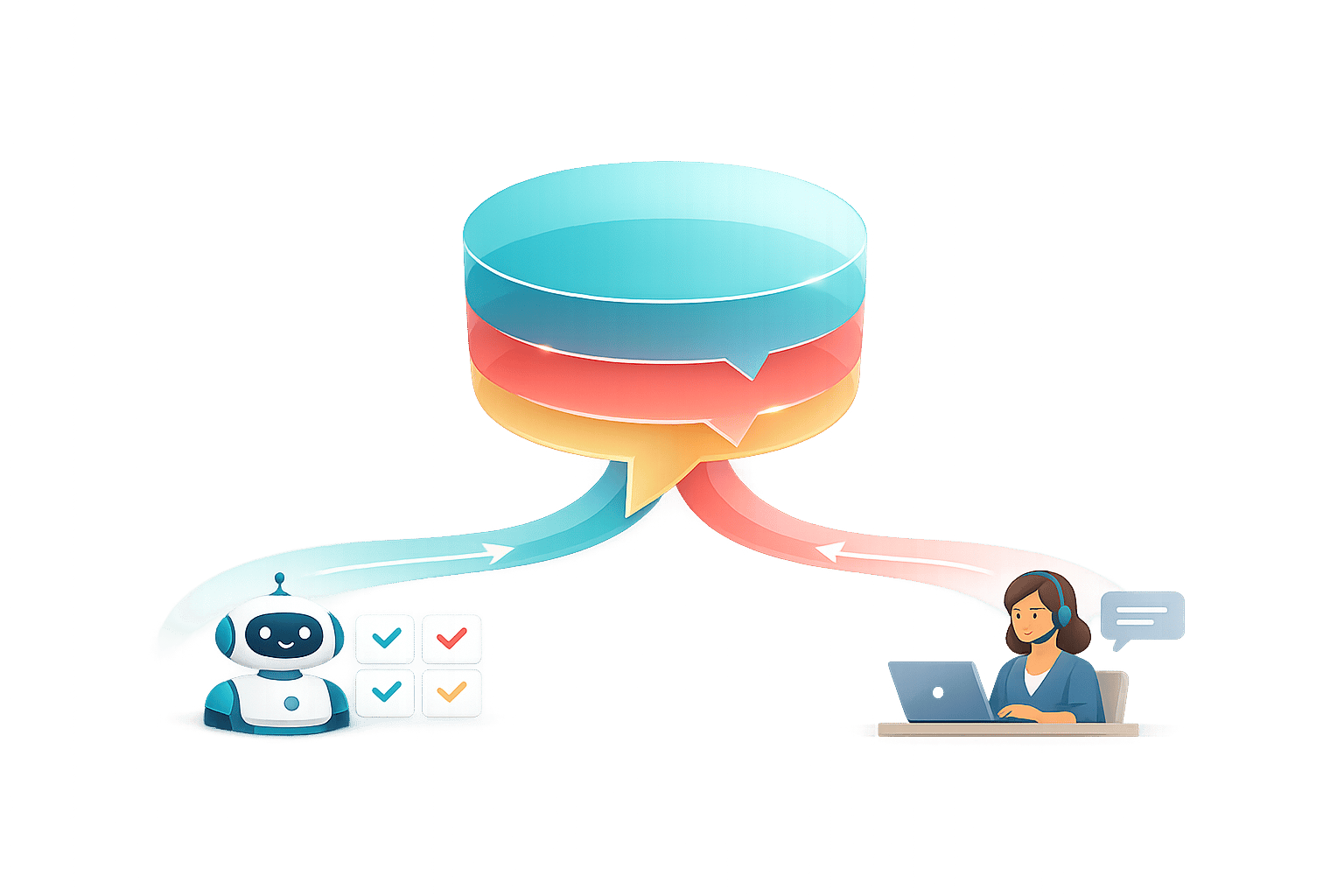
- Confidence Scoring: Ensures accurate responses or triggers human intervention for low-confidence cases.
Technologies like deep learning, transformers (e.g., BERT, GPT), and platforms like ChatSpark make intent recognition more accurate and scalable. Businesses using these systems report faster query resolution, higher customer satisfaction, and significant cost reductions.
AI intent recognition is transforming customer support, offering faster, smarter, and more personalized interactions.
How AI Intent Recognition Works
Core Steps in Intent Recognition
AI intent recognition starts with preprocessing the input. This involves cleaning up the text by removing punctuation, numbers, and stop words, followed by breaking the text into smaller units like words or n-grams for analysis [6].
The next step is feature extraction and vectorization. Here, the system converts text into numerical representations called embeddings, often in 300 dimensions. This allows phrases like "not switching on" and "cannot power up" to be understood as conveying the same intent [6].
At the core of the process is intent classification. Machine learning models take the vectorized input and classify it into specific intents, such as order_status or password_reset. Alongside this, the system identifies entities like dates, locations, or product names to add context [1][6][5].
Each prediction is accompanied by a confidence score between 0.0 and 1.0. If the score exceeds a predefined threshold (commonly 0.5), the system matches the intent and triggers the corresponding action or response. When the confidence score is too low, a "no-match" event is triggered to prevent incorrect responses [1][7]. Advanced systems can even handle multiple intents in a single sentence. For instance, "I want to return my order and ask for a refund" includes both "return" and "refund" intents [6].
These steps lay the groundwork for more complex models that improve accuracy and contextual understanding.
Technologies Behind Intent Recognition
Building on these foundational steps, various technologies enhance the performance of intent recognition systems. Classical machine learning methods, such as Support Vector Machines (SVM), Random Forests, and Logistic Regression, use features like TF-IDF and n-grams to classify text. These methods are effective for smaller datasets and controlled environments but struggle with more complex language variations.
Deep learning architectures have become the go-to choice for most production systems. Convolutional Neural Networks (CNNs) are adept at identifying local patterns in text, while Bidirectional Long Short-Term Memory networks (BiLSTM) excel at capturing sequential information and long-range dependencies. Multi-head attention mechanisms further refine accuracy by focusing on the most relevant parts of a sentence [6][9].
Transformer models, such as BERT and RoBERTa, take this a step further by capturing deep contextual and semantic nuances. For example, they can differentiate between "Apple" the company and "apple" the fruit based on the surrounding words. A BERT-based medical chatbot demonstrated this capability by achieving 98% accuracy through natural language processing [9]. Large language models (LLMs) like GPT and Claude simplify intent recognition with zero-shot or few-shot learning, allowing for quick implementation without requiring extensive labeled datasets [9].
Platforms like ChatSpark utilize these advanced technologies to deliver accurate intent recognition in over 85 languages, ensuring the speed and reliability necessary for round-the-clock customer support.
How to Implement AI Intent Recognition
Define Intent Categories
Start by outlining the main customer intents, such as "Order Status" or "Account Help", along with structural intents like "Greetings" or "Speak to human" [11]. Initially, aim for 30-40 intents, and as your data grows, expand to 60-80 [11].
Focus on queries that make up at least 2% of your total conversation volume [11]. To pinpoint these high-frequency patterns, use content coverage analysis on historical chat logs, support tickets, and emails. It's also important to include a fallback intent (often labeled "None") for questions outside your scope - this should account for about 10% of your training utterances [10].
"A good intent structure is the foundation of a strong AI model." - Zendesk [11]
Avoid creating separate intents for minor variations. Instead, use entities to capture distinctions [10][11]. Keep the vocabulary for each intent unique - if two intents share too much overlapping language, merge them and rely on entities to differentiate [10][11].
Train and Fine-Tune Models
Collect 10-20 diverse training phrases per intent, drawing from real customer conversations. Include examples with typos, slang, and informal language to ensure the model can handle real-world inputs. Annotate these phrases to extract structured data like dates, locations, or order IDs [13][7][14]. Set a classification threshold (commonly between 0.5 and 0.7) to determine when a confidence score is high enough to trigger a response [7]. Regularly monitor intent health (average confidence scores) to identify intents that may need more training data [11]. Additionally, include a default negative intent to train the model on phrases that don’t match any defined categories [7].
Once the model is trained, deploy it to provide real-time responses seamlessly.
Integrate with Conversational AI Platforms
Platforms like ChatSpark make it easy to deploy your trained intent recognition system across multiple channels, offering 24/7 support in over 85 languages. Integration typically involves connecting your intent model to the platform's natural language understanding engine and mapping recognized intents to specific responses or automated workflows.
Set up human handoffs for complex or low-confidence queries. Use function calling to generate structured outputs like {"intent": "Order_Status", "order_id": "12345"}, which can automatically trigger API calls [15]. Regularly review confusion matrices to spot overlapping intents that need refinement, ensuring your model maintains an accuracy rate above 90% for production-level performance [15].
Benefits and Challenges of AI Intent Recognition
Benefits of Intent Recognition
When implemented effectively, AI intent recognition offers a host of advantages for businesses, especially in terms of operational efficiency and customer engagement. For instance, it can cut response times by as much as 50% by quickly identifying customer needs and providing relevant answers 24/7 [4]. Companies that respond to inquiries within an hour are nearly seven times more likely to qualify leads compared to those that delay their responses [8].
By automating routine tasks - like tracking orders or handling password resets - and analyzing customer interaction patterns, this technology enables human agents to focus on more complex issues. At the same time, it helps businesses identify recurring problems and fine-tune their services [4][6]. Many organizations that adopt AI-powered customer service solutions report operational cost reductions of around 40% and a boost in customer engagement by up to 30% [4].
"For example, Bank of America's AI assistant, Erica, now sees users engaging with it for advice and insights over 60% of the time, rather than just for basic transactions" [4].
Another key advantage is the system's ability to understand the intent behind a query - going beyond simple keyword matching. This allows for more personalized responses, which can enhance customer satisfaction and build stronger brand loyalty [4][15].
Common Challenges and Solutions
Despite its benefits, implementing AI intent recognition comes with its own set of challenges. One major hurdle is ensuring high-quality, accurately labeled data. Manual labeling is a time-intensive process, and a lack of domain expertise can lead to biased labels [8][6]. To address this, businesses should use real customer conversations, which include natural variations like typos, slang, and diverse phrasing, instead of relying solely on synthetic templates [15].
Ambiguity and context also pose significant challenges. For example, a word like "mouse" could refer to either an animal or a computer accessory, potentially confusing the system [2]. One way to handle this is by setting a confidence threshold - commonly around 0.7. If the AI is unsure of its prediction, it can either escalate the query to a human agent or ask the user for clarification [15][1].
Improving intent recognition is a top priority for 60% of brands, and ongoing efforts have significantly increased accuracy rates - from about 80% in 2020 to over 95% by 2024 [16]. However, overlapping intents remain a common issue. When too many categories share similar language, the AI may struggle to differentiate between them. Regularly reviewing the confusion matrix to identify and address frequently mixed-up intents can help. Merging similar categories into broader ones and organizing intents around nouns (like "Refunds" or "Invoices") instead of verbs can also improve performance [11][15].
"Grouping around nouns will lead to much higher performance" - Benjamin Aronov, Developer Advocate at Vonage [15].
How Do Intent Recognition Mechanisms Actually Work?
AI Intent Recognition vs. Keyword-Based Systems
AI Intent Recognition vs Keyword-Based Systems Comparison
Key Differences and Advantages
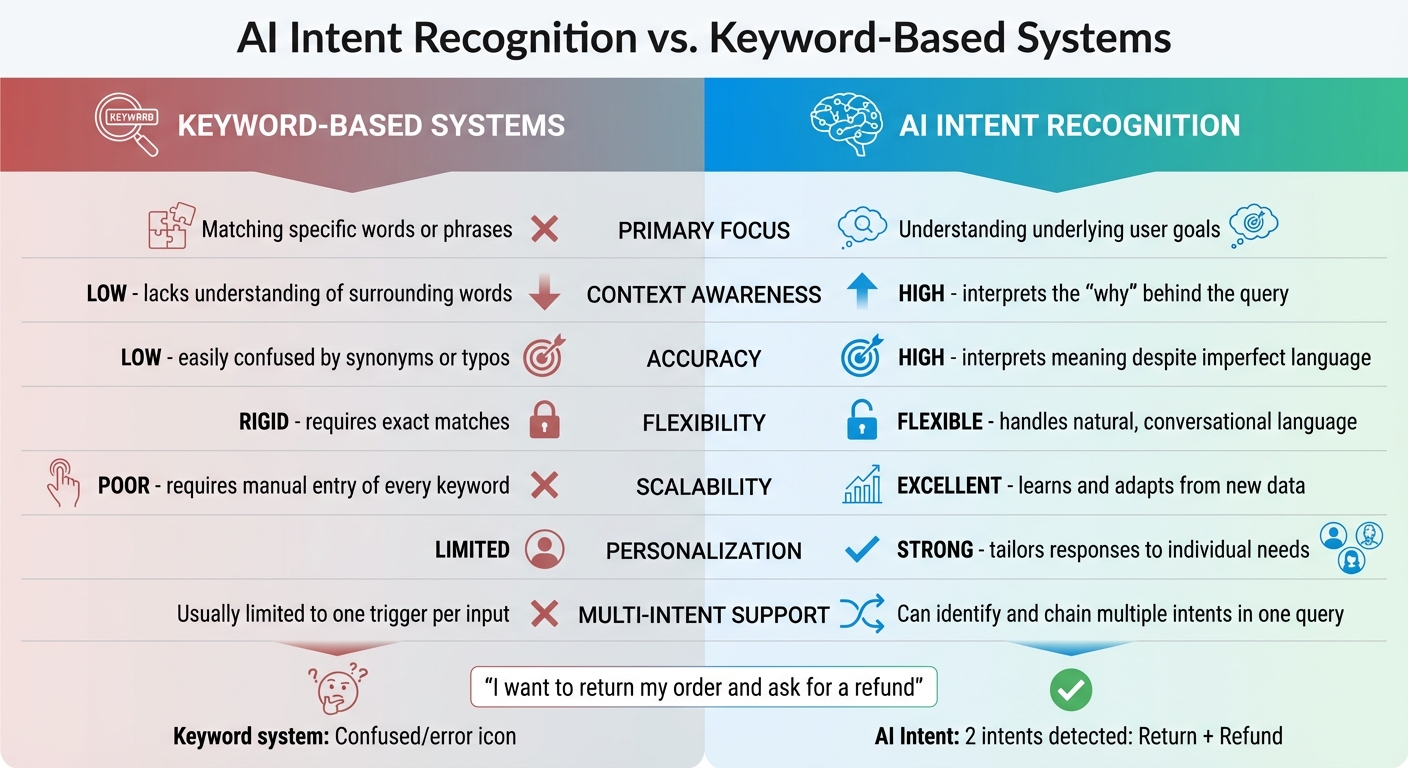
The fundamental difference between these two approaches lies in how they interpret user input. Keyword-based systems focus on identifying specific words or phrases within a message and triggering pre-set responses when matches are found [17]. In contrast, AI intent recognition evaluates the entire message to grasp the user's actual purpose or goal [3].
This distinction becomes critical in practical scenarios. For example, a keyword-based system might struggle to differentiate between "book a flight" and "change a flight" simply because both include the word "flight" [17]. On the other hand, AI intent recognition can discern that these are entirely different requests. Moreover, advanced AI models are capable of identifying multiple intents within a single sentence. For instance, in a query like "I want to return my order and ask for a refund", AI systems can process both actions simultaneously [6].
Another significant advantage of AI systems is their ability to learn and improve over time by analyzing data. This adaptability makes them more effective as businesses expand and customer inquiries grow more varied. For example, a global e-commerce company experienced 30% faster query resolution times and a 25% increase in customer satisfaction scores after transitioning from a keyword-based system to one powered by natural language processing (NLP) [3].
These differences highlight why AI intent recognition is becoming a cornerstone for providing efficient, high-quality customer support. The comparison table below further illustrates these distinctions.
Comparison Table: Intent Recognition vs. Keyword-Based Systems
| Feature | Keyword-Based Systems | AI Intent Recognition |
|---|---|---|
| Primary Focus | Matching specific words or phrases [17] | Understanding underlying user goals [3] |
| Context Awareness | Low; lacks understanding of surrounding words [3] | High; interprets the "why" behind the query [17] |
| Accuracy | Low; easily confused by synonyms or typos [17] | High; interprets meaning despite imperfect language [17] |
| Flexibility | Rigid; requires exact matches [17] | Flexible; handles natural, conversational language [17] |
| Scalability | Poor; requires manual entry of every keyword [17] | Excellent; learns and adapts from new data [17] |
| Personalization | Limited [3] | Strong; tailors responses to individual needs [3] |
| Multi-Intent Support | Usually limited to one trigger per input | Can identify and chain multiple intents in one query [6] |
Conclusion
AI intent recognition is now the driving force behind smarter, more efficient conversational AI. By focusing on the purpose behind a customer’s message rather than just scanning for keywords, this technology delivers 24/7 automated support, resolves queries faster, and creates personalized interactions that lead to real results [18][2].
The numbers speak for themselves. Top-performing models now boast over 90% accuracy in identifying user intent [15]. This precision, combined with automated systems, was projected to save industries more than $7 billion annually by 2023 [8]. Such advancements ensure that conversational AI systems can consistently understand customer needs and respond appropriately.
For intent recognition to work effectively, a strong foundation is essential. This means defining intents clearly, training models with real-world conversational data (including slang and typos), setting an optimal confidence threshold (around 0.7) to trigger human intervention when necessary, and continuously monitoring performance metrics to fine-tune the system [15].
Platforms like ChatSpark exemplify how these capabilities translate into actionable solutions. ChatSpark supports omnichannel deployment across platforms like websites, WhatsApp, Facebook, Instagram, Telegram, and Slack. It offers instant, brand-consistent responses in over 85 languages. The platform also manages lead capture and ensures seamless handoffs to human agents for complex queries, all while being easy to set up without extensive technical knowledge [12].
This shift from keyword-based systems to AI-powered intent recognition is more than just a technical upgrade - it’s a game-changer in how businesses understand and engage with their customers. With the right tools and strategies, every interaction becomes an opportunity to deliver accurate, efficient, and meaningful support. AI intent recognition is redefining what’s possible in customer communication.
FAQs
How does AI intent recognition make customer service more efficient?
AI intent recognition helps businesses improve customer service by leveraging natural language processing (NLP) to determine what a customer’s message is about. Whether someone is asking a question, requesting support, or making a purchase, this technology identifies their intent instantly, allowing for faster, more precise responses.
By automating processes like directing inquiries to the correct department or agent, it minimizes wait times and eliminates the frustration of customers having to repeat themselves. This technology also helps businesses handle urgent matters more efficiently, optimize workflows, and deliver tailored assistance - all while lightening the load for human agents. The end result? Faster issue resolution and happier customers.
What technologies make AI intent recognition accurate?
AI intent recognition depends on a mix of technologies to understand and interpret user inputs effectively. At the heart of this process is Natural Language Processing (NLP), which enables the system to break down text or speech, identify key words, analyze sentence structures, and grasp context. This helps the AI figure out what the user wants.
Next, classification algorithms come into play. These assign user inputs to specific intents, like "track an order" or "reset a password", ensuring the AI provides a relevant response.
Some advanced systems go a step further by incorporating semantic matching and using conversation history. These additions help the AI understand the context better, making its responses more accurate and meaningful. Together, these technologies power smooth, natural interactions in tools like chatbots, voice assistants, and customer support systems.
How can businesses successfully implement AI intent recognition?
To get AI intent recognition up and running effectively, businesses need a clear plan. Start by pinpointing the specific intents you want the system to recognize. Keep it simple at first - around 30-40 intents is a good starting point. Group these intents into logical categories, such as Account Management or Billing, to make the system more organized and easier to scale later.
The next step is training the system with high-quality, varied data. Aim to provide 80-100 examples for each intent, preferably pulled from actual user interactions. This helps the AI learn to identify and classify queries more accurately. Setting confidence thresholds is also key - this ensures the system can handle unclear inputs appropriately, avoiding confusion.
Finally, connect the intent recognition system to a conversational AI platform like ChatSpark. This allows businesses to automate tasks like customer support or lead generation while maintaining natural and precise interactions. Don’t forget to regularly monitor and fine-tune the system to keep up with changing user behavior. This ongoing effort is crucial for long-term effectiveness.