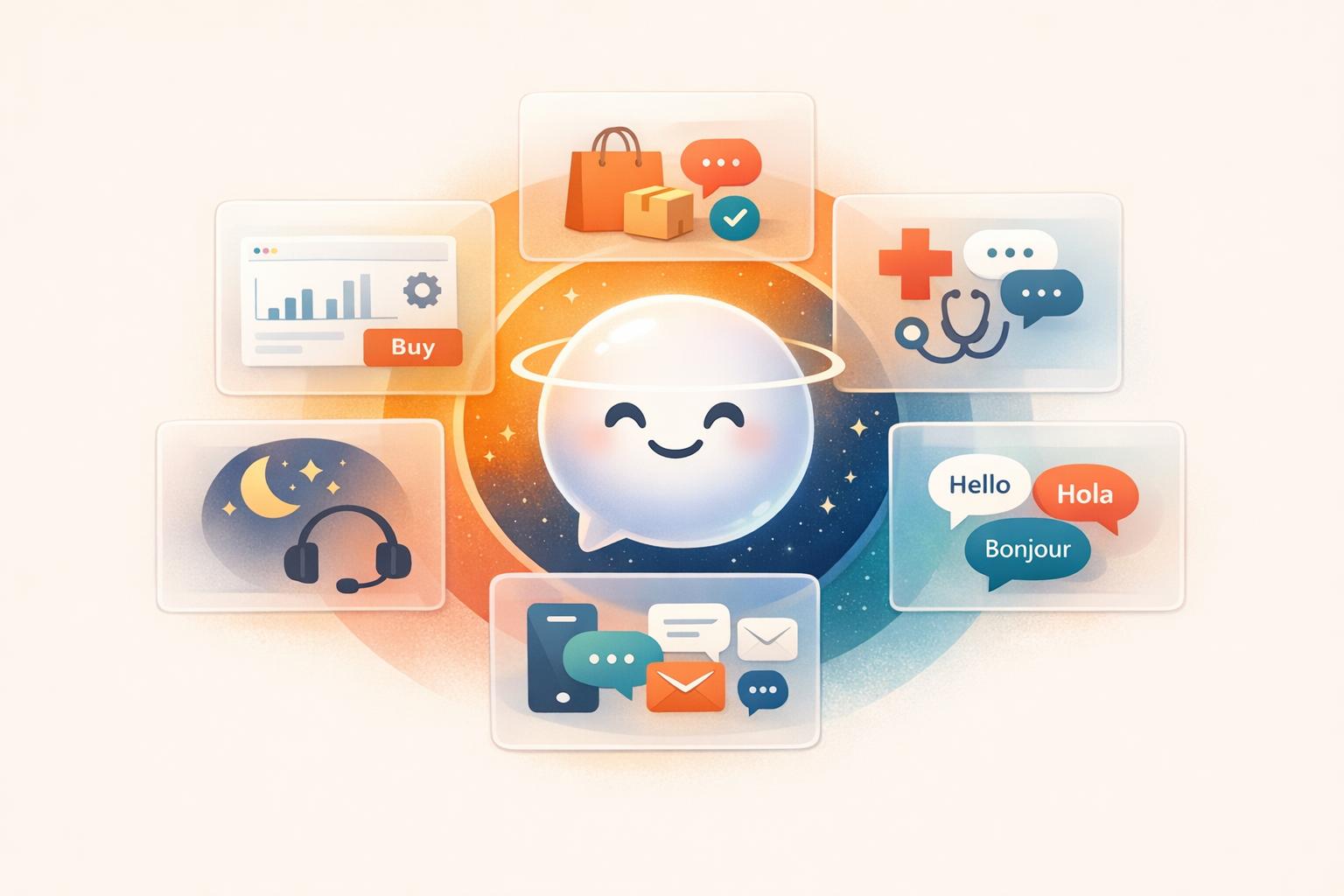
Conversational AI is changing how businesses interact with customers, saving costs, and improving efficiency. It uses advanced technologies like Natural Language Processing (NLP) and Machine Learning (ML) to provide human-like interactions, automate repetitive tasks, and handle complex workflows - like processing refunds or scheduling appointments - without human input.
Why It Matters:
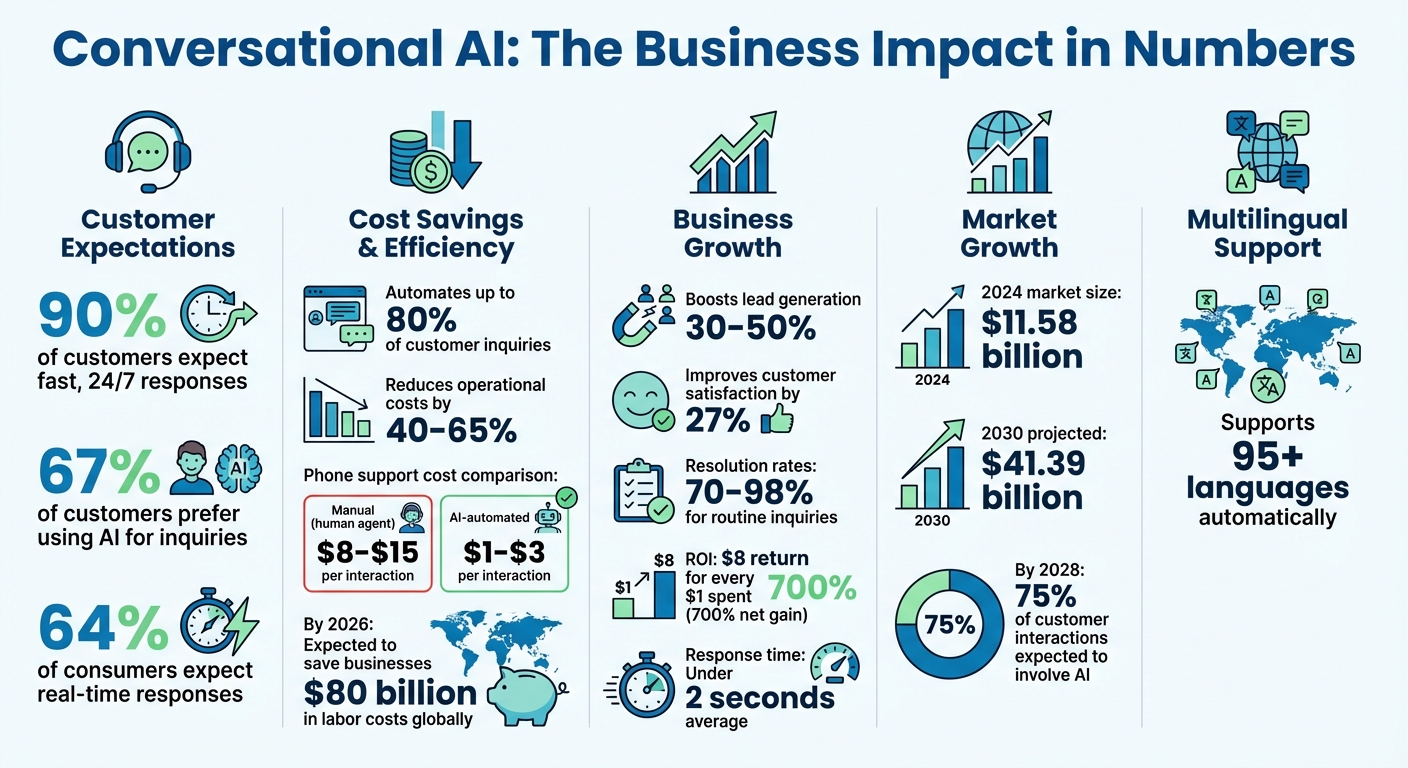
- Customer Expectations: 90% of customers expect fast, 24/7 responses.
- Cost Savings: Automates up to 80% of inquiries, reducing costs by 40%–65%.
- Business Growth: Boosts lead generation by 30%–50% and improves customer satisfaction by 27%.
- Market Impact: By 2026, Conversational AI is expected to save businesses $80 billion in labor costs.
Key Features:
- Contextual Understanding: Recognizes intent, maintains conversation flow, and retrieves relevant data.
- Omnichannel Integration: Works across websites, messaging apps, and social media.
- Efficiency: Handles thousands of interactions simultaneously, reducing wait times to seconds.
Whether you're looking to implement AI customer support or improve internal operations, Conversational AI offers measurable results. Businesses using tools like ChatSpark have reported faster response times, higher satisfaction rates, and significant cost reductions.
Conversational AI Business Impact: Key Statistics and ROI
What Is Conversational AI?
Conversational AI combines technologies like Natural Language Processing (NLP), Machine Learning (ML), and Large Language Models (LLMs) to enable computers to interact with humans in a way that feels natural [6]. It doesn't just respond to words - it understands context, interprets intent, and keeps conversations flowing smoothly across multiple exchanges [6].
Nurix.ai puts it simply: "Chatbots automate conversations; conversational AI automates work" [6].
These systems go beyond basic chat. They integrate with backend systems to perform tasks like updating CRM records, processing refunds, qualifying leads, and managing complex workflows - all without needing human input [6].
The market for conversational AI is booming. In 2024, it reached $11.58 billion, and it's expected to grow to $41.39 billion by 2030 [6]. Companies using these tools see significant benefits, including cutting operational costs by 40% to 65%. When implemented effectively, these systems can resolve 70% to 85% of predictable customer inquiries [7, 5].
Core Components of Conversational AI
To understand what sets conversational AI apart from simpler tools, let's break down its four main components:
- Natural Language Understanding (NLU): This technology deciphers user input to determine intent and extract details like dates or account numbers. It focuses on understanding meaning, not just keywords [6].
- Natural Language Generation (NLG): Instead of sticking to pre-written templates, NLG creates dynamic, context-aware responses based on the conversation's flow and history [6].
- Machine Learning (ML): ML continuously learns from vast amounts of interaction data, improving the system's ability to provide accurate and effective responses over time [6].
- Omnichannel Integration: This ensures users have a seamless experience across platforms - whether they're interacting via voice, text, mobile apps, or social media. Advanced systems are even starting to handle images and documents within conversations [6].
Business Applications
These technologies aren't just impressive - they're practical, transforming how businesses operate.
- Customer Support: Conversational AI handles routine tasks like tracking orders, resetting passwords, and answering billing questions. It can automate up to 80% of these interactions, meeting the demand of 90% of customers who expect fast responses [6].
- Sales and Lead Generation: AI-powered systems engage website visitors, qualify leads, and pass them to sales teams. Companies report a 30% to 50% boost in qualified leads thanks to these tools [5].
- Internal Operations: From HR tasks to IT helpdesk requests, conversational AI lightens the load on internal teams. It also speeds up processes like expense reporting and document analysis, including tasks like contract reviews [6].
How Conversational AI Works in Business
In business, conversational AI ensures smooth, accurate, and context-aware interactions, making customer communication more efficient.
The Process: From Input to Response
When a customer interacts with a conversational AI system - whether by message or voice - the process kicks off with input standardization. This step involves tasks like fixing typos, expanding contractions, or converting speech to text, ensuring the system works with clean, understandable data [5][7]. Then, the system pinpoints the user's intent and pulls out essential details, such as dates, product names, or account numbers [5][2].
A key feature is the ability to recall context. For example, if a customer references "the blue one", the AI looks back at the conversation history to identify what "blue" refers to [5][4]. Many platforms now use Retrieval-Augmented Generation (RAG), which taps into a company’s knowledge base - like FAQs, manuals, or policies - to deliver accurate, data-backed responses. This approach minimizes the chances of errors or "hallucinations" [5][8].
Once all the necessary information is gathered, the system generates a response using either large language models or pre-set templates. But it doesn’t stop there. Conversational AI can also trigger AI actions to handle tasks like processing refunds, scheduling appointments, or updating CRM records [5][1]. For voice systems, response time is critical - aiming for 300–500 milliseconds to feel natural, as delays beyond 800 milliseconds can disrupt the user experience [8].
These steps form the backbone of how conversational AI delivers efficient and intelligent interactions.
Technologies Behind Conversational AI
The core technologies behind conversational AI ensure it operates seamlessly. Natural Language Understanding (NLU) goes beyond simple keyword detection, interpreting intent, context, and even sentiment. For instance, it can sense frustration in a customer’s tone and escalate the issue to a human agent if needed [5][1]. Dialogue management keeps track of context across exchanges, even when the conversation shifts topics [4][3]. Machine learning continuously refines the system’s responses by learning from past interactions, improving customer satisfaction over time [1].
Modern systems are designed to handle understanding, reasoning, and response generation in a single step [5]. They also integrate across multiple channels - websites, social media, messaging apps, and voice platforms - making them versatile. Additionally, many now support multimodal inputs, such as analyzing photos or processing uploaded documents [4][3].
Key Benefits of Conversational AI for Businesses
Conversational AI offers clear advantages for businesses, improving customer interactions, reducing costs, and scaling operations with ease.
Better Customer Experience
With conversational AI, customers no longer face long wait times. The system delivers quick and accurate responses around the clock - often within a minute - with resolution rates ranging from 70% to 98% [9][13]. For more complex issues, the AI smoothly hands off conversations to human agents, transferring the entire chat history so customers don’t have to repeat themselves [9][11]. Plus, the technology supports over 95 languages, making it easier for businesses to connect with customers worldwide [9][13]. This level of personalization is crucial, as 67% of consumers now expect tailored service [11].
Efficiency and Cost Savings
Conversational AI doesn’t just improve customer experience - it also slashes operational costs. By automating up to 80% of customer inquiries, businesses can reduce contact center expenses by as much as 30% [12][14]. For example, while phone support with human agents typically costs $8.00–$15.00 per interaction, AI-powered calls cost just $1.00–$3.00 [14].
| Channel | Manual Cost (Staff) | AI-Automated Cost |
|---|---|---|
| Phone Call | $8.00–$15.00 | $1.00–$3.00 |
| $5.00–$12.00 | $0.50–$2.00 | |
| Chat/Messaging | $3.00–$8.00 | $0.25–$1.00 |
One company achieved a 1,097% return on investment, saving $47,880 on a $4,000 spend in just four months [13].
"ChatSpark now handles 1,831 chats per month - delivering $119,225 in savings."
– Lorri G., Customer Service & Technical Support Manager [13]
Speed matters, too. Leads contacted within five minutes are 21 times more likely to convert than those reached after 30 minutes [14]. Additionally, by automating repetitive tasks, conversational AI helps reduce staff burnout and turnover, which can cost $10,000–$15,000 per replacement [14].
Multi-Channel Scalability
Unlike human teams, which grow in proportion to demand, conversational AI can manage thousands of simultaneous interactions across websites and messaging platforms [15][16]. This ensures a consistent brand voice and smooth data integration across all customer touchpoints [10][15].
For example, between late 2025 and early 2026, a global construction products company used ChatSpark to manage two major product lines. Over four months, the AI handled 10,754 messages, resolved 98% of inquiries, and captured 153 new leads - all while saving 66+ days of agent time [13]. The system scaled effortlessly during peak demand, requiring no additional staff.
Companies leveraging AI for customer engagement report 25% higher satisfaction scores compared to human-only teams [15]. AI-powered chat also boosts website conversion rates by four times [15]. This scalability is especially valuable during seasonal spikes or periods of rapid growth, enabling businesses to expand globally without hiring additional regional support teams [13][10].
ChatSpark: A Conversational AI Platform for Business
ChatSpark illustrates how conversational AI can reshape support operations. Designed for businesses of all sizes—including those following a customer service automation checklist, this cloud-based platform allows you to deploy intelligent chatbots and virtual assistants in under 5 minutes - no coding required [20]. Simply provide your website URL, upload documents (PDFs, CSVs, Word files), or paste text, and the AI instantly learns about your business. Let’s dive into ChatSpark’s features and how they can help businesses thrive.
Features and Capabilities
ChatSpark stands out with its speed, versatility, and integration capabilities. It offers 24/7 support, delivering responses in under 2 seconds on average [17]. Powered by Retrieval-Augmented Generation (RAG) technology, the platform extracts precise answers from your business data - whether it’s product catalogs, FAQs, or internal documents - with resolution rates surpassing 80% [18].
The platform supports omnichannel deployment, working seamlessly across six major channels: websites, WhatsApp, Instagram, Facebook Messenger, Telegram, and Slack. All conversations sync to a unified dashboard, providing a complete customer history regardless of the communication platform [19]. It also automatically detects and responds in over 95 languages without requiring manual setup [17].
With AI Actions, ChatSpark can handle real tasks like checking order statuses, booking appointments, or updating CRM records across 40+ tools such as Shopify, Zendesk, Salesforce, and Stripe [18]. The ChatSpark CoPilot browser extension further enhances productivity by integrating into tools like Gmail and Salesforce, helping team members save up to 2 hours daily [17].
Customization is another strong suit. Businesses can adjust avatars, colors, fonts, and tone-of-voice settings to align with their branding. Built-in lead capture tools collect contact details through natural conversations. Additionally, the analytics dashboard tracks metrics like conversation volume, resolution rates, CSAT scores, drop-off points, and ROI, with reports available for export [21].
Pricing Plans
To maximize ChatSpark’s potential, it’s essential to choose the plan that aligns with your business needs.
| Plan | Price (Monthly) | Messages/Month | Training Pages | Key Features | Best For |
|---|---|---|---|---|---|
| Basic | $19 | 100 | 25 | 1 AI agent, basic analytics, multiple data sources | Solo entrepreneurs |
| Plus | $59 | 250 | 50 | 5 AI Actions, ChatSpark CoPilot, REST API access | Growing businesses |
| Pro | $129 | 2,000 | 500 | 40 AI Actions, omnichannel deployment, GA4 tracking, ROI reports | Mature operations |
| Enterprise | Custom | Custom | Custom | Unlimited AI Actions, role-based access, 2FA, dedicated account manager | Large-scale enterprises |
Each plan comes with a 14-day free trial on the Basic tier, and annual billing saves businesses 14% [19]. Message limits reset on the first of every month [19].
Conversational AI Use Cases
Conversational AI turns complex technology into practical solutions that deliver measurable results - faster responses, reduced costs, and improved customer satisfaction. Here’s how businesses are leveraging these systems to make an impact.
Customer Support Automation
Take RTR Vehicles, for example. This automotive brand adopted an AI system in February 2026, training it on their product catalog and Shopify data. The results? 92% of support inquiries were resolved automatically, response times dropped from 2–4 hours to under 15 seconds, and the company trimmed its support team from four full-time employees to one part-timer. This shift saved them $15,000 per month and yielded a sixfold return on investment in just one year [22].
"A 10-second response that correctly confirms fitment and links to the product beats a 4-hour response from a human every time." - Gabe Campbell, AI Genesis [22]
Another e-commerce company with eight agents handling 3,200 monthly tickets integrated conversational AI with Shopify and shipping APIs. Within just 60 days, they achieved a 58% ticket deflection rate. AI reduced average resolution times from 4.2 hours to 11 minutes, and customer satisfaction scores climbed from 3.6 to 4.3 out of 5 [4].
Modern conversational AI doesn’t just answer questions - it processes refunds, updates shipping addresses, and confirms product compatibility. This is especially crucial as 64% of consumers now expect real-time responses, even outside of standard business hours [23]. AI bridges the gap during evenings and weekends when traditional support teams are unavailable.
Internal Operations
The benefits of conversational AI aren’t limited to customer-facing roles. It’s also transforming internal operations by streamlining repetitive tasks.
IBM’s "AskHR" virtual agent handled over 1 million HR transactions and 11.5 million interactions in 2024 alone. By 2025, it automated more than 80 tasks, including generating job verification letters and processing employee transfers. The result? A 75% reduction in support tickets and a 94% containment rate for common HR queries [27].
Cisco introduced an AI assistant to support its 100,000+ global employees, managing 156,000 daily interactions for tasks like IT support, coding help, and language translation. The system even redacts personal data before processing. Employees reported a 73% boost in productivity, saving an average of 5 hours per week [26].
"AI does not replace HR. It amplifies HR by removing repetitive work so humans can focus on human problems." - Purnima Prabha [24]
Salesforce implemented "Agentforce" within Slack for its 25,000-strong sales team. This tool provides instant access to deal insights and pricing information, saving the organization an estimated 203,000 hours annually [25]. For IT helpdesks, AI assistants tackle repetitive tasks like password resets and VPN issues, achieving 50-65% deflection rates for IT tickets [4].
These internal improvements complement the customer support gains discussed earlier. By starting with high-volume, repetitive tasks, companies can see immediate benefits before scaling AI to handle more complex workflows [22][23].
Why Conversational AI Matters Now
Changing Customer Interactions
The way businesses engage with customers has transformed significantly. Today, 67% of customers prefer using AI for inquiries rather than waiting for a human representative [8]. Why? Speed is a big factor - 92% of consumers say AI responds in under 30 seconds, compared to the 8.5 minutes they’re willing to wait for a human agent [28].
But conversational AI doesn’t just respond quickly; it makes interactions more personal by using data from past conversations. Take Unity, the 3D development platform, as an example. Using conversational AI, they deflected nearly 8,000 support tickets, reduced first response time by 83%, and achieved a 93% customer satisfaction score, saving about $1.3 million [11]. Similarly, Esusu, a fintech startup, cut its first reply time by 64% and resolution time by 34% across 10,000 monthly tickets with AI-powered support [11].
"As AI becomes more embedded in everyday experiences, customers have grown accustomed to consistent service across every interaction."
- Candace Marshall, Vice President, Product Marketing, AI and Automation, Zendesk [11]
This isn’t about replacing human interaction - it’s about giving customers what they need, when they need it. In fact, 78% of consumers believe it’s essential to have the option to switch to a human agent when necessary [28]. These improved interactions don’t just boost satisfaction; they also deliver real business results.
Business Growth and ROI
Conversational AI isn’t just a tool for better customer service - it’s a driver of business growth. The financial impact is clear: 97% of executives feel the need to integrate AI tools, and 93% of service professionals report saving significant time on routine tasks [1]. These time savings often translate to a 40% reduction in customer service costs [8].
For small businesses and entrepreneurs, the return on investment can be immediate. Many small businesses miss 25–40% of incoming calls, with each missed call potentially costing $50–$300 [8]. Investing in an AI system, which typically costs $200 to $500 per month, can pay for itself quickly. For example, recovering 70% of 60 missed calls - each worth $150 - could generate over $6,000 in monthly revenue [8]. Compass, a real estate brokerage, used AI to route inquiries across 70 markets, achieving a 65% one-touch resolution rate and a 98% customer satisfaction score [11].
Future Trends
Looking ahead, conversational AI is set to become even more advanced. The next generation of AI tools will go beyond text-based interactions, incorporating multimodal capabilities like photos, screenshots, and voice notes into a single conversation [29]. By 2028, 75% of customer interactions are expected to involve AI in some form [29]. Early adopters will have a notable edge, thanks to the "data moat" advantage - proprietary conversation data that makes AI models increasingly smarter over time [29].
Another emerging trend is flexibility. 81% of organizations now mix and match AI models for specific tasks, rather than relying on a single solution [28]. Meanwhile, API costs have dropped by around 80% between 2023 and 2025, making advanced AI capabilities more accessible. Plans starting at $99–$200 per month now offer features that were once exclusive to enterprise platforms [29].
"In AI, early and messy beats late and perfect."
- BotHero Team [29]
What’s more, no-code interfaces are making AI tools easier to use, removing the need for technical expertise. Even something as simple as an FAQ bot can start gathering valuable data, laying the groundwork for more sophisticated AI solutions in the future.
Conclusion
Conversational AI has become a must-have for businesses, offering round-the-clock support, reducing costs by 40–65%, and managing up to 80% of routine inquiries without human involvement [6]. When implemented effectively, chatbots can deliver an impressive return on investment, with businesses seeing $8 in returns for every $1 spent - a 700% net gain [30]. By 2026, this technology is projected to save companies across the globe $80 billion in labor costs [2].
But the real game-changer isn't just in cutting costs - it's in improving the customer experience. Studies show that 67% of customers prefer using AI for quick questions [8], and 90% expect immediate responses [6]. With its ability to provide instant answers and maintain context across channels, conversational AI has been linked to a 27% boost in customer satisfaction scores for organizations that use it [30].
"The best AI interactions are ones the customer barely notices are AI."
- Hand On Web Team
To get started, focus on automating high-volume, straightforward tasks like order tracking or password resets for quick results [6][8]. Use retrieval-augmented generation to connect your AI to verified business data for accuracy [6], and ensure a smooth transition to human agents for more complex issues [8].
ChatSpark makes adopting Conversational AI simple and scalable. With plans starting at $19 per month, it supports over 85 languages, offers omnichannel deployment, and integrates seamlessly with tools like Zapier and Freshchat. Whether you're a small business or a large enterprise, ChatSpark is designed to grow with you. Start leveraging Conversational AI today to streamline support and enhance customer satisfaction.
FAQs
What’s the fastest way to start with conversational AI?
The fastest way to get started with conversational AI is by opting for ready-made solutions that seamlessly fit into your business operations. Look for a platform that integrates with your current communication channels, like email, social media, or live chat. These solutions often include pre-built chatbots or virtual assistants equipped with natural language processing, which you can tailor to address your specific needs. This approach allows you to automate routine customer interactions quickly and with minimal effort.
How do I connect a chatbot to my CRM, orders, or refunds?
To link a chatbot with your CRM, order management, or refund systems, you’ll need to integrate it with your existing business tools. This is usually done through APIs, automation platforms, or the CRM's built-in connectors. Once integrated, configure the chatbot to collect customer information and ensure the data is automatically synced with your CRM. This setup streamlines updates on leads, orders, and refunds, cutting down on manual tasks and boosting overall efficiency.
How can I keep AI answers accurate and on-brand?
To keep AI responses accurate and aligned with your brand, start by training your conversational AI with high-quality data that mirrors your brand's voice and guidelines. Regular monitoring of interactions is essential to ensure the AI's responses meet your standards. Leverage AI-powered quality management tools to review and fine-tune answers. Additionally, make it a habit to update your training data regularly to maintain both accuracy and relevance over time.