
Conversational AI is transforming customer support by connecting communication channels like chat, email, phone, and social media into a unified system. This eliminates the frustration of customers needing to repeat themselves and ensures consistent, efficient service across platforms. Here's what you need to know:
- Consistency Across Channels: AI keeps track of customer interactions, ensuring the same level of service and information, no matter the platform.
- Faster Responses: AI handles multiple inquiries simultaneously, reducing response times and improving efficiency.
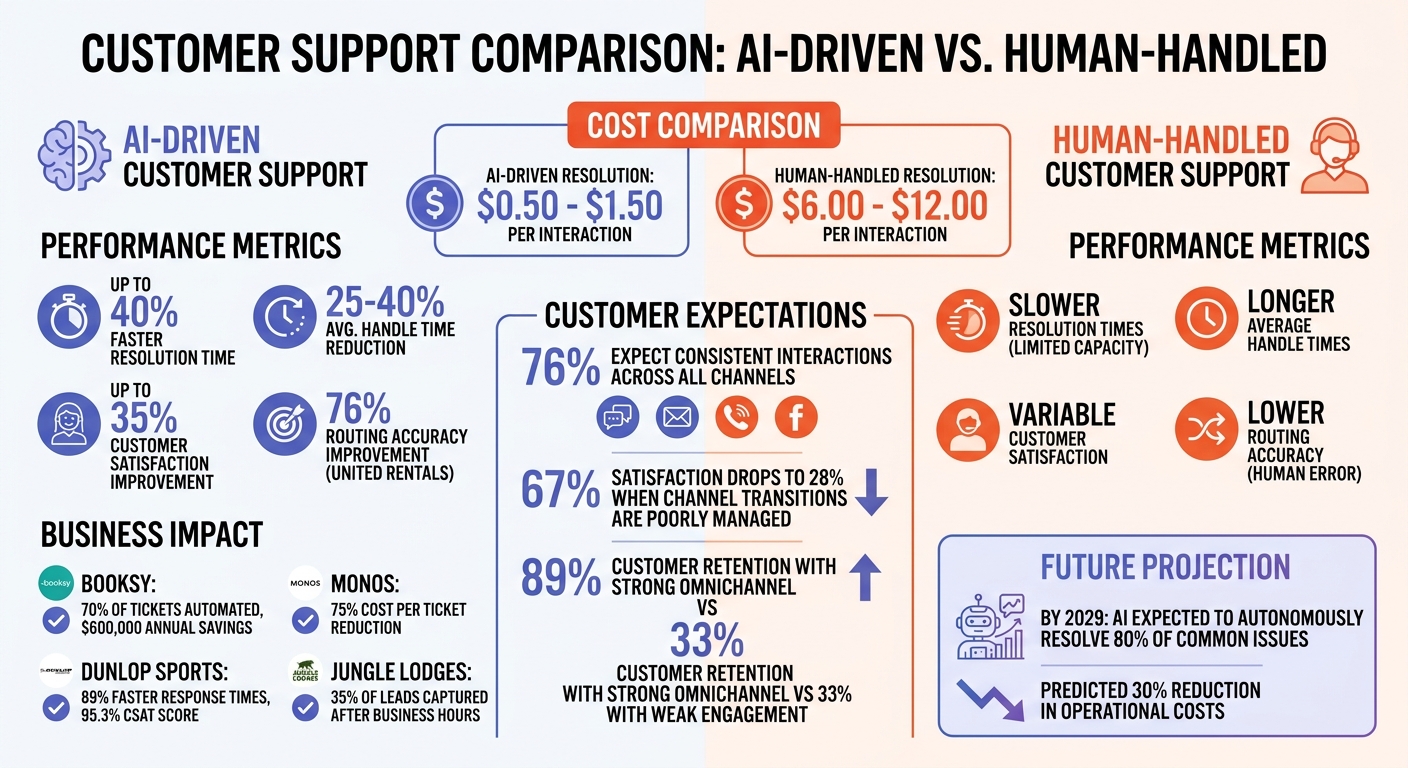
- Cost Savings: AI-driven resolutions cost $0.50–$1.50 per interaction compared to $6–$12 for human agents.
- Scalability: Businesses can expand support without hiring additional staff, handling surges in demand effortlessly.
- Improved Customer Experience: By linking customer profiles across platforms, AI avoids repetitive explanations and enhances satisfaction.
Companies like Booksy and Lush have seen major benefits, from cutting costs to saving agent hours. With tools like ChatSpark, implementing AI customer support is straightforward, offering features like identity resolution, multilingual support, and integration with CRMs.
AI vs Human Customer Support: Cost and Performance Comparison
What is Conversational AI and How Does It Work Across Channels?
Conversational AI Basics
Conversational AI uses a combination of Natural Language Processing (NLP), Machine Learning (ML), and Natural Language Understanding (NLU) to interpret and respond to human language in a way that feels natural. Unlike older chatbots that relied on rigid, rule-based scripts, conversational AI focuses on understanding the intent behind what people say - even when they use informal or varied language.
The system operates through four key components working in harmony:
- NLP: Converts raw text or speech into structured data that machines can understand.
- NLU: Deciphers the intent behind the customer's words, even when phrased differently or in complex contexts.
- Dialogue Management: Keeps track of the conversation's context to determine the next logical response or action.
- Natural Language Generation (NLG): Turns machine-processed data back into human-like responses that feel conversational and appropriate.
Together, these components ensure a smooth, context-aware interaction across various communication channels.
What sets modern conversational AI apart is its ability to handle tasks autonomously. It doesn't just respond to questions - it can process refunds, schedule appointments, or update account details by directly integrating with systems like CRMs, billing platforms, and order management tools. This evolution toward "autonomous AI" transforms these systems into AI-powered assistants capable of resolving issues from start to finish, all while maintaining continuity across channels.
How AI Connects Multiple Support Channels
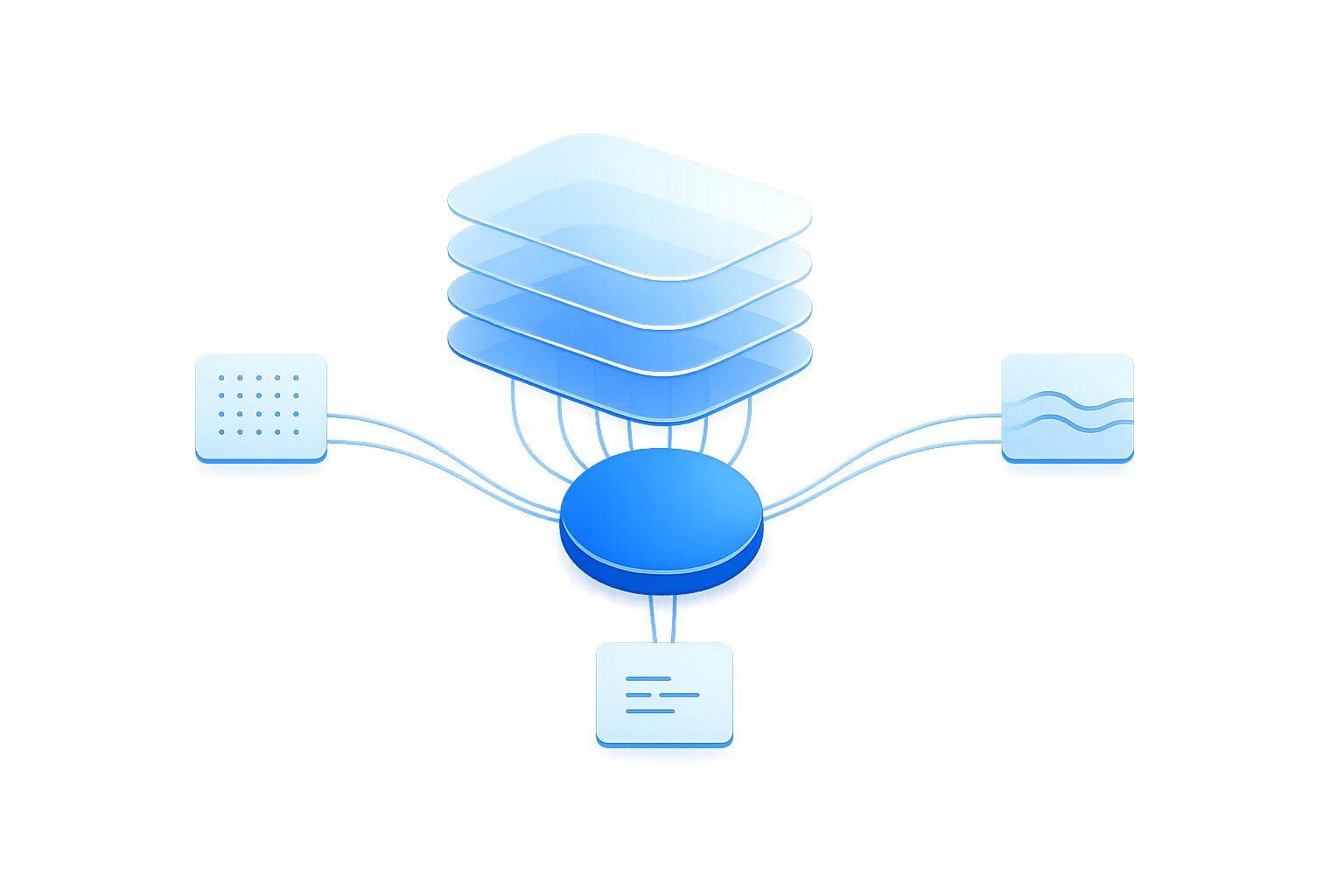
Conversational AI also excels in unifying customer interactions across different platforms. Through identity resolution, the system identifies the same customer across channels by linking information like email addresses, phone numbers, or account IDs.
A shared memory layer plays a critical role here, storing interaction history and customer details. This centralized "brain" ensures that all channels - whether it's chat, email, social media, or voice - access the same information. The result? Customers receive consistent answers and seamless support without needing to repeat themselves.
With 70% of customer experience leaders planning to integrate generative AI across multiple touchpoints by 2026 [4], this unified approach is becoming a cornerstone for delivering seamless and efficient customer service. It ensures businesses meet modern customer expectations while simplifying interactions across the board.
Benefits of Using Conversational AI for Multichannel Support
Delivering Consistent Service Across All Channels
When customers reach out through various platforms, they expect the same level of service - whether it's via chat, email, or social media. Conversational AI delivers this by leveraging a unified knowledge base, ensuring that answers provided on Instagram or your website are consistent and accurate [4].
The system also uses identity resolution to recognize customers across different channels. For example, a person might text from their personal phone and later email from their work address, and the AI connects these interactions into one profile [4][1]. This ensures that a refund policy explained over Facebook aligns perfectly with the information given through live chat, eliminating any confusion caused by mismatched responses.
76% of customers expect consistent interactions across all departments and platforms [1]. When businesses fail to meet this expectation, satisfaction scores drop significantly - from 67% to just 28% when channel transitions are poorly managed [5]. Conversational AI tackles this by maintaining context persistence, so customers don’t have to repeat themselves when switching between platforms [4][1][2].
In addition to ensuring uniform messaging, these AI systems also bring speed and efficiency to customer interactions.
Faster Response Times and Better Efficiency
Quick responses are critical in customer support, and conversational AI excels at delivering instant answers while managing multiple conversations at once. Unlike human agents - who can only handle a handful of chats simultaneously - AI effortlessly processes hundreds of inquiries across different platforms.
Businesses using unified AI support systems report up to 40% faster resolutions and a 25–40% reduction in average handle times [7][1]. This is because AI automates the manual work of gathering context, pulling relevant history, and presenting concise summaries for human agents when escalation is necessary.
A key feature here is intelligent routing. The AI analyzes the intent and sentiment of a query in real time, directing it to the most appropriate resource - whether that’s itself or a specialized human agent [1][8]. For instance, in early 2026, United Rentals deployed AI-powered automation across more than 1,400 locations, achieving a 76% improvement in routing accuracy and cutting agent training time by 50% [8].
These efficiency gains not only improve service quality but also lead to substantial cost reductions and scalability.
Lower Costs and Easy Scaling
The financial benefits of conversational AI are evident when comparing costs. AI-driven resolutions typically range from $0.50 to $1.50 per conversation, while human-handled resolutions cost between $6.00 and $12.00 [6]. This cost difference allows businesses to expand their support capabilities without needing to hire additional staff.
For example, in April 2026, Booksy - a platform for appointment booking - automated 70% of its customer service tickets across multiple regions and languages, cutting annual costs by $600,000 [1]. Similarly, Monos, an ecommerce travel brand, reduced its cost per ticket by 75% by unifying its customer service channels with AI, handling 70% of tickets autonomously [5].
The scalability is straightforward: instead of staffing individual channels, businesses can deploy a single AI system across all platforms. This approach not only ensures consistent service but also allows companies to handle sudden surges in customer inquiries without the need for large-scale hiring. Companies with strong omnichannel strategies see 89% customer retention rates, compared to just 33% for those with weaker engagement [5].
How Businesses Use Conversational AI Across Different Channels
This section dives into how businesses are using conversational AI to connect with customers across their favorite channels. Whether it’s through chat, messaging apps, or phone calls, AI is designed to meet customers where they are, providing quick, personalized, and efficient support.
Website Chat Support
For many businesses, website chat is the go-to starting point for deploying conversational AI. Chatbots on websites are great at collecting visitor details - like names, contact information, and intent - and feeding this data directly into CRM systems [9][10]. Plus, they’re available 24/7.
Take Jungle Lodges & Resorts, for example. Between February and April 2026, they used ChatSpark to capture over 3,300 qualified leads through their website and messaging apps. What’s even more impressive? About 35% of these inquiries came in after business hours - conversations they might have missed without AI [9].
Language capabilities are another standout feature. These systems can detect a visitor’s language and respond in kind, all while pulling from the same knowledge base. This eliminates the need for manual translations, which is a big deal when you consider that 76% of online buyers prefer information in their own language, and 40% won’t buy from sites in other languages [10].
When things get too complex, the AI seamlessly hands off queries to human agents, sharing all the context so customers don’t have to repeat themselves. For example, Dunlop Sports used AI to handle 275,000 interactions annually. By March 2026, they cut response times by 89% while maintaining a 95.3% customer satisfaction score, even as chat volume surged by 168% [11].
Social Media and Messaging Apps
Social platforms like WhatsApp, Instagram, and Facebook Messenger demand a different approach. Responses need to be quick - 67% of Instagram users expect a reply within an hour [6]. Brands that hit this mark often see conversion rates jump by 3.1 times [6].
AI adapts to each platform’s unique vibe. On WhatsApp, messages stay short and mobile-friendly. Instagram DMs, on the other hand, might include emojis and a more casual tone, all while keeping the information accurate [6][9]. Facebook even rewards businesses that respond quickly with a "Very Responsive" badge, which requires replying to 90% of messages within 15 minutes [9].
One of the most powerful tools here is identity resolution. AI can link a customer’s Instagram handle, WhatsApp number, and email into a single profile [1]. This means when someone messages on Facebook, agents can immediately see their past WhatsApp conversations. This not only saves time but also avoids the frustration that 56% of customers feel when they have to re-explain their issues across different channels [1][12].
AI also integrates rich media like product cards, booking carousels, or service menus directly into messaging apps, making it easier for customers to browse and take action [9].
Phone and Voice Support
Voice support remains essential, but it’s also one of the hardest and most expensive channels to scale. Conversational AI changes the game by replacing outdated "press 1 for sales" menus with conversational IVR systems. These systems understand natural language, so customers can simply state their needs, and the AI routes them based on intent, sentiment, and history [1][13].
For instance, Netwealth, an Australian financial firm, used AI to handle over 20,000 calls per month. Customers were connected to an agent within 60 seconds, and nearly 99% of issues were resolved in a single call [13].
AI doesn’t stop there. During calls, it provides real-time assistance by suggesting responses, pulling up relevant context from past emails or chats, and even detecting frustration in a customer’s tone. If needed, it escalates the call proactively [1][13]. Afterward, AI generates instant summaries and transcripts, saving agents from tedious follow-up tasks [1][13].
Wyze Labs, a smart home tech company, saw a 78% boost in call acceptance rates after adopting an omnichannel AI contact center. They also slashed their first-contact resolution time from a week to just one hour [13]. This is all thanks to the AI’s ability to pull up a customer’s entire interaction history, ensuring seamless transitions between channels.
"Voice holds significant value, but it's also the most expensive and hardest channel to scale."
– Candace Marshall, Vice President, Product Marketing, AI and Automation, Zendesk [13]
How to Set Up Conversational AI for Multichannel Support
Setting up conversational AI across multiple channels doesn't have to feel like a massive undertaking. With a clear plan, the right tools, and a focus on key metrics, you can make the process manageable while delivering results.
Choosing the Right AI Platform
Start by mapping out where your customers interact with your brand. Are they reaching out via your website, WhatsApp, Instagram, or email? Document these touchpoints and ensure they connect seamlessly to your CRM. This step helps you understand what needs to integrate and ensures nothing gets overlooked [1].
When choosing a platform, look for one that maintains a single thread of communication across channels. For example, if a customer starts a conversation on chat and follows up via email, the AI should retain the context. This is crucial because 76% of customers expect interactions to be consistent across all channels [1]. Features like identity resolution, which unify customer identifiers (e.g., email, phone number, social media handles), are essential for creating a smooth experience [1].
ChatSpark is one option that integrates with platforms like Instagram, Facebook, WhatsApp, Telegram, Slack, and more. It also connects to tools such as Zapier, Freshchat, Square, and Calendly. Pricing starts at $129/month for the Pro plan, with Enterprise options for larger-scale operations.
Begin with a 90-day roadmap. Focus on one high-impact use case - like order tracking or subscription changes - for the first 30 days. Once that’s running smoothly, expand to other channels and scenarios [3]. This phased approach keeps the process manageable and delivers quick wins.
Finally, align your AI’s tone and style with your brand to ensure a seamless customer experience.
Training AI to Match Your Brand Voice
Your AI should sound like an extension of your team, not a generic bot. The good news? Most platforms make it easy to customize tone and style without needing programming skills.
Start by uploading existing FAQs, product guides, and support documents. For instance, ChatSpark allows up to 500 pages per agent on its Pro plan and can pull from multiple data sources. The AI uses this information to provide accurate answers while staying true to your brand’s personality.
Tone should vary by channel. WhatsApp messages might be short and mobile-friendly, while email responses can be more detailed. On Instagram, a casual and friendly tone might work best. The AI should adapt to each platform’s norms but still deliver consistent information.
Before launching, test the AI’s responses with real-world scenarios. Fine-tune any answers that feel off, paying extra attention to industry-specific language and how your team naturally communicates. The goal is for the AI to feel like part of your team, not a script-reading machine.
With support for over 85 languages, ChatSpark can automatically detect a visitor’s language and respond accordingly. This eliminates the need for manual translations and ensures consistent communication across different audiences.
Once your platform is set up and your AI is trained, it’s time to measure how well it’s performing.
Tracking Performance and Return on Investment
From day one, keep a close eye on performance metrics to gauge your AI’s effectiveness and value.
Focus on key metrics like resolution rate, customer satisfaction (CSAT), response time, and cost per interaction. AI-handled inquiries typically cost between $0.50 and $2.00, compared to $8.00 to $16.00 for human resolutions [3].
Businesses using unified AI systems often see CSAT scores improve by up to 35% and resolution times drop by 40% [7]. Track these metrics monthly to identify trends and areas for improvement.
| Metric Category | What to Track | Why It Matters |
|---|---|---|
| Efficiency | Resolution rate, response time | Shows how much workload AI handles |
| Quality | CSAT scores, escalation rate | Measures customer satisfaction |
| Financial | Cost per interaction, savings | Proves ROI to stakeholders |
| Channel Performance | Volume by channel, peak hours | Helps allocate resources effectively |
ChatSpark’s analytics dashboard provides insights into message volume, response patterns, and customer interactions across channels. Use this data to pinpoint which channels have the highest activity and when your customers need support the most.
AI platform pricing generally ranges from $50 to $200 per agent per month [14]. To calculate savings, compare the cost of the AI to what you’d spend on additional human agents to handle the same volume. Don’t forget to include the value of 24/7 availability - Jungle Lodges, for example, captured 35% of its leads after business hours [9].
During the first quarter, review performance every 30 days. After that, shift to quarterly reviews. Pay attention to patterns in escalations - if certain questions frequently get handed off to humans, it’s a sign the AI needs better training or additional content in its knowledge base.
Conclusion
Conversational AI has reshaped how businesses deliver customer support. By maintaining seamless communication across platforms - whether it’s web chat, email, or social media - it eliminates the frustration of having to repeat information. This approach streamlines the customer experience, boosting satisfaction while delivering measurable benefits to businesses [5].
The financial impact is hard to ignore. AI-managed interactions cost between $0.50 and $1.50, compared to the $6 to $12 typically required for human-handled interactions [6]. This efficiency translates into significant cost savings and smoother workflows.
Another key advantage is scalability. Conversational AI allows businesses to expand into new markets or languages without the traditional challenges of hiring and training. Instead, it’s a matter of configuration, ensuring consistent service quality across all channels.
"The future state [of customer care] marries intelligent triage with end-to-end resolution, not just faster handoffs." – McKinsey [3]
As the technology evolves, the possibilities grow even more exciting. The industry is moving beyond basic chatbots to advanced AI capable of reasoning, system integration, and executing entire workflows. By 2029, predictions suggest that AI could autonomously resolve 80% of common customer service issues, cutting operational costs by 30% [4].
For businesses, adopting unified AI-driven support systems isn’t just about meeting customer expectations - it’s about creating more efficient, scalable operations. Conversational AI is redefining what customer care can look like in today’s fast-paced, multichannel world.
FAQs
How does identity resolution work across channels?
Identity resolution in conversational AI connects the dots between customer interactions across various channels - like chat, email, social media, and voice. This process creates a unified customer profile, allowing businesses to maintain a clear and consistent understanding of each individual.
For example, imagine a customer starts an inquiry on social media and later follows up via email. With identity resolution, the AI remembers the context of the conversation, ensuring the customer doesn’t have to repeat details. This approach enables seamless, personalized support that feels effortless for the customer.
What should I automate first with multichannel AI?
Start by bringing together core customer support channels - email, chat, social media, SMS, and voice - into a single, unified system. This setup keeps the conversation flow intact, cuts down resolution times, and eliminates the frustration of customers having to repeat themselves. By prioritizing this integration, you’ll create a support system that’s not only scalable and efficient but also ensures consistent, personalized service across every channel. The result? Happier customers and smoother operations.
How do I measure ROI from conversational AI?
To evaluate the ROI of conversational AI, focus on both cost savings and enhancements in customer support. Look at metrics such as reduced cost per resolution, fewer escalations, shorter average handle time (AHT), and better customer retention rates. Key performance indicators like CSAT (Customer Satisfaction Score), SLA compliance, First Contact Resolution (FCR), and backlog health also provide valuable insights. By combining these metrics with cost reduction data, you can get a clear picture of ROI, particularly in omnichannel support environments where AI delivers consistent and efficient service.