
Manual customer support is far more expensive than it seems. Beyond salaries, hidden costs like high turnover, operational inefficiencies, and customer churn can drain your budget. For example, a support rep earning $48,000 annually actually costs closer to $92,500 when you include taxes, benefits, and overhead. Plus, replacing a single agent adds $10,000–$15,000 in hiring and training expenses.
The inefficiencies don’t stop there. Slow responses and repetitive tasks frustrate customers, with 53% of online shoppers abandoning purchases due to delayed answers. Choosing live chat vs AI chatbots is critical because scaling manually only worsens the problem, as costs grow linearly with business volume.
AI solutions like ChatSpark cut these costs significantly. By automating 40–60% of inquiries, providing 24/7 support, and responding in under 2 seconds, businesses save money while improving customer satisfaction. For example, one company reduced annual support costs by $180,000, achieving a 6x return on investment.
Key Takeaways:
- Hidden Costs: Manual support includes turnover, inefficiencies, and lost revenue.
- Scaling Problem: Adding staff increases costs without solving delays or errors.
- AI Solution: Automates repetitive tasks, reduces cost per inquiry, and boosts efficiency.
- Savings Example: ChatSpark saved a company over $119,000 annually by automating inquiries.
AI-powered tools like ChatSpark transform customer support from a cost center into a scalable, efficient operation.
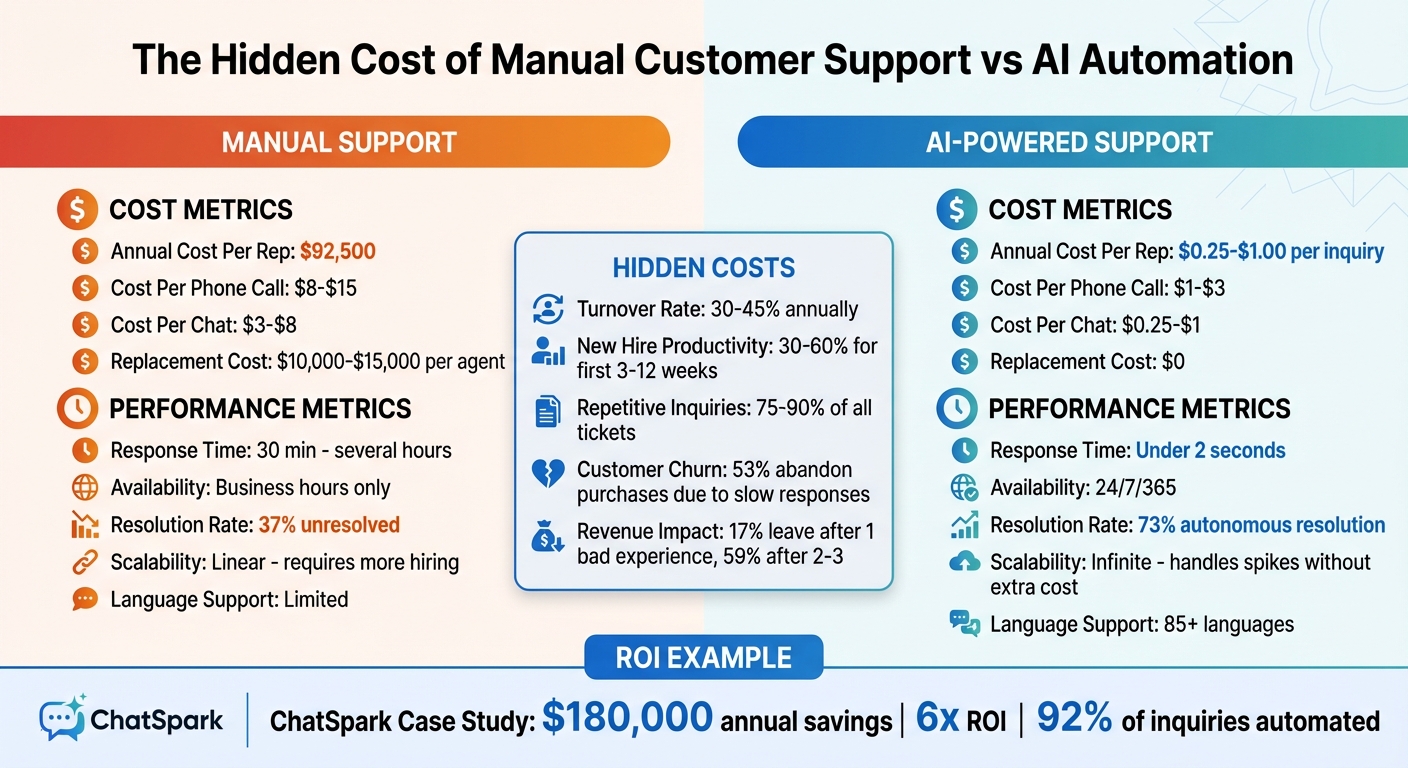
Manual vs AI Customer Support: Cost and Performance Comparison
Financial Costs of Manual Customer Support
High Labor Expenses
When it comes to customer support, the base salary for a representative is just the tip of the iceberg. Once you factor in payroll taxes, benefits, equipment, and office overhead, the total cost per support rep can climb to $92,500 annually [3]. Gabe Campbell from AI Genesis Blog puts it bluntly:
"A customer support rep doesn't cost $45,000 per year. They cost $75,000-$100,000+ when you account for everything." [3]
Labor and benefits alone account for a hefty 60% to 80% of the total customer support budget [4][5]. Add to that the 30% to 45% annual turnover rate, which tacks on another $10,000 to $15,000 in costs for every replacement hire [1]. Onboarding new employees is no small expense either - during their first 3 to 12 weeks, new hires operate at just 30% to 60% productivity while still earning full pay [3].
As your team grows, so do your management requirements. Typically, you’ll need one manager for every 6 to 8 representatives, which can add an extra $12,000 to $18,000 in costs per agent [3]. These expenses pile up fast, making manual customer support a costly endeavor.
And that’s just the labor side of things - manual processes come with another set of challenges: costly errors.
Error-Related Financial Losses
Mistakes are inevitable with manual processes, and they come with a steep price tag. Poor data quality alone costs U.S. companies an average of $12.9 million annually [6]. In customer support, errors like double-posted transactions, incorrect account updates, or missed payments create headaches for customers and expensive fixes for businesses.
For example, recovering a failed payment caused by manual errors can cost 11% to 15% of the payment's value, yet manual recovery efforts succeed only 38% of the time, compared to 70% for automated systems [7]. Even worse, 15% of failed payments lead directly to customer churn [7].
New hires often add to these error-related costs. During training, they can rack up $1,000 to $3,000 in mistake-related expenses [3]. A missed hotel reservation call can cost a business $200 to $2,000 in lost revenue [1], while a property management company missing a maintenance call might face a $5,000 repair because the issue wasn’t addressed on time [1]. These aren’t rare occurrences - they’re baked into the inefficiencies of manual systems.
Scaling Limitations and Cost Inefficiencies
The core issue with manual customer support is its inability to scale efficiently. A 20% increase in business volume means you’ll need a 20% increase in staff, along with the associated training and management costs [4]. This linear growth model makes scaling expensive and impractical.
Take interaction costs, for example. Handling a phone call manually costs $8 to $15, while an email runs $5 to $12 [4]. Across industries, the average cost per support ticket is $6 to $7, but in complex sectors like banking or SaaS, that number can skyrocket to $60 or more [5]. If you’re managing 1,000 tickets daily with a fully manual team, you’re looking at 17 to 20 representatives, which translates to an annual cost of $1.5 million to $1.85 million [3].
This inefficiency is evident in real-world examples. In January 2026, RTR Vehicles found their support costs ballooning to over $300,000 per year for just four representatives. By implementing an AI solution that resolved 92% of inquiries automatically, they reduced their team to a single part-time staff member, cutting costs by $15,000 monthly - a total savings of $180,000 annually and a 6x return on investment [3].
The cost disparity between industries is growing. Regulated sectors like banking now spend 3x to 10x more per interaction due to compliance needs [5]. Manual processes not only fail to close this gap - they make it worse.
Operational Inefficiencies in Manual Customer Support
Manual customer support isn't just costly - it’s also riddled with inefficiencies that slow operations, frustrate employees, and damage customer loyalty. These inefficiencies create delays and bottlenecks that make it harder for businesses to grow smoothly.
Time Wasted on Repetitive Tasks
Support agents often spend a significant chunk of their time on repetitive tasks, like retrieving data or answering routine questions. Gabe Campbell from AI Genesis highlights the issue:
"You're paying $60,000-$90,000 per year per rep to do work that a well-trained system can do in seconds, more accurately, and without ever needing a day off."
The numbers back this up. Around 75% to 90% of customer inquiries are predictable and repetitive, with topics like order status, product details, returns, and shipping making up 60% to 70% of all tickets. Here's a breakdown of how these inquiries typically stack up:
- Order status and tracking: 25% to 35% of support volume
- Product compatibility questions: 15% to 25%
- Returns and exchanges: 10% to 15%
- Shipping inquiries: 8% to 12%
For these routine tasks, a human representative might take 3 to 8 minutes to resolve a ticket. In contrast, an automated system can handle the same inquiry in just 10 to 30 seconds. This time disparity adds up, leading to slower responses and dissatisfied customers.
Delayed Response Times
Manual processes often result in response times that range from 30 minutes to several hours, while automated systems deliver answers in just 10 to 30 seconds [8]. Quick responses aren't just convenient - they’re essential for keeping customers happy. By 2026, 65% of customers will expect chat responses within 60 seconds, citing "speed" as their top priority for excellent service [2].
Manual agents, however, face challenges that slow them down. They often juggle 6 to 12 tools to verify identities, retrieve data, and log notes, which increases handle times [10]. These delays have real consequences:
- 59% of customers say they’d leave a brand after 2 to 3 poor experiences.
- 17% of customers might leave after just one bad interaction.
- Negative experiences are shared with 9 to 15 people, compared to 4 to 6 for positive ones.
- A re-contact rate of 20% to 30% means nearly one-third of customers have to follow up on unresolved issues [2].
When speed and efficiency are lacking, customer loyalty takes a hit.
Challenges in Scaling Operations
Scaling a manual support operation brings its own set of headaches. If business volume grows by 20%, you’ll likely need to increase staff, training, and management by the same amount [1]. This "linear scaling" adds complexity without fixing the root inefficiencies [8].
Real-world examples show how costly this approach can be. Businesses often hire multiple full-time staff to handle repetitive tasks that AI could manage at a fraction of the cost [8]. This manual scaling can lead to:
- 15% to 25% payroll increases due to overtime and after-hours staffing.
- Error correction for 3% to 8% of all tickets [9].
- High turnover rates in support roles (30% to 45% annually), with each replacement costing $10,000 to $15,000 in recruiting and training.
New hires also take time to ramp up, often operating at just 30% to 60% productivity during their first 3 to 12 weeks [1][3].
| Metric | Manual Support | AI-Automated Support |
|---|---|---|
| Response Time | 30 minutes to several hours | 10–30 seconds |
| Availability | Limited (Business Hours) | 24/7 |
| Scalability | Linear (Requires more hiring) | Near-infinite (No extra headcount) |
| Cost Per Interaction | $6.00–$15.00 | $0.25–$3.00 |
The problem with manual scaling is that it introduces fragility. Each new hire adds variability to service quality. Every extra tool or process step creates more delays and opportunities for errors. As Alex, a former support agent, put it:
"Every day felt like fighting fires with damp matches." [9]
Fixing these inefficiencies is essential to cutting the hidden costs of manual support and improving overall service quality.
Impact on Customer Satisfaction and Retention
Operational hiccups in manual support systems can seriously harm customer relationships. When issues go unresolved or responses are delayed, customers often feel undervalued. What starts as a product issue can quickly escalate into a personal frustration [10].
"Waiting turns a product problem into a personal problem." - Secure Path Innovation [10]
Increased Wait Times and Customer Frustration
Speed is everything in customer service. In fact, 65% of customers say that quick responses are the most important aspect of quality service [10]. Unfortunately, manual support systems often fall short, with response times stretching from minutes to days [10]. Looking ahead, customers will expect even faster service - automated chat responses under 60 seconds and email replies within 4 hours by 2026 [2].
The impact of slow service is hard to ignore. A whopping 96% of customers admit that one bad support experience can make them consider switching brands [10]. Even more striking, 17% will leave a brand they love after just one poor interaction [2]. When customers are left waiting, it sends a clear message: they aren’t a priority. This loss of trust can be more damaging than any product defect.
One of the most concerning issues is "silent churn." Around 80% of dissatisfied customers won’t bother complaining - they’ll simply stop using the service [10]. This silent exodus makes it nearly impossible for businesses to address problems before losing customers altogether. Beyond frustration, these delays lead to missed opportunities and higher churn rates.
Lost Opportunities and Higher Churn Rates
Manual processes don’t just waste time - they also drive customers away. For instance, 53% of online shoppers will abandon their purchase if they can’t get a quick answer to their question [2]. That’s a lost sale before the customer has even been acquired. For existing customers, the numbers are equally alarming: 59% will leave after two or three bad experiences, and 73% will switch to competitors [2][10].
One major source of frustration is repetition. 47% of customers list explaining their issue multiple times as a top reason for switching brands [11]. Worse, 63% have had to restart conversations because context was lost during a transfer [11]. These experiences not only drive churn but also leave customers feeling unheard.
The ripple effects of a bad support experience are far-reaching. A negative interaction is shared with 9–15 people, while a positive one only reaches 4–6 [10]. Poor reviews can also hit revenue hard - a one-star drop on Yelp can lead to a 5% to 9% revenue loss [2]. On the flip side, speed matters: leads contacted within 5 minutes are 21 times more likely to convert than those reached after 30 minutes [1].
Manual vs. AI Support Metrics Comparison
The difference between manual and AI-powered support is striking. Here’s a quick breakdown:
| Metric | Manual Support | AI-Powered Support |
|---|---|---|
| Response Time | Minutes to hours/days [10] | Under 2 seconds [2] |
| Cost Per Phone Interaction | $8.00–$15.00 [1] | $1.00–$3.00 [1] |
| Cost Per Chat Interaction | $3.00–$8.00 [1] | $0.25–$1.00 [1] |
| Availability | Business hours only [2] | 24/7/365 [10] |
| Resolution Rate | 37% end unresolved [11] | 73% autonomous resolution [2] |
| Re-contact Rate | 20%–30% [2] | Significantly reduced [2] |
| Scalability | Linear (more staff needed) [1] | Infinite (handles spikes without extra cost) [10] |
The comparison is clear: while manual support struggles with delays and inefficiencies, AI-powered systems excel at delivering fast, consistent, and scalable service.
"Customers don't leave because your product is flawed - they leave because support is slow." - Secure Path Innovation [10]
How ChatSpark Eliminates Manual Support Costs
ChatSpark tackles the hidden expenses of manual support by introducing automated solutions that simplify operations. It combines fast AI-driven responses with system integrations, reducing the need for human involvement. Businesses can deploy ChatSpark across various platforms - websites, Instagram, Facebook, WhatsApp, Telegram, and Slack - allowing the AI to manage inquiries 24/7. With response times under 2 seconds and the ability to scale with demand, it ensures smooth automation across enterprise functions [13].
ChatSpark's Native AI Actions integrate seamlessly with systems like Salesforce, Zendesk, HubSpot, Shopify, and Stripe. This enables tasks like order lookups, lead syncing, or refund processing without requiring custom development. Additionally, its CoPilot tool embeds into Gmail and Zendesk, cutting down fragmented searches and saving up to 2 hours daily [12][13]. By automating data entry and reducing search time, ChatSpark significantly improves operational efficiency.
24/7 Automated Support and Multichannel Integration
ChatSpark works across all customer channels, ensuring that whether a query comes via Instagram DM at 2:00 AM or WhatsApp during a holiday, the AI responds instantly and accurately. This 24/7 availability addresses a major limitation of manual support - restricted operating hours that leave customers waiting until the next business day.
The platform also keeps track of conversation histories across channels. This means customers don’t have to repeat themselves when switching from one platform to another. These real-time, multichannel capabilities enable personalized and efficient support.
AI-Driven Knowledge Retrieval and Customization
ChatSpark uses AI to retrieve specific information from internal knowledge bases instantly. For example, real estate firms can access live MLS listings, while finance teams can pull current QuickBooks data [14][15]. Instead of guessing or providing generic answers, the AI delivers precise, actionable information.
It also ensures a professional, consistent tone that aligns with the brand’s voice. Research shows that customers care more about response speed (a 0.72 correlation with satisfaction) than whether support is provided by a human or AI (a 0.08 correlation) [2]. What matters most is fast and accurate assistance.
In addition to its precision, ChatSpark’s global scalability allows it to address diverse customer needs, adapting to different languages and regions effortlessly.
85+ Language Support and Scalability
ChatSpark supports over 85 languages without requiring extra setup [14]. This means businesses can serve customers in cities like Tokyo, São Paulo, or Berlin without hiring multilingual staff or relying on translation services. The AI automatically identifies and communicates in the customer’s preferred language, tackling inefficiencies and improving satisfaction compared to manual systems.
Scalability is one of ChatSpark’s standout features. For instance, from October 2025 to February 2026, a global construction products company used ChatSpark for one of its flagship brands. During that time, the AI handled 10,754 messages with a 98% resolution rate, captured 153 new leads, and saved over 66 days of agent time, resulting in $47,880 in savings on a $4,000 investment [13]. Another example comes from Lorri G., Customer Service & Technical Support Manager, whose team deployed ChatSpark for a year to manage two major product lines. The AI processed an average of 1,831 chats per month without any human intervention, saving $119,225 [13].
"ChatSpark has been managing two of our largest product lines over the past year. It currently handles an average of 1,831 chats per month without any human intervention. Since implementing it on our website, we've realized measurable savings of $119,225." - Lorri G., Customer Service & Technical Support Manager [13]
Real-World ROI from ChatSpark Deployment
ChatSpark isn't just about streamlining operations - it delivers measurable returns that cut costs and improve productivity.
Cost Reductions and Productivity Gains
One of the standout benefits of ChatSpark is its ability to significantly lower operational costs. For example, in 2025, an enterprise customer used ChatSpark to manage two of its largest product lines. Over the course of the year, the AI handled an average of 1,831 chats per month without requiring human intervention, leading to annual savings of $119,225 [16].
"ChatSpark has been managing two of our largest product lines over the past year. It currently handles an average of 1,831 chats per month without any human intervention. Since implementing it on our website, we've realized measurable savings of $119,225." - Lorri G., Customer Service & Technical Support Manager, Enterprise Customer [16]
The cost difference between human agents and AI is striking. While a human agent typically costs $3.00 to $6.00 per inquiry, ChatSpark can handle the same inquiry for just $0.25 to $0.50. That’s an 85% to 92% reduction in per-inquiry costs. For companies managing high volumes, this means potential annual savings of $1.375 million to $2.8 million when transitioning from human-only support ($1.5M–$3.0M) to AI-powered automation ($125,000–$200,000).
And the benefits don’t stop at cost savings. ChatSpark’s quick response times also enhance customer satisfaction, which directly impacts retention.
Improved Response Times and Customer Retention
ChatSpark’s ability to deliver immediate responses, 24/7, in over 85 languages addresses one of the biggest frustrations customers face: waiting for support. By integrating with systems like Shopify and Salesforce, ChatSpark can instantly retrieve order statuses and other information [18].
Studies reveal that response speed has a 0.72 correlation with customer satisfaction, while the source of support - human or AI - has only a 0.08 correlation [2]. This means that by eliminating delays and being available around the clock, ChatSpark not only boosts satisfaction but also reduces churn, keeping customers engaged no matter where they are.
Analytics-Driven Performance Improvements
ChatSpark goes beyond basic automation by offering advanced analytics that shed light on support trends. These insights reveal which queries take the most time, which channels see the highest activity, and where customers are dropping off. Armed with this data, businesses can prioritize automating high-volume areas, such as billing inquiries or order tracking, for immediate gains [17].
Conclusion
Handling customer support manually comes with more expenses than just payroll. On top of salaries, businesses spend between $10,000 and $15,000 per agent on recruitment and training. Add to that the potential revenue loss from missed off-hour inquiries, and the costs quickly add up. Issues like slow response times, inconsistent answers, and limited scalability can also hold back a company's growth, especially when trying to handle high-volume customer inquiries efficiently.
ChatSpark changes the game by automating 40–60% of repetitive inquiries, delivering lightning-fast responses in under 2 seconds [2]. It offers 24/7 support across multiple channels - voice, chat, SMS, and WhatsApp - and supports over 85 languages. This ensures no customer or lead slips through the cracks, even during off-hours, when up to 42% of inquiries typically occur [2].
The financial impact is clear: the cost per inquiry drops significantly, from $3.00–$8.00 with manual support to just $0.25–$1.00 using AI [1]. Despite the lower costs, customer satisfaction remains strong, averaging 4.2 out of 5 [2]. These efficiencies not only save money but also help retain customers and safeguard revenue.
ChatSpark also helps prevent customer churn, which is critical - 17% of customers leave after a single bad experience, and 59% exit after two or three [2]. On top of that, its analytics turn customer support into a powerful tool for driving strategy and growth, transforming it from a cost burden into a true business asset.
FAQs
How do I calculate my true cost per support ticket?
To figure out your true cost per support ticket, take your total support operating costs and divide them by the number of resolved tickets. Be sure to include all relevant expenses - such as agent salaries, software tools, and overhead costs.
For instance, say your monthly support expenses total $50,000 and your team resolves 1,500 tickets in that time. Your cost per ticket would come out to about $33.33. If crunching the numbers feels tedious, cost calculator tools can help by automating the process for you.
Which support requests should I automate first with AI?
When implementing automation in customer support, begin with the repetitive and straightforward tasks. These typically include handling common questions like order status, return policies, product details, and shipping timelines. Queries such as "Where's my order?" often dominate support tickets, accounting for around 80% of the overall volume.
By assigning these routine inquiries to AI, you can significantly cut down response times and operational costs. Even better, this approach allows your team to focus their energy on resolving more complex and nuanced customer issues.
How do I keep AI answers accurate and on-brand?
To make sure AI-generated answers stay accurate and reflect your brand's tone, start with reliable, high-quality data sources. Regularly track performance and fine-tune the AI models to align with your brand's voice and messaging.
Set up clear guidelines for the AI, review its outputs often, and give feedback to address any errors or inconsistencies. For topics that are complex or sensitive, consider adding human oversight to ensure the responses are appropriate and well-rounded.
By combining technical adjustments with regular procedural reviews, you can keep AI responses consistent and in line with your brand's core values.