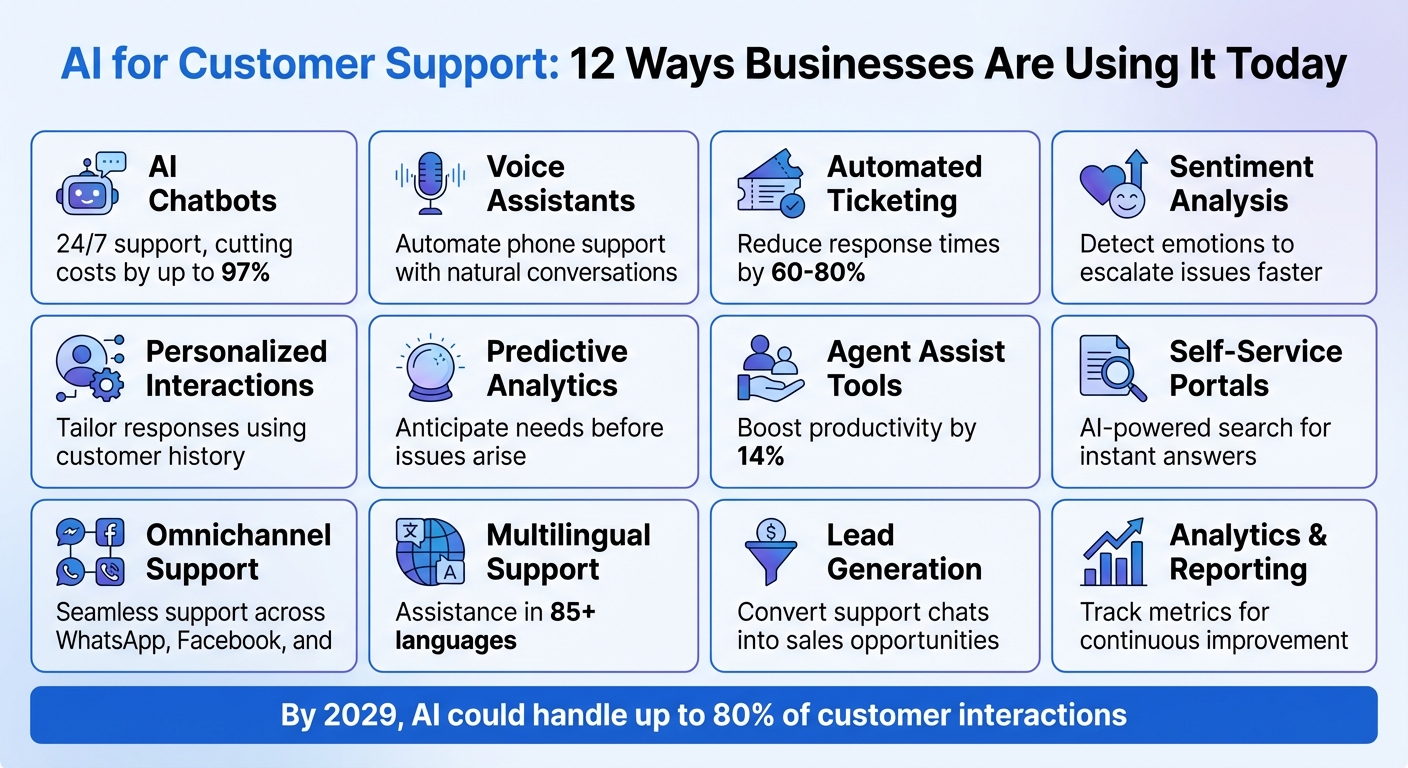
AI is transforming customer support by automating repetitive tasks, improving response times, and enhancing customer satisfaction. Here’s a quick overview of how businesses are leveraging AI right now:
- AI Chatbots: Available 24/7 to handle FAQs, order tracking, and more, cutting costs by up to 97%.
- Voice Assistants: Automate phone support with natural, conversational interactions.
- Automated Ticketing: Sort and prioritize customer inquiries instantly, reducing response times by 60–80%.
- Sentiment Analysis: Detect customer emotions to escalate and resolve issues faster.
- Personalized Interactions: Use AI analytics to tailor responses based on customer history.
- Predictive Analytics: Anticipate customer needs and prevent issues before they arise.
- Agent Assist Tools: Provide real-time guidance to support agents, improving productivity by 14%.
- Self-Service Portals: AI-powered search tools deliver instant answers to customer queries.
- Omnichannel Support: Manage customer interactions seamlessly across platforms like WhatsApp and Facebook.
- Multilingual Support: Offer assistance in 85+ languages with real-time translation.
- Lead Generation: Turn support chats into opportunities to qualify and capture leads.
- Analytics & Reporting: Use AI to track performance metrics and continuously improve customer service.
AI’s role in customer support isn’t about replacing humans - it’s about making support faster, smarter, and more efficient. By 2029, AI could handle up to 80% of customer interactions, saving businesses time and money while keeping customers happy.
12 Ways Businesses Use AI for Customer Support in 2024
1. ChatSpark: AI Chatbots for 24/7 Customer Support
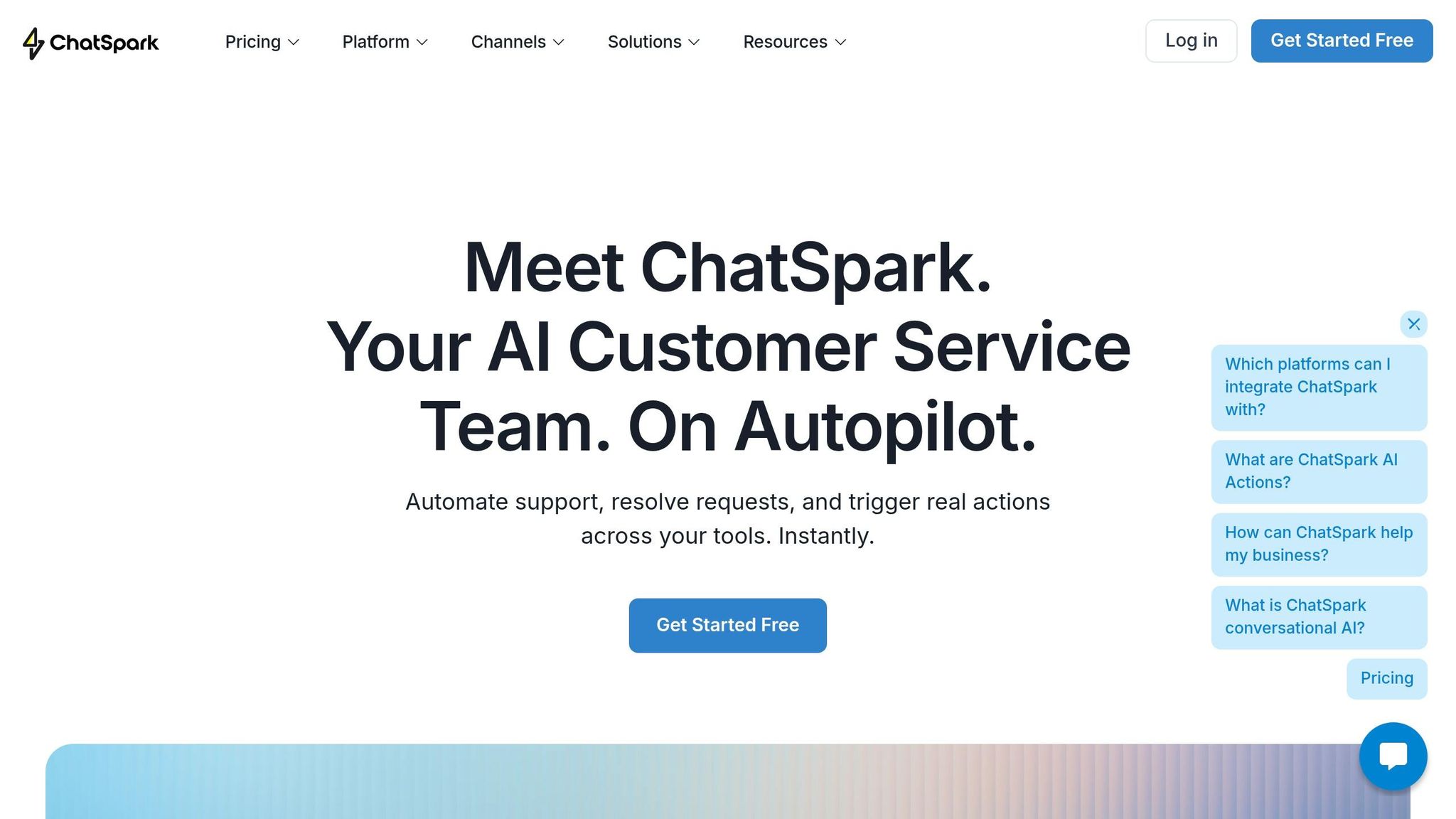
ChatSpark offers a solution for businesses looking to provide constant customer support without the need for human agents around the clock. This platform works seamlessly across websites and popular messaging apps like WhatsApp, Facebook, Instagram, Telegram, and Slack, handling everything from product inquiries to order tracking. With support for over 85 languages, ChatSpark ensures instant assistance for customers anywhere, anytime.
Making Customer Support More Efficient
One of the standout advantages of AI chatbots is their ability to significantly cut costs. While a human agent costs around $19.50 per hour, chatbot interactions cost just $0.50–$0.70 each [3]. For example, Klarna's AI assistant managed 2.3 million conversations in its first month during 2024–2025, a workload that would have required 700 full-time agents. Response times dropped from 11–15 minutes to under 2 minutes, all while maintaining support in over 35 languages [5].
Businesses can achieve quick wins by automating the most common 10–15 queries, such as those about returns, billing, or order status [3]. ChatSpark uses advanced RAG (retrieval-augmented generation) technology to pull accurate answers from up-to-date documentation. A great example is Decathlon, which trained its AI on a catalog of 10,000 products. Within just seven days, the system handled over 500 conversations with an impressive 98.47% resolution rate in October 2025 [6].
These improvements translate into faster service and happier customers.
Boosting Customer Satisfaction and Engagement
ChatSpark goes beyond answering questions - it also monitors customer sentiment. Using sentiment analysis, it can detect frustration or urgency and escalate issues to human agents when necessary. This matters because 70% of consumers say emotional intelligence from support systems influences their loyalty to a brand. Additionally, 80% of users find AI chatbots helpful for solving simple issues, and 8 in 10 companies report better support performance after adopting AI [1].
The benefits are clear. In 2025–2026, OpenTable automated 73% of its reservation-related queries, which led to a 40% increase in customer satisfaction (CSAT) scores and a 12% boost in upsell conversions [5]. Similarly, ATK, a retailer specializing in gaming gear, used an AI chatbot to handle off-hours traffic. In just a short period, the bot managed 1,963 conversations and generated $8,163.99 in assisted revenue by capturing customers who might have abandoned their carts [6].
Designed to Grow With Your Business
ChatSpark isn’t just for large enterprises - it’s built to scale with businesses of any size. For small operations, the Basic plan starts at $19 per month and includes 100 messages. Larger businesses can opt for the Pro plan at $129 per month, which supports 2,000 messages and integrates with tools like Zapier and Freshchat. For even bigger needs, custom enterprise solutions offer dedicated account management and tailored options, ensuring your customer support can grow without requiring a proportional increase in staffing.
2. Voice Assistants for Automated Phone Support
Voice AI is changing the way phone support works, moving away from outdated "press 1 for sales" menus to more natural, conversational interactions. Thanks to Natural Language Understanding (NLU), callers can simply speak naturally, and the system figures out their needs to guide them to the right solution [7]. These systems analyze caller intent, sentiment, and even past interactions, allowing routine requests to be resolved automatically or routed to the most suitable agent. This shift not only makes the process smoother but also boosts overall efficiency.
Efficiency in Streamlining Customer Support Processes
Voice assistants are great at handling repetitive, multi-step tasks like checking account balances, tracking orders, or scheduling appointments - all without needing a human agent. By automating these routine tasks, companies free up their support teams to tackle more complicated issues that require human expertise. In fact, businesses using AI-driven call centers have reported over 25% increases in productivity, while automation can cut operating costs by up to 20% by diverting simpler inquiries [7]. On a broader scale, conversational AI in customer service is expected to save $80 billion in agent labor costs by 2026 [8].
Another major benefit is the reduction of after-call work. AI tools can generate real-time transcripts and summaries, trigger backend processes, and provide agents with relevant context during calls - significantly cutting down on manual documentation [9].
Integration Capabilities with Existing Tools and Platforms
Beyond saving time and money, voice assistants also improve the quality of customer support by integrating seamlessly with existing tools. Many modern solutions come with plug-and-play APIs and pre-built connectors for popular platforms like Salesforce, Zendesk, HubSpot, and Freshdesk [10]. This allows voice assistants to pull real-time data from CRMs and knowledge bases, enabling personalized interactions based on a caller’s recent activity or purchase history [11]. Hybrid models take it further by gathering context and authenticating callers before handing them off to a human agent when needed. This smooth integration ensures a unified and consistent experience across all customer touchpoints.
3. Automated Ticketing Systems for Issue Management
When customer inquiries pile up, manually sorting through tickets can slow everything down. AI-powered ticketing systems use Natural Language Processing (NLP) to analyze intent, sentiment, and urgency. This ensures tickets are routed to the right agent or department instantly. For example, a customer frustrated over a billing error gets priority over someone with a general question [12]. This kind of automation significantly improves how efficiently tickets are handled.
Efficiency in Streamlining Customer Support Processes
Automated ticketing takes the burden of categorizing tickets off agents. AI can handle routine tasks like password resets or tracking orders, and it even filters out unnecessary replies like "thanks."
In April 2025, Otter.ai adopted a system using Zapier and ChatGPT to manage such tasks. Over three months, it resolved more than 1,000 tickets automatically and prioritized over 10,000 critical issues. Allen Lai, Head of Customer Experience at Otter.ai, shared:
"Before automation, agents had to manually review and close thousands of unnecessary reopened tickets. Now, Zapier and ChatGPT handle it instantly, saving us time and keeping our queue clean" [16].
The time saved is substantial. AI-assisted triage cuts an average of 45 seconds per ticket compared to manual sorting [12]. Companies also report reductions in first response times by as much as 60–80% [13]. For instance, Obvi, a health and wellness brand, automated the triage of over 10,000 support tickets each month. By tagging issues like shipping or returns automatically, they reduced first response times by 65% [1]. Faster resolutions like these lead to happier customers.
Impact on Customer Satisfaction and Engagement
Automated ticketing ensures customers experience swift, reliable support. These systems acknowledge requests instantly and resolve common issues 24/7. Sentiment analysis adds another layer by identifying frustration or urgency in messages, escalating critical tickets to senior agents when needed [1].
Take Lyft as an example. By integrating Anthropic's Claude AI via Amazon Bedrock, they reduced average resolution times by 87% while handling thousands of cases daily [1]. Similarly, Bank of America's virtual assistant "Erica" uses NLP to resolve 78% of client queries in just 41 seconds [14].
Scalability for Businesses of Various Sizes
AI-powered ticketing systems adapt easily to meet fluctuating business needs. Whether it’s a seasonal rush, a product launch, or an unexpected surge in demand, these systems scale instantly without requiring extra staff or overtime [14].
For example, Montana West, a fashion brand, saw an 83% spike in inquiries and implemented an AI ticketing solution. The system handled over 80% of tickets on its own, learning their 400+ product catalog. This led to a 32% boost in chat-to-sales conversions and $41,000 in AI-driven sales [13]. Looking ahead, by 2029, it’s estimated that 80% of common customer service issues will be resolved through AI, potentially cutting labor costs by 30% [14].
Integration Capabilities with Existing Tools and Platforms
Modern ticketing systems work seamlessly with tools businesses already rely on. They integrate with CRMs like Salesforce and Zendesk, e-commerce platforms like Shopify, and communication channels like WhatsApp and Slack. This allows agents to access customer history, order details, and past interactions - all from one dashboard [13].
For instance, Zendesk’s internal support team used its AI platform to automate over 60,000 service requests per quarter in 2025. This included automating more than 2,000 complex workflows that previously required manual effort, resulting in a 120% improvement in high-quality responses [15]. Similarly, Brex implemented an advanced ticketing system to handle high email volumes. This sped up response times by three times and saved users an average of 3.5 hours per week on inbox management [14]. These seamless integrations highlight AI’s transformative role in customer support across all channels.
4. Sentiment Analysis to Detect Customer Emotions
Customer inquiries can range from straightforward questions about store hours to heated complaints about service delays. AI-powered sentiment analysis uses Natural Language Processing (NLP) to pick up on the emotional tone of messages - whether it’s frustration, anger, satisfaction, or urgency - by analyzing word choices, punctuation, and context. This helps support teams tailor their responses and prioritize tickets that demand immediate attention.
Efficiency in Streamlining Customer Support Processes
Sentiment analysis takes automated ticket routing a step further by prioritizing tickets based on emotional urgency. For instance, a highly negative message will automatically move ahead of routine inquiries, regardless of when it was received. Advanced systems can identify these emotional cues with up to 85% accuracy, ensuring urgent matters are addressed promptly [18].
The system evaluates linguistic signals like specific words, excessive capitalization, or punctuation patterns to assign intensity scores [17]. If a message exceeds a certain threshold of negativity, it’s escalated to senior agents or specialized teams. Real-time sentiment detection also offers live coaching prompts for agents, helping them use empathetic language when dealing with frustrated customers. This approach has been shown to reduce average handling times by 15% to 30% [1].
Impact on Customer Satisfaction and Engagement
Spotting negative emotions early can stop small issues from snowballing into major complaints. Research shows that 70% of customers appreciate when support teams accurately understand their emotions, which can directly boost brand loyalty [1]. On the flip side, 60% of customers will abandon a brand after just one or two bad experiences [17]. Businesses using real-time sentiment analysis are 2.4 times more likely to surpass their customer satisfaction goals [18].
By improving the quality of conversations, sentiment analysis tools have been linked to a 25% increase in customer retention [18].
Scalability for Businesses of Various Sizes
Sentiment analysis tools adapt well to businesses of all sizes, maintaining consistent support quality even as operations grow. These tools work seamlessly across multiple channels, including email, live chat, social media, and marketplace messaging, ensuring no frustrated customer slips through the cracks. The rising demand for such solutions is reflected in the global sentiment analytics market, which is projected to grow from $5.71 billion in 2025 to $19.01 billion by 2035 [17]. Companies adopting AI in their customer service operations report improvements of 20% to 32% in customer satisfaction, cost efficiency, and employee productivity [17].
Integration Capabilities with Existing Tools and Platforms
Modern sentiment analysis tools integrate effortlessly with popular helpdesk platforms like Zendesk and Freshdesk, as well as eCommerce platforms like Shopify and marketplaces like Amazon and eBay. They achieve this through native connectors or APIs [17][3][19]. For these tools to work effectively, real-time data ingestion from all customer channels is essential to flag urgent issues promptly.
Tom Eggemeier, CEO of Zendesk, highlights the benefits of AI in customer service:
"With AI purpose-built for customer service, you can resolve more issues through automation, enhance agent productivity and provide support with confidence" [19].
To get started, businesses can use sentiment analysis to flag and escalate the most negative tickets, tracking the immediate effects on response times [17]. Incorporating Retrieval-Augmented Generation (RAG) ensures AI-generated responses are accurate and consistent, grounded in reliable knowledge bases [3].
5. Personalized Customer Interactions Using AI Analytics
Nobody likes a canned response, especially when they’re seeking help. Customers today expect service that feels tailored to them. AI analytics makes this possible by analyzing customer behavior, past interactions, and real-time data. By diving into details like purchase history, browsing habits, previous support tickets, or even the tone of a current conversation, AI helps predict what a customer might need before they even ask. This not only makes interactions feel more personal but also speeds up the entire support process.
Efficiency in Streamlining Customer Support Processes
AI analytics takes the guesswork - and the legwork - out of customer support. For instance, in 2026, Esusu leveraged Zendesk AI summarization to dramatically improve efficiency. Their first reply time dropped by 64%, and ticket resolution time shrank by 34% across 10,000 monthly tickets [20]. Instead of manually sifting through piles of past messages, agents received instant summaries highlighting the most important details, preferences, and unresolved issues.
Real-time assistance tools further enhance productivity by displaying key customer history and suggesting context-aware replies right within the helpdesk. These AI-powered copilots can boost agent productivity by 14% [3] and cut handle times by up to 25% [1]. With automated ticket summaries and quick access to relevant context, agents can deliver personalized service without slowing down. The result? Happier customers and more efficient support teams.
Impact on Customer Satisfaction and Engagement
The demand for personalized service is higher than ever. A whopping 61% of consumers now expect tailored support because they know AI can analyze their past interactions [20][21]. Even more - 67% - want greater personalization overall [20]. Meeting these expectations isn’t just good for customer experience; it’s good for business. AI-driven personalization can boost customer satisfaction scores by 15% to 20% [3][19], and companies focusing on AI-enhanced customer journeys often see 10% to 15% revenue growth [3].
Customer experience expert Blake Morgan sums it up perfectly:
"AI allows companies to scale personalization and speed simultaneously. It's not about replacing humans - it's about augmenting them to deliver a better experience" [1].
Integration Capabilities with Existing Tools and Platforms
The good news? You don’t need to overhaul your entire system to get started with AI-powered personalization. Modern tools integrate smoothly with existing platforms through native connectors and APIs. Retrieval-Augmented Generation (RAG) ensures AI systems pull from approved knowledge bases, so responses stay accurate and aligned with your brand [3][19]. Some advanced AI systems can even handle secure tasks, like processing refunds or updating accounts, all while adhering to real-time permissions [15].
Take Unity, for example. In April 2026, the company implemented Zendesk AI agents connected to its knowledge base to handle a surge in support tickets. The results? Nearly 8,000 tickets deflected, an 83% improvement in first response times, a 93% customer satisfaction score, and $1.3 million in savings [20]. For businesses looking to test the waters, AI tools can be piloted in just 2–6 weeks using connectors for platforms like Salesforce, Zendesk, or HubSpot [3]. Starting with "approve before send" modes ensures quality control while helping agents build confidence in AI-generated suggestions [3].
6. Predictive Analytics for Anticipating Customer Needs
Predictive analytics takes customer support to the next level by addressing problems before they even arise. Rather than reacting to issues as they come up, this approach uses AI to analyze historical data, product usage, and even factors like weather or shipping routes to anticipate potential challenges. This shift from reactive to proactive support not only lightens the workload for agents but also improves the overall quality of customer service.
Efficiency in Streamlining Customer Support Processes
Predictive analytics reshapes how support teams function by forecasting demand and spotting issues before they escalate. For example, AI can analyze historical data to predict staffing needs, helping businesses optimize schedules, cut down on overtime, and minimize customer wait times [21][19]. In fact, this method has been shown to improve operational efficiency by 20–30% [1].
A great example of this in action is Verizon's use of intent-based routing. By predicting 80% of calls, they managed to reduce visit times by seven minutes [1]. Similarly, proactive outage notifications have been shown to reduce ticket spikes by 20–25% [3]. These operational improvements not only streamline processes but also set the stage for stronger customer relationships.
Impact on Customer Satisfaction and Engagement
Predictive analytics doesn’t just improve processes - it also enhances customer satisfaction. Dell Technologies, for instance, developed its "Next Best Action" Engine over 18 months, wrapping up in November 2025. Spearheaded by VP of Service Operations Erin Kurusz, this system uses product telemetry and call logs to give agents real-time guidance. The result? Faster resolutions, higher satisfaction scores, and fewer repeat issues [22].
But the benefits go beyond individual interactions. Predictive models can identify behaviors that signal a customer might be considering leaving. This allows businesses to step in with personalized offers or outreach to retain them [1][2]. With 61% of consumers expecting more personalized service when AI is involved [21], meeting these expectations is no longer optional - it’s a must for staying competitive.
Integration Capabilities with Existing Tools and Platforms
Predictive AI tools are designed to work seamlessly with platforms like Salesforce, Zendesk, HubSpot, and Freshdesk. Thanks to APIs, deployment can happen in as little as 2–6 weeks [3]. However, for these tools to deliver accurate results, it’s crucial to ensure that CRM data and knowledge bases are clean and well-organized - poor data leads to poor predictions [2].
For a quick return on investment, start with high-volume queries such as "where is my order" or password resets [3]. And no matter how advanced the automation, always offer customers an easy way to connect with a human agent if their issue remains unresolved [4][2].
7. Agent Assist Tools for Real-Time Guidance
Agent assist tools are transforming customer support by providing frontline teams with real-time, context-driven guidance. Acting as copilots, these tools analyze live interactions to suggest responses and pull relevant knowledge base articles. By identifying customer intent instantly, they equip agents with the resources they need, such as product documentation, without delay.
Efficiency in Streamlining Customer Support Processes
The efficiency gains from agent assist tools are hard to ignore. For example, they can cut average handle time by up to 35% [24], while real-time context panels save agents an average of 45 seconds per issue [25]. For an enterprise retailer, this translates into 120 hours saved per month [25].
In early 2026, Trilogy adopted Kayako's AI Helpdesk Assistant, enabling agents to access thread summaries and suggested replies. This led to a 70% boost in solved tickets per agent [1]. These tools also summarize customer history and conversation threads into concise overviews, saving agents from manual scrolling [1][24].
Real-time sentiment analysis is another standout feature. It flags situations where customers may be frustrated or upset, prompting agents to adjust their tone or escalate the issue when necessary [1][24]. For instance, in February 2026, MetLife used NICE Enlighten AI to monitor customer emotions during live calls, providing visual prompts - like a "heart icon" - to alert agents when emotional stress was detected [1].
These time and efficiency improvements don’t just make processes smoother; they also directly enhance customer satisfaction, which we’ll explore next.
Impact on Customer Satisfaction and Engagement
Speed is only part of the equation. Agent assist tools also improve service quality. Companies using these tools have reported a 20% increase in first contact resolution rates [24]. They also enhance agent productivity by about 14%, with the biggest benefits seen among newer or less experienced agents [3].
"AI allows companies to scale personalization and speed simultaneously. It's not about replacing humans - it's about augmenting them to deliver a better experience." - Blake Morgan, Customer Experience Expert [1]
Another advantage is how these tools streamline onboarding for new agents. Training time can be reduced by as much as 50%, thanks to features like conversation summarization [24]. Jessica Hannes, Director of Support at Esusu, shared:
"The summarization feature has been a huge help, especially for onboarding new reps. It saves us the time and energy of looking through an entire thread so we can work more efficiently" [19].
Integration Capabilities with Existing Tools and Platforms
Agent assist tools are designed to integrate seamlessly with existing support systems. Most tools offer native compatibility with popular CRM and helpdesk platforms like Salesforce, Zendesk, HubSpot, and Freshdesk [3]. These integrations pull real-time data from backend systems - such as billing, order management, and product analytics - giving agents a complete view of the customer in one interface [24].
When rolling out these tools, it’s wise to start with an "approve before send" mode. This allows agents to review AI-generated suggestions, ensuring accuracy and building trust [3]. Using Retrieval-Augmented Generation (RAG) also ensures that AI recommendations are based solely on verified company knowledge, not general AI training data [3]. A good starting strategy is to focus on the top 10–15 customer queries - like billing, returns, or account access - and train the tool to handle these scenarios first [3][24].
8. Self-Service Portals with AI Knowledge Retrieval
Self-service portals powered by AI take customer support to the next level, giving users instant, accurate answers without needing to wait for a support agent.
These portals use cutting-edge technology like Natural Language Processing (NLP) and semantic search to understand the intent behind a user’s question, even if it’s phrased informally or lacks technical terms. Instead of sifting through endless articles or FAQs, customers can simply type their question in plain language and get an immediate response.
Efficiency in Streamlining Customer Support Processes
Traditional keyword searches often leave customers frustrated, as they rely on exact matches to find answers. AI-powered portals remove this hurdle. For example, a customer asking, "Why hasn’t my order arrived?" will receive the same relevant information as someone searching for "track my package."
These systems rely on Retrieval-Augmented Generation (RAG) to pull responses directly from your approved knowledge base, ensuring accuracy and consistency with company policies [28]. A great example is Unity, which implemented a Zendesk AI agent in 2025. This system deflected 8,000 tickets and saved $1.3 million in operational costs [19][3].
AI portals also identify gaps in your knowledge base by flagging commonly searched topics that lack answers. This allows companies to proactively update content, leading to a 206% increase in self-service usage and a 50% reduction in ticket volume [3]. The result? A smoother, frustration-free support experience for customers.
Impact on Customer Satisfaction and Engagement
Speed is everything when it comes to customer service. Around 70% of customers prefer self-service options for initial inquiries [26]. AI-powered portals deliver answers in seconds, operating 24/7 to provide assistance no matter the time or location.
Take Bank of America’s AI assistant, Erica, as an example. Since its launch in 2018, Erica has handled over two billion interactions for 42 million clients, significantly reducing call volumes and in-person visits [27]. Companies that invest in AI-driven customer support often see a 20–30% improvement in customer satisfaction [3].
Verizon has also seen success with AI. By implementing a system that predicts customer intent, it now accurately anticipates the reason for 80% of its 170 million annual calls. This proactive approach has helped the company avoid 100,000 potential customer churn cases each year [1]. As Blake Morgan, a Customer Experience Expert, explains:
"AI allows companies to scale personalization and speed simultaneously. It's not about replacing humans - it's about augmenting them to deliver a better experience." [1]
Scalability for Businesses of Various Sizes
One of the standout advantages of AI self-service portals is their ability to handle unlimited queries simultaneously. This makes them perfect for businesses experiencing rapid growth or seasonal demand spikes, without the need to hire additional staff.
Platforms like ChatSpark offer flexible solutions for businesses of all sizes. Their Basic plan starts at $19/month, covering 100 messages, while larger enterprises can scale to handle thousands of inquiries daily with custom plans and dedicated support. With support for over 85 languages, ChatSpark ensures global reach while staying on-brand.
Integration Capabilities with Existing Tools and Platforms
The ability to integrate seamlessly with existing tools amplifies the effectiveness of AI-powered self-service portals.
Modern AI portals connect effortlessly with popular platforms like Salesforce, Zendesk, HubSpot, and Shopify. Many solutions come with pre-built connectors, allowing businesses to get started in as little as two to six weeks without overhauling their entire system [3]. They can also integrate with team collaboration tools like Slack and Microsoft Teams, centralizing knowledge and streamlining workflows.
To maximize efficiency, start by automating your top 5–10 most common inquiries - such as returns, billing, or order tracking. Always include an option for customers to escalate to a human agent for more complex issues. By grounding AI responses in your approved knowledge base with RAG, you maintain both accuracy and customer trust [3].
9. Omnichannel Support Across WhatsApp, Facebook, and More
Today's customers don't stick to just one platform. They might start a conversation on Instagram, follow up on WhatsApp, and finish through email - all while expecting you to remember every detail of their previous interactions. AI makes this seamless experience possible by creating a unified customer profile, matching details like phone numbers or email addresses across channels [29]. This unified approach lays the groundwork for smoother, more efficient support processes.
Efficiency in Streamlining Customer Support Processes
Traditional support systems often treat each channel as its own isolated world. This means a customer reaching out on Facebook and then emailing later has to repeat their story all over again. AI eliminates this frustration by keeping track of conversations across platforms [29][30].
With modern AI, processes like refunds or order updates can be automated end-to-end through integrations with tools like Shopify or Zendesk [29][3]. For instance, in February 2024, Klarna introduced an AI assistant that managed 2.3 million conversations in its first month - handling two-thirds of all customer chats. This AI assistant performed the work of 700 full-time agents, reduced repeat inquiries by 25%, and cut resolution times from 11 minutes to just under 2 minutes [30].
If you're starting out, focus on automating a couple of high-volume, straightforward tasks - like returns or order status updates - that can be managed entirely by AI [30].
Impact on Customer Satisfaction and Engagement
Streamlined processes do more than save money - they also boost customer satisfaction. Customers today expect quick, personalized responses. For example, Bank of America's AI assistant processed 2 million interactions daily after its launch, with an average response time of just 44 seconds [30].
AI also tailors its responses to the format of each platform while drawing from a unified knowledge base [29]. By 2026, 70% of customer experience leaders plan to use generative AI to enhance multiple touchpoints [29]. Tools like ChatSpark allow businesses to deploy AI across platforms like websites, Instagram, Facebook, WhatsApp, Telegram, and Slack, offering support in over 85 languages. This ensures that customers get help wherever they are, in the language they prefer.
Scalability for Businesses of Various Sizes
Whether you're running a small business or a global corporation, AI-powered omnichannel support grows with you - without requiring a proportional increase in staff. Platforms like ChatSpark offer plans starting at $19/month for 100 messages, making it affordable for smaller businesses. Larger companies can manage millions of conversations across multiple markets with custom Enterprise plans. These tailored options ensure businesses of all sizes can provide consistent, high-quality support.
By 2028, it's estimated that AI will power 95% of all customer interactions, with virtual assistants automating over 70% of customer queries [31]. On top of that, AI-driven customer service could reduce operational costs by up to 30% [31]. Gartner predicts that by 2029, agentic AI will autonomously resolve 80% of common customer service issues [29]. This scalability becomes even more effective when AI solutions integrate seamlessly with your existing tools.
Integration Capabilities with Existing Tools and Platforms
AI omnichannel support works best when it connects smoothly with your current tools. Many modern platforms integrate with solutions like Salesforce, Zendesk, HubSpot, Shopify, Zapier, Freshchat, Square, and Calendly, ensuring consistent support across all channels.
It's also essential to include clear "talk to an agent" options to maintain customer trust. AI can even trigger proactive alerts - such as notifications about shipping delays or renewal reminders - across channels before customers reach out [30][3]. The backbone of effective omnichannel support is identity resolution. Without it, your chat software might see a "cookie" while your email system recognizes an "address", leading to fragmented and frustrating customer experiences [29].
10. Multilingual Support in 85+ Languages
Multilingual support is a prime example of how ChatSpark caters to a global audience. With only 20% of the world speaking English, the remaining 80% of potential customers require support in their native languages [37]. Modern AI takes this beyond simple translation - it understands intent and adapts to the nuances of each language. For instance, a German customer might receive a formal and precise response, while a Japanese customer experiences communication that’s polite and respectful. This capability ensures interactions feel natural and contextually appropriate [46,47].
Efficiency in Streamlining Customer Support Processes
In the past, adding a new language to customer support meant months of recruiting and training native speakers. AI has revolutionized this process. Now, enabling support for a new language is as simple as a quick configuration change, taking mere minutes [32].
Take the example of a mobile strategy game with 15 million active players. In June 2025, they expanded their language offerings from 12 to 25 languages. At the same time, they reduced their support team from 45 to 15 agents. This shift resulted in a 180% productivity boost, a 35% reduction in support costs (saving $1.8 million annually), and an improvement in customer satisfaction (CSAT) scores from 2.8 to 4.1 in previously underserved regions [35].
AI also introduces two-way real-time translation. For instance, if a ticket arrives in Spanish, the agent views it in English. They respond in English, and the customer receives the reply in Spanish - all within the same interface [46,47]. This means your existing team can handle multilingual tickets without needing specialized language skills, cutting costs and improving efficiency.
Impact on Customer Satisfaction and Engagement
Offering support in a customer’s native language makes a huge difference. Research shows that 76% of customers are more likely to make repeat purchases when support is provided in their language, while 40% won’t buy at all from a site that doesn’t offer this option [47,50]. Companies that provide multilingual support also see a 73% higher customer retention rate [37].
"76% of consumers prefer to buy from websites in their native language, and 40% will never buy from websites in other languages." - CSA Research [36]
ChatSpark supports over 85 languages across platforms like websites, Instagram, Facebook, WhatsApp, Telegram, and Slack. It even remembers each customer’s language preferences, ensuring every future interaction is automatically tailored. This seamless personalization eliminates friction, whether customers are browsing, checking out, or seeking post-purchase support [33].
Scalability for Businesses of Various Sizes
AI-powered multilingual support scales effortlessly, making it accessible for businesses of all sizes. Small businesses can explore international markets immediately with plans starting at $19/month for 100 messages. ChatSpark’s Basic plan includes support for 85+ languages right from the start, allowing businesses to test new markets without hiring multilingual staff.
For larger companies, the cost savings are substantial. AI chatbots operate at just 1% of the cost of hiring multilingual agents and 2% of outsourcing expenses [32]. Traditional hiring for multilingual roles can cost between $25,000 and $80,000 annually per agent, while outsourcing ranges from $15 to $40 per hour per language [32]. AI, on the other hand, provides round-the-clock coverage in every language for a flat monthly fee, handling demand spikes without overstaffing risks.
Integration Capabilities with Existing Tools and Platforms
Modern multilingual AI solutions integrate effortlessly with existing systems using API-driven architecture. ChatSpark connects with leading help desks like Zendesk, Salesforce Service Cloud, Intercom, and Freshdesk [48,52]. It pulls from a centralized knowledge base, ensuring updates are reflected across all supported languages automatically [33].
Smart routing features detect a customer’s language, intent, and sentiment, directing tickets to the appropriate agent or support channel [34]. If escalation is needed, human agents receive translated transcripts and summaries in their preferred language, ensuring they have the full context [46,48]. Additionally, built-in security measures remove personally identifiable information (PII) before processing, ensuring compliance with GDPR and SOC 2 standards [34]. ChatSpark also integrates with tools like Zapier, Freshchat, Square, and Calendly, making it easy to incorporate multilingual support into your existing workflows.
11. Lead Capture and Conversion During Support Chats
ChatSpark doesn't just speed up service - it turns every support chat into a chance to generate leads. Studies reveal that 96% of website visitors leave without converting or providing contact details [38]. By replacing static forms with conversational AI, ChatSpark transforms these interactions into opportunities. It not only helps resolve customer issues but also gathers and qualifies leads.
The platform uses a conversational approach to collect essential BANT data (Budget, Authority, Need, Timeline) through 3–5 strategic questions, keeping the process smooth and unobtrusive [38][39]. Leads are automatically scored as "hot", "warm", or "cold" based on conversation cues, and high-priority prospects are routed to sales teams via Slack, SMS, or email [38][42]. This ensures a seamless handoff to sales teams, boosting lead conversion rates.
Efficiency in Streamlining Customer Support Processes
AI chatbots like ChatSpark outperform static forms, with conversion rates of 15–25% compared to just 2–5% [38][39]. This success comes from offering value first - such as a pricing guide or personalized recommendations - before requesting contact details. Exit-intent triggers further enhance engagement by offering timely help or incentives on critical pages like pricing or checkout [38][42]. Centralizing support channels can increase lead conversions by 79%, and businesses that respond to leads within an hour are 7 times more likely to qualify them [44][39]. These streamlined processes not only improve conversions but also enhance the customer experience.
Impact on Customer Satisfaction and Engagement
ChatSpark goes beyond support by analyzing purchase history and customer intent during chats. This allows it to suggest complementary products, boosting cart values by 35% [43]. For SaaS businesses, ChatSpark enhances trial-to-paid conversions by 20–35% by tracking key activation milestones and sending targeted prompts to guide users [40].
Scalability for Businesses of Various Sizes
ChatSpark caters to businesses of all sizes with flexible pricing. The Basic plan starts at $19/month for 100 messages, offering 24/7 proactive engagement that can increase conversion rates by up to 105% [38]. For growing businesses, the Pro plan at $129/month includes 2,000 messages and integrations with tools like Zapier, Freshchat, Square, and Calendly. These integrations allow high-intent leads to book demos directly during support chats [45][40]. This scalability ensures businesses can capture leads efficiently, even without a full-time support team.
Integration Capabilities with Existing Tools and Platforms
Integrated chatbots achieve 40–60% higher lead conversion rates compared to standalone solutions [45]. ChatSpark syncs effortlessly with CRMs like HubSpot and Salesforce, providing full conversation details - such as lead scores and timestamps - so sales teams have all the context they need without asking customers to repeat themselves [45][41]. Additionally, the platform supports webhooks and APIs for custom workflows, like enrolling leads in Mailchimp nurture campaigns or creating CRM deals [45]. By mapping chatbot fields to CRM fields and using unique identifiers like email addresses, ChatSpark ensures data accuracy and avoids duplicate records [45].
12. Analytics and Reporting for Continuous Improvement
ChatSpark's analytics dashboard turns raw conversation data into insights that businesses can use to fine-tune their support strategies. It tracks vital metrics like first response times, resolution rates, and customer sentiment across all channels, providing real-time updates on support performance. This level of visibility allows support managers to make ongoing adjustments to improve operations.
Efficiency in Streamlining Customer Support Processes
ChatSpark takes efficiency to the next level by using automation to simplify support processes. Its AI-powered analytics can identify bottlenecks early, ensuring smoother workflows. Automated quality assurance reviews every support conversation, uncovering patterns in agent performance and pointing out areas for improvement [21]. Additionally, its workforce management tools analyze past ticket volumes to predict staffing needs, helping businesses maintain ideal coverage during busy periods.
The platform also organizes customer feedback from chats, emails, and social media into actionable feature requests. This helps teams prioritize product development effectively [48]. Companies using AI-driven workflows report cutting costs by 40% per unit by eliminating the need for manual data sorting and analysis [46].
Impact on Customer Satisfaction and Engagement
ChatSpark doesn’t just focus on efficiency - it also keeps an eye on customer satisfaction. Its sentiment analysis scans conversations in real time, flagging frustrated customers who may be at risk of leaving. By identifying negative sentiment immediately, managers can step in before problems escalate.
"The future of AI agents is about anticipating needs, not just responding. It's smarter, faster, and lets teams act before problems grow." - Mika Yamamoto, Chief Customer and Marketing Officer, Freshworks [47]
The platform also calculates customer health scores by analyzing factors like ticket volume, sentiment, product usage, and engagement trends. This proactive approach helps businesses address potential issues weeks before a customer considers leaving. Research shows that 65% of service leaders believe AI will improve customer satisfaction (CSAT) scores within the next year [49].
Integration Capabilities with Existing Tools and Platforms
ChatSpark integrates seamlessly with tools like HubSpot and Salesforce, pulling data from past tickets and customer records to provide more context-aware reporting. The Pro plan, priced at $129/month, includes integrations with Zapier, Freshchat, Square, and Calendly, consolidating analytics data for easier reporting. Additionally, its API and webhook support allow for custom workflows - such as flagging urgent issues in Slack or sending email alerts when sentiment scores drop below a set threshold. This system ensures automation handles routine tasks while leaving complex issues for human review [46]. With a centralized approach to support management, 92% of customer success leaders report faster response times [49].
Conclusion
AI has reshaped customer support, turning what was once a reactive and resource-heavy operation into a more proactive, efficient, and tailored experience. Today, AI manages 70–80% of routine inquiries[24], allowing human agents to focus on complex issues that require empathy and critical thinking. This blend of automation and human expertise creates a powerful partnership.
The results speak for themselves. Businesses leveraging AI-driven workflows report a median 40% reduction in cost-per-unit[46], while average response times have plummeted from 12 minutes to just 12 seconds[24]. In 2026, Unity's AI agent deflected 8,000 tickets, saving the company an estimated $1.3 million[19]. Similarly, IPSY saw a staggering 943% ROI within four months by reimagining customer care as a growth opportunity[50].
"AI should handle the common path. Humans should own the moments that matter." – Kenji Hayward, Senior Director of Customer Support, Front[46]
But AI isn’t a “set it and forget it” solution. It demands ongoing monitoring and refinement. Businesses need to review conversation logs, address gaps in knowledge, and continuously adapt their systems to meet changing customer expectations[23]. A smart starting point? Automate repetitive questions without losing quality[6] and establish clear handoff protocols to ensure high-value or frustrated customers are quickly routed to human agents[46].
The real challenge lies in selecting tools that seamlessly integrate with existing systems, support multiple channels, and reflect your brand’s voice. With 67% of business leaders already using AI in customer service and predictions that AI will autonomously solve 80% of common issues by 2029[23], the question isn’t whether to adopt AI - it’s how fast you can implement it to maintain a competitive edge.
FAQs
How do I start using AI in support without hurting quality?
Start by introducing AI tools that work alongside human agents rather than replacing them. Begin with automating repetitive tasks, such as sorting tickets or answering common FAQs, to free up your team for more complex issues. Keep a close eye on how these tools perform and make adjustments as needed.
Leverage AI for tasks like proactive customer support and sentiment analysis to better understand customer needs and address them promptly. It's also crucial to train your team to collaborate effectively with AI tools. Regularly gather feedback from both employees and customers to ensure satisfaction stays high while improving overall efficiency.
What data does AI need to answer customers accurately?
AI thrives on data like customer queries, language preferences, sentiment analysis, interaction history, and details from CRM systems or knowledge bases. This data enables the AI to deliver precise, context-driven responses, boosting both the efficiency of customer support and overall satisfaction levels.
How do I measure ROI from AI customer support?
To figure out the ROI of AI-driven customer support, focus on a few key metrics. Start by looking at cost savings from automating tasks like ticket management and providing round-the-clock support. Next, assess improvements in response times and customer satisfaction scores - both are strong indicators of success.
It's also crucial to evaluate how much the AI system has reduced the workload for your human agents. This can highlight operational efficiencies and help you compare pre- and post-AI costs. Additionally, track metrics like customer retention rates, sales conversions, and the volume of positive feedback - these can reveal how well the AI system is meeting customer needs and contributing to your bottom line.