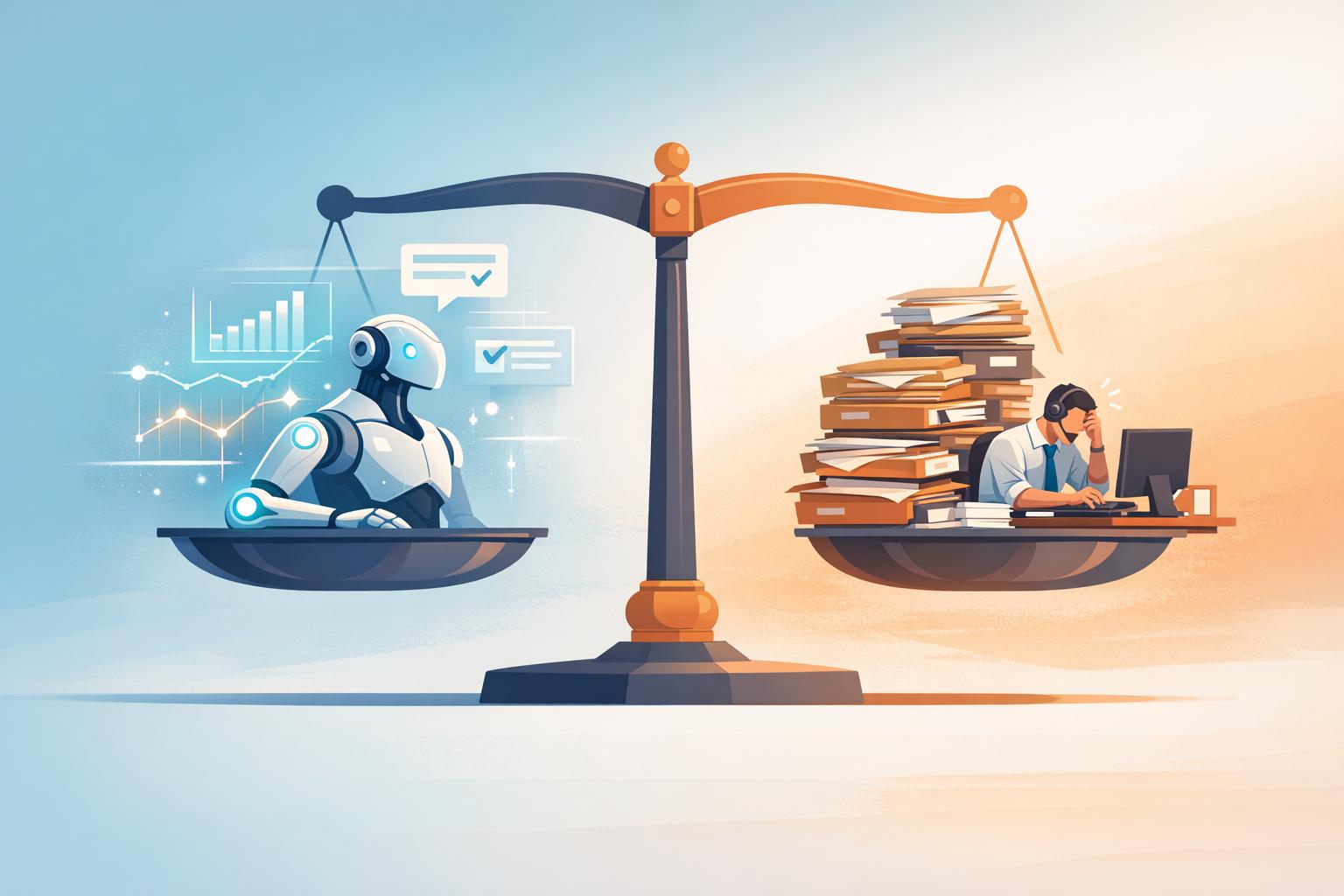

AI and human agents each bring unique strengths to customer service. AI excels at speed, cost-efficiency, and handling routine tasks like order tracking or account updates, with response times under 5 seconds and costs as low as $0.10 per ticket. Human agents, on the other hand, are better suited for complex or emotional issues, offering empathy, judgment, and personalized solutions, achieving satisfaction rates of up to 90%.
The best approach combines both: AI tackles repetitive inquiries, while humans address high-stakes or nuanced problems. This hybrid model improves efficiency, reduces costs, and ensures customers receive the care they need. For example, systems like ChatSpark integrate AI for routine queries and seamlessly escalate complex cases to human agents, delivering faster resolutions and higher satisfaction.
Key Stats:
- AI handles up to 70% of interactions, cutting costs to $0.10–$0.75 per ticket.
- Human agents resolve 60–80% of complex cases with satisfaction rates of 85–90%.
- 95% of consumers prefer human support for complicated or sensitive issues.
Quick Comparison:
| Metric | AI | Human Support | Hybrid Approach |
|---|---|---|---|
| Response Time | < 5 seconds | 8–15 minutes | 1–3 minutes |
| Cost per Ticket | $0.10–$0.75 | $5.00–$15.00 | $1.00–$4.00 |
| Complex Issues | 15–30% resolution | 60–80% resolution | 70–80% resolution |
| Empathy | Low | High | High |
| Scalability | Unlimited | Limited | High |
Combining AI and human support ensures speed, empathy, and cost-efficiency, creating a customer experience that meets modern expectations.
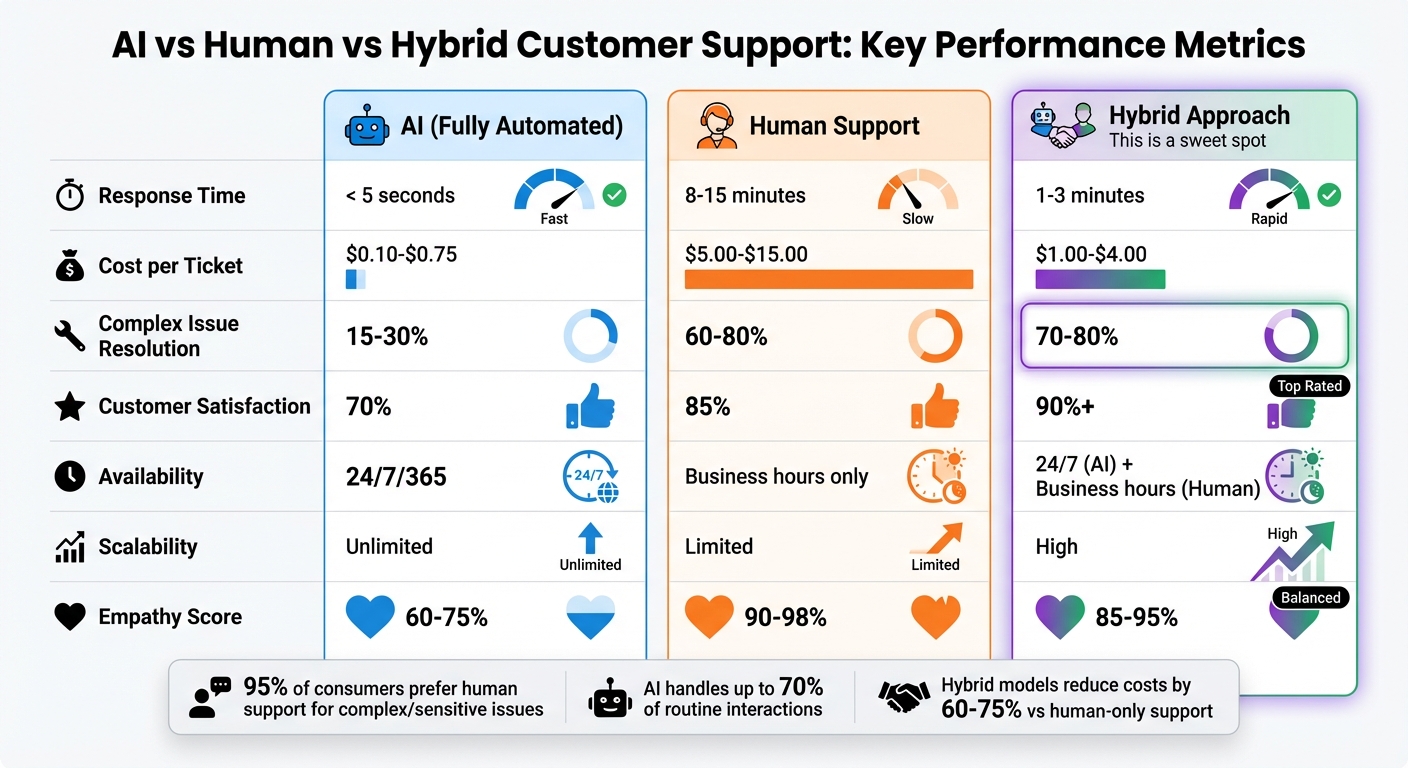
AI vs Human vs Hybrid Customer Support: Performance Metrics Comparison
What AI Does Well in Customer Service
AI shines in areas that demand speed, consistency, and scalability. Today’s AI systems go beyond simple FAQ responses - they handle tasks like processing refunds, updating accounts, and tracking orders through direct backend integrations [2]. This evolution has redefined customer service, offering key advantages in uptime, managing high volumes, and reducing costs. However, achieving these results requires a structured AI customer support implementation strategy.
Always-On Service and Lightning-Fast Replies
AI’s response time averages 0.8 seconds, a stark contrast to the 4.2 minutes it takes for human agents [8]. This speed is crucial, especially since 77% of customers expect immediate responses when they reach out to a company [4].
Another major perk is 24/7 availability. With 35% of support requests happening outside regular business hours [1], AI ensures customers aren’t left waiting. This matters because 82% of customers say a poor after-hours experience could push them to a competitor [8]. By being always on, AI prevents backlogs and keeps customer satisfaction high.
Managing High Volumes Without Breaking a Sweat
AI can handle an unlimited number of simultaneous inquiries without slowing down. Whether it’s Black Friday, a major product launch, or a service outage, AI manages 10x the volume without increasing wait times or needing extra staff [8].
The results speak for themselves: 92% of customer service teams using AI report faster response times, and 86% see improved customer satisfaction [5]. AI also resolves routine tickets 3–5 times faster than human agents [2] and automates up to 70% of interactions for e-commerce and subscription-based businesses [2]. This efficiency allows human agents to dedicate their time to more complex, high-value customer issues.
Cutting Costs While Ensuring Consistency
AI interactions cost between $0.10 and $0.75, compared to the $5.00 to $15.00 range for human agents [1][8][9]. On top of that, AI maintains less than 2% quality variance across thousands of interactions, ensuring dependable performance in multiple languages [8].
What Human Agents Do Best
Human agents bring something to the table that machines simply can't replicate: the ability to handle complex or emotional situations with empathy and precision. In fact, 84% of consumers trust the accuracy of human agents over AI when it comes to resolving their issues[6]. This isn't just about preference - it's about the fundamental strengths humans have in managing nuanced customer interactions. Their ability to connect on a personal level becomes especially important when emotions and context play a big role.
Understanding Emotions and Context
One area where human agents truly shine is in their ability to interpret emotions and context. They can pick up on subtle cues like tone of voice, word choice, or even silence, which helps them navigate sensitive or ambiguous situations[2][5]. When customers are upset or frustrated, generic AI responses often make things worse instead of better[2]. Humans, on the other hand, can adapt their approach on the fly. This adaptability is why 61% of people believe human agents are better at understanding their specific needs[6]. When a customer's request is unclear or incomplete, human agents know how to ask the right follow-up questions, "reading between the lines" to uncover the real issue[5].
"AI will deliver the speed customers expect, but human connection will ultimately determine who earns their loyalty."[6]
Complex Problem-Solving and Judgment Calls
When it comes to solving intricate problems or making judgment calls, humans have the upper hand. Unlike AI, which operates within programmed rules, human agents can consider factors like customer history or the overall value of the relationship to make decisions in gray areas[2]. This kind of flexibility is critical - 53% of consumers believe humans provide clearer and more thorough explanations than automated systems[6]. Scenarios like multi-party disputes, unusual technical issues, or high-stakes situations in fields like law, medicine, or finance often require the nuanced thinking that only people can provide.
"When you're talking about premium brands or high-touch engagements, it's not about automating everything; it's about giving a personalized interaction capability. That means you still need people."[7]
These abilities don't just solve problems; they build trust and strengthen customer relationships.
Creating Trust and Customer Loyalty
Trust isn't something that algorithms can generate - it’s built through genuine human interaction. For highly emotional customer issues, satisfaction rates jump to 78% when handled by humans, compared to just 52% with AI[1]. For complex problems, human agents achieve satisfaction rates as high as 85% to 90%[2]. And the stakes are high: bad experiences can lead to significant customer loss[5]. That's why 73% of consumers insist on having the option to speak with a real person when their issues escalate[10], and 42% are willing to pay extra for access to human representatives[6]. When things get complicated, it’s human judgment, empathy, and accountability that make all the difference.
AI vs Human Support: Side-by-Side Comparison
Building on earlier discussions about the strengths of AI and human support, this comparison sheds light on how these two approaches can work together to enhance customer service. A side-by-side breakdown highlights their individual strengths and limitations. The numbers make it clear: AI excels at speed and scalability, while humans bring critical thinking and emotional intelligence to the table.
"The question isn't whether to use AI or human agents - it's how to combine them optimally." - WorkFlux [11]
By understanding the strengths and weaknesses of each, businesses can craft a support strategy tailored to their customers' needs. For example, 88% of customers prioritize instant responses for simple queries, even over accuracy [11]. But when issues get complicated, 95% of consumers still value human interaction [5].
Comparison Table: AI vs Human Support
| Metric | AI (Fully Automated) | Human Support | Hybrid (AI-Assisted) |
|---|---|---|---|
| Response Time | < 5 seconds [1] | 8–15 minutes [1] | 1–3 minutes [1] |
| Availability | 24/7/365 [11] | Business hours [11] | 24/7 (AI) / Business hours (Human) |
| Cost per Ticket | $0.10–$0.50 [1][12] | $5.00–$15.00 [1][11] | $1.00–$4.00 [1] |
| Accuracy (Routine) | 70–85% [1] | 90–98% [1] | 95–99% [1] |
| Empathy Score | 60–75% [1] | 90–98% [1] | 85–95% [1] |
| Scalability | Unlimited [1][11] | Limited [1][11] | High [1] |
| Complex Issues | Poor (15–30% resolution) [12] | Excellent (60–80% resolution) [12] | Good (70–80% resolution) [12] |
| Consistency | 99% [1] | 70–85% [1] | 95% [1] |
| Relationship Building | Low (Transactional) | High (Personalized) | High (AI-supported) |
While this table provides a helpful overview, it’s worth noting that complex issues highlight the limitations of AI. Human agents resolve 60–80% of these cases, compared to AI's 15–30% resolution rate [12]. The hybrid approach, which combines AI’s efficiency with human expertise, bridges this gap with resolution rates of 70–80%, all while maintaining manageable costs [12].
Transparency also plays a crucial role in customer satisfaction. When customers know a human has reviewed an AI-generated response, satisfaction jumps to 81%. In contrast, only 45% of customers feel satisfied when AI operates without disclosure [1]. These comparisons emphasize the value of blending AI's speed and consistency with the empathy and insight of human agents - a balance that will be explored further.
When to Use AI
AI shines when it comes to low-risk, repetitive tasks where speed takes priority over nuanced decision-making. Studies show that around 50–60% of customer interactions fall into this category - simple, transactional requests that follow clear business rules and don’t demand subjective judgment [2]. This division of labor aligns perfectly with a hybrid support model, where AI handles routine inquiries while human agents focus on more complex, nuanced issues.
The ideal use case for AI is in Tier 1 support - tasks like order tracking, answering policy questions, updating billing information, or making simple account changes. These types of inquiries are straightforward and don’t require interpretation or negotiation. Here, AI outpaces humans significantly, responding in less than 5 seconds compared to the 3-minute average for human chat and the 12-hour average for email [1]. Considering that 90% of customers rate an immediate response as "important" or "very important" [13], this speed advantage becomes a competitive edge.
Routine Questions and FAQs
AI is particularly effective for handling routine questions and FAQs, especially when the answers are well-documented and straightforward. Tasks like password resets, account updates, and policy clarifications are procedural and repeatable, making them perfect for automation. For these types of inquiries, AI achieves 90%+ accuracy when dealing with well-organized FAQ topics [3]. Interestingly, 62% of customers actually prefer using chatbots or automated systems for simple queries, prioritizing speed over human interaction [3].
AI’s role has evolved from merely deflecting inquiries to actively resolving them. Modern systems integrate with backend operations, enabling them to complete multi-step processes like issuing refunds or initiating replacements - all within a single interaction [2]. This shift toward autonomous resolution has allowed AI to handle 40–60% of overall ticket volumes across industries, with e-commerce businesses seeing rates as high as 70% [2].
High-Volume, Simple Requests
AI thrives in scenarios involving high volumes of simple requests, such as during Black Friday sales, product launches, or service outages. These events generate massive spikes in customer inquiries that could easily overwhelm human teams. AI, however, scales instantly to handle thousands of simultaneous interactions without losing efficiency. Unlike human support teams that require hiring, training, and scheduling, AI can manage unlimited concurrent conversations at a cost of just $0.10–$0.50 per ticket [1], compared to $5.00–$15.00 for human agents [1].
Additionally, AI addresses the growing demand for 24/7 availability. About 67% of customers now expect round-the-clock support [11], and roughly 35% of inquiries come in outside regular business hours [1]. AI also supports over 45 languages fluently [11], making it easier for companies to provide seamless global service without needing multilingual staff. Platforms like ChatSpark handle high-volume scenarios across multiple channels - including websites, WhatsApp, Facebook, Instagram, and Telegram - offering instant, consistent, and on-brand responses in 85+ languages. These capabilities demonstrate how AI can efficiently manage customer interactions while maintaining quality, even during peak demand.
When Human Support Is Required
There are moments when only a human can step in and make a difference. Situations that are complex, emotionally charged, or require nuanced judgment call for the empathy and responsibility that only human agents bring to the table. In fact, customer satisfaction for emotionally sensitive cases rises to 78% with human involvement, compared to just 52% when AI handles these interactions alone[1].
While human support costs significantly more - ranging from $5.00 to $15.00 per ticket versus AI's $0.10 to $0.75 per ticket[1] - some cases justify the expense. With 50% of consumers willing to switch to a competitor after just one poor experience[5], knowing when to involve human agents becomes a critical business decision.
Emotional or Complicated Issues
When customers are frustrated, anxious, or dealing with sensitive matters, human agents shine. AI might handle routine questions well, but it struggles with emotional nuance. It can't read a customer's tone, shift its approach mid-conversation, or provide the genuine empathy needed to calm a tense situation. For example, billing disputes or technical issues often require a human's ability to ask precise follow-up questions and make decisions based on the bigger picture[1][2].
Take a billing dispute: a human agent can review the customer's history, weigh their overall value, and craft a resolution that acknowledges their concerns. These types of personalized interactions are crucial for maintaining trust and resolving complex challenges effectively.
High-Stakes Problems and Escalations
Certain scenarios demand human accountability and discretion - legal inquiries, safety-critical situations, medical advice, or large financial disputes are prime examples[5][2]. Customers expect a real person to take responsibility when the stakes are high. Unsurprisingly, 69% of consumers are uneasy about using AI for medical advice, and 68% feel the same about investment recommendations[6].
VIP and enterprise clients also have higher expectations. These high-value accounts often require tailored, human-driven service rather than automated responses. For these clients, the stakes are too high for anything less. Customer satisfaction for human-resolved complex tickets in these scenarios averages between 85–90%[2], underscoring the importance of human involvement.
Industry leaders echo this sentiment, emphasizing the importance of personal connection:
"AI will deliver the speed customers expect, but human connection will ultimately determine who earns their loyalty. While AI can inform and personalize interactions more deeply than ever, it cannot replace the trust-building moments that only come from personal connection." – Sabrina Leblanc, Senior Vice President for Sales and Customer Success, SurveyMonkey[6]
How to Combine AI and Human Support with ChatSpark
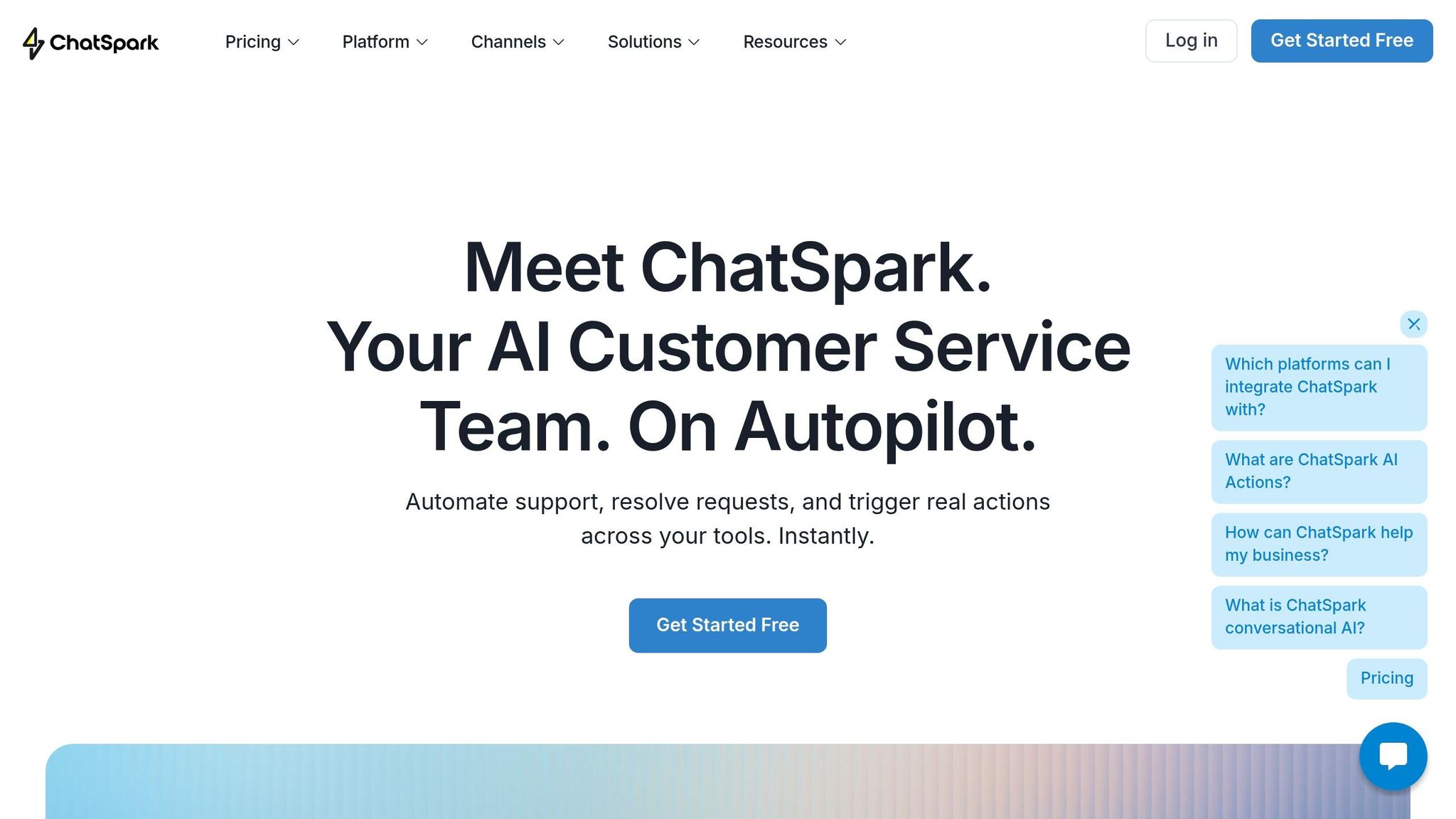
ChatSpark brings together the best of AI and human expertise to create a balanced customer support system. By blending AI's efficiency with the empathy and critical thinking of human agents, it ensures customer needs are met effectively. Since 95% of consumers see human support as essential for handling complex issues [5], ChatSpark strategically uses AI for routine tasks while reserving human agents for more intricate or high-stakes situations.
Layered Support Systems
ChatSpark employs a tiered approach to support. AI takes the lead on handling high-volume, straightforward requests like password resets, order tracking, or FAQs. When issues become more complex, the system seamlessly routes them to human agents. For example, ChatSpark’s AI Actions can transfer conversations to platforms like Freshchat, Intercom, or HappyFox Chat in real time, complete with the full conversation history for context [14].
The system is also designed to recognize when human intervention is needed. Specific keywords (like "speak to a person" or "help") or flagged emotional cues can trigger an immediate handoff to a human agent [14]. For asynchronous support, the AI creates detailed tickets in systems like Zendesk, Freshdesk, or Salesforce, attaching the entire conversation history to ensure nothing gets lost [14].
ChatSpark's Omnichannel Capabilities
ChatSpark ensures consistency by deploying the same AI across multiple channels, including your website, WhatsApp, Instagram, Facebook, Telegram, and Slack. This unified approach maintains a consistent brand voice, even before human agents step in.
Its CoPilot browser extension further enhances efficiency by integrating the AI’s knowledge base directly into tools like Gmail, Salesforce, and Zendesk. This integration saves teams an average of 2 hours per day per member by cutting down on time spent searching for information [16]. Additionally, with automatic responses in over 95 languages [16], the system scales effortlessly to support global operations. Impressively, ChatSpark AI Agents achieve resolution rates above 80%, with some enterprise deployments reaching as high as 98% [15][16].
Getting the Most from AI and Human Teams
This hybrid model delivers both cost savings and better customer experiences. Lorri G., Customer Service & Technical Support Manager at ITW, highlights that ChatSpark autonomously handles 1,831 chats per month, saving the company $119,225.
To keep improving, teams can use the "Top Unanswered Questions" dashboard to identify areas where AI needs better training or where human oversight is required. When the AI encounters queries it can’t confidently address, the Human-in-the-Loop Engine drafts responses for human review. This process not only maintains quality but also allows teams to refine the AI’s knowledge base over time.
Conclusion
Striking the right balance between AI's efficiency and the empathy of human agents is the cornerstone of effective customer service. AI shines when it comes to managing large volumes of routine inquiries quickly and affordably. On the other hand, human agents excel in situations requiring empathy, critical thinking, and nuanced problem-solving - especially when emotions run high or issues are complex. Combining these strengths creates a powerful strategy that delivers speed, precision, and the human connection customers value most.
Hybrid support models are proving their worth with impressive results: over 90% customer satisfaction, significant cost savings, and response times slashed by up to 81%. These models outperform both human-only (85% satisfaction) and AI-only (70% satisfaction) approaches [3]. They also reduce the cost per support ticket from $8–$15 to just $2–$5 [2] and maintain the personal touch that 95% of consumers see as essential for resolving complex issues [5]. This approach allows businesses to scale their operations while meeting customer expectations for both efficiency and empathy.
Take ChatSpark, for example. Its layered support system manages routine queries autonomously, seamlessly passing complex issues to human agents with full conversation context. The platform's omnichannel capabilities ensure consistent service across websites, WhatsApp, Instagram, Facebook, and more. Meanwhile, the CoPilot browser extension equips human agents with instant access to knowledge bases, all within their existing workflows.
"The future of customer service isn't AI or humans. It's AI and humans, working together in ways that leverage the strengths of both" [3].
FAQs
How do I decide which tickets AI should handle vs a human?
Deciding how to allocate tickets between AI and human agents comes down to the nature of the task. AI is great for handling straightforward, repetitive tasks - think order tracking, processing refunds, or making account updates. On the other hand, human agents shine when it comes to complex problems that demand empathy, critical thinking, or a personalized touch. By leveraging AI for high-volume, simple requests and leaving emotionally sensitive or intricate cases to human support, businesses can create a smoother and more satisfying experience for customers.
When should AI automatically escalate a chat to an agent?
AI systems should transfer a chat to a live agent in specific situations to ensure users receive the help they need. These situations include:
- When the AI's confidence level drops below 40%.
- If the user explicitly asks to speak with an agent.
- When negative sentiment is detected in the user's messages.
- For complex issues like billing disputes, security concerns, or legal matters.
- After repeated failed attempts to resolve the issue.
By escalating in these cases, the system ensures users get proper support, which plays a key role in improving customer satisfaction.
How can I measure if a hybrid support setup is working?
To assess the performance of a hybrid support setup, focus on tracking essential metrics like Customer Satisfaction Score (CSAT), Net Promoter Score (NPS), and Customer Effort Score (CES). These help measure the overall customer experience. Additionally, keep an eye on key operational indicators such as resolution times, first contact resolution (FCR), and the balance between automated and human-driven support. Pairing these numbers with employee engagement data and qualitative feedback offers a well-rounded view of how effective the setup truly is.