
When deciding between AI chatbots and live chat for customer support, the right choice depends on your business needs. Here’s a quick breakdown:
- AI chatbots are faster, cheaper, and available 24/7. They handle simple tasks like FAQs, order tracking, and password resets, resolving up to 80% of routine queries instantly. Costs range from $0.10 to $2.00 per interaction, making them ideal for high volumes and after-hours support.
- Live chat excels in complex problem-solving and emotionally sensitive situations. Human agents resolve 82% of intricate issues, provide empathy, and increase purchase rates by 2.8x for high-value sales. However, costs are higher, ranging from $5 to $25 per interaction, and scalability is limited.
Quick Comparison
| Metric | AI Chatbot | Live Chat |
|---|---|---|
| Response Time | < 2 seconds | 45 seconds–3+ mins |
| Resolution Time | 45 seconds–3 mins | 8–15 minutes |
| After-Hours Support | 24/7 availability | Limited (unless outsourced) |
| Cost Per Interaction | $0.10–$2.00 | $5.00–$25.00 |
| Complex Issue Handling | 38% success | 82% success |
| Customer Satisfaction | 70–85% | 85–92% |
Best Approach
A hybrid model combining both is often the most effective. Use AI chatbots to manage routine queries and escalate complex cases to live agents. This approach reduces costs by up to 80% while maintaining satisfaction rates of 90–95%.
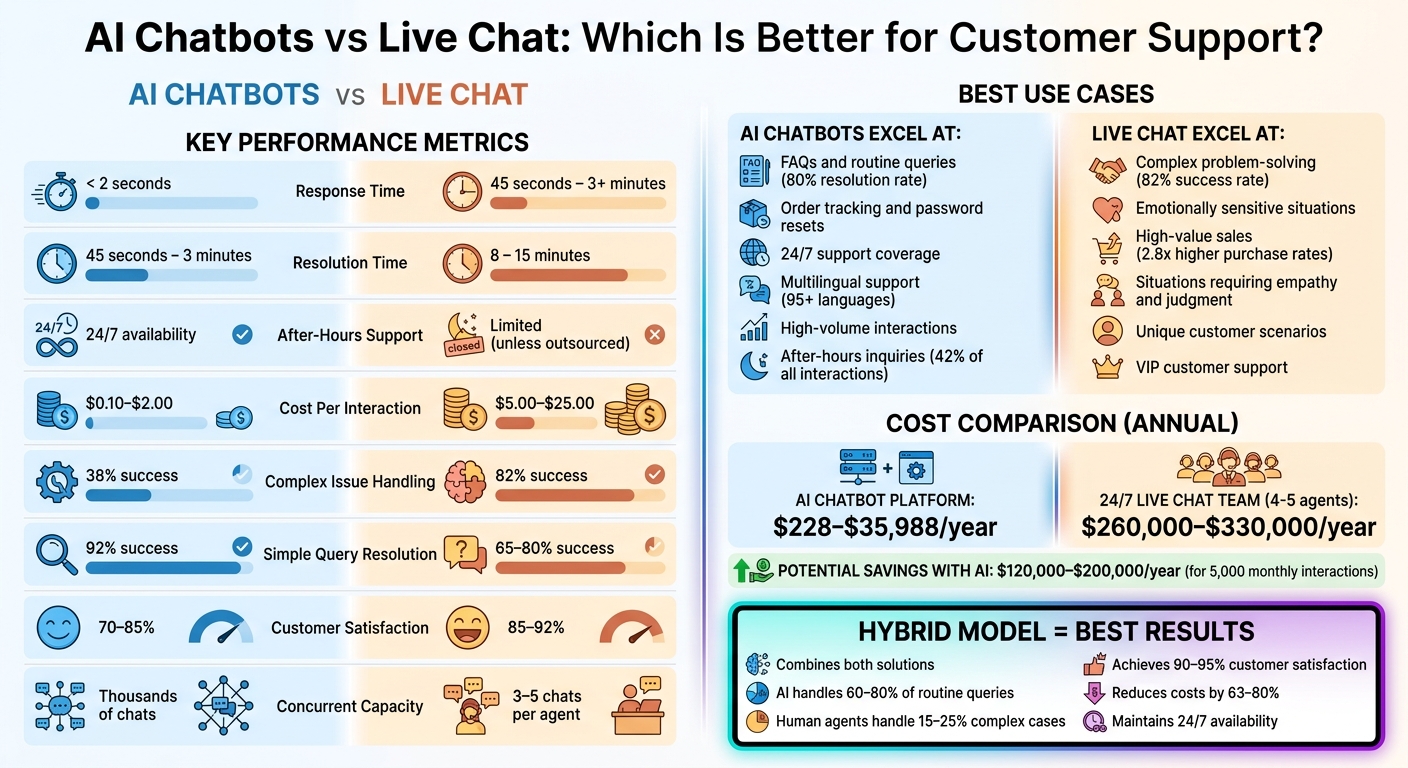
AI Chatbots vs Live Chat: Performance Metrics and Cost Comparison
AI Chatbots: Features and Drawbacks
How AI Chatbots Work
AI chatbots are designed to simulate conversations, primarily addressing customer inquiries and resolving basic issues before escalating more complex problems to human agents [8][5]. They rely on a combination of Natural Language Processing (NLP) to interpret human language, Large Language Models (LLMs) like GPT-5 and Claude Opus 4.6 to grasp context, and Retrieval-Augmented Generation (RAG) to ensure responses are grounded in verified company knowledge - avoiding fabricated answers [2][3][5][8].
The most advanced chatbots now use Agentic AI, which goes beyond answering questions to handle tasks like processing refunds or updating accounts through API integrations [8][1]. Additionally, sentiment analysis plays a key role by detecting customer emotions through language and punctuation. When frustration or dissatisfaction is identified, the chatbot can adjust its tone or escalate the interaction to a human agent [8][1].
With this technical foundation in mind, let’s explore how these capabilities translate into practical benefits for customer support.
Where AI Chatbots Excel
AI chatbots shine in their ability to provide instant responses - usually in under 2 seconds - and operate around the clock, every day of the year, without breaks or overtime [2][1]. This reliability ensures uninterrupted support.
Another standout feature is their scalability. While a human agent can manage 3–5 chats at once [1], chatbots can handle unlimited concurrent conversations without any drop in performance [1][5]. A real-world example is Amtrak's chatbot, "Ask Julie", which managed over 5 million queries annually, leading to a 25% increase in bookings and generating over $1 million in additional revenue [3].
Chatbots also bring cost savings to businesses. Each AI-driven interaction costs between $0.10 and $0.50, compared to $5.00 to $15.00 for human-led interactions [1]. For instance, a mid-sized company handling 5,000 monthly interactions could save significantly: over three years, a chatbot setup would cost about $28,764, compared to $766,078 for live agent support [4].
Beyond cost and speed, AI chatbots offer multilingual support, instantly communicating in 95 to over 100 languages [1][5]. They deliver consistent, documentation-based answers, avoiding the variability that can occur with human agents. Currently, 69% of customer queries are simple enough to be fully addressed by chatbots, and modern systems can autonomously resolve up to 80% of routine tasks like tracking orders, resetting passwords, and answering FAQs [5][1].
While these advantages are impressive, there are still areas where AI chatbots face challenges.
Where AI Chatbots Fall Short
AI chatbots often encounter difficulties with complex, multi-step troubleshooting that requires creativity or nuanced judgment. Their success rate for handling such issues drops to around 38% [2]. Additionally, 59% of businesses report that chatbots frequently misunderstand subtle shifts in context, sarcasm, or emotionally charged language [3].
Another major limitation is their lack of empathy. Chatbots cannot replicate the emotional intelligence needed for handling sensitive or high-stakes situations. This shortcoming is significant, as 65% of power users say they would stop using a business after a single poor chatbot experience [3]. Many systems also fall into what’s known as the "deflection trap" - focusing too much on keeping users away from human agents rather than genuinely resolving their issues. This can lead to frustrating, repetitive conversation loops [1][3].
Accuracy remains another concern. LLM-powered bots can sometimes "hallucinate", generating incorrect information based on statistical patterns instead of verified data. As company knowledge bases expand, they can suffer from "knowledge base rot" - a phenomenon where outdated or conflicting policies lead to errors and confusing responses [3]. For example, CTT, Portugal's postal service, discovered that 70% of the effort in deploying its chatbot "Helena" went into ensuring the bot maintained the company’s specific tone and avoided sounding overly robotic [10].
"A well-implemented AI chatbot doesn't compete with a live agent. It competes with a wait queue." – Canary Team [3]
Recognizing these limitations is essential for creating a balanced approach to customer support. The real challenge isn’t choosing between AI and human agents but understanding where each excels and designing systems that combine their strengths effectively.
Live Chat: Features and Drawbacks
How Live Chat Works
Live chat creates a direct connection between customers and support agents through a real-time messaging interface. Customers can start a chat by clicking on a website widget or responding to a proactive invitation triggered by specific behaviors, like lingering on a page for a set time. Once initiated, the system assigns the conversation to an available agent based on routing methods such as round-robin, skill-based, or department-specific allocation [11][1].
During the chat, agents and customers exchange messages, files, and even screenshots. Features like typing previews allow agents to respond more quickly. Agents also have access to real-time contextual data, including the customer’s current URL, browsing history, device type, and past interactions. This eliminates the need for customers to repeat themselves. The session concludes when the issue is resolved, escalated to a specialist, or turned into a support ticket for follow-up [11][2].
Modern live chat systems are shifting toward persistent messaging, similar to platforms like WhatsApp or Facebook Messenger, where conversations can be resumed later. Additionally, AI tools now assist agents by suggesting responses, summarizing chat histories, and pulling up relevant knowledge base articles in real time [1][9]. Let’s dive into what makes live chat effective.
Where Live Chat Excels
Live chat’s human element brings distinct advantages to customer support. One of its standout qualities is the ability to convey empathy and emotional understanding. Unlike automated systems, human agents can pick up on emotional cues and build genuine rapport. This matters because 62% of customers prefer dealing with a person for complex or emotionally charged issues [1].
Live chat also shines when solving intricate problems. For example, human agents are far better at handling situations that require pulling data from multiple systems, such as CRM tools, shipping logs, or payment platforms. In fact, they resolve such cases successfully 82% of the time, compared to only 38% for AI [2]. Customer satisfaction rates for live chat typically range from 85% to 92% when teams are properly staffed [1].
Another advantage is the ability to make judgment calls. Human agents can approve exceptions for loyal customers or make decisions in high-stakes scenarios. This flexibility contributes to higher conversion rates - website visitors who use live chat are 2.8 times more likely to make a purchase [3]. Speed is another strength, with the industry median for first response times at about 46 seconds, and top-performing teams aiming for 30 to 60 seconds [12][9].
"It is no longer a choice between automation or real agents. Both work together." – Drake Q., Co-founder & CPO Chatty [11]
Where Live Chat Falls Short
Despite its strengths, live chat has some limitations. The cost of human interactions ranges from $5 to $15 per case and can climb to $25 for more complex issues [1][3][2]. Additionally, the annual cost of a single U.S.-based live chat agent - including salary, benefits, and overhead - averages $65,400. On top of that, platform fees can range from $29 to over $299 per agent each month [3][2][1].
Scalability is another hurdle. A single agent can usually handle only 3 to 5 chats at once before the quality of support starts to drop [1][2]. Offering 24/7 live chat often requires hiring 4 to 5 agents, which can cost between $260,000 and $330,000 per year [3].
Limited availability also causes delays. Around 42% of inquiries occur outside business hours, yet 21% of live chat requests go unanswered. Furthermore, 35% of customers will abandon a chat if they wait longer than 3 minutes [2][5][1]. High agent turnover, fueled by repetitive tasks, ranges from 30% to 45%, and the median first response time of 2 minutes and 34 seconds often leaves customers dissatisfied. Support quality can also vary depending on an agent’s experience, mood, or workload [2].
"The preference for humans is real but narrow - it applies mainly to emotional situations, complex complaints, and high-stakes decisions." – LoopReply Team [2]
Head-to-Head: AI Chatbots vs. Live Chat
Performance Across Key Metrics
When comparing AI chatbots and live chat, the differences in performance are striking. Let’s start with speed: AI chatbots respond in a lightning-fast median time of 1.8 seconds. In contrast, live chat averages 2 minutes and 34 seconds for the first response, and during peak times, it can stretch beyond 5 minutes. This matters because 73% of consumers expect businesses to respond instantly online, and response time has a strong 0.72 correlation with customer satisfaction [2].
Availability is another area where AI chatbots shine. They operate around the clock, 365 days a year, at a cost that’s 90% to 98% lower per interaction than live chat systems [1][4]. This is crucial since 42% of customer interactions happen after regular business hours, and more than half of customers (53%) will abandon their attempt to contact a company if they have to wait longer than 10 minutes [2][13].
However, when it comes to resolving complex issues, live chat takes the lead. Human agents successfully resolve 82% of these cases, compared to AI chatbots, which manage only 38%. On the flip side, AI chatbots excel at simpler tasks, resolving 92% of routine inquiries [2].
Here’s a quick side-by-side look at the key metrics:
| Metric | AI Chatbot | Live Chat |
|---|---|---|
| First Response Time | < 2 seconds [2] | 45 seconds – 3+ minutes [1] |
| Resolution Time | 45 seconds – 3 minutes [1] | 8 – 15 minutes [1] |
| After-Hours Coverage | Full [2] | None (unless outsourced) [2] |
| Concurrent Capacity | Thousands of chats | 3–5 chats per agent [1][2] |
| Complex Issue Resolution | 38% [2] | 82% [2] |
| Simple Query Resolution | 92% [2] | 65–80% [4] |
| Customer Satisfaction | 70–85% [4] | 85–92% [1] |
These differences highlight how each option impacts customer satisfaction and operational performance. Let’s look at some real-world examples to see these metrics in action.
Visual Comparison
The numbers come to life when you examine real-world success stories. For instance, Klarna’s AI assistant managed 2.3 million conversations in its first month - handling the workload of 700 full-time agents. It also cut resolution times from 11 minutes to under 2 minutes, all while maintaining high satisfaction ratings [2][3]. Similarly, Amtrak’s AI assistant, "Ask Julie", processes over 5 million inquiries every year. This instant responsiveness led to a 25% increase in booking completions and saved the company an estimated $1 million annually in staffing costs [3].
These examples also help explain why chatbots are gaining popularity. A whopping 89% of Gen Z consumers prefer chatbots for initial contact to avoid waiting, and 62% of all consumers choose chatbots when they want to skip long queues [3][13].
In short, AI chatbots dominate in speed, availability, and cost-efficiency, while live chat excels at resolving complex issues and offering a more personalized touch. The right choice depends on your business goals, customer expectations, and how you automate customer support without losing quality.
Best Scenarios for Each Solution
When AI Chatbots Work Best
AI chatbots shine in environments where speed and consistency are key. They’re perfect for managing repetitive inquiries like order tracking, shipping details, return policies, and business hours - questions that often make up more than half of customer support requests. If you analyze your last 500–1,000 support tickets and find that over 50% fall into this category, an AI chatbot can significantly reduce your team’s workload [3].
They’re also great at handling straightforward, step-by-step tasks like resetting passwords, checking account balances, scheduling appointments, or processing simple returns. For instance, HelloFresh introduced a Facebook Messenger bot named "Freddy", which cut response times by 76% even as message volume increased by 47%. Similarly, Edwardian Hotels saw a 50% boost in room service sales after launching "Edward", an SMS chatbot capable of assisting guests with over 1,200 topics.
Another advantage is their ability to offer round-the-clock support. AI chatbots keep your business accessible 24/7, ensuring customers always have help when they need it. Plus, with modern AI capable of communicating in over 85 languages, there’s no need to hire multilingual staff. And when it comes to cost, AI interactions are far cheaper than live chat, making them ideal for businesses managing high volumes of customer queries [2][4].
When Live Chat Works Best
Live chat excels in situations that require complex problem-solving, emotional sensitivity, or a personal touch. When customers face multi-step technical issues, billing disputes, or unique challenges that go beyond standard procedures, a human agent’s ability to think creatively and empathize is irreplaceable.
Empathy and judgment are especially critical in high-stakes or emotionally charged scenarios. For instance, when a customer is frustrated about a lost order or dealing with a billing mistake, bot responses can feel detached. Studies show that 62% of consumers prefer interacting with a human agent for sensitive issues, and 86% overall would rather deal with a real person [1][6].
Live chat also plays a crucial role in high-value sales and negotiations. Whether it’s an enterprise contract or a luxury purchase exceeding $10,000, trust-building and personalized communication are essential. Research shows that live chat users are 2.8 times more likely to complete a purchase and spend an average of 60% more than those who don’t use chat [3]. Many businesses even reserve human support as a premium feature for their VIP customers or top-tier plans.
Using Both: The Combined Approach
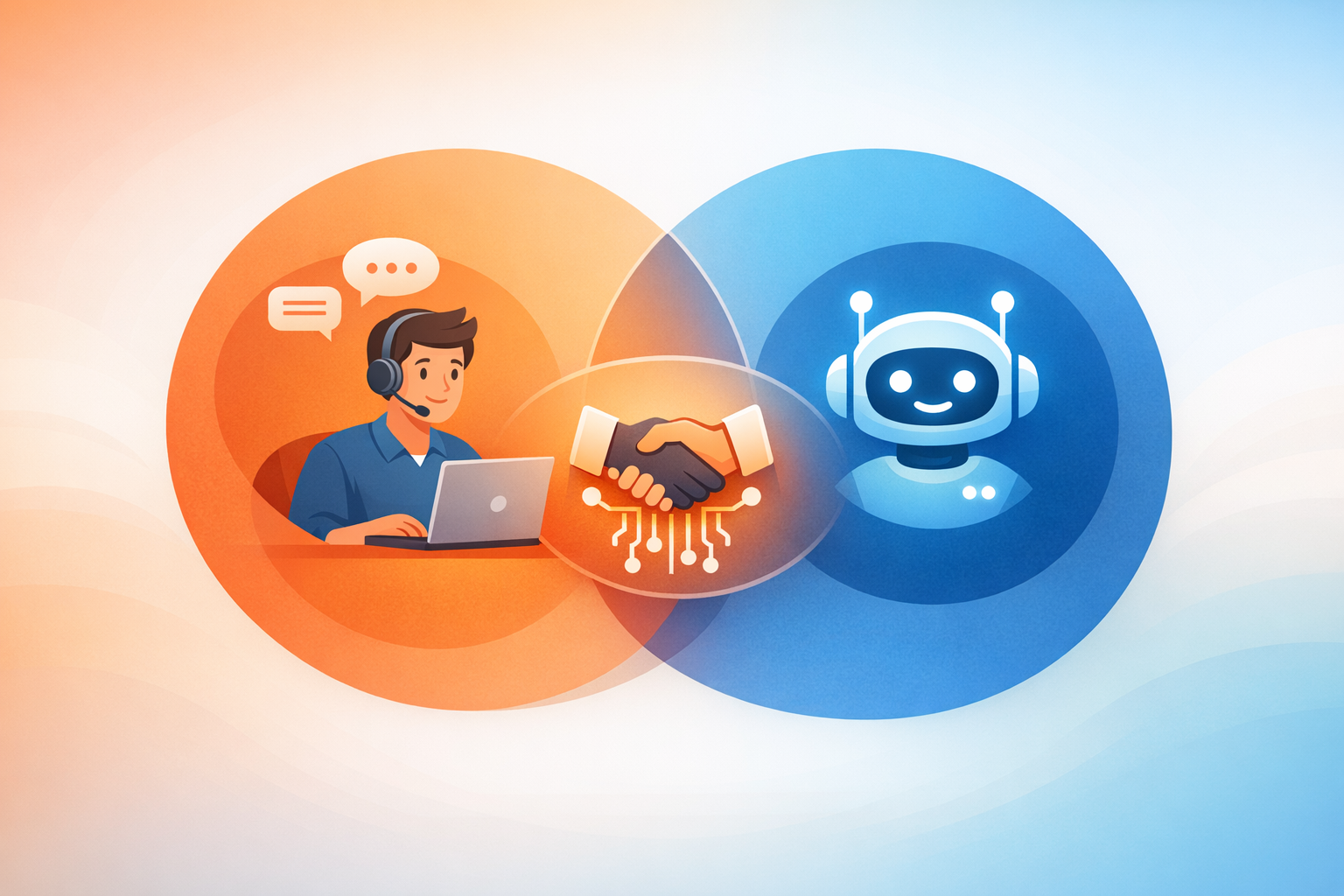
The smartest strategy doesn’t involve choosing between AI chatbots and live chat - it’s about blending the two into a tiered support system. AI chatbots act as the first line of defense, handling 70% to 80% of routine queries instantly, while human agents step in for the remaining 20% to 30% of complex or high-value cases [5][2].
The success of this hybrid approach lies in effective handoff mechanisms. Your system should escalate to a human agent when the AI’s confidence score falls below 70%, when it detects negative sentiment, or when customers mention high-priority keywords like "billing dispute" or "cancel." To ensure a seamless experience, always pass the full conversation history to the human agent so customers don’t have to repeat themselves.
This combined strategy delivers impressive results: customer satisfaction rates between 90% and 95% - higher than either method on its own - while reducing agent workload by 40% to 60%. Plus, it offers 24/7 availability without inflating costs [1].
"A well-implemented AI chatbot doesn't compete with a live agent. It competes with a wait queue" [3].
Costs and Returns
Cost Per Interaction Comparison
When it comes to cost efficiency, AI chatbots significantly outshine live chat handled by humans. AI chatbots typically cost between $0.50 and $2.00 per interaction, while live chat with human agents can range from $8.00 to $25.00 per conversation [3][2]. For a mid-sized business managing 5,000 interactions each month, this difference translates to annual savings of approximately $120,000 to $200,000 [1].
Staffing costs widen the gap even further. A single U.S.-based support agent costs about $65,400 per year when factoring in salary, benefits, taxes, and overhead [3]. To maintain 24/7 coverage, businesses often need four to five agents, bringing the total cost to $260,000 to $330,000 annually [3]. In comparison, AI chatbot platforms typically charge flat monthly fees, ranging from $19 to $200 for small businesses, while enterprise plans run between $500 and $2,999 per month [5][3].
The financial benefits are clear in real-world examples. Companies like Klarna and Amtrak have reported substantial savings and revenue gains - Klarna, for instance, projected $40 million in additional profits, while Amtrak generated over $1 million in booking revenue [3].
These cost advantages directly influence return on investment (ROI), which is explored further below.
Measuring ROI
The cost savings from AI chatbots translate into rapid ROI, often within 30 to 60 days, as their marginal cost per additional query approaches zero [1][15][3].
AI chatbots enhance efficiency, drive revenue, and improve customer satisfaction. For instance, they handle the 42% of customer interactions that occur after 5 PM, turning after-hours inquiries into sales without the need for costly night-shift staffing [2]. Additionally, responding to customers within 5 minutes increases the likelihood of conversion by 21 times [3]. Businesses that adopt a hybrid model - automating 70–80% of routine tasks while leaving complex issues to human agents - see the highest returns [15][2].
To estimate potential ROI, use an AI ROI calculator or this formula:
Monthly Benefit = (automated inquiries × minutes saved × cost per minute) + (recovered inquiries × conversion rate × average order value) – monthly platform fee [7].
If repetitive FAQs make up more than 50% of your last 500 support tickets, an AI chatbot is likely to pay for itself within 6 to 12 months if you follow a proven automation checklist [3].
Customer Satisfaction and Experience
How Response Speed Affects Satisfaction
When it comes to customer satisfaction, response time is a game-changer. Studies show that response time is the strongest predictor of customer satisfaction, with a correlation of 0.72 [2]. Customers reaching out online expect quick answers - 73% want an instant response [1]. The numbers don’t lie: if wait times jump from 10 seconds to 3 minutes, satisfaction plummets from 95% to 45% [1].
AI chatbots excel here, delivering responses in under 2 seconds. In contrast, live chat agents typically respond within 30 seconds to 5 minutes, though this can stretch to nearly 6 minutes during peak times [2]. Here’s the kicker: response times under 5 seconds can boost satisfaction by 1.7 points on a 5-point scale compared to waits longer than 5 minutes [2]. Fast responses matter, and when AI gets it right, 81% of customers rate their interactions as 4 or 5 out of 5 [2].
Take the example of "Helena", a generative AI chatbot launched by CTT, Portugal’s postal service, in 2025. Over just three months, Helena handled 281,000 interactions and improved the company’s Net Promoter Score by 40 points [10]. It’s clear that customers prioritize fast, accurate answers over whether they’re dealing with a human or AI. In fact, 60% of customers say waiting on hold is the most frustrating part of customer service [5].
While speed is essential, it’s not the whole story. The tone, consistency, and quality of the interaction also play a big role in shaping the customer experience.
Personal Touch vs. Consistency
Speed may grab attention, but the quality of the interaction keeps customers coming back. Live chat agents bring empathy and adaptability to the table, especially when handling complex or emotionally charged issues. This human touch can make a big difference - personalized help from live agents increases conversion rates by 2.8 times, particularly for high-stakes decisions or sensitive complaints [14].
However, human responses can vary based on mood, training, or experience. That’s where AI chatbots shine, delivering consistent, brand-aligned, and factually accurate answers every time [1]. For routine queries, this consistency is invaluable. Yet, when a personal touch is needed, human agents outperform by dynamically adjusting their approach. A hybrid strategy - where AI manages initial contact and escalates to human agents when necessary - consistently leads to satisfaction scores between 90% and 95% [1]. Advanced systems even use sentiment-aware routing to transfer frustrated customers to human agents proactively [1].
Preferences vary depending on the situation. 62% of customers prefer chatbots for simple questions, while 75% prefer humans for complex issues [16][1]. Interestingly, nearly 48% of customers can’t tell the difference between a modern AI agent and a human during routine interactions [16]. Meanwhile, 71% of people prefer self-service options for straightforward tasks [1]. The secret lies in using the right tool for the job: AI for speed and consistency on routine matters, and human agents for situations requiring judgment and empathy. By combining AI’s efficiency with the human ability to connect emotionally, businesses can deliver the best of both worlds and keep customers satisfied.
Conclusion
Main Differences Recap
AI chatbots stand out with their rapid response times (under two seconds), the ability to handle unlimited chats simultaneously, and costs ranging from just $0.10 to $5.00 per interaction - compared to $5.00 to $25.00 for live chat agents [1][2]. They shine in managing routine questions and offer 24/7 availability without adding staffing expenses. On the other hand, live chat agents bring the human element, offering the flexibility and judgment needed for addressing complex, nuanced issues. Simply put: AI dominates in speed, scalability, and cost-efficiency, while human agents excel at tackling more intricate, multifaceted concerns. These distinctions are key when deciding on the right support strategy.
How to Choose
Start by reviewing your last 500 support conversations. If more than half are repetitive FAQs, AI chatbots should be your priority [3]. For businesses handling fewer than 200 inquiries a month, live chat may meet your needs. However, if your volume exceeds 500 inquiries, AI becomes essential to sustain ROI [4]. Also, think about availability - about 42% of customer interactions happen after 5 PM, a time when many live chat teams are offline [2]. If 24/7 support is critical but you can’t afford the $130,000 to $330,000 annual cost of staffing a round-the-clock live chat team, AI is the practical choice [3]. By assessing these factors, you can craft a support strategy that balances efficiency and customer care.
Why the Combined Approach Works Best
A hybrid model isn’t just a middle ground - it’s a game-changer. By combining the speed and efficiency of AI with the problem-solving skills of live chat agents, your support system becomes stronger and more effective. Hybrid setups often achieve customer satisfaction rates of 90% to 95% [1][2]. Here’s how it works: AI acts as the first point of contact, handling 60% to 80% of routine queries, while the remaining 15% to 25% of more complex issues are escalated to human agents [3][4]. For this to work seamlessly, ensure that human agents receive the full conversation history when cases are handed off [6]. This approach not only improves outcomes but also cuts costs by 63% to 80% compared to relying solely on live chat [4].
FAQs
How do I know what to automate with a chatbot?
When figuring out what tasks to automate, start with routine and repetitive activities. These might include things like order status checks, answering FAQs, or handling basic account inquiries. Chatbots excel at managing these tasks efficiently and on a large scale.
For more complex or emotionally sensitive matters, it’s crucial to set up clear escalation points so those cases can seamlessly transfer to a human representative. This ensures that customers still get the empathy and nuanced understanding they need.
Automation also works well for multi-step processes or FAQs that require context retention and advanced natural language understanding. Focus on automating tasks where speed and high volume are essential - this is where chatbots truly shine.
When should a chat go to a human agent?
When a situation becomes complex, emotionally charged, or requires a nuanced understanding, it’s time to bring in a human agent. These scenarios often demand empathy and judgment that automation simply can't provide. Smooth handoffs can be initiated through triggers like low confidence scores, negative sentiment analysis, or even direct customer requests.
The key is ensuring the transition feels seamless. Preserving the context of the conversation is crucial, as it allows the human agent to step in without missing a beat. This approach not only delivers the personalized support customers need but also reinforces their trust and satisfaction when automation reaches its limits.
How do I prevent chatbot wrong answers?
To minimize chatbot errors, focus on a few key strategies. First, set clear triggers for escalation, such as low confidence scores or negative sentiment, so a human agent can step in when necessary. Make sure the conversation context is preserved during handoffs to avoid frustrating users with repeated questions. Additionally, regularly test and monitor the chatbot’s performance to catch and correct inaccuracies. These practices help improve both accuracy and reliability over time.