AI agents are changing how businesses handle customer support and sales by automating tasks, providing 24/7 assistance, and enabling faster, more personalized interactions. Unlike traditional chatbots, these systems use advanced reasoning to manage complex workflows, such as resolving customer issues or qualifying sales leads, without human intervention. Key highlights include:
- Customer Support: AI agents resolve up to 70% of inquiries independently, cutting response times by 80% and saving businesses 40-60% in support costs.
- Sales: They automate lead qualification, follow-ups, and CRM updates, saving sales reps 10-13 hours per week and boosting revenue through personalized outreach.
- Real-World Impact: Companies like Salesforce and Zendesk report significant efficiency gains, with AI agents handling thousands of tickets and generating millions in revenue.
With tools like ChatSpark, businesses of all sizes can quickly deploy AI agents to improve efficiency, reduce costs, and enhance customer experiences. Starting at $19/month, these platforms offer features like omnichannel support, real-time analytics, and workflow automation, making AI agents accessible and effective for any team.
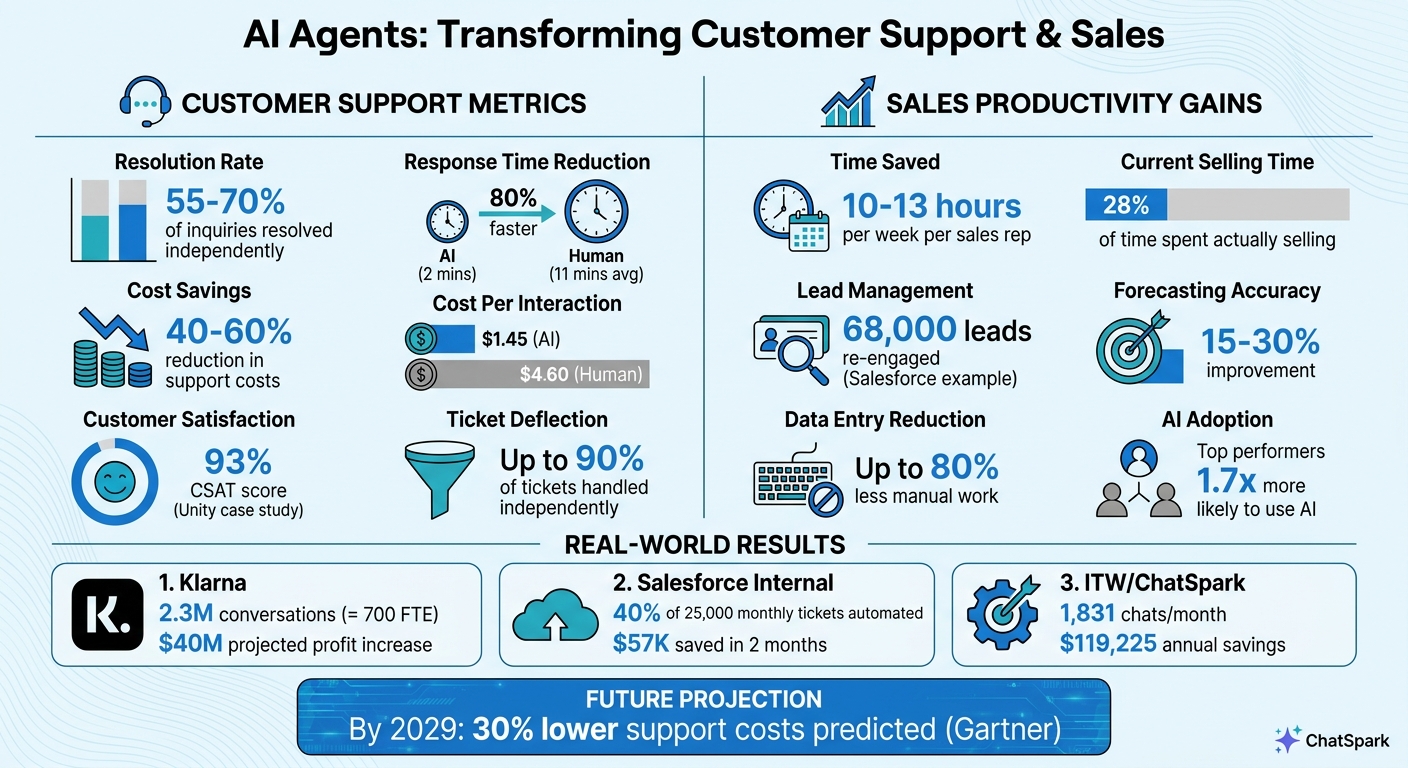
AI Agents Impact on Customer Support and Sales: Key Statistics and ROI
What Are AI Agents and How Do They Work?
AI agents are autonomous software systems designed to handle complex workflows by reasoning, planning, and executing tasks. Unlike traditional chatbots that stick to rigid scripts or decision trees, AI agents leverage Large Language Models (LLMs) to understand and respond to nuanced customer needs - even when those needs are expressed through complicated conversations.
At their core, AI agents are built around four main components:
- Language models: These serve as the reasoning engine, enabling comprehension and decision-making.
- Tools and APIs: They allow agents to take actions across various systems.
- Memory: This ensures the agent can maintain context across multiple interactions.
- Instructions: These act as behavioral guardrails, ensuring the agent operates within set boundaries.
This architecture enables AI agents to go beyond simply providing information. They can complete tasks autonomously, such as issuing refunds, updating CRM records, or scheduling appointments. For example, if a customer asks about a delayed order, an AI agent can check the shipping status, identify the issue, process a refund if necessary, and update the customer record - all in one seamless interaction. Traditional chatbots, in contrast, often fail when faced with tasks outside their programmed responses, leaving customers frustrated with an unhelpful "I don't understand."
Understanding how these agents operate lays the groundwork for exploring the technologies that make them so effective.
Core Technologies Behind AI Agents
AI agents rely on Retrieval Augmented Generation (RAG) to ensure their responses are accurate and grounded in your business's data. This technology connects agents to knowledge bases, CRM systems, and internal documentation, allowing them to retrieve relevant information before crafting their replies. This approach prevents the agent from "guessing" answers, keeping the responses reliable and up-to-date.
Another key capability is independent reasoning, which uses advanced Natural Language Processing (NLP) and Machine Learning to interpret context, grasp intent, and adapt responses based on the situation. Erin DeCesare, CTO of ezCater, highlights this strength:
"What AI is really great at is understanding the human context of language. As customers use this unstructured set of prompts, agents can narrow down what caterer is best suited for that particular order" [4].
AI agents also excel at tool calling, enabling them to interact with external systems like payment processors, helpdesks, and logistics platforms. This functionality allows them to perform actions - like issuing refunds or updating orders - rather than just providing information. These integrations streamline workflows and emphasize efficiency, with some agents now capable of handling up to 90% of customer tickets independently [9]. They also maintain context across devices and platforms, ensuring a consistent experience.
These technologies form the backbone of AI agents, but their evolution over time has significantly transformed customer interactions.
The Evolution from Basic Chatbots to AI Agents
The leap from basic chatbots to AI agents represents a shift from rigid, rule-based systems to dynamic, context-aware interactions. Traditional chatbots relied on deterministic programming, meaning they could only handle scenarios they were explicitly built for. AI agents, on the other hand, are probabilistic, using advanced reasoning to navigate ambiguous, real-world situations that don’t fit neatly into predefined categories.
This evolution has delivered tangible benefits. For example, in early 2026, 1-800Accountant adopted Salesforce's Agentforce to manage customer inquiries. According to CTO Ryan Teeples, these AI agents now resolve up to 50% of incoming requests, handling tasks like checking tax return statuses and freeing up human agents for more complex issues [4]. Similarly, Camping World slashed customer wait times from hours to just 33 seconds, while boosting customer engagement by 40% [9].
The results speak for themselves. AI-powered support platforms are now driving cost reductions of 40% to 60% [5], with tier-1 AI agents resolving 55% to 70% of inquiries without human intervention [7]. Looking ahead, Gartner predicts that by 2029, agentic AI will handle most routine service issues, leading to 30% lower support costs [5]. This isn't just about deflecting customer queries - it’s about solving problems completely and efficiently.
Benefits of AI Agents for Customer Support
AI agents are transforming customer support by improving availability, creating tailored experiences, and boosting team productivity. These advancements lead to reduced inquiry volumes, better customer experiences, and noticeable cost reductions for businesses.
24/7 Support and Faster Response Times
AI agents provide instant, round-the-clock assistance, ensuring customers always receive timely help. Take Klarna, for instance - its AI assistant, launched in February 2024, handled 2.3 million conversations in its first month. That’s equivalent to the workload of 700 full-time agents. This system not only cut repeat inquiries by 25% but is also projected to add $40 million to annual profits [8].
On average, AI agents resolve inquiries in just 2 minutes - 80% faster than the 11-minute industry average for human agents. This speed translates into significant savings, with AI-driven interactions costing about $1.45 each compared to $4.60 for human-led support.
"Each quarter, we resolve over 60,000 support requests with AI agents that carry out full workflows, execute backend actions, and adapt in real time to what our customers need."
– Austin Lacey, Director, Chatbots, AI & Automation, Zendesk [10]
But speed isn’t the only advantage - AI agents also excel at delivering personalized experiences.
Personalized Customer Interactions
AI agents use customer data - such as CRM records, purchase histories, and prior interactions - to provide responses tailored to individual needs. This capability ensures customers receive support and recommendations that align with their preferences. For example, Unity integrated Zendesk AI agents with its knowledge base in April 2026, deflecting nearly 8,000 tickets, achieving a 93% customer satisfaction score, and saving $1.3 million in operational costs [11]. Similarly, Esusu reduced first reply times by 64% and cut overall ticket resolution times by 34% by equipping agents with instant context for 10,000 monthly tickets.
These personalized interactions are increasingly expected by customers - 61% now expect tailored support, and 80% are more likely to make purchases when brands offer individualized experiences [9]. Businesses adopting AI-driven personalization often see satisfaction scores improve by 15% to 20% [5].
This focus on personalization also helps reduce the workload for human teams by automating routine tasks.
Reducing Workload for Human Support Teams
AI agents take over repetitive inquiries, freeing human teams to tackle complex or emotionally charged cases. For example, Salesforce's IT team uses Agentforce to manage 25,000 monthly tickets for 76,000 employees. The AI agents now handle 40% of IT support cases, resolving 9,500 issues automatically and saving $57,000 in just two months [8]. Similarly, ITW’s ChatSpark AI agents handle an average of 1,831 chats monthly, saving $119,225 over a year.
This automation can free up to 11.2 hours per week for sales and support staff [6]. Other success stories include Stockbit, which automated 30% of its over 1 million incoming conversations, saving $1 million annually and reducing the need for 27 full-time employees. HelloSugar automated 66% of its customer interactions, saving $14,000 per month while doubling its locations from 81 to 160 in just one year.
"With Agentforce automating a significant share of standard inquiries, our team can focus on more complex issues, ensuring faster and more accurate support."
– Tiina Vesterinen, Vice President, Commerce & CX Solutions, Finnair [4]
How AI Agents Transform Sales Processes
Sales teams are now tapping into AI to streamline administrative tasks and improve lead engagement. On average, sales reps spend only 28% of their time selling, while the rest is tied up in admin work and manual data entry [13]. AI agents flip this dynamic by taking over tasks like lead qualification, follow-ups, and data analysis, letting reps focus on what they do best - building relationships and closing deals.
These agents save reps 11.2–15 hours per week, and AI-powered forecasting cuts the gap between predicted and actual results by 15%–30% [13][6]. The impact shows in revenue: top-performing sales teams are 1.7 times more likely to use AI for prospecting and outreach compared to lower performers [3].
Lead Qualification and Automated Follow-Ups
AI agents use frameworks like ICP and BANT to assess leads based on firmographics, website activity, and intent signals [12][14][15]. Unlike static automation, these agents adapt to context. They might analyze a prospect's LinkedIn activity or company news to craft personalized outreach - scaling this approach across thousands of leads [12][15].
For example, between July and October 2025, Salesforce deployed its Agentforce AI agents to reconnect with 68,000 previously overlooked leads. These agents sent 156,000 emails, booked 800 meetings, and helped close several deals [1]. As Salesforce CEO Marc Benioff explained:
"We just couldn't call them back because we didn't have enough people. Moving at that speed and scale is what transforms a bottleneck into a breakthrough" [1].
AI also tackles CRM maintenance by automatically updating records, logging summaries, and advancing deal stages. This reduces manual data entry by up to 80%, ensuring sales teams always have accurate and current information [13][6].
| Task | Manual Time | AI Agent Time | Weekly Savings |
|---|---|---|---|
| Contact Enrichment | 8–12 min/contact | 0 (Automatic) | ~2–3 hrs/rep |
| Call Logging/Summary | 10–15 min/call | 0 (Automatic) | ~3–4 hrs/rep |
| Pipeline Hygiene | 30–60 min/week | 5 min (Review) | ~2–3 hrs/rep |
| Follow-up Sequences | 20–30 min/deal | 2–3 min (Review) | ~2–3 hrs/rep |
| Total Reclaimed Time | ~10–13 hrs/rep |
By automating these processes, AI agents not only simplify lead management but also open doors for more proactive, data-informed sales strategies.
Real-Time Data and Predictive Analytics
AI agents actively track pipeline health by flagging risks like stalled deals, declining stakeholder engagement, or inactivity [13][2]. Instead of waiting for reps to check dashboards, these agents deliver tailored recommendations directly via platforms like Slack. This approach achieves a 38% action completion rate, compared to just 8% for traditional alerts [2].
In a Salesforce pilot from February to May 2025, AI systems provided 24,000 personalized recommendations, generating $28 million in pipeline and $9 million in closed revenue over four months [2]. As Ali Nahvi, Salesforce's Director of Product Innovation, pointed out:
"AI doesn't inherently know the difference between good and great the way that our subject matter experts do. We recognize that humans are the tastemakers" [2].
Predictive models analyze a mix of behavioral, firmographic, and intent data (each contributing 25–35%) to estimate conversion likelihood. This enables intent-based routing, where leads are assigned to reps based on fit scores, territories, and workloads. By 2027, AI agents are projected to reduce prospect research time by 34% and content creation time by 36% [3].
These predictive capabilities ensure sales teams stay ahead, providing timely insights that drive smarter decisions.
Omnichannel Customer Engagement
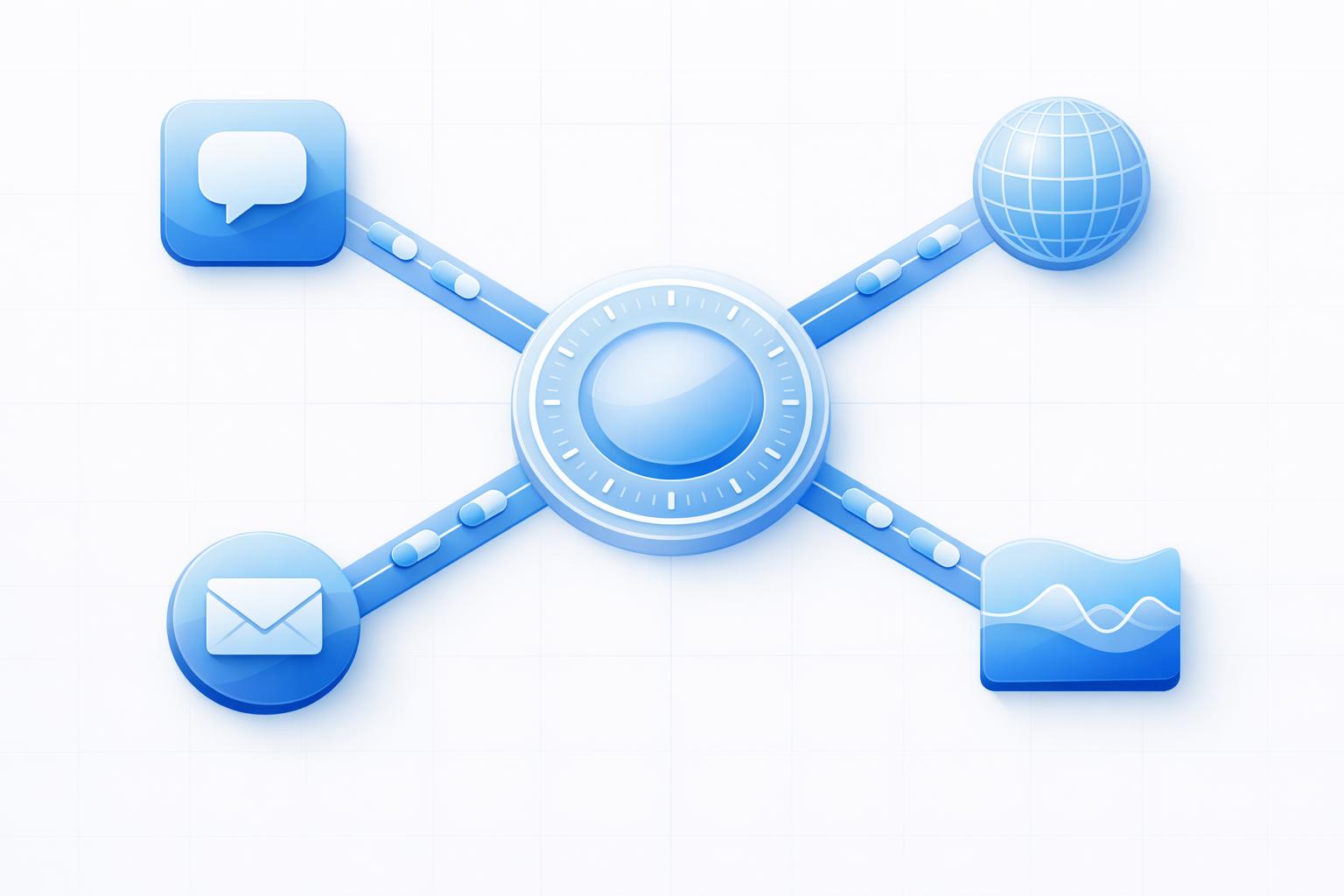
AI agents ensure seamless communication as prospects move across platforms - whether starting on social media, following up via email, or chatting on a website. They track buying signals, like repeated visits to a pricing page, and initiate personalized outreach instantly [6][15].
This tech enables global engagement, supporting over 85 languages with real-time translation while maintaining consistent messaging. Adam Alfano, Salesforce's EVP of Sales, emphasized the importance of unified data:
"The secret sauce for sales AI agents is unified data. Stand-alone agents without comprehensive customer context tend to fail" [3].
Unlike traditional automation with rigid rules, AI agents adapt to real-time data and continuously refine their methods through outcome analysis [15]. Operating 24/7, they respond to buyer intent as it happens, scheduling meetings directly into rep calendars [14][1]. Alfano summed it up well:
"We want to kill the busywork so our teams can focus on what actually moves deals forward: building relationships and driving success. AI agents make that possible" [3].
ChatSpark: AI Agents for Customer Support and Sales
ChatSpark showcases how AI agents are reshaping customer support and sales. This platform automates interactions across multiple channels, including websites, Instagram, Facebook, WhatsApp, Telegram, and Slack. It operates 24/7 in over 85 languages while maintaining your brand’s unique tone. Businesses can train AI agents using a variety of sources like URLs, PDFs, CSVs, DOCX files, YouTube transcripts, and Google Docs, creating a dynamic knowledge base tailored to customer needs [16].
ChatSpark Features
ChatSpark combines automated customer support with tools for lead capture and analytics. It tracks customer interactions and pinpoints conversion opportunities. Its integration capabilities include popular tools like Zapier, Freshchat, Square, and Calendly, allowing AI agents to handle tasks such as scheduling meetings, processing payments, and syncing with workflows. For live conversations, the ChatSpark CoPilot browser extension (available on Plus plans and above) offers AI-generated responses. Additionally, AI Actions can automate tasks like ticket creation and data updates , such as syncing with Follow Up Boss for real estate leads [16].
Pro and Enterprise plans offer omnichannel deployment, enabling businesses to centralize conversations from multiple platforms on one dashboard. GA4 event tracking provides insights into user behavior and conversion paths, while unbranded widgets ensure a smooth customer experience. Enterprise users gain access to features like SOC 2 compliance, role-based access control, audit logs, and a dedicated account manager [16][17]. These features provide businesses with the flexibility to adapt to their unique needs.
Pricing Plans for Different Business Needs
ChatSpark offers four pricing tiers designed to grow alongside your business. An annual billing option includes a 14% discount, which is like getting nearly two months free [16]. Businesses can also combine multiple plans under one account to increase AI agent slots and expand limits for messages and training pages [16].
| Plan | Price (Monthly) | Messages | Training Pages | Key Features | Best For |
|---|---|---|---|---|---|
| Basic | $19 | 100 | 25 | 1 AI Agent, Zapier integration, basic analytics | Solo entrepreneurs |
| Plus | $59 | 250 | 50 | 5 AI Actions, ChatSpark CoPilot, REST API access | Growing businesses |
| Pro | $129 | 2,000 | 500 | 40 AI Actions, omnichannel deployment, GA4 tracking, unbranded widgets | Mature operations |
| Enterprise | Custom | Custom | Custom | Unlimited AI Actions, SOC 2 compliance, dedicated account manager | Large organizations |
Standard AI models use 1 credit per reply, while advanced models (available on Pro and Enterprise plans) require 20 credits per reply [16]. A 14-day free trial is available for the Basic plan, giving businesses a chance to explore its capabilities [16].
Business Success Stories with ChatSpark
A global leader in construction products turned a $4,000 investment in ChatSpark into $47,880 in savings. By automating support queries and cutting response times, the AI agent handled routine customer inquiries around the clock. This allowed human teams to focus on complex issues and strategic sales efforts, driving both efficiency and growth [16].
How to Implement AI Agents with ChatSpark
Here’s a step-by-step guide to getting started with ChatSpark to boost your AI-driven support and sales efforts.
Setting Up ChatSpark
Getting ChatSpark up and running is quick and simple. You can integrate it into your website in under 5 minutes. Once you’ve signed up for the 14-day free trial, you’ll receive an embed code from your dashboard. This is a single JavaScript snippet that you paste into your website's HTML footer. ChatSpark is compatible with platforms like WordPress, Shopify, and custom-built sites, and no coding skills are required.
For social media and messaging apps, ChatSpark offers built-in integrations under the "Channels" section. For example:
- Facebook Messenger: Link your page ID and verify it through Meta Business Suite.
- WhatsApp: Connect using a Business API number.
Setup wizards walk you through the process in about 10–15 minutes, ensuring all conversations are synced into a centralized dashboard, making omnichannel support a breeze.
You can also personalize your AI agent to match your brand. Choose from pre-designed tones or train a unique tone using 50–200 conversations. Enhance branding by uploading your logo, selecting HEX-based color schemes, and adding avatars. In the "Knowledge Base" section, upload PDFs, URLs, or CSV files (up to 100 MB total), and use the auto-indexing tool to categorize content by topics like FAQs or product details.
Improving AI Agent Performance
Once your AI agent is live, use the "Analytics" dashboard to monitor its performance in real time. Focus on these key metrics:
- Resolution rate: Aim for over 85%.
- Response time: Keep it under 30 seconds.
- Customer satisfaction (CSAT): Maintain a score above 4.5 out of 5.
- Escalation rate: Target below 15%.
Customizable CSV reports are available for exporting data and conducting deeper analysis.
Dedicate about 2 hours each week to review the "Top Unanswered Questions" and identify areas where the AI struggled. Adding 10–20 new entries to your knowledge base regularly can reduce deflection rates, especially in e-commerce. Use the Workflow Builder's drag-and-drop tool to automate processes like routing complex queries to human agents or setting up upsell triggers. Additionally, A/B testing different prompt variations can increase conversions by up to 25%.
For a hybrid approach, enable the "Seamless Handoff" feature. This ensures that when the AI’s confidence drops below 80% or it identifies specific keywords (like "refund dispute"), it escalates the conversation to a live agent via tools like Slack or Zendesk. The full conversation context is passed along, cutting resolution time by 50% while maintaining a personal touch.
"The biggest mistake businesses make with AI agents is trying to automate everything from day one. Start with your top five repetitive questions, get those right, and expand from there." – Gopi Krishna Lakkepuram, Founder & CEO, Hyperleap AI
With these optimizations in place, your AI agents will be ready to handle increasing demand.
Scaling AI Agents as Your Business Grows
After fine-tuning your setup, scaling your AI agents becomes seamless. Use the "Auto-Scaling" feature in advanced settings to handle demand spikes without interruptions. This tool dynamically allocates cloud resources to support up to 10,000 concurrent sessions, ensuring 99.9% uptime even during traffic surges. You can also clone agents for different departments - like sales and support - and integrate CRM data via Zapier to deliver more personalized interactions.
To measure success, calculate ROI using this formula:
(Savings + Revenue Gain – Costs) / Costs × 100
ChatSpark’s dashboard includes an ROI calculator that benchmarks your performance against industry standards. Many mid-sized U.S. businesses report achieving a 300–500% ROI within the first year, thanks to reduced agent hours and increased lead conversions.
Conclusion
AI agents have evolved far beyond basic automation. Today, they tackle intricate workflows, engage with customers in meaningful ways, and allow human teams to focus on relationship-building instead of monotonous tasks. The benefits are clear: sales teams using AI agents report cutting prospect research time by 34% and content creation time by 36%. Additionally, top-performing teams are 1.7 times more likely to leverage these tools for prospecting compared to their less successful peers [3].
ChatSpark makes this leap forward attainable for businesses of all sizes, starting at just $19/month with the Basic plan. Whether you're a solo entrepreneur managing 100 messages monthly or a large enterprise juggling thousands of simultaneous conversations, ChatSpark adapts to your needs. With features like CRM integration, omnichannel deployment, and real-time analytics, the platform empowers you to see results right away.
Adam Alfano, EVP of Sales at Salesforce, sums it up perfectly: "We want to kill the busywork so our teams can focus on what actually moves deals forward: building relationships and driving success. AI agents make that possible." [3] This isn't just about streamlining operations - it's about enhancing customer experiences and staying competitive in a world where 30–50% of website traffic happens after hours.
The companies thriving today are those that see AI agents as a way to amplify their efforts, not replace the human touch. Start small - address the top five repetitive customer questions - and grow from there. The real question isn't whether you should adopt AI agents, but how soon you can get started.
FAQs
What tasks should I automate first with an AI agent?
Start with automating basic, repetitive tasks like answering FAQs, tracking orders, or resetting passwords. These types of tasks not only speed up response times but also help reduce costs and allow human agents to focus on more challenging issues. For more complex workflows - like handling refunds or updating customer records - AI agents equipped with advanced reasoning can manage inquiries effectively. Tackling simpler tasks first helps deliver quick results and sets the stage for expanding automation efforts.
How do AI agents avoid giving wrong answers?
AI agents reduce mistakes by leveraging autonomous reasoning, integrating deeply with systems, and analyzing context in real time. Unlike standard chatbots, they rely on advanced machine learning to interpret complex questions, tailor their responses, and improve over time through continuous learning. They also access the latest data and escalate ambiguous cases to human agents, providing accurate support and minimizing the risk of spreading incorrect information.
How do I measure ROI from AI agents in support and sales?
When assessing the ROI of AI agents, focus on metrics that directly reflect their impact on your business. Key areas to monitor include time savings, cost reductions, resolution rates, and revenue growth.
For instance, you can track how AI agents lower the cost per interaction - dropping from around $8 to as low as $0.50–$2. They also speed up resolutions, sometimes by as much as 87%, and improve sales conversions, such as recovering 18% of abandoned carts.
To get a clear picture of their value, combine your business data with industry benchmarks. This will help you measure their effect on efficiency, customer satisfaction, and overall performance.