Customer support is under pressure like never before. By 2026, 73% of U.S. consumers expect their issues resolved in one interaction, but complex queries - like billing disputes combined with service requests - make this a tough challenge. Automation handles simple tasks, leaving human agents to manage intricate, time-sensitive, and emotionally charged cases.
Agent assist tools are changing the game. These AI-driven systems help agents by:
- Providing real-time guidance through live conversation analysis.
- Retrieving accurate information instantly from knowledge bases.
- Automating repetitive tasks like writing summaries and updating records.
This means faster resolutions, fewer escalations, and happier customers. Tools like ChatSpark have shown measurable results, cutting costs by up to 40% and increasing agent productivity by 66%. With features like instant knowledge retrieval, context-aware suggestions, and automated transcripts, these tools are transforming the way businesses handle customer support.
The stakes are high - 41% of inquiries are complex, accounting for 68% of dissatisfaction. But with agent assist tools, businesses can tackle these challenges head-on and deliver better outcomes for both customers and agents.
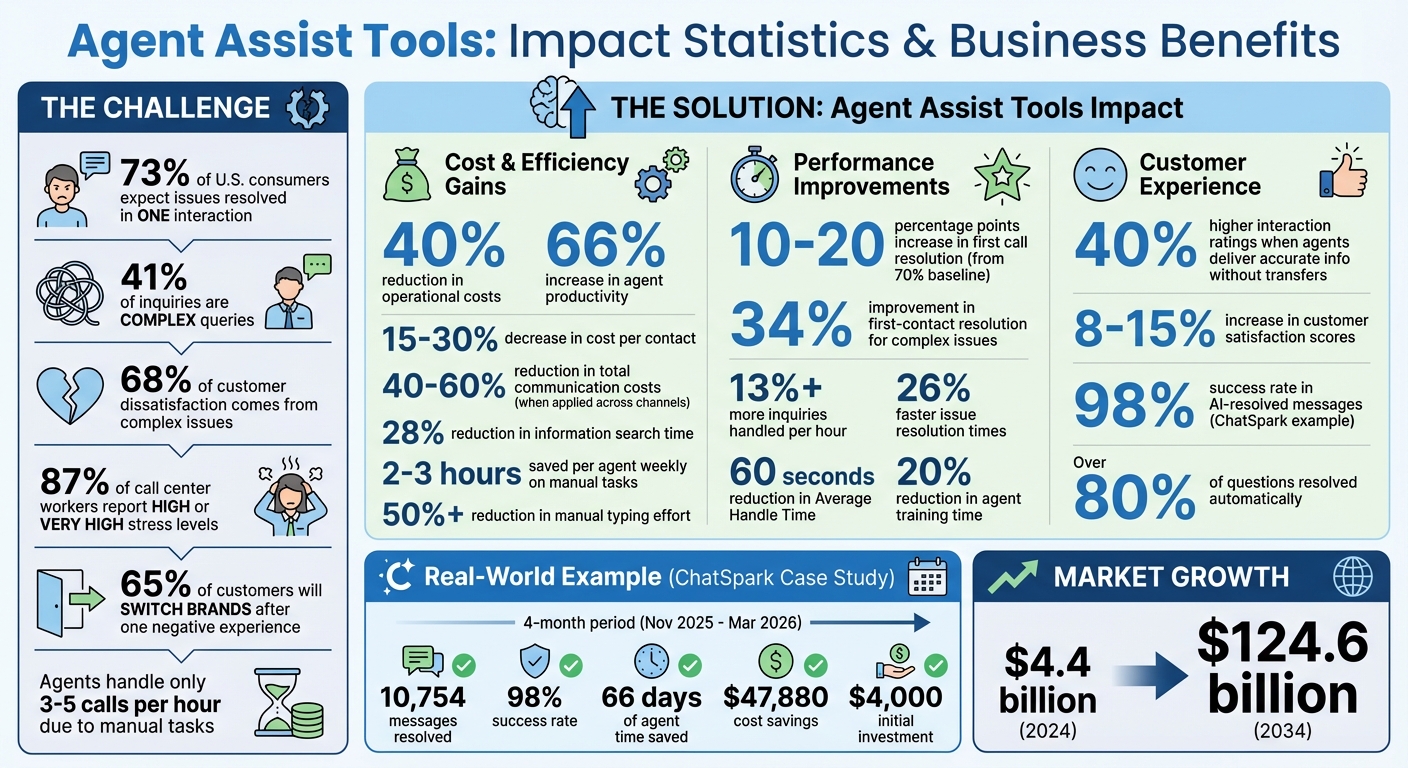
Agent Assist Tools Impact: Key Statistics and Business Benefits
Common Problems When Handling Complex Customer Queries
Handling complex customer queries isn't just about basic troubleshooting - it's a whole different ballgame. These situations require quick thinking, deep product knowledge, and the ability to connect with customers on a personal level.
Information Overload and Knowledge Gaps
Customer service agents are expected to juggle a mountain of information every day. They need to remember product specs, policy updates, and troubleshooting workflows - all while keeping the customer on the line. On top of that, they often have to switch between platforms like Slack, Google Docs, and Confluence just to find the right information. This constant back-and-forth takes a toll: 87% of call center workers report experiencing high or very high stress levels because of the mental strain their jobs require[1].
Time Pressure and Accuracy Requirements
Time is always ticking for customer service teams. Agents often need to collaborate with multiple departments - billing, technical support, or account management - while racing against the clock. And the stakes are high: 73% of U.S. consumers expect their issue to be resolved in a single interaction[4]. But resolving these cases often takes longer than expected, especially when manual tasks like writing notes or updating records eat into their time. On average, agents can only manage 3-5 calls per hour due to these after-call tasks[3]. Add emotionally charged cases to the mix, and the challenge of balancing empathy with precision becomes even more demanding.
Maintaining Consistency Across Channels
Customers expect seamless service, no matter how they reach out - whether it’s through Instagram, email, phone, or live chat on your website. But when communication channels don’t sync up, important context gets lost. For example, a customer who starts a conversation on social media and later calls support shouldn’t have to repeat their issue from scratch. Unfortunately, this happens far too often. The fallout? Dissatisfied customers. In fact, 65% of customers are willing to switch to another brand after just one negative experience[2].
| Impact Area | Consequence of Information Overload/Gaps | Business Metric Affected |
|---|---|---|
| Customer Experience | Inconsistent answers, long wait times, misinformation | CSAT, NPS, Churn Rate |
| Agent Performance | High stress, reliance on memory, slow onboarding | AHT, Agent Turnover, Ramp Time |
| Operational Cost | Frequent escalations, manual audits, wasted search time | Cost per Ticket, Operational Expense |
Core Features of Agent Assist Tools
Agent assist tools tackle the common issues of information overload and time constraints by simplifying data access and automating repetitive tasks. These tools use AI to provide agents with the right information at the right moment, ensuring smoother workflows. They work seamlessly in the background, analyzing conversations in real time and delivering relevant data without interrupting the agent's focus. Here’s a closer look at the key features that help agents handle queries more efficiently.
Instant Knowledge Retrieval
Gone are the days when agents had to sift through endless tabs or knowledge bases to find answers. With instant knowledge retrieval, these tools use advanced methods like fast vector search and semantic matching to understand customer questions and immediately provide source-backed answers [7][9]. This not only saves time but also reduces mental strain for agents. Customers also notice the difference - interactions are rated 40% higher when agents can deliver accurate information without transferring the call [7]. Beyond just quick access, these tools also adapt to the context, offering real-time support tailored to the conversation.
Context-Aware Suggestions in Real Time
These tools don't stop at delivering answers - they analyze live conversations for tone, intent, and sentiment using sophisticated natural language processing (NLP) techniques [6][7]. Based on this analysis, they provide tailored "next-best-action" prompts, guided scripts, and behavioral tips to help agents navigate the interaction effectively [8][9]. For example, the system might suggest calming language during a tense exchange or notify a supervisor if intervention is needed. These suggestions appear almost instantly, keeping pace with the flow of the conversation.
"Cresta is instantaneous so I don't even know if we could quantify how much better it is than how we used to coach...it's 100% better because it's instant coaching." – Crissa Warner‐Graham, Director of Marketing at Holiday Inn Club Vacations [9]
Automated Transcripts and Summaries
Real-time Automatic Speech Recognition (ASR) converts spoken words into text with minimal delay - just 300 milliseconds [7]. These systems are highly accurate, achieving over 91% precision even in noisy environments [7]. Once a call ends, the AI generates detailed summaries and syncs them directly to CRM platforms, eliminating the need for agents to handle manual wrap-ups. This feature alone can save agents 2–3 hours each week [8]. Additionally, AI-powered typing assistance and suggested responses cut down on manual effort by over 50% [9], allowing agents to dedicate more energy to engaging with customers.
How Agent Assist Tools Resolve Complex Queries
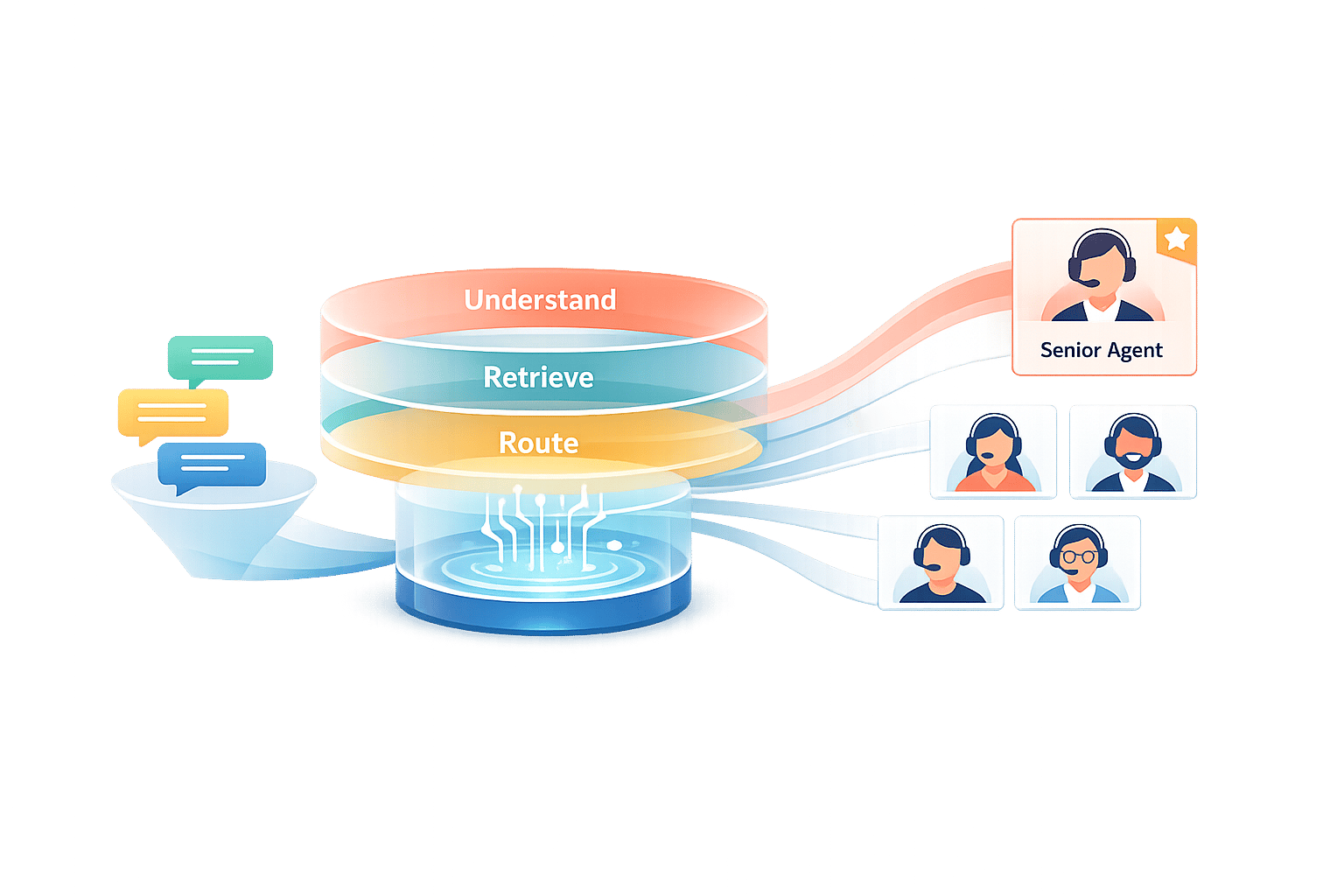
When customers approach with complex issues, agent assist tools follow a structured process to bring clarity to the situation. These systems go beyond simple keyword searches - they analyze the full query, retrieve accurate information, and know when to involve a human agent. This three-step process ensures even the trickiest problems are addressed effectively. Let’s break down how these tools handle queries using advanced AI techniques.
Query Analysis with AI and Language Models
The process kicks off with the tool analyzing the query using cutting-edge AI. Whether a customer is typing or speaking, the system converts their words into text in real time. Advanced natural language understanding (NLU) engines then interpret the customer’s intent, even if the language is informal. Using transformer-based architectures, the system tracks context across multiple exchanges, identifying critical details like order numbers, dates, or error codes [7].
These tools are capable of recognizing multiple intents in a single statement. For instance, if a customer says, “I was charged twice and my delivery is late,” the system identifies both a billing issue and a shipping delay, then prioritizes them based on urgency [4]. Meanwhile, sentiment analysis gauges the customer’s emotional tone - detecting frustration or urgency - and adjusts its approach accordingly [7]. This emotional awareness ensures agents respond in a way that matches the customer’s mood.
Information Retrieval and Response Suggestions
Once the system understands the query, it retrieves relevant information using Retrieval-Augmented Generation (RAG). This approach combines semantic search with vector embeddings to pull accurate data from internal knowledge bases and CRM systems. The result? A 28% reduction in the time agents spend searching for information compared to manual methods [4][10].
The AI operates in a continuous “think-act-observe” loop - evaluating the task, querying databases, reviewing results, and repeating the process until it finds a solution [11]. For more intricate problems, the system uses Chain of Thought reasoning, breaking down multi-step issues into logical sequences before suggesting a response [11]. Agents receive these suggestions alongside citations, making it easy to verify the source [12].
"An LLM alone is not an agent... An LLM is like a brilliant person locked in a room with no phone... An agent is that same person given a phone (tools), a filing cabinet (memory), and a to-do list (planning loop)."
– Fello AI [11]
If the automated solution isn’t enough to resolve the issue, the system seamlessly initiates an escalation process.
Escalation Process for Unresolved Issues
When the system’s confidence level drops below a set threshold - usually around 85% - or when it detects growing customer frustration, it triggers an escalation [10]. It evaluates multiple signals, such as query complexity, sentiment trends, and specific markers like billing disputes or legal matters [4].
A standout feature of modern escalations is the warm handoff. Instead of forcing customers to repeat themselves, the system provides the human agent with a real-time summary. This includes the customer’s emotional state, actions already taken, and unresolved factors like error codes [4][12]. Organizations using this approach report a 34% improvement in first-contact resolution rates for complex issues [4]. Additionally, the human agent receives actionable guidance, such as “request logs” or “verify identity,” enabling them to pick up seamlessly where the AI left off [12].
"The handoff must be warm and context-rich. The human agent should receive a real-time summary of the entire interaction, the customer's emotional state, what has already been attempted, and what remains unresolved. Anything less defeats the purpose of the intelligence layer."
– Robert Haas, CX Industry Expert [4]
Business Benefits of Agent Assist Tools
Agent assist tools tackle challenges like information overload and time pressure while delivering clear business advantages. Contact centers using these tools report better first call resolution rates, shorter average handle times, and improved agent morale. For instance, the average first call resolution rate in many centers hovers around 70% [13]. With agent assist technology, this can increase by 10 to 20 percentage points [14], thanks to real-time delivery of relevant information, eliminating the need for agents to sift through knowledge bases while customers wait.
Take AmeriHealth Caritas, a U.S.-based healthcare insurance provider, as an example. By adopting Uniphore's real-time agent assist platform, they cut Average Handle Time by about 60 seconds and reduced agent training time by 20% [1]. These tools also address the issue of wasted time, as 73% of contact center leaders report that up to 25% of agents' time is spent searching for information [13][16]. Such improvements directly reduce operational costs.
The cost savings are impressive. Organizations often see a 15% to 30% drop in cost per contact, and when AI is applied across voice and messaging channels, total communication costs can decrease by 40% to 60% [14][15]. For example, PepsiCo implemented Capacity's Answer Engine® to unify corporate knowledge across silos. This enabled employees to access millions of consumer insights in seconds, saving the company over 438 hours each month [1].
Beyond financial benefits, agent satisfaction and productivity see significant gains. Real-time support boosts agent confidence, easing the stress of managing complex inquiries. Service teams using AI report a 66% increase in productivity, with agents handling over 13% more inquiries per hour [5]. This is particularly important given that 87% of call center workers report high stress levels [1], and annual turnover rates often exceed 40% to 50% [17]. With a "digital mentor" to guide them through challenging scenarios, agents tend to stay longer and perform better, leading to customer satisfaction scores that typically rise by 8% to 15% [14].
"The real ROI emerges when leaders account for the full operational lifecycle of a customer inquiry: how quickly agents learn, how consistently they follow processes, how confidently they resolve issues, and how much value they create in each interaction."
– Liad Churchill, Head of Brand Communications, TechSee [17]
ChatSpark: Agent Assist Tool for Complex Queries
ChatSpark combines automated support with real-time agent assistance to tackle complex customer queries across multiple channels. The platform boasts the ability to resolve over 80% of customer questions automatically while enhancing human agents' efficiency through its CoPilot browser extension [18].
ChatSpark Features
ChatSpark supports over 140 actions across 40+ platforms, enabling tasks like checking order statuses, booking appointments, and updating CRMs - all through natural conversation. Its CoPilot browser extension integrates seamlessly with tools like Gmail, Zendesk, and Salesforce, pulling in internal knowledge and drafting real-time responses. This feature alone can save agents approximately 2 hours daily [18].
The system uses proprietary algorithms to assess query intent, context, and relevance, delivering accurate answers from sources like PDFs, URLs, and Google Docs. Responses are lightning-fast, typically under 2 seconds, and the platform supports over 95 languages. Setup is quick and straightforward, with most businesses operational in just 5 minutes using an embed code [18]. These capabilities help agents handle even the most intricate customer issues efficiently.
Here’s an example of its impact: A global construction products company used ChatSpark between November 2025 and March 2026 to manage its flagship brands. During this four-month period, the AI resolved 10,754 messages with a 98% success rate, saving over 66 days of agent time and cutting costs by $47,880, all from an initial investment of about $4,000 [18].
"ChatSpark has been managing two of our largest product lines over the past year. It currently handles an average of 1,831 chats per month without any human intervention. Since implementing it on our website, we've realized measurable savings of $119,225."
– Lorri G., Customer Service & Technical Support Manager [18]
Next, let’s dive into ChatSpark’s pricing plans, designed to fit businesses of all sizes.
Pricing Plans for Different Business Sizes
ChatSpark offers four pricing tiers, catering to everyone from solo entrepreneurs to large enterprises. Each plan is designed to meet specific business needs for handling complex customer interactions:
- Basic Plan: Priced at $19/month, this plan includes 100 messages, 1 AI agent, and 25 training pages. It’s a great starting point for small businesses exploring AI support.
- Plus Plan: At $59/month, it adds the CoPilot browser extension, 5 AI Actions, and REST API access, making it ideal for internal team use.
- Pro Plan: For $129/month, this plan supports 2,000 messages, 500 training pages, and 40 AI Actions, along with omnichannel deployment across platforms like WhatsApp, Instagram, and Slack.
- Enterprise Plan: Custom-priced, this plan offers unlimited AI Actions, role-based access control, audit logs, and a dedicated account manager.
| Plan | Monthly Price | Messages | AI Agents | Training Pages | Key Features |
|---|---|---|---|---|---|
| Basic | $19 | 100 | 1 | 25 | Website deployment, basic analytics, automated lead capture |
| Plus | $59 | 250 | 1 | 50 | CoPilot, 5 AI Actions, REST API access |
| Pro | $129 | 2,000 | 1 | 500 | 40 AI Actions, omnichannel deployment, GA4 tracking, 2 team members |
| Enterprise | Custom | Custom | Custom | Custom | Unlimited AI Actions, role-based access control, audit logs, account manager |
Businesses can scale their plans by stacking multiple subscriptions to increase message limits and add team seats. Opting for annual billing provides a 14% discount, which translates to nearly two months free [18].
Conclusion
Handling complex customer queries no longer has to overwhelm your support team. With the right agent assist tools, you can streamline knowledge retrieval, provide real-time suggestions, and automate workflows without losing quality. The result? Your agents stay focused, productive, and ready to deliver exceptional service.
The numbers speak for themselves: AI-powered tools can cut issue resolution times by 26%, increase team productivity by at least 15%, and improve customer satisfaction by 40% [3][7]. With the market expected to grow from $4.4 billion in 2024 to $124.6 billion by 2034 [1], it's clear these tools are shaping the future of customer support. For many, the first step is following a guide to AI customer support implementation.
Take ChatSpark, for example. This platform seamlessly blends automation with human expertise, resolving up to 98% of inquiries instantly [19]. Whether you're managing a small volume of messages or overseeing enterprise-level operations across multiple channels, ChatSpark adapts to your needs with ease.
FAQs
What counts as a “complex” customer query?
A "complex" customer query isn’t your run-of-the-mill question. These inquiries come with multiple layers of information and often require agents to dig into various sources to find answers. They might involve specialized knowledge, like troubleshooting advanced features, or call for personalized responses, such as resolving billing disputes.
These types of issues can also be high-stakes. Whether it’s a problem that affects customer satisfaction or one that threatens business continuity, these queries demand extra care. Agents need to act quickly, show emotional sensitivity, and handle the situation with precision to ensure a positive outcome.
How does agent assist keep answers accurate in real time?
Agent assist works like a real-time co-pilot, providing immediate guidance and verifying facts based on the flow of the conversation and the user's intent. This helps minimize mistakes and ensures responses stay accurate and relevant.
When should a query be escalated to a human agent?
When a query involves complex, sensitive, or unclear issues, or when AI confidence drops below 40%, it’s time to escalate to a human agent. Other triggers include detecting negative sentiment or encountering repeated failures in resolving the issue. To ensure a seamless transition, always pass along the full conversation history so the agent has all the necessary context.