AI workflow orchestration connects tools, automates tasks, and manages processes to improve how businesses operate. Unlike rigid automation, it dynamically coordinates AI systems across departments, reducing inefficiencies and boosting productivity. Without orchestration, companies face fragmented systems, manual errors, and scaling challenges.
Key Takeaways:
- Integration: Links tools like Salesforce, SAP, and ServiceNow for smoother workflows.
- Automation: Handles repetitive tasks, saving time and cutting costs.
- Management: Ensures compliance, tracks performance, and reduces errors.
For example, companies like Popl and Engine have saved significant time and money by automating workflows and connecting systems. The result? Faster processes, better collaboration, and improved customer experiences.
If you're looking to streamline operations, start with high-impact workflows like onboarding or IT requests. Choose platforms with strong integration and governance features to ensure scalability and success.
Common Enterprise Workflow Problems
Disconnected Systems and Departments
When systems don’t communicate effectively, employees often juggle more than 10 different applications just to complete a single task [5]. This constant switching between tools disrupts workflows and creates inefficiencies [5].
The bigger issue? Collaboration takes a hit. Without a centralized way to access organizational knowledge, employees waste valuable time hunting down colleagues or sifting through documents to answer even basic questions [3]. This lack of cohesion slows decision-making, as critical data remains isolated within departmental silos, making it hard to see the bigger picture.
"Siloed AI agents without orchestration can create inefficiencies: When multiple agents are deployed in isolation, task-specific agents can create fragmented experiences, governance challenges, and unreliable workflows." - Moveworks [5]
Another problem is the flood of notifications. Each disconnected system sends its own alerts, overwhelming employees until they start ignoring them altogether - leading to missed critical updates. Processes that span multiple departments often fall apart because systems don’t share context about previous steps [5].
These gaps force employees to rely on manual workarounds, further draining their productivity and adding unnecessary complexity to their day-to-day tasks.
Manual Processes and Wasted Time
Manual workflows are a major productivity killer. Transferring information manually between systems wastes time and increases the likelihood of errors [2]. Linear workflows, which are rigid by nature, often fall apart when unexpected issues arise, forcing employees to intervene manually - slowing everything down [2][6].
Take Popl, a digital business card company, as an example. In August 2025, they faced a bottleneck while manually qualifying and routing hundreds of inbound leads across HubSpot and Salesforce. By introducing over 100 AI-driven automated workflows, they verified lead details and routed leads based on region and company size. This shift not only eliminated manual delays but also saved the company $20,000 annually in integration costs [6].
Switching between disconnected tools also disrupts focus [2]. When businesses rely on dozens of separate automations - sometimes 50 or more - without a centralized monitoring system, it becomes nearly impossible to track performance or quickly identify where problems arise [1].
These inefficiencies become even more pronounced as business demands grow, making scalability a challenge.
Difficulty Scaling Operations
Traditional workflows often buckle under the pressure of growth or sudden shifts in the market. A staggering 72% of IT and business leaders admit their current automation efforts can’t keep up with rapid changes within their organizations [9]. Rule-based systems, while useful in predictable scenarios, struggle to adapt to new or unexpected situations.
This reliability issue is magnified when AI agents operate without orchestration. For instance, these agents succeed only 58% of the time on single-turn tasks, and their success rate drops to just 35% for multi-turn interactions [8]. Even minor errors can snowball - an 80% reliable process can drop to 70% accuracy after just five steps [8].
Additionally, 78% of respondents report that complex workflows or long-running processes make achieving full automation nearly impossible [9]. When workflows rely on disconnected tools and manual patches, they accumulate technical debt, making them increasingly costly and difficult to maintain.
Despite the fact that 92% of executives expect AI-powered workflows to become the norm by 2025 [1], many organizations are still struggling to scale their automation initiatives effectively. The challenges highlight the need for smarter, more integrated solutions to keep up with growing demands.
How AI Workflow Orchestration Solves These Problems
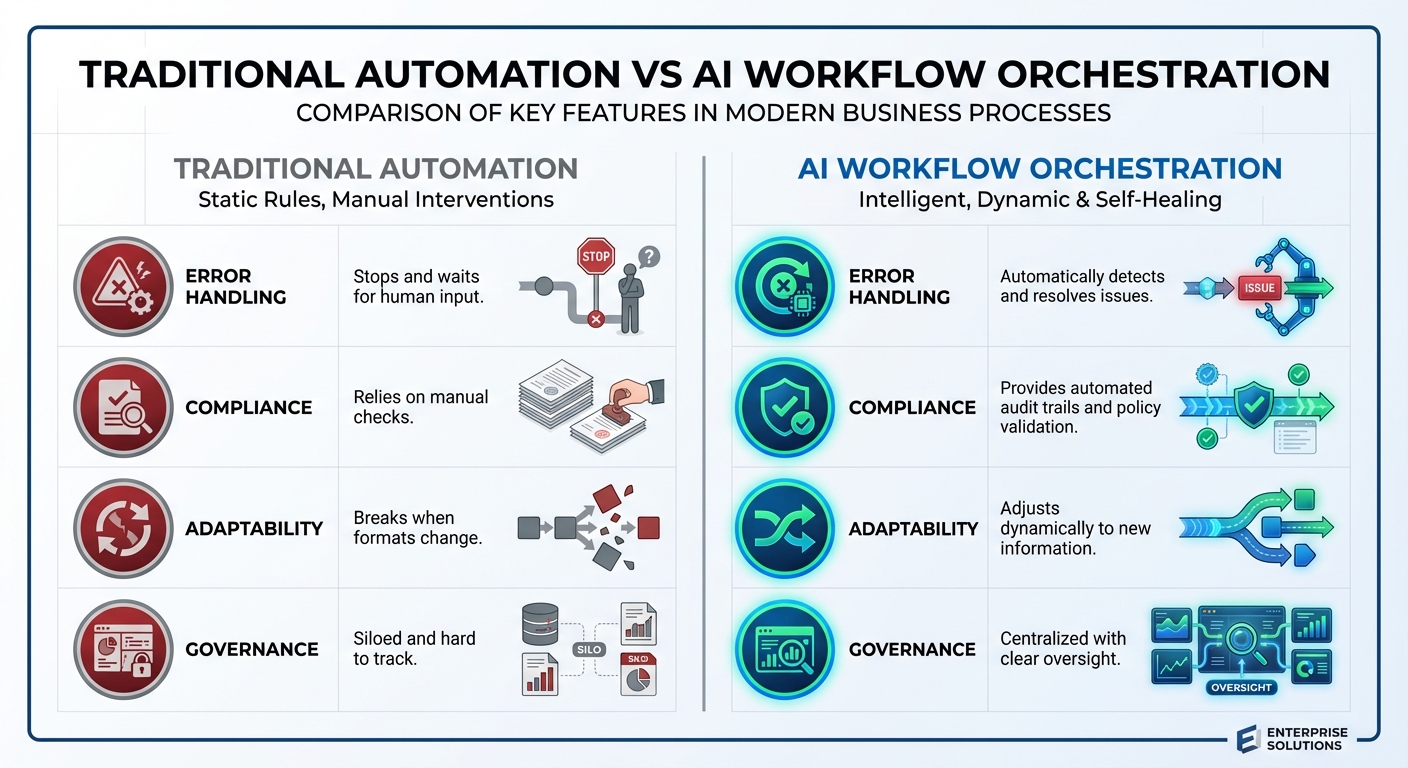
Traditional Automation vs AI Workflow Orchestration Comparison
Connecting Systems and Data Across Departments
AI orchestration brings tools, agents, and even legacy systems together in a cohesive way [5][7]. Instead of requiring employees to jump between platforms like Workday, SAP, ServiceNow, and Salesforce, orchestration uses APIs and data pipelines to seamlessly connect these systems [3][5].
By sharing context across departments, it breaks down silos. For example, when HR initiates an employee onboarding process, orchestration automatically notifies IT to set up accounts and alerts Facilities to prepare resources [5][2]. This cross-department data sharing ensures that actions in one system are visible to others, creating a unified workflow [5][7].
A single interface adds another layer of efficiency [5][2]. Adaptive logic within these systems routes tasks based on real-time factors like urgency or customer value, moving away from rigid, step-by-step processes [6][7]. As enterprise software evolves, these adaptive AI capabilities will likely become standard [5].
Beyond improving collaboration, orchestration delivers measurable savings in both time and costs. This is particularly evident when following a structured AI customer support implementation strategy.
Automating Tasks and Reducing Costs
Eliminating inefficiencies often means cutting costs and reducing errors. AI orchestration takes over repetitive tasks that sap employee productivity. For IT teams, this includes automating password resets and ticket triage, and incident management [7][1][5]. Sales and marketing teams benefit from automated lead scoring and CRM data entry [10][7][5]. Meanwhile, HR departments streamline onboarding by automating tasks like account setup and training schedules [10][2][5].
These orchestrated systems speed up enterprise workflows dramatically, reducing processing times by 20% to 80% [5]. Yogesh Kumar, Deputy Manager of Branding & Corporate Communication at Pinnacle Infotech, shared:
"What used to drag on for weeks now wraps up in three to five days" [10]
Similarly, Neha Rathi, founder of Nifty, noted:
"This method was a huge success that managed to cut QA-prep time by up to 60%" [10]
Such automation doesn’t just save time - it also improves accuracy and compliance. Looking ahead, 86% of executives predict that by 2027, AI agents will make process automation far more effective, with 75% expecting these agents to handle transactional processes independently [11][1]. Considering that 27% of employees cite time spent in meetings and emails as their biggest productivity drain [2], automating these workflows allows teams to focus on higher-value work.
Reducing Errors and Meeting Compliance Requirements
Centralized governance ensures AI models operate within controlled parameters [12][5]. Unlike traditional automation, which halts when errors occur, AI orchestration identifies and resolves issues in real time by referencing historical data. These systems can either fix problems automatically or flag them for human review [13][14].
Every action performed by AI is tracked and logged, creating an automated audit trail - essential for industries like finance and healthcare that operate under strict regulations [13][5]. Advanced platforms go a step further by using "Policy Validators" to ensure that automated tasks align with corporate policies and compliance rules throughout the workflow [5]. By analyzing patterns, these systems can even predict potential failures and route high-risk cases to specialists before issues arise [14].
| Feature | Traditional Automation | AI Workflow Orchestration |
|---|---|---|
| Error Handling | Stops and waits for human input | Automatically detects and resolves issues |
| Compliance | Relies on manual checks | Provides automated audit trails and policy validation |
| Adaptability | Breaks when formats change | Adjusts dynamically to new information |
| Governance | Siloed and hard to track | Centralized with clear oversight |
David Pascale, Sr. Director Data & AI at Faye, highlights the importance of orchestration:
"AI initiatives rarely fail due to a lack of tools. They often stall because the systems behind them aren't designed to scale, govern, and deliver outcomes consistently" [12]
Benefits of AI Workflow Orchestration for Enterprises
Scaling Operations as Business Needs Change
AI orchestration evolves alongside shifting business demands, eliminating the need for constant manual adjustments. Tools like Kubernetes handle the deployment and scaling of container-based applications, redistributing resources dynamically as workloads increase or decrease [3]. Unlike traditional automation, orchestration reacts in real time, considering context, sentiment, and past performance to optimize operations [6][7].
This flexibility allows enterprises to trial new AI initiatives without overhauling existing workflows [5]. As businesses grow, 86% of executives predict AI agents will significantly enhance scalability by 2027 [11][1]. Additionally, 75% of these leaders foresee AI agents autonomously managing transactional processes [11]. A centralized orchestration approach simplifies managing growing complexities, ensuring businesses can efficiently handle spikes in data and workloads [7][1].
Real-Time Monitoring and Data Insights
Orchestration doesn’t just scale operations - it also ensures constant monitoring and actionable insights. Platforms provide a clear, end-to-end view of how AI models and agents function within complex workflows [3][15]. Real-time tracking of metrics and data flows enables businesses to make immediate, informed adjustments [1]. By 2027, 90% of executives expect AI agents to empower professionals to go beyond basic reporting, enabling advanced analytics for real-time decision-making [11].
Predictive analytics further enhances these capabilities by identifying potential failures or delays before they happen, allowing resources to be reallocated proactively [15]. This proactive approach replaces reactive troubleshooting, with orchestrated agents detecting anomalies and resolving issues - such as restarting services - before they disrupt operations [5].
Better Customer Experiences
AI orchestration isn’t just about internal efficiency; it also transforms customer interactions by streamlining data across departments. Orchestration ensures that specialized agents work together seamlessly, eliminating the frustration of fragmented experiences where customers repeatedly provide the same information [5].
Take Engine, a travel technology company valued at $2.1 billion in 2025, as an example. It utilizes AI agents integrated with Slack and Salesforce to handle booking modifications and other tasks end to end. Their virtual assistant "Eva" pulls customer data from Service Cloud, while "Mae" addresses internal employee inquiries across IT, HR, and accounting [16]. Mollie Bodensteiner, SVP of Operations at Engine, highlights the impact:
"Our service standard is speed and quality. Agentforce gives us both, with a level of personalization no chatbot can match" [16].
ChatSpark offers similar advantages, providing round-the-clock automated customer support across platforms like Instagram, Facebook, WhatsApp, Telegram, and Slack. With instant, brand-aligned responses in over 85 languages, ChatSpark ensures consistent interactions that guide customers toward conversions. Meanwhile, AlgoCademy’s orchestration system saved 25 hours of human support time weekly while boosting student satisfaction scores by 40% [10].
Choosing and Implementing an AI Orchestration Platform
What to Look for in a Platform
When selecting an AI orchestration platform, seamless integration should be at the top of your list. Look for platforms that connect through APIs and Model Context Protocol (MCP) servers to bring together tools like SAP, Salesforce, ServiceNow, and internal databases [5][7][17]. Without this connectivity, you risk ending up with yet another isolated tool rather than a fully unified system.
Another must-have is strong governance features [5][6][7]. These are essential when multiple departments share data or when AI agents make independent decisions. The platform should go beyond basic "if-then" rules and support context-sharing and dynamic decision-making. This means AI agents can assess full business scenarios - considering customer history, transaction details, and potential risks - before taking action [14].
David Pascale, Sr. Director Data & AI at Faye, highlights a common issue in AI projects:
"AI initiatives rarely fail due to a lack of tools. They often stall because the systems behind them aren't designed to scale, govern, and deliver outcomes consistently" [12].
This insight is vital. Without a scalable and well-governed system, many AI projects fail to move beyond the pilot phase. In fact, 95% of Generative AI pilots fail when they lack a proper orchestration structure [12]. The right platform lays the groundwork for scalable, governed automation from the start, helping organizations avoid these pitfalls.
Steps for Successful Implementation
Once you've chosen a platform that meets your technical and governance requirements, the next step is to integrate it effectively across your organization.
Start by targeting high-impact use cases like insurance application processing, IT service requests, or customer onboarding. These areas often deliver quick, measurable results, such as faster processing times or fewer errors [12][5]. Establish clear KPIs tied to business goals before diving into implementation [5].
Collaboration is key. Bring together IT, operations, and business leaders to align on security protocols, workflows, and strategic objectives [5]. Without this alignment, even the most advanced platform can struggle to gain traction. Incorporate human-in-the-loop (HITL) workflows to ensure employees can step in for complex decisions that require judgment or expertise [13].
For example, ChatSpark simplifies the implementation process by offering an easy setup across platforms like websites, Instagram, Facebook, WhatsApp, Telegram, and Slack. With minimal engineering, businesses can start small - automating customer support - and expand as they see results. From the beginning, integrate governance features like audit trails and role-based access controls to manage data-sharing risks effectively [5].
Conclusion
Main Points to Remember
AI workflow orchestration brings disconnected systems, manual processes, and scalability challenges together by coordinating specialized AI agents in real time. This approach transforms fragmented operations into a unified system where tools and agents work collaboratively, sharing context seamlessly. Moving away from rigid, rule-based automation to more flexible systems allows businesses to address exceptions and adapt to changing demands with minimal manual effort. Real-world examples, like Toyota cutting equipment downtime by 50% through AI-driven predictive maintenance and Camping World reducing customer wait times to just 33 seconds[4], highlight the tangible benefits of orchestration. These successes demonstrate how connecting data, tools, and intelligence across departments can reshape enterprise operations.
Getting Started with AI Orchestration
To take advantage of these benefits, start by focusing on a high-impact workflow, such as customer onboarding, IT service requests, or insurance claims processing. These areas can deliver quick, measurable results and help build momentum for broader adoption[7]. Define clear KPIs linked to your business goals and ensure that data across systems is clean and accessible.
For customer workflows, tools like ChatSpark make it easy to integrate support across platforms like websites, Instagram, Facebook, WhatsApp, Telegram, and Slack. With 24/7 automated assistance available in over 85 languages, solutions like this demonstrate the power of orchestration in action.
The future of enterprise operations isn’t about replacing human decision-making - it’s about enhancing it. Intelligent systems can take over repetitive tasks, provide actionable insights, and allow teams to concentrate on strategic priorities. With 86% of executives noting that AI agents are improving process automation effectiveness[1], the real question is no longer whether to embrace orchestration, but how quickly your business can implement it.
FAQs
How does AI workflow orchestration help enterprises scale effectively?
AI workflow orchestration simplifies how enterprises manage and scale their AI systems by bringing multiple tools, models, and processes together into one cohesive system. This approach minimizes inefficiencies often caused by disconnected operations. Plus, it allows businesses to easily add new AI solutions or phase out older ones without disrupting their existing workflows.
By automating complex tasks and ensuring smooth communication between AI systems, orchestration reduces the need for manual work and speeds up operations. This helps companies handle increasing workloads, adjust to shifting demands, and keep their processes running smoothly as they grow. On top of that, orchestrated AI systems offer both flexibility and dependability, making it easier for businesses to adapt quickly to new challenges while ensuring steady, scalable growth.
What are the main benefits of using AI-driven workflow orchestration in customer service?
AI-powered workflow orchestration brings some clear benefits to customer service. For starters, it boosts efficiency by connecting and coordinating various AI tools. This eliminates silos, speeds up response times, and ensures customer inquiries are handled accurately. The result? Faster resolutions and happier customers.
Another major perk is the improvement in consistency and quality. By allowing AI systems to share context and work together in real-time, responses stay coherent, aligned with brand messaging, and tailored to individual customer needs. Plus, automating complex workflows means less manual effort, lower operational costs, and the ability to scale your customer service operations with ease. Together, these advantages create a dependable, responsive experience that strengthens customer loyalty and drives business growth.
How does AI workflow orchestration help businesses stay compliant and reduce errors?
AI workflow orchestration streamlines operations by weaving governance, security, and monitoring into the fabric of business processes. By centralizing the oversight of AI models, workflows, and data sources, companies can consistently meet regulatory standards while cutting down on the chance of human mistakes.
Integrating automation for repetitive tasks and embedding compliance checks directly into workflows not only sharpens accuracy but also reduces the likelihood of oversights. This method boosts transparency and accountability, giving organizations better control over their AI-driven activities and ensuring operations run smoothly without unnecessary errors.