
Looking to automate customer support? Here’s the key difference:
- Chatbots: They follow scripts and handle simple, repetitive queries (like FAQs). Quick to set up, cost-effective, but struggle with complex or unexpected questions.
- Conversational AI: Uses advanced tools like NLP and machine learning to understand context and intent. Handles multi-step tasks, adapts to varied phrasing, and provides a more natural interaction.
Quick Overview:
- Chatbots: Best for small businesses with straightforward tasks like order tracking or store hours.
- Conversational AI: Ideal for companies managing complex queries or scaling support across multiple channels.
By 2027, 25% of businesses are expected to use conversational AI as their main customer service tool. Whether you need simplicity or advanced functionality, the right choice depends on your business goals and customer needs.
Traditional Chatbots: What They Do and Where They Fall Short
What Are Traditional Chatbots?
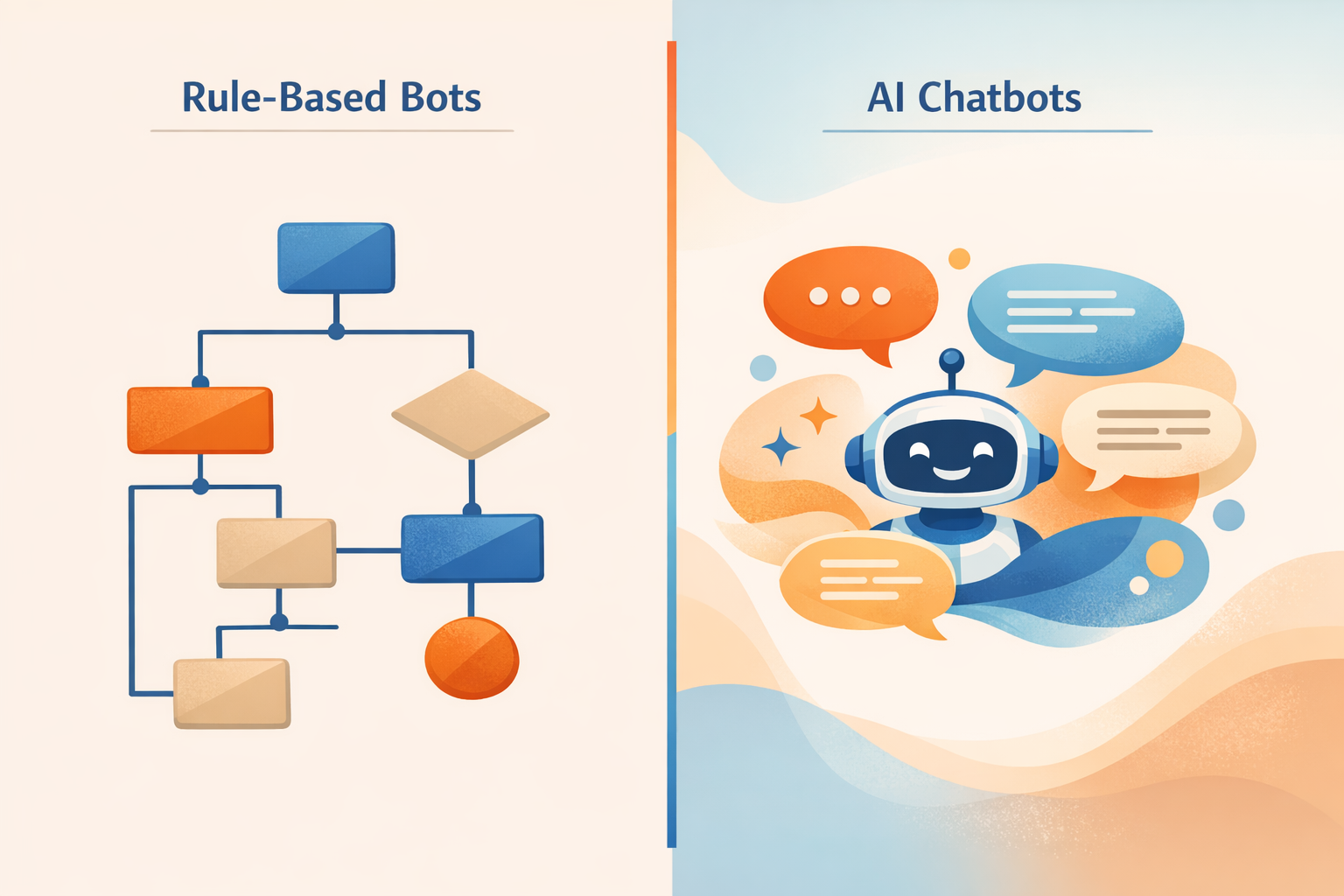
Traditional chatbots - often referred to as rule-based bots - work by following a set of preprogrammed rules and decision trees. When a user sends a message, these bots scan for specific keywords or phrases and respond based on their pre-configured scripts. Essentially, they rely on pattern recognition rather than any form of true comprehension.
This makes them great for handling structured, repetitive tasks, like answering FAQs, providing store hours, or tracking orders. For example, if a customer asks, "Where's my order?" and the bot is programmed to recognize that query, it will deliver the correct response every time.
However, this rigid setup comes with its own set of advantages and challenges, depending on how they're used in business contexts.
Strengths and Limitations of Traditional Chatbots
The predictable nature of rule-based bots makes them both useful and restrictive. On the plus side, they’re quick to implement - you can often have one up and running in just a few days or weeks. They’re also relatively inexpensive to maintain, making them a practical solution for businesses looking to cut down on human workload while managing high volumes of predictable inquiries.
But here’s where they fall short: their rigidity. If a customer phrases a question differently or asks something outside the bot’s programmed knowledge, the interaction stalls. The bot might loop back to the same menu or escalate the issue to a human agent, creating a clunky experience. Unlike AI-driven bots, these traditional ones don’t adapt or learn from past conversations, meaning your team has to manually update them whenever new scenarios arise.
When Traditional Chatbots Work for Businesses
Even with their limitations, rule-based chatbots can be a budget-friendly solution for certain use cases. For example, a small online store dealing with routine questions about shipping or returns can handle those inquiries effectively without needing advanced AI. Similarly, businesses like clinics or salons, where customer interactions follow a predictable booking process, can benefit from their simplicity.
In short, if your customer interactions are straightforward and don’t require much nuance, a rule-based chatbot can efficiently handle the workload while keeping costs in check. They’re a solid choice for environments where repetitive tasks dominate and complexity is minimal.
Conversational AI: How It Changes Customer Support
What Is Conversational AI?
Conversational AI taps into natural language processing (NLP), natural language understanding (NLU), and machine learning to interpret user input in a more nuanced way. Instead of just matching keywords, it grasps the meaning and intent behind what users say. Here's how it works: NLP breaks down the language structure, NLU identifies the user's intent, and machine learning adapts and improves responses based on past interactions. This allows for conversations that feel fluid and unscripted, making customer interactions more engaging and efficient.
What Conversational AI Can Do That Traditional Chatbots Cannot
One of the standout features of conversational AI is its ability to retain context throughout a conversation. This means it can understand references and implied meanings without requiring rigid, pre-programmed scripts. For instance, if a customer says, "Can you change that to tomorrow?" after several exchanges, the AI knows what "that" refers to. It also handles varied phrasing effortlessly, so users can ask the same question in different ways, and the system will still provide accurate answers. These capabilities open the door to more personalized and effective customer support.
Use Cases for Conversational AI in Customer Support
Conversational AI can tackle everything from answering basic FAQs to managing complex tasks like processing returns or troubleshooting issues. It’s a game-changer for businesses, as it can automate up to 80% of customer inquiries, significantly improving response times and operational efficiency. For example, in February 2026, RTR Vehicles introduced an AI-powered support system that resolved 92% of inquiries on its own. This reduced average response times from 2–4 hours to under 15 seconds and saved the company $15,000 per month [4].
For companies dealing with large volumes of customer queries, these advancements aren’t just helpful - they can be a major competitive edge.
Conversational AI vs. Traditional Chatbots: A Side-by-Side Comparison
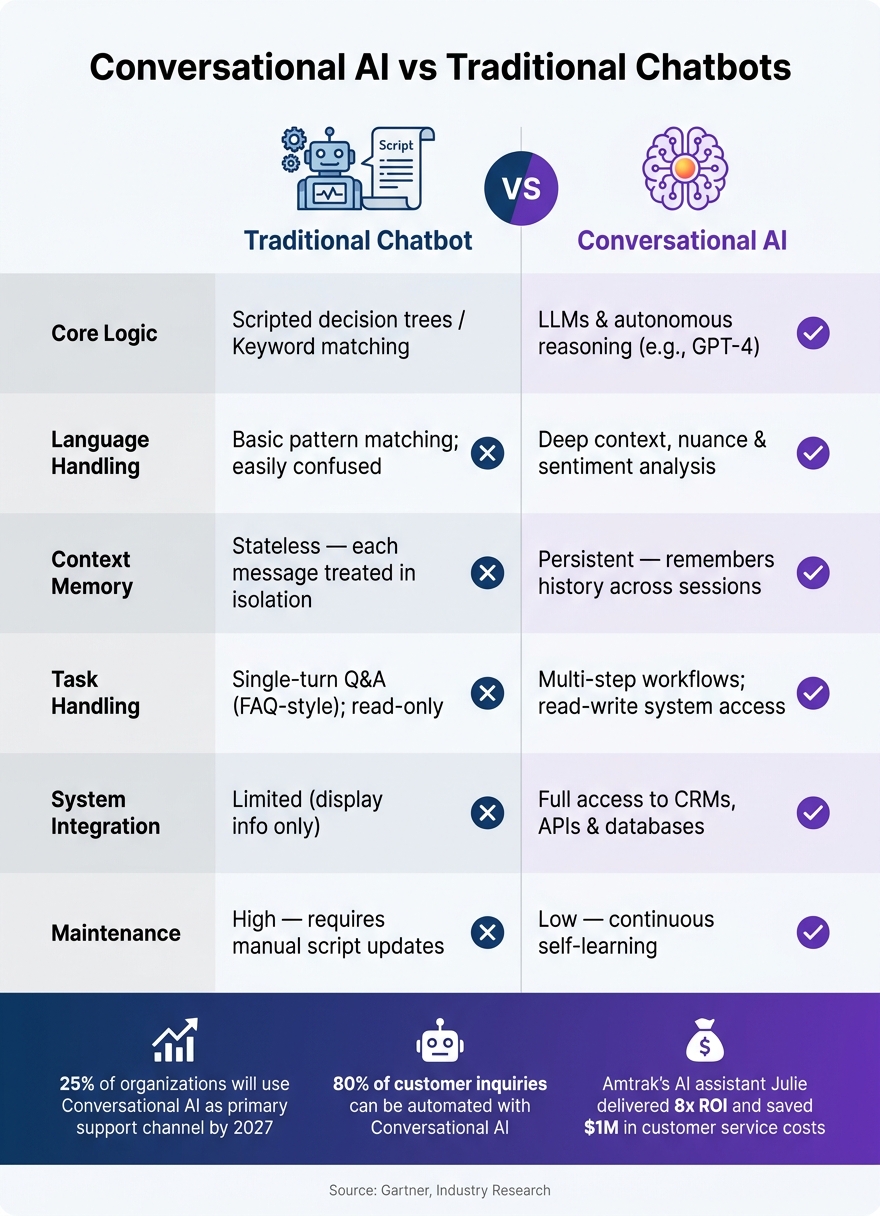
Conversational AI vs Traditional Chatbots: Side-by-Side Comparison
Technical and Functional Differences
The core distinction lies in how these systems are built and what they can do. Traditional chatbots operate on scripted decision trees and keyword recognition, which makes them prone to errors when faced with unexpected queries. On the other hand, conversational AI uses advanced tools like NLP (Natural Language Processing), NLU (Natural Language Understanding), machine learning, and large language models (LLMs) such as GPT-4 to understand intent, context, and even emotional tone.
| Feature | Traditional Chatbot | Conversational AI |
|---|---|---|
| Core Logic | Scripted decision trees / Keywords | LLMs and autonomous reasoning |
| Language Handling | Basic pattern matching; easily confused | Deep context, nuance, and sentiment analysis |
| Context | Stateless; each message treated in isolation | Persistent; remembers history across sessions |
| Task Handling | Single-turn Q&A (FAQ-style); read-only | Multi-step workflows; read-write access for actions |
| System Integration | Limited (display info only) | Full read/write access to CRMs, APIs, and databases |
| Maintenance | High (manual script updates) | Low (continuous self-learning) |
These differences explain why conversational AI provides a more dynamic and effective user experience compared to the rigid, limited functionality of traditional chatbots.
Customer Experience and Business Outcomes
The technical gap between these systems translates directly into how they interact with users. Traditional chatbots often frustrate users by forcing them into predefined menus and failing to handle unexpected inputs. In contrast, conversational AI can maintain a natural flow, answer follow-up questions, and adjust when users shift topics mid-conversation.
The results? Businesses see a dramatic improvement in performance. Take Amtrak’s AI assistant, Julie, as an example. Julie delivered an 8x return on investment, reduced customer service costs by $1 million, and boosted booking rates by 25%, generating 30% more revenue compared to other booking methods [1]. This isn’t just a minor improvement - it’s a transformative leap in efficiency and profitability.
Looking ahead, conversational AI is poised to dominate customer service. By 2027, 25% of organizations are projected to use conversational AI as their primary customer service channel [2]. Gartner also predicts that by 2028, 70% of customers will rely on conversational AI interfaces to begin their service interactions [6]. The shift is already underway.
Setup, Training, and Maintenance Requirements
Traditional chatbots are relatively simple to get started with. You map out decision trees, write the scripts, and hit launch. However, this simplicity comes with a hidden cost. Every time there’s a product update or a new customer scenario, the scripts need manual updates. Over time, this becomes a significant drain on resources.
Conversational AI, while requiring more initial effort for training and integration, offers long-term advantages. These systems improve continuously through self-learning and can handle unfamiliar requests using zero-shot learning - a feature that traditional chatbots lack [5]. Scaling is also much easier: instead of building new branches as you would with a traditional bot, conversational AI expands by training on new data and integrating with additional systems, avoiding the need for a complete overhaul [5].
How to Choose the Right Solution for Your Business
Key Factors to Evaluate Before Deciding
When deciding on the right solution, it’s important to consider the complexity of your support needs and your business's growth plans. If your customer inquiries are mostly straightforward - questions like store hours, return policies, or order tracking - a traditional chatbot can handle those efficiently. In fact, 61% of customers prefer self-service for simple issues [7], and a well-designed chatbot can manage these tasks without much hassle. However, if your customers often require help with more intricate questions, multi-step processes like booking or refunds, or expect conversational interactions, a traditional chatbot might not keep up.
Another factor to weigh is how quickly your business is growing. Traditional chatbots need manual updates as your offerings change, which is manageable for smaller operations but can become overwhelming as you scale. On the other hand, conversational AI evolves with your business, learning from interactions and adapting without needing a complete overhaul. While maintaining AI systems typically costs 15%–25% of the initial build cost annually, this investment is often more predictable than the ongoing effort required to update rule-based systems.
| Business Signal | Better Fit |
|---|---|
| Simple FAQs, limited support volume | Traditional chatbot |
| Complex queries, multi-step tasks | Conversational AI |
| Limited budget and IT capacity | Traditional chatbot |
| Omnichannel presence, high growth goals | Conversational AI |
| Static product/service catalog | Traditional chatbot |
| Frequent updates, dynamic workflows | Conversational AI |
Start by reviewing your most common support tickets. If they’re mostly simple and repetitive, a rule-based chatbot will do the job. But if those tickets involve decision-making, follow-ups, or system integrations, conversational AI is likely the smarter long-term choice.
Ultimately, your decision comes down to balancing cost, functionality, and the ability to scale. Tools like ChatSpark are designed to adapt to these shifting needs, offering a flexible way to enhance your customer support automation.
How ChatSpark Supports Both Approaches
ChatSpark offers solutions tailored to businesses at different stages, from basic automation to advanced AI capabilities. The Basic plan at $19/month is perfect for small businesses or solo entrepreneurs automating simple tasks without a big upfront commitment. For those needing more, the Pro plan at $129/month enables omnichannel support across platforms like WhatsApp, Instagram, Facebook, and Slack. It also integrates with tools like Zapier, Freshchat, and Calendly. For larger businesses with complex workflows, Enterprise plans start at $499/month, offering custom message limits, dedicated account management, and tailored SLAs.
What makes ChatSpark stand out is its flexibility. You don’t have to lock yourself into a single approach. Start with simple FAQ-style automation and, as your business grows, add advanced conversational AI features like multi-step workflows and CRM integrations. This approach allows you to scale your support system in line with your business needs without overcommitting resources upfront.
Conclusion: What Business Decision-Makers Should Take Away
Here’s the key difference: traditional chatbots stick to fixed scripts, while conversational AI adapts, learns from interactions, and takes meaningful action. Traditional chatbots handle straightforward, repetitive queries, while conversational AI is designed to tackle complex issues from start to finish.
That said, neither is inherently "better." Traditional chatbots work well for businesses dealing with predictable, high-volume FAQs. On the other hand, conversational AI becomes essential when your customers need detailed support, multi-step solutions, or consistent experiences across various channels. The shift toward conversational AI is already underway, and businesses that align their tools with their actual support demands will be better equipped to keep pace.
Today’s conversational AI can even handle entire workflows autonomously [3]. Tasks like booking appointments, processing refunds, and updating CRM systems are no longer just theoretical - they’re happening now. Companies that embrace these capabilities early can gain a strong competitive advantage.
ChatSpark has recognized this shift and designed its solutions to meet the rising expectations of customer support. With a content-first approach, over 140 pre-built AI Actions, and smooth human handoff features [8][9], ChatSpark allows businesses to scale their support operations without a complete system overhaul. Start small, grow as needed, and avoid the headache of rebuilding from the ground up.
The real question isn’t “Should we choose chatbots or AI?” Instead, it’s “What do our customers need, and what can our team effectively manage?” By focusing on these factors, you can find the right solution for your business.
FAQs
How do I know when I’ve outgrown a rule-based chatbot?
If your chatbot's bot-to-human escalation rate consistently tops 30%, it might be time to rethink your approach. Other red flags include customers having to repeat themselves because the bot can't keep track of context, spending too much time on manual updates, or customers hitting dead ends or frustrating loops in conversations. Plus, if you’re looking to handle more advanced, multi-step workflows that go beyond basic "if-then" logic, your current rule-based chatbot may no longer be cutting it.
What data and integrations do I need to launch conversational AI?
To get conversational AI up and running, start by bringing together resources like FAQs, product manuals, and policy documents into a single, centralized knowledge base. Upload commonly used file formats - such as PDFs, Word documents, or even website content - to train the AI effectively.
Next, connect systems like CRMs, order management tools, or scheduling platforms through APIs. This integration allows the AI to handle tasks like processing refunds or checking order statuses automatically. The result? Personalized, context-aware support that works seamlessly across all your communication channels.
How can I measure ROI from conversational AI in customer support?
Start by pinpointing baseline metrics like cost per interaction, average handle time, and resolution rate before implementing any changes. These benchmarks will help you gauge the impact of your efforts over time.
Next, account for all related costs, including subscription fees, integration expenses, and training investments. These factors play a crucial role in determining your overall return.
To track progress, focus on key metrics such as:
- AI resolution rate: How many issues are resolved without human intervention.
- Agent time saved: The reduction in time agents spend on tasks.
- Cost savings: The financial benefits achieved through improved efficiency.
Use analytics tools to monitor these metrics. For ease of reporting, set up automated monthly summaries that highlight trends and efficiency gains. For example, you can calculate savings based on an estimated agent cost of $30.00 per hour. This approach makes it simple to quantify the value you're generating.