
AI-powered lead management can transform how businesses handle customer acquisition, boosting efficiency and results. Here's the bottom line: using AI tools like ChatSpark helps businesses automate lead scoring, prioritize high-value prospects, and respond instantly across multiple platforms. This leads to faster response times, better-qualified leads, and increased sales opportunities.
Key takeaways:
- Faster responses matter: Businesses responding within 5 minutes are 100x more likely to connect with leads.
- AI improves accuracy: Predictive lead scoring can reach 75–85% accuracy with clean data.
- Personalized engagement drives results: Nurtured leads generate 20% more sales opportunities.
- Automation saves time: Sales teams can focus up to 80% of their time on qualified leads.
- Compliance is critical: Privacy laws like GDPR and CCPA require secure and transparent data use.
AI tools like ChatSpark offer 24/7 engagement, real-time analytics, and seamless CRM integration, making it easier to manage leads effectively. By focusing on the right metrics, automating follow-ups, and refining strategies with A/B testing, businesses can stay ahead in a competitive market.
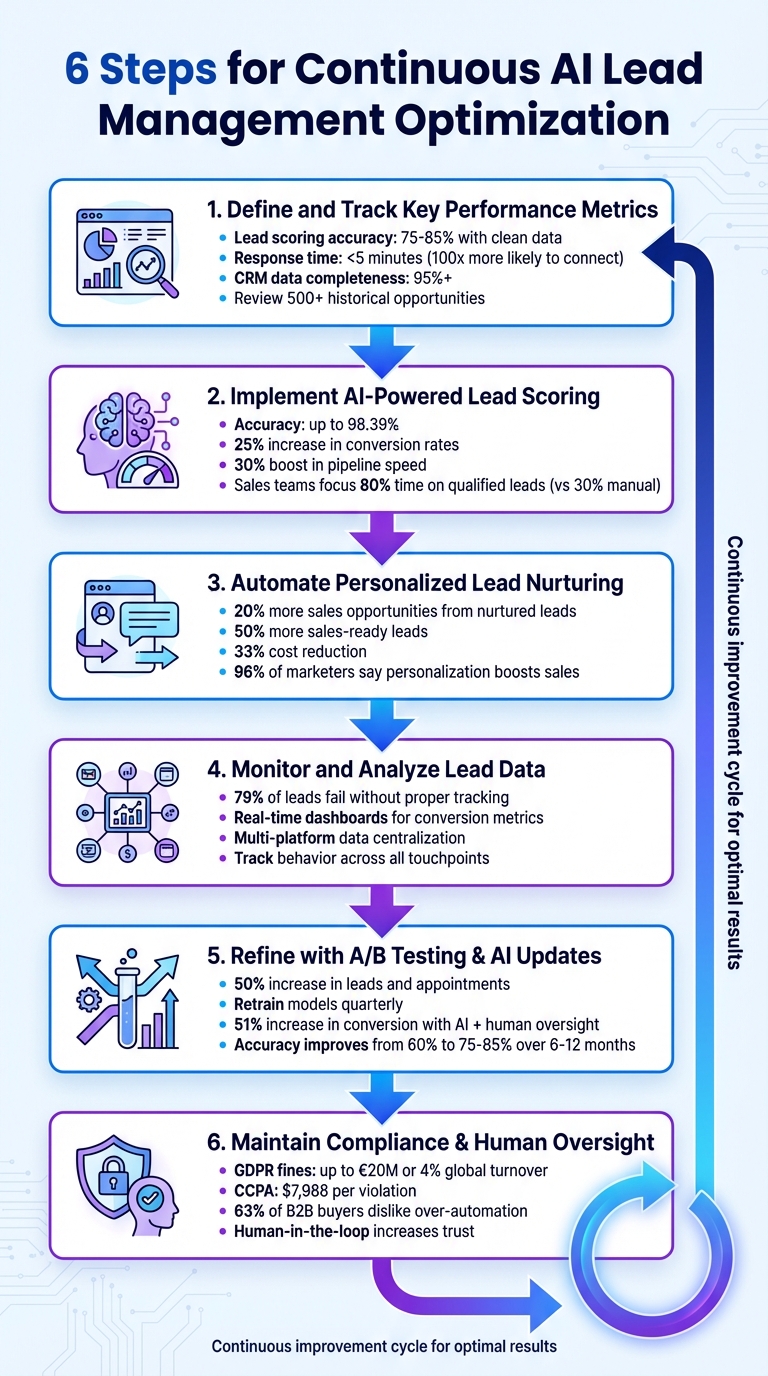
6 Steps for AI Lead Management Optimization
How To Optimize AI Lead Generation with Einar Vollset
Step 1: Define and Track Key Performance Metrics
To make sure your AI system is delivering results - not just noise - you need to focus on the metrics that directly impact conversions. These include lead scoring accuracy, response time, lead-to-opportunity conversion rate, and sales velocity. Together, they provide a clear picture of how effectively your system is performing.
When it comes to AI's ability to predict lead conversions, accuracy often starts around 60%. With 6 to 12 months of clean sales data, this can improve significantly, reaching 75–85% accuracy [2]. To assess the AI’s impact, calculate conversion rates at every stage of the funnel. Aim for a score-to-conversion correlation above 0.7 to ensure your system is driving meaningful results [7].
Set Up Performance Benchmarks
Once you’ve identified key metrics, setting benchmarks is the next step. These benchmarks act as a baseline for measuring progress and improving over time. For this, it’s crucial to ensure your CRM data is at least 95% complete. Additionally, review at least 500 historical closed-won and closed-lost opportunities to identify trends that influence revenue outcomes [7].
Establish clear goals, such as achieving an MQL acceptance rate of 85% or higher and keeping the false positive rate below 15% [7]. Response time is another critical factor - aim to respond to leads in 5 minutes or less. Studies show that responding within one hour can increase meaningful conversations sevenfold, but even a delay of 10 minutes can drastically reduce your chances of connecting. A sub-5-minute response time is the gold standard [6][9].
Use AI Analytics for Tracking
After setting benchmarks, use AI analytics to keep track of your performance. Tools like ChatSpark’s analytics dashboard can provide real-time insights by monitoring lead capture across multiple platforms such as websites, Instagram, Facebook, and WhatsApp. One key metric to watch is lead processing latency - the time it takes to assign a lead after form submission. Fast processing is crucial for boosting conversions [9].
AI analytics can process hundreds of data points at once, identifying patterns like how specific mobile page visits at certain times lead to higher conversion rates [6]. Set up real-time alerts for high-scoring leads (scores of 81 or above), and review your scoring thresholds every 30 days. This ensures your system stays aligned with current market conditions and sales outcomes [6].
Step 2: Implement AI-Powered Lead Scoring and Prioritization
Once you've established your metrics, using AI to refine lead prioritization can take your efforts to the next level. Traditional scoring methods rely on static points for factors like job titles or engagement levels. While helpful, these systems require constant manual updates and often miss subtle buying signals. AI, on the other hand, processes hundreds of data points simultaneously, predicting conversion probabilities in real time [6].
With AI-powered lead scoring, you can pinpoint high-value prospects with up to 98.39% accuracy [7]. This precision translates into tangible results: a 25% increase in conversion rates, a 15% reduction in lead costs, and a 30% boost in pipeline-building speed [7][10].
Improve Lead Scoring with Predictive Models
Predictive models rely on three key data categories - behavioral signals, firmographics, and intent signals - to estimate how likely a lead is to convert. Typically, effective AI systems distribute weights as follows: 30–35% for behavioral data, 25–30% for firmographics, and 25–30% for intent signals [7].
To get the most out of these models, ensure your CRM data is 95% complete and includes at least 500 historical records of closed-won and closed-lost deals [7]. These records help the AI detect behavioral patterns that indicate strong buying intent [6]. Unlike static systems, predictive models retrain themselves automatically with new deal data, continuously improving their accuracy [6].
For streamlined operations, use score-based routing. Leads scoring 81 or higher can trigger immediate follow-up, while lower-scoring leads can enter nurture campaigns [7]. This method allows your sales team to focus up to 80% of their time on qualified leads, compared to just 30% with manual systems [6]. This dynamic recalibration ensures your team is always working on the most promising opportunities.
Use Conversational AI for Lead Qualification
Lead scoring is just the start - real-time conversations can elevate your qualification process even further. Tools like ChatSpark use AI to qualify leads across websites and major social platforms in over 85 languages, eliminating the need for manual translation.
These AI-driven conversations gather intent signals by asking about budget, authority, need, and timeline. The responses are fed directly into your scoring model, instantly updating lead scores as new information comes in [6]. This real-time adjustment ensures your team engages with hot leads at the perfect moment. Timing is critical - responding within an hour increases your chances of having a meaningful conversation with a decision-maker by seven times [6].
Step 3: Automate Personalized Lead Nurturing
Once you've nailed down precise lead scoring, the next step is keeping those leads engaged with personalized communication. This is where automated nurturing comes in. Using AI, you can analyze real-time behaviors like clicks and website visits to tailor messages to each lead's unique journey [11]. Why does this matter? Nurtured leads generate 20% more sales opportunities compared to those left unattended [13]. Plus, companies that prioritize lead nurturing see 50% more sales-ready leads while cutting costs by 33% [8].
Instead of sending out generic emails, AI tools craft messages that speak directly to a prospect's industry pain points or even reference recent company updates [2]. Personalization like this makes a huge difference - 96% of marketers say it directly boosts sales [11]. Connecting AI tools to your CRM takes this to the next level, enabling you to use details like company size, purchase history, and previous interactions to deliver messages that feel tailor-made [11][13]. This approach creates dynamic, behavior-driven communication that feels timely and relevant.
Create Dynamic Nurturing Sequences
AI allows you to move beyond static email campaigns. Imagine this: a lead downloads a white paper or clicks on a pricing link. Instead of sending the same follow-up to everyone, the system automatically shifts gears - delivering case studies or even an invitation to schedule a meeting, depending on the lead's behavior [11][13][14][15].
Behavioral triggers make this possible. For example, if a lead visits your pricing page, you can automatically send them an email with relevant testimonials and a link to book a meeting [14]. This kind of conditional messaging ensures leads only receive content that aligns with their current needs. Timing is also critical - AI can pinpoint the best times to send emails. Studies show that the chances of successfully contacting a lead drop more than tenfold if you wait longer than an hour after they show interest [11]. Acting quickly makes all the difference in keeping conversions on track.
Integrate Tools for Better Engagement
To make nurturing seamless, your AI tools need to sync effortlessly with the platforms your team already relies on. For instance, ChatSpark uses Zapier to automatically route leads into nurturing workflows. When a lead reaches a high-intent stage, integrations with tools like Calendly can send out booking invites without any manual intervention [12].
ChatSpark also supports multiple platforms - including websites, Instagram, Facebook, WhatsApp, Telegram, and Slack - so you can connect with leads on their preferred channels. Better yet, the messaging stays consistent no matter where the conversation happens, ensuring a smooth experience across every touchpoint.
Step 4: Monitor and Analyze Lead Data
Once you've implemented personalized lead nurturing, keeping a close eye on your data is key to staying in tune with changing buyer behaviors. Automated nurturing processes require consistent tracking to remain effective. Here's a striking fact: 79% of marketing leads fail to convert into customers - often because of poor tracking throughout the sales funnel [16]. By regularly analyzing your data, you can identify where leads drop off and what drives conversions, allowing you to refine your strategy.
Track Lead Behavior Across Touchpoints
Every interaction matters - whether it's an email click, a website visit, a content download, or participation in a webinar. Capturing these actions with precise timestamps and linking them to specific leads gives you a complete picture of the buyer journey. Tools like ChatSpark are designed to centralize this multi-channel data, ensuring no interaction goes unnoticed, no matter the platform [16][17].
AI-powered analytics can reveal key patterns that signal buying intent. For example, a sudden surge in engagement or multiple team members from the same company researching your product might indicate readiness to purchase [2][5]. In 2025, a global construction products company used ChatSpark to handle 10,754 messages in just four months. The results? They captured 153 leads, achieved a 98% resolution rate, saved over 66 agent workdays, and generated $47,880 in cost savings - all from an investment of around $4,000 [1].
Real-time dashboards make it easier to monitor metrics like lead quality, conversion rates by source, time-to-conversion, and ROI. For example, "Time Saved" compares how quickly AI resolves queries versus human agents, while "Cost Savings" calculates savings based on average agent hourly wages [1][2]. Additionally, tracking unanswered questions can help identify gaps in your knowledge base or training data, providing valuable insights for improving your AI solution [1].
Compare Plans for Scalability
As your lead volume increases, choosing a plan that can scale with your needs becomes essential. ChatSpark offers tiered plans - Basic, Plus, Pro, and Enterprise - each tailored to different levels of message limits and analytics requirements. For businesses ready to scale, the Pro plan, priced at $129/month, is a solid choice. It includes 2,000 messages per month, robust analytics, and integrations with tools like Zapier, Freshchat, Square, and Calendly [1].
For companies managing higher lead volumes or requiring custom solutions, the Enterprise plan provides added flexibility. This option includes dedicated account management and priority support, ensuring your system adapts seamlessly as your business grows. Comparing features like message limits, agent capacity, and analytics depth will help you select the plan that aligns best with your current needs and long-term goals [3].
Step 5: Refine Strategies with A/B Testing and AI Model Updates
Once you've analyzed your lead data, it's time to fine-tune your outreach strategies. Markets are constantly shifting, and buyer preferences rarely stay the same. What worked a few months ago might not be effective today. By continuously testing and refining your approach, AI-powered lead management can increase leads and appointments by as much as 50% [2]. Regular updates to your processes and AI models help keep your outreach relevant and effective.
Run A/B Tests on Messaging and Processes
A/B testing is a powerful way to figure out what resonates most with your audience. By splitting your traffic between two variations, you can rely on data - not guesswork - to make informed decisions. Focus on testing key variables like the tone of your outreach, the timing of your messages, or how leads are routed. These factors can have a big impact on conversion rates [19][20][21].
For example, you might adjust lead scoring weights for specific actions, such as attending a webinar or downloading content. To avoid overwhelming your analysis, track just one or two critical metrics, like reply rates or the percentage of leads classified as "marketing qualified" [19].
A simple 50/50 traffic split between your current strategy and a new variation allows you to validate changes without risking your entire lead pipeline [22]. This method ensures any adjustments are backed by measurable improvements.
Update AI Models with Fresh Data
AI models are only as good as the data they’re trained on. To stay effective, they need regular updates that reflect current buyer behavior. Initially, prediction accuracy for lead conversion might hover around 60%, but with 6–12 months of sales data, it can rise to 75–85% [2]. To keep your AI sharp, retrain your models quarterly using closed-won and closed-lost deals from the past 90 days [21]. This ensures your AI captures the latest trends in buyer behavior [18].
Tools like ChatSpark can simplify this process by pulling updated datasets and generating personalized responses based on recent visitor interactions [20]. Don’t overlook the value of feedback from your sales team - they provide qualitative insights that can further refine your models [4][5]. Combining automation with human oversight can lead to a 51% increase in lead conversion rates [4]. Regular updates ensure your lead scoring reflects real outcomes rather than outdated predictions.
| Feature | Traditional Lead Scoring | AI Lead Scoring |
|---|---|---|
| Foundation | Manual rules and assumptions [5] | Historical data and buyer behavior [5] |
| Maintenance | Requires constant manual tweaking [5] | Continuously improves with new data [5] |
| Adaptability | Struggles with changing behavior [5] | Automatically adjusts to trends [5] |
| Pattern Detection | Isolated actions (e.g., +5 for a click) [5] | Recognizes patterns across touchpoints [5] |
Step 6: Maintain Compliance and Human Oversight
As AI-driven lead management continues to grow, staying compliant with regulations and incorporating human judgment are essential for long-term success. While AI excels at processing large amounts of lead data, human oversight ensures that the system remains trustworthy and aligned with ethical standards. Striking the right balance between automation and human input is critical, especially as privacy laws become stricter. For example, violating GDPR could result in fines of up to €20 million or 4% of global turnover, while CCPA violations carry penalties of $7,988 per instance [24][25]. With privacy laws tightening across over 20 U.S. states, along with the EU AI Act and India's DPDP Act converging by 2026, compliance isn’t just a best practice - it’s a necessity [25]. This changing regulatory environment makes robust data security and human oversight more important than ever.
Ensure Data Privacy and Security
To build trust, be transparent about how you collect and use data. Update your privacy policies regularly and automate processes for data access, deletion, and opt-out requests [23][25]. By January 1, 2026, several U.S. states - including California, Kentucky, and Indiana - will require businesses to honor Global Privacy Control (GPC) signals as valid opt-out mechanisms [25]. Make sure your lead capture tools are equipped to automatically recognize and respect these signals.
Minimize the personal data you collect, focusing only on what’s necessary for lead management. This reduces your risk exposure [25][19]. For high-risk AI activities, such as automated profiling or training, conduct Data Protection Impact Assessments (DPIAs) to evaluate potential risks [25]. If your company processes data for over 250,000 consumers or earns more than 50% of its revenue from data sales, California will require annual cybersecurity audits starting in 2026 [25]. Additionally, use Explainable AI (XAI) to ensure transparency in decision-making. Both regulators and customers should be able to understand how AI-driven outcomes are reached [24].
Balance Automation with Human Review
Once privacy and security measures are in place, focus on integrating human oversight to improve AI accuracy and build stronger customer relationships. While AI offers efficiency, human input adds trust and empathy. Research shows that 63% of B2B buyers find overly automated sales processes frustrating [26]. Implementing a human-in-the-loop (HITL) system can bridge this gap, allowing representatives to handle complex issues with a personal touch [24][19].
A great example comes from Waiver Group, a healthcare consulting firm that introduced an AI bot named "Waiverlyn" in January 2026. The bot handled initial lead qualification and consultation booking, while the human sales team managed the actual consultations. This approach led to a 25% increase in total leads and delivered positive ROI within just three weeks [4].
"Automation augments people - it doesn't replace them. Keep humans in the loop for judgment calls." - The Digital Ring [19]
To ensure smooth collaboration between AI and your sales team, set up automated alerts that provide representatives with detailed contact histories and interaction notes. This makes the handoff from AI to human seamless and effective [19]. Regularly review AI conversation logs and lead scoring data to identify areas where users drop off or where the AI may misqualify leads [4][26]. Sales team feedback is crucial for fine-tuning AI models - companies that pair automation with human oversight have reported a 51% boost in lead conversion rates [4].
Conclusion
Refining your AI-driven lead management strategy is an ongoing process. The six steps outlined earlier provide a solid foundation, but consistent adjustments are essential to keep your system performing at its best. This approach allows businesses to scale lead generation efforts without adding unnecessary costs or increasing headcount. By setting clear KPIs, leveraging predictive lead scoring, automating personalized follow-ups, and keeping human oversight in place, you create a system that evolves and improves over time.
Companies using AI for lead management report impressive results, such as a 50% increase in leads and appointments and a 51% boost in conversion rates when applying AI to lead scoring [2][4]. Additionally, automating routine tasks can save sales representatives an average of 10–15 hours per week [2]. These time savings free up your team to focus on what matters most - connecting with high-value prospects when they’re most ready to engage.
ChatSpark enhances this process with 24/7 lead qualification, instant multi-channel engagement, and real-time analytics in over 85 languages. Combined with clean CRM data and regular A/B testing, businesses can respond to leads in minutes instead of hours, creating a seamless and efficient system.
"AI lead gen is the lowest-hanging automation for any company. It's so easy to set up that even if you don't want to prioritize AI lead generation, it's something every company should do." – Matea Vasileski and Milos Arsik, Co-directors, Envyro [4]
To get started, focus on simple automations and gradually introduce advanced predictive analytics as your data quality improves [2]. Begin with weekly reviews to fine-tune your system, transitioning to quarterly assessments once it’s stable [11]. With 90% of commercial leaders planning to rely heavily on generative AI solutions in the near future [2], adopting AI for lead management is no longer optional - it’s a necessity for staying competitive. Use AI to refine your strategy and lead the way in modern lead management.
FAQs
How does AI enhance lead scoring accuracy?
AI takes lead scoring to the next level by leveraging machine learning to process massive amounts of historical and real-time data. Unlike traditional methods, which depend on fixed rules or human intuition, AI evolves continuously, offering sharper predictions about which leads are most likely to convert.
By analyzing factors like demographics, behaviors, and firmographics, AI uncovers deeper insights into each lead's potential. This means sales teams can zero in on top-priority prospects, cutting down on guesswork and working more efficiently. On top of that, AI updates scores in real time, ensuring sales and marketing stay aligned with the best opportunities. The result? Higher conversion rates and smoother workflows.
What metrics should you track to optimize AI lead management?
To get the most out of your AI lead management system, keep a close eye on a few key performance metrics. Start with lead capture volume, AI resolution rates, time saved for your team, and cost savings. For instance, tools like ChatSpark can handle hundreds of leads, resolve most inquiries automatically, and lighten the load on your human agents.
It's also important to track lead qualification rates, engagement levels, and conversion rates. These metrics give you insight into how well your AI system is fostering meaningful customer interactions. Regularly reviewing this data will help you spot opportunities to fine-tune your system and ensure it delivers the best possible results for your business.
How do AI systems stay compliant with privacy laws like GDPR and CCPA?
AI systems play a key role in meeting privacy laws like GDPR and CCPA by adhering to strict data protection measures. These measures include obtaining clear user consent before gathering personal information, offering straightforward and transparent privacy notices, and empowering users to access, update, or delete their data as required by law.
To stay compliant, these platforms use safeguards such as data encryption, anonymization, and setting limits on data retention periods. They also stay current with regulations through regular updates and monitoring. This approach helps businesses safeguard sensitive information, minimize legal risks, and strengthen user trust.