
Work fails when finding answers takes too long. Employees spend about 13 hours weekly searching for information or handling repetitive tasks. This inefficiency costs businesses millions annually and drains productivity. Delays in retrieving information disrupt focus, lower work quality, and lead to incomplete decisions.
The solution? AI tools that provide instant, reliable answers. By delivering information in under 100 milliseconds, AI reduces task time by up to 60%, improves decision-making, and eliminates the mental strain caused by constant context switching. Tools like conversational AI let employees ask questions in plain language, cutting through scattered data and saving hours each week.
When information is just one question away, workers can focus on meaningful tasks, boosting productivity and reducing burnout. Companies that adopt these tools see faster workflows, better decision-making, and significant cost savings. This shift transforms work into a process of action, not endless searching.
How Information Delays Affect Decision Making
When retrieving information takes too long, the quality of decisions can take a hit. Delays don’t just slow things down - they often lead to incomplete decisions or tasks being abandoned entirely.
Here’s why: switching between tasks requires both goal shifting and rule activation [4]. These processes drain mental energy fast. In fact, task switching alone eats up as much as 40% of an employee’s productive time [4], costing the global economy an estimated $450 billion every year [4].
This issue doesn’t just stop there - it snowballs throughout the day. Constant small decisions, like handling emails (replying, archiving, or ignoring), wear down your mental stamina, much like a muscle that gets tired after overuse [4]. This phenomenon, known as "ego depletion", leads to procrastination, lower-quality work, and reduced focus as the day drags on. A well-known study on judicial behavior highlights this: judges were 65% more likely to grant parole at the start of a session, but their approval rates dropped to nearly zero as mental fatigue set in before breaks [4].
To put this into perspective, the average worker deals with 126 business emails daily - roughly one every four minutes [4]. Heavy email users check their inboxes over 400 times a day [4]. Each inbox check represents a mental shift that drains focus. And when employees hit an information roadblock and can’t get answers quickly, nearly half (47%) turn to "internet drifting" as their go-to distraction [3].
"A single meeting can blow a whole afternoon, by breaking it into two pieces each too small to do anything hard in." - Paul Graham [4]
The outcome? Workers spend more time juggling information than actually using it effectively. On average, employees are only productive for 4 hours and 12 minutes during an eight-hour workday [3]. The rest of the time is lost to delays, distractions, and the mental effort of piecing together scattered information. This inefficiency highlights the need for solutions that provide fast, context-rich answers to keep productivity on track.
What Happens When Answers Are Instant
When information is delivered in under 100 milliseconds, AI aligns seamlessly with the user's natural thought process. This kind of near-instant response isn’t just convenient - it directly boosts productivity in ways that can be measured.
For example, workers using real-time AI completed tasks 25% faster and produced outputs that were 40% higher in quality compared to those who didn’t use it[1]. Generative AI also slashed the time spent on knowledge retrieval and automating workflows by 60%[1]. These aren’t minor tweaks - they fundamentally change how work gets done.
Take June 2025, for instance. Colette Stallbaumer, GM of Microsoft 365 Copilot, used the "Researcher" agent to draft a white paper. By leveraging real-time research and instant analysis, she completed the entire process - research, drafting, and editing - in just two hours. Previously, this would have taken several days of manual effort[6]. The ability to stay in a single, uninterrupted flow of thought was the game-changer.
The benefits ripple throughout the day. Traditional AI typically takes 2–5 seconds to generate a response, which falls short of the sub-100 millisecond threshold needed to maintain uninterrupted focus[2]. These small delays force users to switch contexts, disrupting their train of thought. Real-time AI removes these interruptions, shifting the workflow from waiting and searching to instant access to insights[1].
When answers arrive at the speed of thought, work evolves. Decision-making becomes a process of rapid iteration and feedback, rather than high-stakes deliberation[2]. This kind of fluid interaction captures the essence of AI agent capabilities - keeping users just one question away from their next breakthrough idea.
From Searching to Asking
The way we access information is evolving - from navigating systems to simply having a conversation. By September 2025, an estimated 800 million people initiated tasks using conversational AI interfaces[10]. This shift cuts out the delays of traditional search methods, offering a smoother, faster way to get things done.
AI assistants are taking this to the next level, streamlining tasks with AI-powered agents that once required manual effort. Traditional search often involves crafting precise queries and sifting through endless results. But tools like ChatSpark CoPilot change the game. Instead of digging through Slack threads, Jira tickets, or ServiceNow databases, employees can ask questions in plain language and get concise, context-aware answers[5][8]. Behind the scenes, the AI handles the heavy lifting, pulling together information from multiple sources into a single, actionable response - no endless links, just solutions.
"Work starts in conversation. That's why we see Slack as the natural place to build our agents." - Guillermo Rauch, CEO, Vercel[11]
This conversational approach is more than just convenient - it’s a time-saver. For example, conversational AI can reduce task times by up to 94 minutes for frontline workers and 24 minutes for knowledge workers on routine activities[10]. In Slack alone, users report saving an average of 97 minutes per week thanks to features like AI-powered search and channel recaps[11].
The power of natural language processing allows employees to focus on their goals rather than navigating complex software. The challenge shifts from "How fast can I find what I need?" to "How clearly can I explain what I’m looking for?"[12]. This evolution turns AI into more than just a tool - it becomes an operational partner capable of planning, executing, and verifying multi-step workflows autonomously[9]. By delivering answers through conversation rather than search, AI frees up employees to spend less time searching and more time taking action.
Why Trust Requires Current Data
For an AI assistant to truly excel in a workplace setting, it must deliver not just quick answers but also reliable and current insights. The accuracy of an AI system hinges on the quality and timeliness of its data. If the assistant relies on outdated information, it creates a disconnect between its responses and the real-world situation. Large Language Models, which are trained on static datasets, face this challenge. Without updates, they risk becoming historical archives rather than functional tools for today’s needs. This issue can lead to what’s known as temporal hallucination, where the AI confidently asserts facts that were once true but are no longer accurate - think of outdated laws or expired policies as examples[13].
Another critical failure, authority collapse, occurs when an AI treats outdated and current data as equally valid. This inconsistency undermines trust, especially in professional environments where employees depend on accurate answers[13]. A 2025 study highlighted this problem, revealing that leading AI systems changed their answers nearly 60% of the time when users simply asked, "Are you sure?"[14]. This underscores the need for AI to operate on a foundation of up-to-date information. Trust in AI isn’t just about speed - it’s about delivering accurate, timely insights.
"The capability ceiling for enterprise AI in 2026 is not model quality. It is memory architecture." - CA Business Design Consultancy[13]
Speed also plays a vital role in maintaining trust. For seamless collaboration, AI needs to respond almost instantly - ideally within 100 milliseconds[2]. However, speed alone means little if the information provided isn’t accurate. Cutting-edge systems that combine real-time data access with temporal tracking have achieved an impressive 94.8% temporal consistency, proving that integrating live, secure, and current data significantly boosts reliability[13].
What 'Always One Question Away' Makes Possible
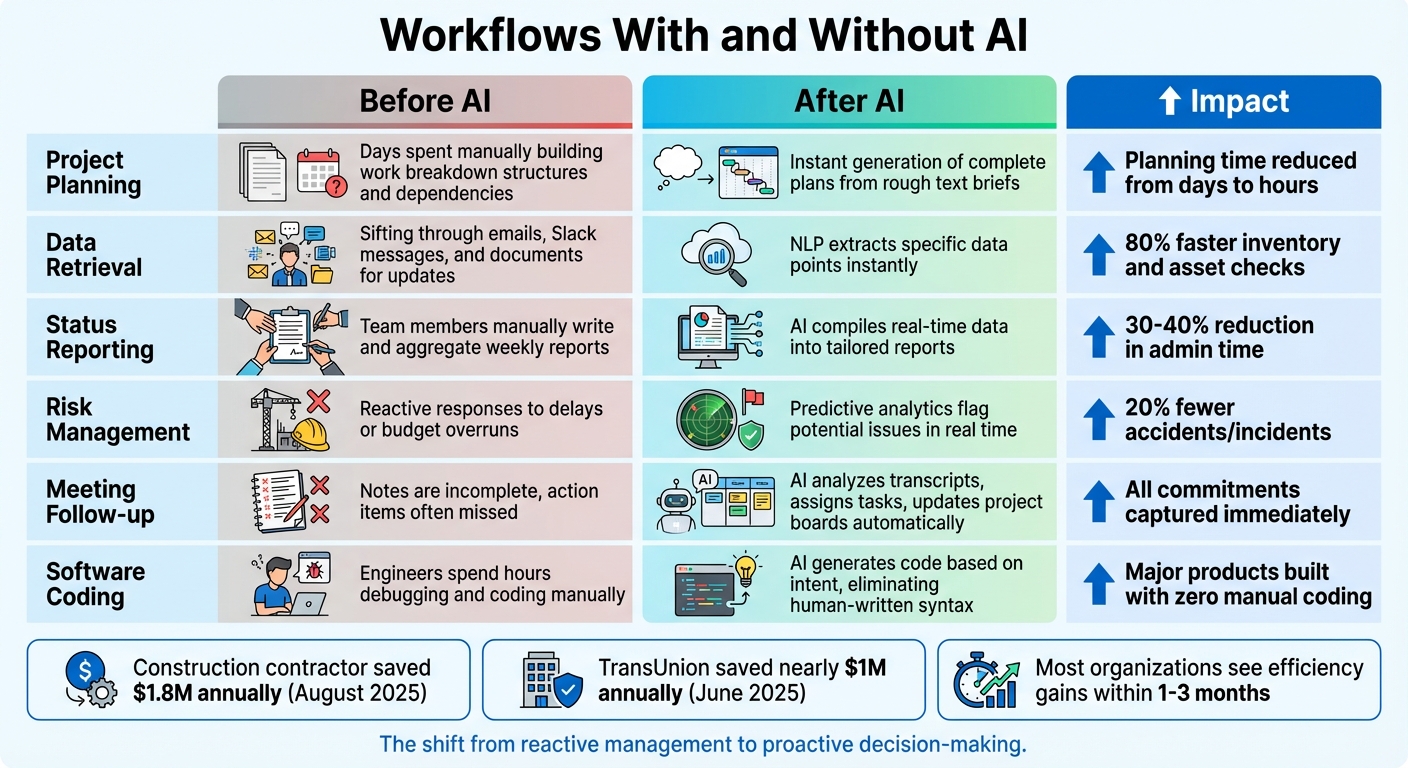
AI-Powered Workflows: Before vs After Transformation
When information is instantly accessible, the way we work undergoes a dramatic transformation. The usual "coordination tax" - those hours spent hunting for data, sorting through emails, or summarizing meetings - shrinks significantly [5]. Instead of wasting time searching for answers, teams can focus on interpreting those answers and applying them to the business. It’s not just about working faster; it’s about removing the distractions that pull attention away from the work that matters most.
This seamless access to information allows organizations to rethink how they use their talent. By leveraging Microsoft's "intelligence on tap", businesses can scale expertise with AI that handles complex cognitive tasks on demand [5]. For example, Microsoft’s Researcher agent turned a task that typically takes several days into a two-hour work session [6]. This isn’t just automating repetitive tasks - it’s expanding the capacity for strategic, high-value work.
The impact on frontline workers is especially striking. Conversational AI can save frontline employees around 94 minutes per task, compared to 24 minutes saved for knowledge workers handling desktop tasks [10]. Picture a field technician describing an issue aloud and receiving immediate, actionable advice - completely bypassing tedious manual checks. In September 2025, a global professional services firm’s CFO switched to a bottom-up agent strategy after a costly $1 million top-down project failed. By enabling frontline teams to create task-specific mini-agents, the firm projected 70,000 hours saved annually, translating to over $7 million in savings within just eight weeks [10].
"Intelligence on tap - abundant, affordable, and almost infinitely scalable - will underpin the next wave of business transformation." - Jared Spataro, CMO of AI at Work, Microsoft [5]
Beyond speeding up tasks, AI shifts teams from reactive problem-solving to proactive decision-making. When answers are always just a question away, teams can experiment quickly, adapt in real time, and base decisions on the most up-to-date information, rather than outdated assumptions.
Before and After: Workflows With and Without AI
The contrast between traditional workflows and AI-enabled ones is stark. It’s the difference between spending days on a task and wrapping it up in hours, or between constantly putting out fires and anticipating risks before they escalate. Here’s a side-by-side look at how AI transforms common workflows:
| Workflow Task | Before AI | After AI | Impact/Time Saved |
|---|---|---|---|
| Project Planning | Days spent manually building work breakdown structures and dependencies. | Instant generation of complete plans from rough text briefs. | Planning time reduced from days to hours [15]. |
| Data Retrieval | Sifting through emails, Slack messages, and documents for updates. | NLP extracts specific data points instantly. | 80% faster inventory and asset checks [16]. |
| Status Reporting | Team members manually write and aggregate weekly reports. | AI compiles real-time data into tailored reports. | 30–40% reduction in admin time [16]. |
| Risk Management | Reactive responses to delays or budget overruns. | Predictive analytics flag potential issues in real time. | 20% fewer accidents/incidents [16]. |
| Meeting Follow-up | Notes are incomplete, and action items are often missed. | AI analyzes transcripts, assigns tasks, and updates project boards automatically. | All commitments captured immediately [15]. |
| Software Coding | Engineers spend hours debugging and coding manually. | AI generates code based on intent, eliminating human-written syntax for major projects. | Major products built with zero manual coding [7]. |
The financial benefits are just as compelling. In August 2025, a construction contractor saved $1.8 million annually by adopting iPads and cloud-based workflows, which even cut $10,000 in yearly printing costs [16]. Similarly, in June 2025, TransUnion saved nearly $1 million annually by streamlining workflows and centralizing data retrieval in a unified Jira system [17]. These gains aren’t just theoretical - they show up in quarterly earnings.
This shift to being "always one question away" isn’t just about improving individual tasks. It’s about reshaping the entire structure of work. Across industries, when teams can get accurate answers instantly, they eliminate wasted time on administrative tasks and focus on delivering meaningful results. While many organizations see efficiency gains from AI within one to three months [15], the real advantage lies in the long-term transformation. With immediate access to critical insights, work evolves from routine management into a strategic exercise in decision-making and innovation.
How This Changes Productivity Over Time
AI-assisted work brings a significant shift to how we approach daily tasks. Imagine handling over 100 emails and 150 Microsoft Teams messages each day, sometimes starting as early as 6 AM just to manage the chaos. AI tools can ease this burden, allowing workers to focus on tasks that demand human judgment and creativity. With instant access to information - always just one question away - employees can concentrate on meaningful work, setting the stage for long-term productivity improvements.
The numbers back this up. Between April and July 2023, a Microsoft study involving 11,500 agents using AI showed impressive results: a 12% reduction in case resolution time and a 10% decrease in cases requiring peer collaboration, cutting down the time customers spent waiting [19]. Similarly, a survey of 133 Microsoft salespeople revealed that AI saved them an average of 90 minutes per week, with 67% of that time reinvested directly into customer interactions [19].
AI also helps reduce mental fatigue and burnout. Employees report that catching up on missed meetings is 58% less exhausting with AI-generated summaries, and they can get up to speed nearly four times faster [19]. In fact, one in three employees says modern work demands would be unmanageable without AI assistance [6]. Lumen Technologies’ CEO, Kate Johnson, highlighted this impact, noting:
"Our people are seeing immediate productivity improvements with Copilot"
This reduction in daily stress contributes to better work-life balance, which only improves over time.
But the benefits go beyond individual tasks. As these short-term efficiencies add up, organizations see broader impacts, including improved employee satisfaction and retention. For instance, companies using AI for administrative tasks have seen a 20% drop in employee turnover [21]. Additionally, 68% of workers actively want more AI tools to manage heavy workloads and avoid burnout [20]. This shift isn’t just about speeding up work - it’s about reclaiming time for high-value, strategic tasks instead of constant firefighting. Employees at "Frontier Firms", who prioritize AI in their operations, report thriving in their roles and finding opportunities for meaningful work [6]. Over time, this shift from survival mode to a more strategic, fulfilling work environment transforms not just productivity but entire workplace cultures.
A New Way to Think About Work
The "always one question away" model is reshaping how we approach work. Instead of jumping between systems to locate fragmented data, employees can now simply ask questions and act immediately on the answers. This goes beyond the old "search and click" routine, streamlining workflows and decision-making [64,65].
The numbers highlight this shift. ChatGPT has become a central hub for information, attracting 800 million weekly users [24]. Meanwhile, the percentage of news-related searches ending in "zero clicks" surged from 56% to 69% in just a year. Additionally, 55% of consumers now rely on AI chatbots for tasks that were traditionally handled through search engines [24]. These trends are paving the way for a new era of automated efficiency.
Adding to this evolution, the cost of creating specialized AI agents has plummeted. These agents can now be developed at almost no extra cost [22]. As Red Hat AI Insights aptly states:
"The future of AI isn't about better answers - it's about better actions" [18].
This shift is also redefining human roles. With routine tasks increasingly handled by AI, people are focusing more on strategic oversight. The demand for skills like judgment, problem framing, and accountability is growing as routine cognitive work becomes cheaper and more accessible [23]. Instead of crafting prompts, workers are now tasked with setting high-level goals for AI agents to execute [50,62]. Greg Twemlow captures this change well:
"Value is moving up the abstraction layer. Human worth does not disappear in this shift, but the market increasingly rewards different kinds of human contribution" [23].
The workplace is evolving into a model where humans lead, but AI manages. Leaders are no longer managing large teams directly; instead, they're designing and overseeing automated systems. Employees define objectives and set boundaries while digital agents carry out tasks around the clock [60,68]. This isn't about replacing human effort - it’s about reimagining the essence of human work.
FAQs
What does “always one question away” mean at work?
"Always one question away" describes a workplace where AI becomes an integral part of everyday tasks, delivering instant, dependable answers. Rather than spending time searching or waiting for information, employees can simply ask a question and receive real-time insights. This minimizes delays, bridges information gaps, and keeps work flowing smoothly. By providing instant access to constantly updated data, this approach helps teams stay agile and focused.
How can an AI assistant for work stay accurate with changing policies and data?
An AI assistant ensures its accuracy by constantly refreshing its knowledge base with up-to-date policies and verified information. By incorporating regular feedback loops and validating data in real time, it delivers reliable responses. Additionally, autonomous systems adjust to changes on the fly, leveraging live data streams to stay aligned with current standards. These methods are crucial for maintaining trust and precision in environments where policies shift frequently.
What should a company do first to adopt this way of working?
To improve AI performance, the first priority is cutting down latency and incorporating live data access into these systems. Instead of relying on outdated, delayed processes, transition to real-time AI tools that deliver immediate responses and work seamlessly within existing workflows. Focus on building infrastructure that integrates AI directly into core systems. This setup allows for live, data-driven decision-making, paving the way for faster, sharper questions and boosting overall efficiency.