AI chatbots are transforming online shopping by simplifying the decision-making process. Instead of overwhelming customers with endless options, these tools use advanced algorithms to recommend products tailored to individual preferences. Here’s what you need to know:
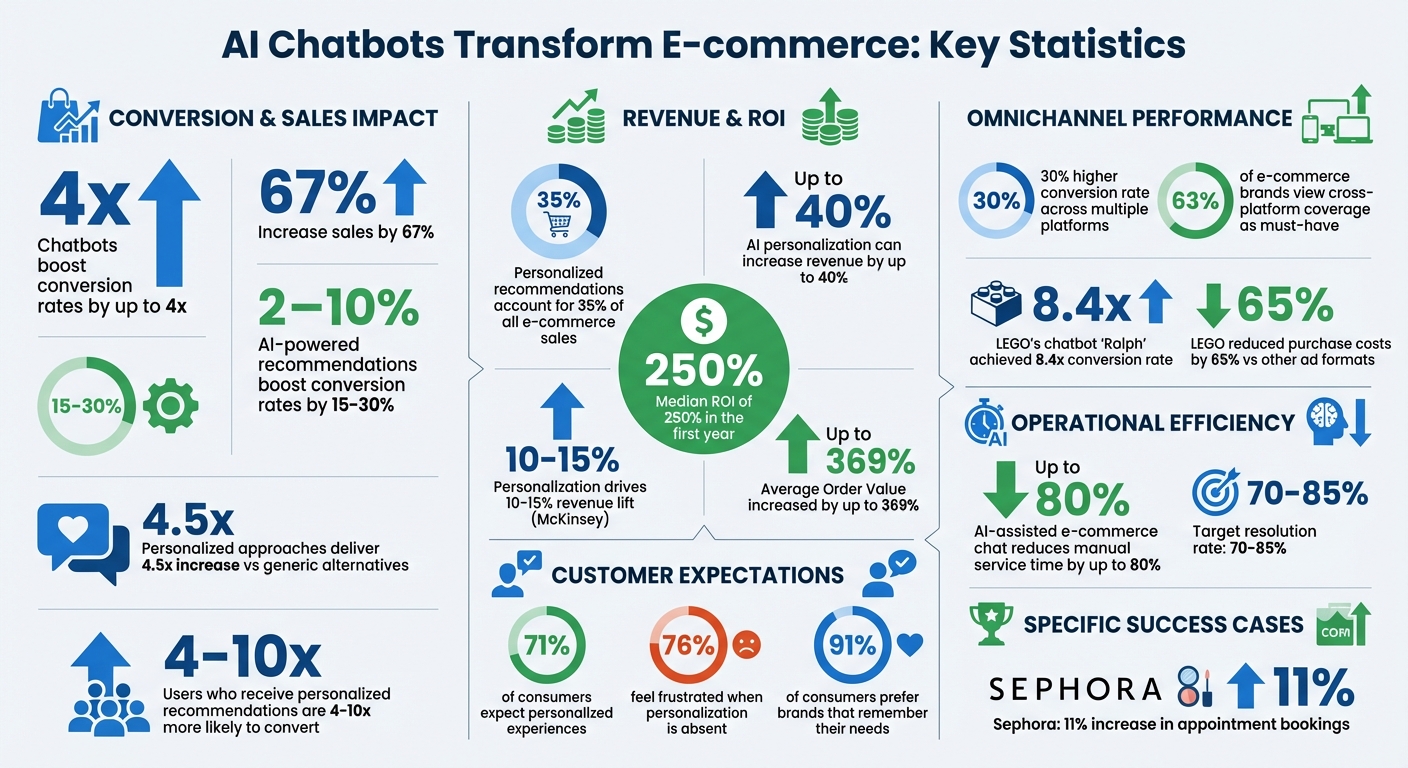
- Higher Conversions: Chatbots can boost conversion rates by up to 4x and increase sales by 67%. When deciding between live chat vs AI chatbots, businesses often find that automation provides the scalability needed for these results.
- Personalized Suggestions: They analyze user behavior, past purchases, and real-time inputs to offer highly relevant recommendations.
- Real-Time Assistance: Chatbots respond instantly to queries like “running shoes under $100,” filtering options based on intent.
- Cross-Platform Continuity: They maintain user preferences across platforms, ensuring smooth interactions on websites, apps, or social media.
- Data-Driven Insights: Metrics like conversion rates, click-through rates, and average order value help businesses track and improve performance.
AI chatbots are no longer optional - they’re essential for businesses aiming to improve customer experience and drive revenue. By leveraging real-time data and conversational AI, these systems make shopping faster, easier, and more personalized.
AI Chatbot Impact on E-commerce: Key Performance StatisticsHow AI Chatbots Personalize Product Recommendations
AI chatbots rely on data to deliver tailored recommendations. By combining user interactions, purchase history, and demographic details - along with zero-party data from direct queries - they create a detailed user profile [1]. For example, a chatbot might ask, "What style are you looking for today?" or "Are you shopping for yourself or someone else?" These direct questions help refine suggestions in real-time.
This matters because 71% of consumers expect personalized experiences, and 76% feel frustrated when they're absent [5]. AI chatbots don't just rely on past behavior; they adapt to the present moment. They know if you arrived via an Instagram ad or a Google search, and they can even adjust recommendations based on external factors like weather or time of day. A great example is Sephora's AI-powered "Reservation Assistant" on Facebook Messenger, which used tools like "Color IQ" to enhance its recommendation engine. By 2025, this system led to an 11% increase in appointment bookings while simplifying the confirmation process [5].
Analyzing Customer Data
AI chatbots excel at synthesizing data from across the customer journey. They analyze product data - like names, descriptions, categories, prices, stock levels, and reviews - alongside user data, which includes browsing behavior, purchase history, and real-time conversation inputs [1]. For instance, they track actions such as time spent on specific pages, items added to the cart multiple times, and explicitly stated preferences to narrow down the most relevant suggestions.
These systems use collaborative filtering to identify patterns by comparing your behavior to similar customer profiles, while content-based filtering matches product attributes to your personal preferences [1]. Advanced techniques like vector embeddings and semantic search allow chatbots to recognize nuanced requests. For example, when someone searches for a "brunch-ready neutral lip", the bot understands they’re looking for specific shades and finishes - not just any lipstick.
Machine Learning for Tailored Suggestions
Machine learning enables chatbots to process session data, past purchases, and behavior from similar customers simultaneously, generating spot-on recommendations in real time [4]. Using Natural Language Processing (NLP) and Large Language Models (LLMs), these systems grasp intent, tone, and context. For instance, they can distinguish between "running shoes for commuting" and general athletic footwear, honing in on exactly what the user needs [4][3].
"A chatbot personalizes during the conversation - learning preferences in real time and adapting suggestions as it goes." - Sarah Chudleigh, Researcher & AI Content Lead, Botpress [1]
What sets AI chatbots apart is their ability to adapt in real time. They use memory features to recall past conversations across sessions, ensuring a seamless experience [3][1]. If you asked for a red jacket two weeks ago and now mention needing "something waterproof", the bot connects those dots. This ongoing learning process evaluates patterns like conversation flow, response times, and feedback to continuously improve recommendations [4][2].
The results speak for themselves: personalized recommendations account for about 35% of all e-commerce sales, and users who receive them are 4 to 10 times more likely to convert compared to those who don’t [6].
Real-Time Product Discovery Through Conversational AI
AI chatbots are changing the way customers shop by responding instantly to their needs. Unlike traditional recommendation widgets that offer generic suggestions like "Customers also bought", conversational AI engages users in a more dynamic way. For instance, when someone types, "I need running shoes under $100", the system immediately understands the intent - affordable athletic footwear - and filters the catalog to show only relevant options [3]. This level of responsiveness is fueled by cutting-edge technologies that enable real-time product discovery.
These chatbots rely on a combination of advanced tools to deliver instant results. Using Retrieval-Augmented Generation (RAG), they access live data from product catalogs, including details like specifications, pricing, inventory levels, and reviews [1]. They also consider the user's current browsing behavior, purchase history, and ongoing conversation to refine recommendations on the fly [4]. By continuously learning from each interaction, these systems ensure that the suggestions become more accurate and personalized over time.
Natural Language Processing for Contextual Understanding
Natural Language Processing (NLP) plays a key role in helping chatbots understand the context behind customer requests. Modern systems use Large Language Models (LLMs) to interpret meaning, preferences, and intent [3]. For example, if someone mentions "something waterproof" after previously asking about "red jackets", the chatbot connects the dots and suggests red, waterproof jackets [3][1].
To make recommendations even more precise, these systems ask follow-up questions like "Are you shopping for yourself or someone else?" or "What's your budget range?" This back-and-forth dialogue helps narrow down options before presenting tailored suggestions [3].
Reducing Choice Overload
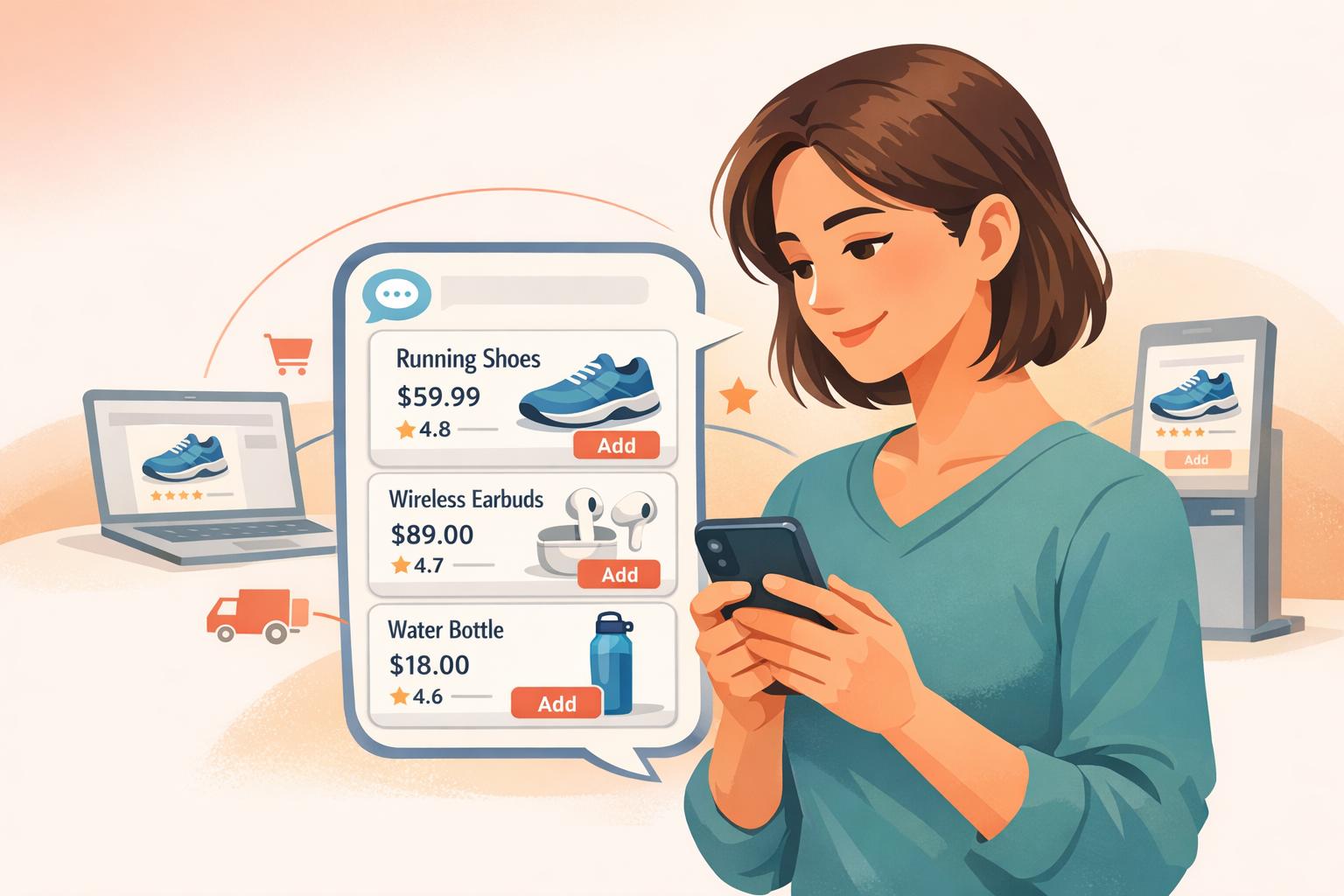
Having too many options can overwhelm customers, making it harder for them to make decisions. AI chatbots address this issue by using contextual insights to present a small, curated selection of two to four highly relevant products instead of an endless list [3][1]. This approach not only reduces decision fatigue but also improves the overall shopping experience.
"When a chatbot can recommend the right product instantly, it removes decision fatigue - the biggest killer of online satisfaction."
– Sarah Chudleigh, Researcher & AI Content Lead, Botpress [1]
Take Fromages d'ici, a Canadian cheese retailer with over 1,000 local cheeses, as an example. Their chatbot, "Froméo", asks customers about flavor and texture preferences to recommend specific cheeses. This personalized approach shows how asking the right questions can lead to better-curated options. Similarly, Interhome uses a chatbot to help travelers sort through thousands of vacation rentals by asking about budget, amenities, and travel style, streamlining the entire booking process into a single conversation [1].
Platforms like ChatSpark (https://chatspark.io) are leveraging these advanced features to deliver personalized recommendations, boosting customer engagement and improving conversion rates.
Omnichannel Delivery of Recommendations
Today's customers rarely stick to just one platform when shopping. They might discover a product on Instagram, ask questions about it on WhatsApp, and complete the purchase on your website. If your AI chatbot treats each interaction as a standalone event, it creates unnecessary friction. Customers are forced to repeat their preferences, which can erode trust and discourage engagement.
Consider this: 91% of consumers prefer brands that remember their needs [1][4]. A chatbot capable of continuing conversations across platforms - whether transitioning from your website to Facebook Messenger or WhatsApp to your mobile app - delivers a seamless, intuitive experience. Let’s dive into how a unified backend makes this omnichannel communication possible.
Unified Customer Data Integration
Consistency across platforms hinges on robust integrations with systems like CRM, OMS, and ERP [7][8]. These integrations allow AI chatbots to access a wealth of customer data, including browsing history, past purchases, abandoned carts, and preferences.
For example, when connected to platforms like Shopify or Magento, the chatbot can pull real-time updates on inventory, pricing, and customer activity [7][4]. Imagine a customer adds an item to their cart on your website and later messages you on WhatsApp to ask about shipping costs. The chatbot, already aware of their cart contents, can provide an accurate response without asking the customer to repeat themselves.
Solutions like ChatSpark (https://chatspark.io) excel at this by seamlessly operating across platforms like Instagram, Facebook, WhatsApp, Telegram, Slack, and websites. With a unified backend, customers can start a conversation on one platform and pick it up on another without losing context. This smooth transition fosters trust and enhances the overall shopping experience.
Let’s look at real-world examples to see how this approach drives results.
Examples of Omnichannel Engagement
LEGO, for instance, introduced a chatbot named "Ralph" to provide gift recommendations across various platforms. According to an Edelman case study, Ralph delivered an 8.4x conversion rate and reduced purchase costs by 65% compared to other ad formats like carousels [8]. Whether customers interacted with Ralph on Facebook Messenger or the LEGO website, the bot remembered their preferences, ensuring consistent recommendations throughout their shopping journey.
Similarly, Zalando, a leading fashion retailer, launched a ChatGPT-powered shopping assistant that works across its digital channels. Customers can ask for suggestions like "outfits for a weekend in Lisbon", and the bot provides options tailored to weather forecasts and personal style preferences from their unified profile [8]. Whether browsing on the website or mobile app, users receive consistent recommendations because the system draws from the same centralized data.
The benefits of this approach are clear. Retailers engaging customers across multiple platforms report a 30% higher conversion rate [4]. Moreover, 63% of e-commerce brands now view cross-platform coverage as a "must-have" feature for chatbot implementation [4]. The real game-changer? Ensuring your AI chatbot doesn’t just exist on multiple platforms but operates as a unified, intelligent assistant that remembers your customers and their needs - no matter where they reach out.
Measuring Success: Metrics for Product Recommendations
Launching an AI chatbot is just the beginning; the real work lies in tracking the right metrics to see if it’s boosting sales and engaging customers. AI personalization has the potential to increase revenue by up to 40% [4] and deliver a median ROI of 250% in just the first year [4]. Businesses that monitor their chatbot's performance closely can achieve these results by focusing on meaningful data. Let’s dive into the key numbers that matter and how they can guide ongoing improvements.
Key Performance Indicators (KPIs) to Monitor
To start, focus on metrics that directly affect revenue. One of the most critical is the Conversion Rate, which measures the percentage of chatbot interactions that lead to a purchase. If your recommendations aren’t converting, it’s time to reassess. Data shows that AI-powered recommendations can boost conversion rates by 15–30% [11], with some personalized approaches delivering a 4.5x increase compared to generic alternatives [10].
Another essential metric is Average Order Value (AOV) - an indicator of how well your chatbot is upselling or cross-selling. AI recommendation engines have been shown to increase AOV by up to 369% [10]. If your AOV isn’t climbing, your bot may be suggesting low-margin items or missing opportunities to bundle complementary products.
Recommendation Click-Through Rate (CTR) is equally important, as it measures how often users click on the products your chatbot suggests. A low CTR could mean the recommendations aren’t relevant. This might happen if the AI isn’t fully understanding customer intent or if your product data needs improvement. Similarly, keep an eye on the Fallback Rate, which tracks how often the bot responds with “I don’t understand.” Spikes in fallback rates, especially during new product launches, often point to gaps in your bot’s training data [9].
Engagement metrics like Session Duration and Resolution Rate (the percentage of issues resolved without human help) also provide valuable insights. A resolution rate of 70–85% [9] is a good target, as it shows your chatbot is effectively handling most customer inquiries. Tools like ChatSpark (https://chatspark.io) offer built-in analytics dashboards that monitor these KPIs across multiple channels - such as your website, WhatsApp, and Instagram - giving you a comprehensive view of performance.
Together, these metrics lay the groundwork for continuous improvement.
Continuous Learning and Improvement
Once you’ve identified the right KPIs, use them to refine your chatbot through ongoing analysis and experimentation. AI chatbots learn from every interaction, constantly improving their ability to make accurate recommendations based on user clicks, drop-offs, and misunderstood queries [9][3].
A/B testing is a powerful way to uncover what resonates with your audience. Try experimenting with different recommendation prompts, welcome messages, or product bundles. For example, testing whether “Customers also bought…” performs better than “You might like…” can reveal preferences unique to your audience. Before rolling out changes, use simulation modes to test your AI against historical interactions. This helps predict resolution rates and catches potential issues before they affect live customers [9].
When customers abandon chats or escalate to human agents, review the transcripts. Were the recommendations off-target? Did the bot misinterpret slang or typos? These moments offer valuable opportunities for improvement. Regularly analyze high-fallback-rate queries and update your chatbot’s knowledge base to address gaps. While AI-assisted e-commerce chat can reduce manual service time by up to 80% [4], that’s only achievable if you’re actively addressing these shortcomings.
Finally, establish baseline metrics - such as current conversion rates, AOV, and bounce rates - before making changes to your chatbot [4]. This allows you to clearly measure the impact of any updates. With proper tracking and regular refinements, your AI chatbot evolves from a basic tool into a dynamic sales assistant that learns and improves with every interaction.
Best Practices for Implementing AI Chatbots
Implementing AI chatbots successfully hinges on two key factors: high-quality data and rigorous testing. With personalized recommendations accounting for about 35% of e-commerce sales [6], businesses have a significant opportunity to enhance customer experiences. However, with over 50% of shoppers worried that AI assistants might manipulate their purchasing decisions [10], building trust is just as critical as building functionality. Ensuring your chatbot operates with accurate data and respects user privacy is a solid foundation for success.
Ensuring Data Quality and Privacy
The quality of your chatbot’s recommendations directly depends on the quality of the data it uses. Regular audits of website analytics, purchase history, and product interactions are essential to ensure clean and accurate datasets [3]. Tools like Retrieval-Augmented Generation (RAG) can help anchor your chatbot’s responses in real-time business data, such as live inventory levels and current pricing, avoiding reliance on outdated or irrelevant information [10][1]. To keep things running smoothly, automate updates to your product feeds [10][1].
Equally important is safeguarding user privacy. Adopting privacy-focused approaches like on-device inference or anonymized large language models ensures personal data isn’t stored during interactions [3][10]. Compliance with regulations such as GDPR, CCPA, and SOC 2 is non-negotiable, and all customer interactions should be encrypted [10][12][2].
Transparency is a key trust-builder. Use clear, straightforward language in privacy policies to explain what data is being used and why [10][2]. Give users control by offering features like one-click options to clear conversation history or browse without AI personalization [10]. Platforms like ChatSpark (https://chatspark.io) simplify compliance with built-in encryption and secure integrations for channels like WhatsApp, Instagram, and your website.
Once your data and privacy measures are solid, the next step is thorough testing to fine-tune your chatbot’s performance.
Testing and Iterating on Recommendations
Before launching your chatbot, pilot it with real users to identify areas for improvement [12]. Conduct functional testing to ensure rules and integrations are working as intended, usability testing to confirm conversations feel natural, and intent validation to verify the bot understands diverse inputs like typos, slang, or ambiguous phrasing [13][15]. A/B testing can be invaluable here - experiment with different approaches, such as showing three product options versus five, to see what drives better conversions [14][3].
Leverage AI tools to create varied test queries, simulating how customers might phrase requests differently. This approach can cut manual testing efforts in half [16]. Track key metrics like containment rates (how often the bot resolves queries without human assistance) and fallback rates (how often the bot fails to understand) to pinpoint areas needing attention [13][3]. Finally, have human agents review anonymized chat logs to catch inaccuracies and technical hiccups [10][12].
Conclusion
AI chatbots are reshaping how product recommendations are delivered. By analyzing real-time browsing habits, purchase history, and the context of conversations, these tools provide scalable and tailored suggestions that elevate the shopping experience. The results speak for themselves: shoppers who interact with AI chatbots convert at much higher rates, directly contributing to revenue growth and improved customer satisfaction. This builds on the personalization and omnichannel strategies discussed earlier.
To make the most of this technology, it's essential to see your chatbot as more than just a sales assistant. It should simplify decision-making by narrowing down overwhelming product catalogs into a few relevant options, offer 24/7 expert guidance on platforms like WhatsApp and Instagram, and maintain seamless conversation continuity so customers never have to repeat themselves. When executed with clean data, strong privacy safeguards, and ongoing testing, AI chatbots can seamlessly integrate into your customer service strategy. As previously highlighted, consistent data practices and refinement are critical to their success.
"Personalization usually drives a 10-15% revenue lift, according to the smart analysts over at McKinsey." - Sarah Chudleigh, Researcher & AI Content Lead, Botpress [1]
The potential here is massive. With 91% of consumers expecting personalized recommendations and companies reporting a median ROI of 250% from AI chatbot investments within the first year [4], the real question isn't whether to adopt this technology - it’s how quickly you can implement it effectively. Platforms like ChatSpark make it easier, offering omnichannel deployment, built-in analytics, and support for over 85 languages, ensuring the consistent, cross-platform experiences emphasized throughout this guide.
Focus on maintaining high-quality data, testing rigorously, and allowing your chatbot to learn from every interaction. The payoff? A smarter, more efficient sales process that enhances the customer experience while delivering measurable growth for your business. This guide has shown how leveraging AI chatbots can lead to a better customer journey and tangible business results.
FAQs
How do AI chatbots provide personalized product recommendations?
AI chatbots use real-time data like customer preferences, browsing history, purchase habits, and interaction patterns to offer tailored product recommendations. By understanding what each shopper is looking for, they can suggest items that match individual needs and interests.
These chatbots rely on advanced algorithms to adapt during conversations, ensuring their suggestions remain relevant and well-timed. The result? A smoother shopping experience that not only feels personalized but also encourages purchases by pointing customers toward products they’re more likely to buy.
What key metrics help evaluate the performance of AI chatbots?
To gauge how well AI chatbots are performing, businesses should keep an eye on a few key metrics:
- Containment Rate: This shows how often the chatbot resolves customer inquiries without needing help from a human agent.
- Customer Satisfaction (CSAT): A direct indicator of how happy customers are with their chatbot interactions.
- Response Time: Tracks how quickly the chatbot replies to user questions, reflecting its speed and efficiency.
- Resolution Rate: Measures the percentage of customer issues the chatbot successfully resolves.
- Conversion Rate: Indicates how often chatbot interactions result in desired actions, such as making a purchase or generating a lead.
By monitoring these metrics, businesses can better understand how effectively their chatbot is working, its impact on customer experience, and how it supports broader business objectives.
How do AI chatbots ensure a consistent shopping experience across platforms?
AI chatbots make shopping consistent and reliable across different platforms by using centralized systems to synchronize their responses and behavior. Whether a customer reaches out via a website, Instagram, Facebook, or messaging apps like WhatsApp or Slack, these chatbots ensure the communication stays aligned with the brand and accurate.
By tapping into shared data - like past interactions, preferences, and purchase history - AI chatbots deliver responses that feel personal and relevant. This not only keeps the tone and style uniform but also builds customer trust and satisfaction, ensuring a smooth shopping experience no matter the channel.